SUPERCOMPUTING NEWS SUPERCOMPUTING NEWS
    • MEDIA KIT
    • MOST READ
    • RSS FEED
    • ACADEMIA
    • AEROSPACE
    • APPLICATIONS
    • ASTRONOMY
    • AUTOMOTIVE
    • BIG DATA
    • BIOLOGY
    • CHEMISTRY
    • CLIENTS
    • CLOUD
    • DEFENSE
    • DEVELOPER TOOLS
    • EARTH SCIENCES
    • ECONOMICS
    • ENGINEERING
    • ENTERTAINMENT
    • GAMING
    • GOVERNMENT
    • HEALTH
    • OIL & GAS
    • INDUSTRY
    • INTERCONNECTS
    • MANUFACTURING
    • MIDDLEWARE
    • MOVIES
    • NETWORKS
    • PHYSICS
    • PROCESSORS
    • RETAIL
    • SCIENCE
    • STORAGE
    • SYSTEMS
    • VISUALIZATION
    • AcyMailing subscription form

    • ADD YOUR VIDEOS
    • MANAGE VIDEOS
    • CONVERSATION INBOX
    • SOCIAL ADVERTISER
    • SOCIAL NETWORK VIDEOS
    • SURVEYS
    • GROUPS
    • PAGES
    • MARKETPLACE LISTINGS
    • APPLICATIONS BROWSER
    • PRIVACY CONFIRM REQUEST
    • PRIVACY CREATE REQUEST
    • LEADERBOARD
    • POINTS LISTING
      • BADGES
    • TRADE SHOWS
Sign In
Tyler O'Neal, Staff Editor ACADEMIA December 6, 2021, 6:00 am

German engineers design turbo boost for AI to predict new compounds for materials

A new algorithm has been designed to help discover previously unknown material compounds. It was developed by a team from Martin Luther University Halle-Wittenberg (MLU), a public, research-oriented university in the cities of Halle and Wittenberg in the State of Saxony-Anhalt, Germany. Working with professors from Friedrich Schiller University Jena, and Lund University in Sweden, the researchers designed a form of artificial intelligence (AI) based on machine learning that can perform complex calculations within a very short space of time. This has enabled the team to identify several thousand potential new compounds using a computer. The study was published in the journal "Science Advances."

Inorganic materials are essential for humans. For example, they form the basis for solar cells and for new advancements in semiconductor electronics that are used in technical devices. Around 50,000 stable inorganic compounds have already been identified. "However, considerably more may theoretically exist - if they can be produced artificially," says Dr. Miguel Marques, professor of physics at MLU. There are two basic ways to detect these undiscovered materials: in the laboratory via countless experiments on different substances, or through computer simulation. The latter has increasingly become standard in recent years, says Marques: "The problem is that many earlier approaches require a lot of computing power and are slow to produce results." 

The researchers, therefore, developed a new method based on machine learning. Instead of performing whole calculations, the computer predicts their final results. "In other words, we want to obtain the results of the calculations without having to do the actual calculations," says Jonathan Schmidt from MLU, first author of the new study. "This requires two things: an algorithm that carries out the desired task, and a dataset which can be used to train the algorithm," adds the physicist. The team used several databases containing over 2.4 million compounds. "The calculations on which these databases are based have a combined calculation time of 100 to 200 million hours," says Schmidt.   

The new AI searches for new materials much faster than previous methods and is expected to soon also predict their electrical and optical properties. The researchers have already been able to identify several thousand possible candidates. "Of course, promising material candidates and their properties have to be confirmed by experiments and investigated further. However, we are very confident that most of our predictions will be confirmed," says Marques. 

James Hone's lab at Columbia demos a superconducting qubit capacitor built with atom-thin materials

Tyler O'Neal, Staff Editor ACADEMIA December 6, 2021, 12:00 am

Using 2D materials, researchers have built superconducting qubits that are a fraction of the size of previous qubits, paving the way for smaller quantum supercomputers.

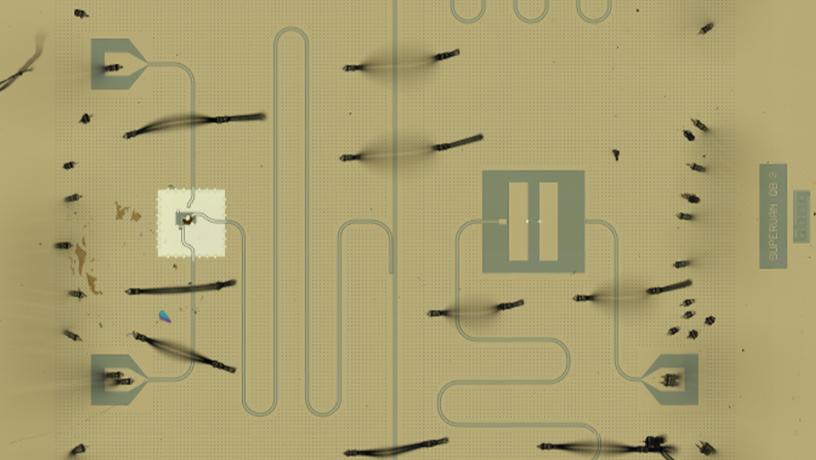
For quantum supercomputers to surpass their classical counterparts in speed and capacity, their qubits—which are superconducting circuits that can exist in an infinite combination of binary states—need to be on the same wavelength. Achieving this, however, has come at the cost of size. Whereas the transistors used in classical computers have been shrunk down to nanometer scales, superconducting qubits these days are still measured in millimeters—one millimeter is one million nanometers. Optical micrograph of the team’s superconducting qubit chip that’s 1,000 times smaller than others made with conventional fabrication techniques. Photo credit: Abhinandan Antony et al./Columbia Engineering

Combine qubits together into larger and larger circuit chips, and you end up with, relatively speaking, a big physical footprint, which means quantum supercomputers take up a lot of physical space. These are not yet devices we can carry in our backpacks or wear on our wrists.

To shrink qubits down while maintaining their performance, the field needs a new way to build the capacitors that store the energy that “powers” the qubits. In collaboration with Raytheon BBN Technologies, Wang Fong-Jen Professor James Hone’s lab at Columbia Engineering recently demonstrated a superconducting qubit capacitor built with 2D materials, rendering it a fraction of the size of previous capacitors.

To build qubit chips previously, engineers have had to use planar capacitors, which set the necessary charged plates side by side. Stacking those plates would save space, but the metals used in conventional parallel capacitors interfere with qubit information storage. In the current work, published on November 18 in NanoLetters, Hone’s Ph.D. students Abhinandan Antony and Anjaly Rajendra sandwiched an insulating layer of boron nitride between two charged plates of superconducting niobium diselenide. These layers are each just a single atom thick and held together by van der Waals forces, the weak interaction between electrons. The team then combined their capacitors with aluminum circuits to create a chip containing two qubits with an area of 109 square micrometers and just 35 nanometers thick—that’s 1,000 times smaller than chips produced under conventional approaches.

When they cooled their qubit chip down to just above absolute zero, the qubits found the same wavelength. The team also observed key characteristics that showed that the two qubits were becoming entangled and acting as a single unit, a phenomenon known as quantum coherence; that would mean the qubit’s quantum state could be manipulated and read out via electrical pulses, said Hone. The coherence time was short—a little over one microsecond, compared to about 10 microseconds for a conventionally built coplanar capacitor, but this is only a first step in exploring the use of 2D materials in this area, he said.

Separate work published on arXiv in August from researchers at MIT also took advantage of niobium diselenide and boron nitride to build parallel-plate capacitors for qubits. The devices studied by the MIT team showed even longer coherence times—up to 25 microseconds—indicating that there is still room to further improve performance.

From here, Hone and his team will continue refining their fabrication techniques and test other types of 2D materials to increase coherence times, which reflect how long the qubit is storing information. New device designs should be able to shrink things down even further, said Hone, by combining the elements into a single van der Waals stack or by deploying 2D materials for other parts of the circuit.

“We now know that 2D materials may hold the key to making quantum computers possible,” Hone said. “It is still very early days, but findings like these will spur researchers worldwide to consider novel applications of 2D materials. We hope to see a lot more work in this direction going forward.”

BU astrophysicists reach another milestone on their quest to understand the heliosphere

Tyler O'Neal, Staff Editor ACADEMIA December 3, 2021, 5:00 pm

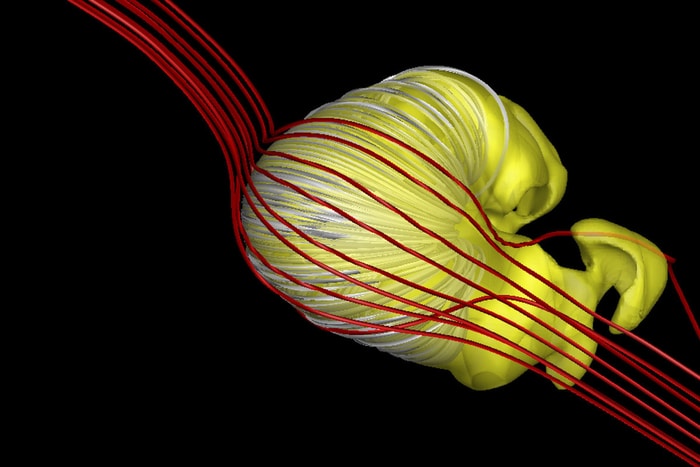
A multi-institutional team of astrophysicists headquartered at Boston University, led by BU astrophysicist Merav Opher, has made a breakthrough discovery in our understanding of the cosmic forces that shape the protective bubble surrounding our solar system—a bubble that shelters life on Earth and is known by space researchers as the heliosphere. The size and shape of the magnetic “force field” that protects our solar system from deadly cosmic rays has long been debated by astrophysicists.  CREDIT Merav Opher, et. al
Astrophysicists believe the heliosphere protects the planets within our solar system from powerful radiation emanating from supernovas, the final explosions of dying stars throughout the universe. They believe the heliosphere extends far beyond our solar system, but despite the massive buffer against cosmic radiation that the heliosphere provides Earth’s life-forms, no one knows the shape of the heliosphere—or, for that matter, the size of it. 

“How is this relevant for society? The bubble that surrounds us, produced by the sun, offers protection from galactic cosmic rays, and the shape of it can affect how those rays get into the heliosphere,” says James Drake, an astrophysicist at the University of Maryland who collaborates with Opher. “There are lots of theories but, of course, the way that galactic cosmic rays can get in can be impacted by the structure of the heliosphere—does it have wrinkles and folds and that sort of thing?”

Opher’s team has constructed some of the most compelling supercomputer simulations of the heliosphere, based on models built on observable data and theoretical astrophysics. At BU, in the Center for Space Physics, Opher, a College of Arts & Sciences professor of astronomy, leads a NASA DRIVE (Diversity, Realize, Integrate, Venture, Educate) Science Center that’s supported by $1.3 million in NASA funding. That team, made up of experts Opher recruited from 11 other universities and research institutes, develops predictive models of the heliosphere in an effort the team calls SHIELD (Solar-wind with Hydrogen Ion Exchange and Large-scale Dynamics). 

Since BU’S NASA DRIVE Science Center first received funding in 2019, Opher’s SHIELD team has hunted for answers to several puzzling questions: What is the overall structure of the heliosphere? How do its ionized particles evolve and affect heliospheric processes? How does the heliosphere interact and influence the interstellar medium, the matter, and the radiation that exists between stars? And how do cosmic rays get filtered by, or transported through, the heliosphere? 

“SHIELD combines theory, modeling, and observations to build comprehensive models,” Opher says. “All these different components work together to help understand the puzzles of the heliosphere.”

And now a paper published by Opher and collaborators in Astrophysical Journal reveals that neutral hydrogen particles streaming from outside our solar system most likely play a crucial role in the way our heliosphere takes shape.

In their latest study, Opher’s team wanted to understand why heliospheric jets—blooming columns of energy and matter that are similar to other types of cosmic jets found throughout the universe—become unstable. “Why do stars and black holes—and our sun—eject unstable jets?” Opher says. “We see these jets projecting as irregular columns, and [astrophysicists] have been wondering for years why these shapes present instabilities.”

Similarly, SHIELD models predict that the heliosphere, traveling in tandem with our sun and encompassing our solar system, doesn’t appear to be stable. Other models of the heliosphere developed by other astrophysicists tend to depict the heliosphere as having a comet-like shape, with a jet—or a “tail”—streaming behind in its wake. In contrast, Opher’s model suggests the heliosphere is shaped more like a croissant or even a donut.

The reason for that? Neutral hydrogen particles, so-called because they have equal amounts of positive and negative charges that net no charge at all.

“They come streaming through the solar system,” Opher says. Using a computational model like a recipe to test the effect of ‘neutrals’ on the shape of the heliosphere, she “took one ingredient out of the cake—the neutrals—and noticed that the jets coming from the sun, shaping the heliosphere, become super stable. When I put them back in, things start bending, the center axis starts wiggling, and that means that something inside the heliospheric jets is becoming very unstable.”

Instability like that would theoretically cause disturbance in the solar winds and jets emanating from our sun, causing the heliosphere to split its shape—into a croissant-like form. Although astrophysicists haven’t yet developed ways to observe the actual shape of the heliosphere, Opher’s model suggests the presence of neutrals slamming into our solar system would make it impossible for the heliosphere to flow uniformly like a shooting comet. And one thing is for sure—neutrals are pelting their way through space.

Drake, a coauthor on the new study, says Opher’s model “offers the first clear explanation for why the shape of the heliosphere breaks up in the northern and southern areas, which could impact our understanding of how galactic cosmic rays come into Earth and the near-Earth environment.” That could affect the threat that radiation poses to life on Earth and also for astronauts in space or future pioneers attempting to travel to Mars or other planets.

“The universe is not quiet,” Opher says. “Our BU model doesn’t try to cut out the chaos, which has allowed me to pinpoint the cause [of the heliosphere’s instability]…. The neutral hydrogen particles.”

Specifically, the presence of the neutrals colliding with the heliosphere triggers a phenomenon well known by physicists, called the Rayleigh-Taylor instability, which occurs when two materials of different densities collide, with the lighter material pushing against the heavier material. It’s what happens when oil is suspended above the water, and when heavier fluids or materials are suspended above lighter fluids. Gravity plays a role and gives rise to some wildly irregular shapes. In the case of the cosmic jets, the drag between the neutral hydrogen particles and charged ions creates a similar effect as gravity. The “fingers” seen in the famous Horsehead Nebula, for example, are caused by the Rayleigh-Taylor instability. 

“This finding is a breakthrough, it’s set us in a direction of discovering why our model gets its distinct croissant-shaped heliosphere and why other models don’t,” Opher says.


  1. Modeling fluid dynamics, NYITCOM prof finds nasal problem plagued long-nosed crocodile relatives
  2. Paderborn University students demo artificial material that protects light states on smallest length scales

Page 91 of 123

  • 86
  • 87
  • 88
  • 89
  • 90
  • 91
  • 92
  • 93
  • 94
  • 95
POPULAR RIGHT NOW
  • Supercomputers uncover a new class of cosmic explosions hidden in plain sight
    Supercomputers uncover a new class of cosmic explosions hidden in plain sight
  • AI supercharges the hunt for stronger magnets: Iowa State researchers launch a new era of intelligent materials discovery
    AI supercharges the hunt for stronger magnets: Iowa State researchers launch a new era of intelligent materials discovery
  • IBM's Historic stock collapse raises questions for the future of enterprise supercomputing
    IBM's Historic stock collapse raises questions for the future of enterprise supercomputing
  • Could a novel dark matter theory simultaneously resolve multiple cosmic enigmas? Supercomputer simulations provide a compelling, albeit currently unverified, potential solution
    Could a novel dark matter theory simultaneously resolve multiple cosmic enigmas? Supercomputer simulations provide a compelling, albeit currently unverified, potential solution
  • Melting icebergs may be reshaping Earth’s greatest ocean current
    Melting icebergs may be reshaping Earth’s greatest ocean current
  • Supercomputers replace ‘bathtub’ flood maps with physics-based digital twins of Britain’s coastline
    Supercomputers replace ‘bathtub’ flood maps with physics-based digital twins of Britain’s coastline
  • Supercomputers push neural quantum simulation beyond previous limits
    Supercomputers push neural quantum simulation beyond previous limits
  • Intel’s AI supercomputing revival: Q2 financial surge signals new era for CPU-powered HPC infrastructure
    Intel’s AI supercomputing revival: Q2 financial surge signals new era for CPU-powered HPC infrastructure
  • AI infrastructure financing fears shake semiconductor sector
    AI infrastructure financing fears shake semiconductor sector
  • AWS supercomputing investment reaches historic scale as Amazon’s AI strategy powers record financial results
    AWS supercomputing investment reaches historic scale as Amazon’s AI strategy powers record financial results
THIS YEAR'S MOST READ
  • Wall Street wants to trade supercomputing power like oil
    Wall Street wants to trade supercomputing power like oil
  • Cosmic ambition at scale: UK’s supercomputer unlocks a 2.5 petabytes universe
    Cosmic ambition at scale: UK’s supercomputer unlocks a 2.5 petabytes universe
  • Hidden order, revealed at scale: Supercomputing, electron ptychography uncover the inner workings of relaxor ferroelectrics
    Hidden order, revealed at scale: Supercomputing, electron ptychography uncover the inner workings of relaxor ferroelectrics
  • Beamforming the future: BeammWave's 6G push signals the rise of orbital-terrestrial wireless networks
    Joakim Axmon
    Joakim Axmon
  • Intel's Q1 results signal supercomputing surge driving Xeon momentum
    Intel's Q1 results signal supercomputing surge driving Xeon momentum
  • When stars fall apart: Supercomputing reveals the hidden physics of black holes
    When stars fall apart: Supercomputing reveals the hidden physics of black holes
  • Multi-layer simulations reveal the hidden supply chain of solar prominences
    Multi-layer simulations reveal the hidden supply chain of solar prominences
  • Japanese scientists decode dolphin speed with supercomputing: Turbulence, vortices, and the hidden physics of propulsion
    Japanese scientists decode dolphin speed with supercomputing: Turbulence, vortices, and the hidden physics of propulsion
  • Cosmic feedback at scale: Supercomputing reveals how quasars regulate the early Universe
    Cosmic feedback at scale: Supercomputing reveals how quasars regulate the early Universe
  • Modeling life at the microscopic scale: A computational breakthrough in oxygen transport
    Modeling life at the microscopic scale: A computational breakthrough in oxygen transport
MOST READ OF ALL-TIME
  • Largest Computational Biology Simulation Mimics The Ribosome
    Details
    112108
    The amino acid (green) slithers into the chemical reaction center, moving through an evolutionarily ancient corridor of the ribosome (purple). The amino acid is delivered to the reaction core by the transfer RNA molecule (yellow).
    The amino acid (green) slithers into the chemical reaction center, moving through an evolutionarily ancient corridor of the ribosome (purple). The amino acid is delivered to the reaction core by the transfer RNA molecule (yellow).
  • Silicon 'neurons' may add a new dimension to chips
    Details
    80994
    Silicon 'neurons' may add a new dimension to chips
  • Linux Networx Accelerators Expected to Drive up to 4x Price/Performance
    Details
    75538
  • Complex Concepts That Really Add Up
    Details
    73637
    Complex Concepts That Really Add Up
  • Blue Sky Studios Donates Animation SuperComputer to Wesleyan
    Details
    68141
    Each rack holds 52 Angstrom Microsystem-brand “blades,” with a memory footprint of 12 or 24 gigabytes each. (Photos by Olivia Bartlett Drake)
    Each rack holds 52 Angstrom Microsystem-brand “blades,” with a memory footprint of 12 or 24 gigabytes each. (Photos by Olivia Bartlett Drake)
  • Humanities, HPC connect at NERSC
    Details
    57947
  • TeraGrid ’09 'Call for Participation'
    Details
    54952
  • Turbulence responsible for black holes' balancing act
    Details
    52312
  • Cray Wins $52 Million SuperComputer Contract
    Details
    50140
  • SDSC Researchers Accurately Predict Protein Docking
    Details
    46080
  • FRONTPAGE
  • LATEST
  • POPULAR
  • REGISTER
  • SOCIAL
  • VIDEO
  • SUBSCRIPTION
  • RSS
  • GUIDELINES
  • PRIVACY
  • TOS
  • ABOUT
  • +1 (816) 799-4488
  • editorial@supercomputingonline.com
© 2001 - 2026 SuperComputingOnline.com, LLC. All rights reserved. This material may not be published, broadcast, rewritten or redistributed without permission.
Sign In
  • FRONT PAGE
  • LATEST
    • MEDIA KIT
    • MOST READ
    • RSS FEED
    • ACADEMIA
    • AEROSPACE
    • APPLICATIONS
    • ASTRONOMY
    • AUTOMOTIVE
    • BIG DATA
    • BIOLOGY
    • CHEMISTRY
    • CLIENTS
    • CLOUD
    • DEFENSE
    • DEVELOPER TOOLS
    • EARTH SCIENCES
    • ECONOMICS
    • ENGINEERING
    • ENTERTAINMENT
    • HEALTH
    • INDUSTRY
    • INTERCONNECTS
    • GAMING
    • GOVERNMENT
    • MANUFACTURING
    • MIDDLEWARE
    • MOVIES
    • NETWORKS
    • OIL & GAS
    • PHYSICS
    • PROCESSORS
    • RETAIL
    • SCIENCE
    • STORAGE
    • SYSTEMS
    • VISUALIZATION
  • VIDEOS
    • ADD YOUR VIDEOS
    • MANAGE VIDEOS
  • COMMUNITY
    • TRADE SHOWS
    • SOCIAL NETWORK VIDEOS
    • SURVEYS
    • APPLICATIONS BROWSER
    • CONVERSATION INBOX
    • SOCIAL ADVERTISER
    • GROUPS
    • MARKETPLACE LISTINGS
    • PAGES
    • LEADERBOARD
    • POINTS LISTING
      • BADGES
    • PRIVACY CONFIRM REQUEST
    • PRIVACY CREATE REQUEST

Hey there! We noticed you’re using an ad blocker.