Harvard astronomers observe a new type of binary star long predicted to exist

Researchers predicted the new class of stars’ existence for 50 years but until now had never observed it in space

Researchers at the Center for Astrophysics | Harvard & Smithsonian have observed a new type of binary star that has long been theorized to exist. The discovery finally confirms how a rare type of star in the universe forms and evolves.

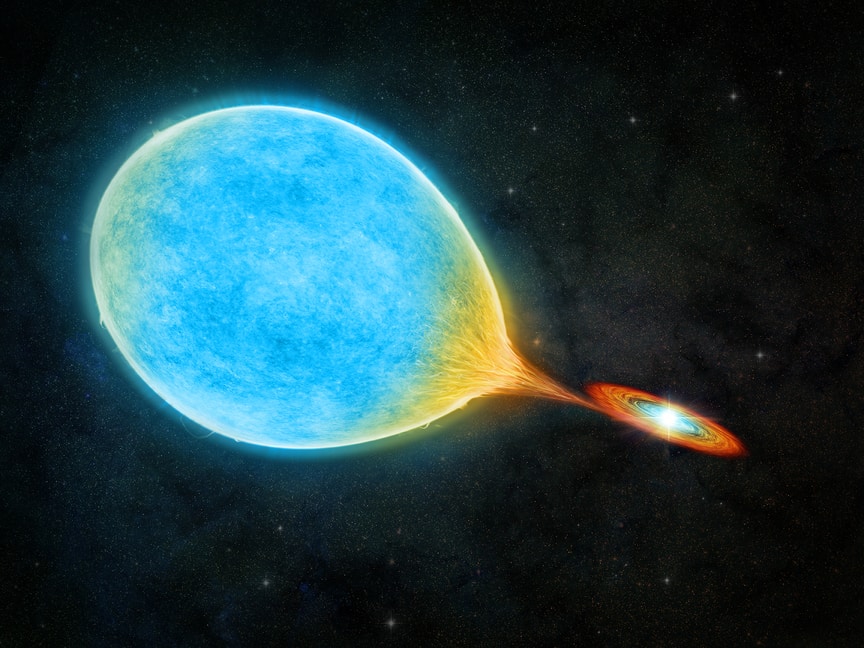
Named pre-extremely low mass (ELM) white dwarfs, the new class of stars is described in their study. It was discovered by postdoctoral fellow Kareem El-Badry using the Shane Telescope at the Lick Observatory in San Jose, California, and data from several astronomical surveys. Artist's depiction of a new type of binary star: a pre-extremely low mass (ELM) white dwarf. Pictured in blue, the star is losing mass to a white dwarf companion and transitioning to an ELM white dwarf. Credit: M.Weiss/Center for Astrophysics | Harvard & Smithsonian/

“We have observed the first physical proof of a new population of transitional binary stars,” said El-Badry, a member of the Institute for Theory and Computation at the Center for Astrophysics. “This is exciting; it’s a missing evolutionary link in binary star formation models that we’ve been looking for.”

A New Type of Star

When a star dies, there is a 97% chance it will become a white dwarf, a small dense object that has contracted and dimmed after burning through all its fuel.

But in rare instances, a star can become an ELM white dwarf. Less than one-third the mass of the sun, these stars present a conundrum: if stellar evolution calculations are correct, all ELM white dwarfs would seem to be more than 13.8 billion years old—older than the age of the universe itself and, thus, physically impossible.

“The universe is just not old enough to make these stars by normal evolution,” El-Badry said.

Over the years, astronomers have concluded that the only way for an ELM white dwarf to form is with the help of a binary companion. The gravitational pull from a nearby companion star could quickly (at least, in less than 13.8 billion years) eat away at a star until it became an ELM white dwarf. But the evidence for this picture is not foolproof.

Astronomers have observed normal, massive stars like the Earth’s sun accreting onto white dwarfs—something called cataclysmic variables. They have also observed ELM white dwarfs with normal white dwarf companions. However, they had not observed the transitional phase of evolution or the transformation in-between: when the star has lost most of its mass and has nearly contracted to an ELM white dwarf.

A Missing Evolutionary Link

El-Badry often compares stellar astronomy to 19th-century zoology.

“You go out into the jungle and find an organism,” he said. “You describe how big it is, how much it weighs—and then you go on to some other organism. You see all these different types of objects and need to piece together how they are all connected.”

In 2020, El-Badry decided to go back into the jungle in search of the star that had long alluded scientists: the pre-ELM white dwarf (also referred to as an evolved cataclysmic variable).

Using new data from Gaia, the space-based observatory launched by the European Space Agency, and the Zwicky Transient Facility at Caltech, El-Badry narrowed down 1 billion stars to 50 potential candidates.

El-Badry emphasized the importance of public data from astronomical surveys for his work. "If it weren't for projects like the Zwicky Transient Facility and Gaia, which represent a huge amount of work behind the scenes from hundreds of people, this work just wouldn't be possible," he said.

El-Badry then followed up with close observations of 21 of the stars. The selection strategy worked.

“One hundred percent of the candidates were these pre-ELMs we’d been looking for,” he said. “They were more puffed up and bloated than ELMs. They also were egg-shaped because the gravitational pull of the other star distorts their spherical shape. We found the evolutionary link between two classes of binary stars—cataclysmic variables and ELM white dwarfs—and we found a decent number of them.”

Thirteen of the stars showed signs that they were still losing mass to their companion, while eight of the stars seemed to be no longer losing mass. Each of them was also hotter than previously observed cataclysmic variables.

El-Badry plans to continue studying the pre-ELM white dwarfs and may follow up on the 29 other candidate stars he previously discovered. Like modern-day anthropologists who are filling the gaps in human evolution, he is amazed by the rich diversity of stars that can arise from simple science. 

Dutch physicists show that only models with sufficient mathematical complexity satisfy Born’s rule for solving the quantum measurement problem

The quantum world and our everyday world are very different places. In a publication that appeared as the “Editor’s Suggestion” in Physical Review A this week, the University of Amsterdam located in Amsterdam, Netherlands (UvA) physicists Jasper van Wezel and Lotte Mertens and their colleagues investigate how the act of measuring a quantum particle transforms it into an everyday object.

Quantum mechanics is the theory that describes the tiniest objects in the world around us, ranging from the constituents of single atoms to small dust particles. This microscopic realm behaves remarkably differently from our everyday experience – even though all objects in our human-scale world are made of quantum particles themselves. This leads to intriguing physical questions: why are the quantum world and the macroscopic world so different, where is the dividing line between them, and what exactly happens there? Despite the fuzziness of the quantum world, measurements of quantum particles yield precise outcomes in our everyday world. How does the act of measuring achieve this transformation?

Measurement problem

One particular area where the distinction between quantum and classical becomes essential is when we use an everyday object to measure a quantum system. The division between the quantum and everyday worlds then amounts to asking how ‘big’ the measurement device should be to be able to show quantum properties using a display in our everyday world. Finding out the details of measurement, such as how many quantum particles it takes to create a measurement device, is called the quantum measurement problem.

As experiments probing the world of quantum mechanics become ever more advanced and involve ever larger quantum objects, the invisible line where pure quantum behavior crosses over into classical measurement outcomes are rapidly being approached. In an article that was highlighted as “Editor’s Suggestion” in Physical Review A this week, UvA physicists Jasper van Wezel and Lotte Mertens and their colleagues take stock of current models that attempt to solve the measurement problem, and particularly those that do so by proposing slight modifications to the one equation that rules all quantum behavior: Schrödinger's equation.

Born’s rule

The researchers show that such amendments can in principle lead to consistent proposals for solving the measurement problem. However, it turns out to be difficult to create models that satisfy Born’s rule, which tells us how to use Schrödinger’s equation for predicting measurement outcomes. The researchers show that only models with sufficient mathematical complexity (in technical terms: models that are non-linear and non-unitary) can give rise to Born’s rule and therefore have a chance of solving the measurement problem and teaching us about the elusive crossover between quantum physics and the everyday world.

Hurricanes are expected to linger over northeast cities, causing greater damage

More storms like hurricane sandy could be in the east coast’s future, potentially costing billions of dollars in damage and economic losses Hurricane Sandy over the Carolinas. Credit: NASA Goddard

By the late 21st century, northeastern U.S. cities will see worsening hurricane outcomes, with storms arriving more quickly but slowing down once they’ve made landfall. As storms linger longer over the East Coast, they will cause greater damage along the heavily populated corridor, according to a new study.

In the new study, climate scientist Andra Garner at Rowan University analyzed more than 35,000 supercomputer-simulated storms. To assess likely storm outcomes in the future, Garner and her collaborators compared where storms formed, how fast they moved and where they ended from the pre-industrial period through the end of the 21st century.

The researchers found that future East Coast hurricanes will likely cause greater damage than storms of the past. The research predicted that a greater number of future hurricanes will form near the East Coast, and those storms will reach the Northeast corridor more quickly. The simulated storms were slow to a crawl as they approach the East Coast, allowing them to produce more wind, rain, floods, and related damage in the Northeast region. The longest-lived tropical storms are predicted to be twice as long as storms today.

The study was published in Earth’s Future, which publishes interdisciplinary research on the past, present, and future of our planet and its inhabitants.

The changes in storm speed will be driven by changes in atmospheric patterns over the Atlantic, prompted by warmer air temperatures. While Garner and her colleagues note that more research remains to be done to fully understand the relationship between a warming climate and changing storm tracks, they noted that potential northward shifts in the region where Northern and Southern Hemisphere trade winds meet or slowing environmental wind speeds could be to blame.

“When you think of a hurricane moving along the East Coast, there are larger scale wind patterns that generally help push them back out to sea,” Garner said. “We see those winds slowing down over time.” Without those winds, the hurricanes can overstay their welcome on the coast.

Garner, whose previous work focused on the devastating East Coast effects of storms like Hurricane Sandy, particularly in the Mid-Atlantic, said the concern raised by the new study is that more storms capable of producing damage levels similar to Sandy are likely.

And the longer storms linger, the worse they can be, she said.

“Think of Hurricane Harvey in 2017 sitting over Texas, and Hurricane Dorian in 2019 over the Bahamas,” she said. “That prolonged exposure can worsen the impacts.”

From 2010 to 2020, U.S. coastlines were hit by 19 tropical cyclones that qualified as billion-dollar disasters, generating approximately $480 billion in damages, adjusted for inflation. If storms sit over coasts for longer stretches, that economic damage is likely to increase as well. For the authors, that provides clear economic motivation to stem rising greenhouse gas emissions.

“The work produced yet more evidence of a dire need to cut emissions of greenhouse gases now to stop the climate warming,” Garner said.

Co-author Benjamin Horton, who specializes in sea-level rise and leads the Earth Observatory of Singapore at Nanyang Technological University, said, “This study suggests that climate change will play a long-term role in increasing the strength of storms along the east coast of the United States and elsewhere. Planning for how to mitigate the impact of major storms must take this into account.”