SUPERCOMPUTING NEWS SUPERCOMPUTING NEWS
    • MEDIA KIT
    • MOST READ
    • RSS FEED
    • ACADEMIA
    • AEROSPACE
    • APPLICATIONS
    • ASTRONOMY
    • AUTOMOTIVE
    • BIG DATA
    • BIOLOGY
    • CHEMISTRY
    • CLIENTS
    • CLOUD
    • DEFENSE
    • DEVELOPER TOOLS
    • EARTH SCIENCES
    • ECONOMICS
    • ENGINEERING
    • ENTERTAINMENT
    • GAMING
    • GOVERNMENT
    • HEALTH
    • OIL & GAS
    • INDUSTRY
    • INTERCONNECTS
    • MANUFACTURING
    • MIDDLEWARE
    • MOVIES
    • NETWORKS
    • PHYSICS
    • PROCESSORS
    • RETAIL
    • SCIENCE
    • STORAGE
    • SYSTEMS
    • VISUALIZATION
    • AcyMailing subscription form

    • ADD YOUR VIDEOS
    • MANAGE VIDEOS
    • CONVERSATION INBOX
    • SOCIAL ADVERTISER
    • SOCIAL NETWORK VIDEOS
    • SURVEYS
    • GROUPS
    • PAGES
    • MARKETPLACE LISTINGS
    • APPLICATIONS BROWSER
    • PRIVACY CONFIRM REQUEST
    • PRIVACY CREATE REQUEST
    • LEADERBOARD
    • POINTS LISTING
      • BADGES
    • TRADE SHOWS
Sign In
Tyler O'Neal, Staff Editor ACADEMIA December 3, 2021, 4:00 pm

Modeling fluid dynamics, NYITCOM prof finds nasal problem plagued long-nosed crocodile relatives

Research published in the journal Anatomical Record finds that humans have more in common with endangered crocodiles than we think—namely, a deviated septum.

Gharials are some of the rarest crocodylians on Earth and members of a group of animals that once roamed the planet with the dinosaurs. Native to India, gharials resemble American alligators and crocodiles, but with bulging eyes and an extremely long and thin snout that allows them to cut through water when hunting prey. In males, this snout houses an even longer nose that ends in an enlarged bulb.

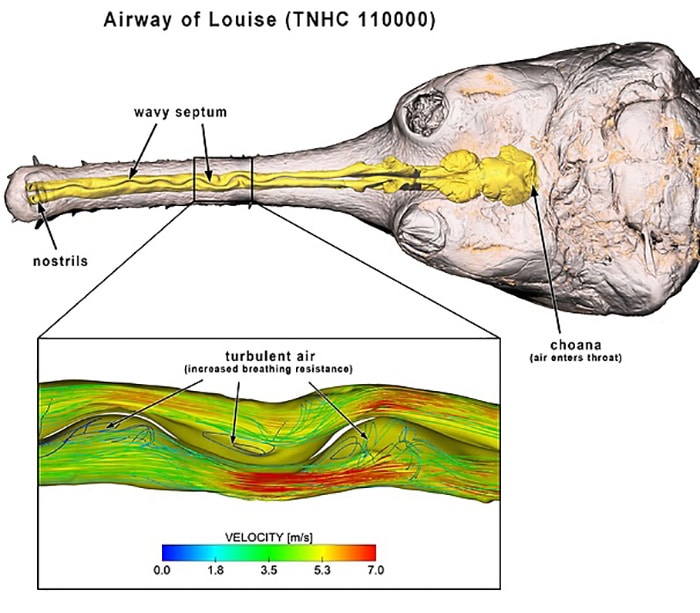
At first glance, these unusual animals appear to have little in common with humans. However, a new study led by Jason Bourke, Ph.D., assistant professor of basic sciences at the College of Osteopathic Medicine at Arkansas State University (NYITCOM-Arkansas), reports that—just like humans—gharials suffer from nasal septal deviation. AN OVERHEAD VIEW OF LOUISE'S SEPTUM, WHICH PRODUCED HIGH SHEARING STRESSES ALONG THE NASAL WALLS AND MAY HAVE CAUSED THE ANIMAL TO EXPERIENCE NOSEBLEEDS.

The Cleveland Clinic estimates that up to 80 percent of people have a deviated septum, a condition in which the nasal cartilage is “off-center.” While the condition is mild in most individuals, larger deviations can restrict nasal breathing and require reconstructive surgery.

Bourke and his colleagues are the first to document deviated nasal septa in crocodylians. Using medical imaging technology, they analyzed the heads of multiple gharial specimens, including that of a large female from the Fort Worth Zoo nicknamed “Louise,” which fueled their curiosity.

“This weird nasal septum was an unexpected discovery,” said study co-author Casey Holliday, Ph.D., associate professor of pathology and anatomical sciences at the University of Missouri, who initially scanned the specimen for a separate project on gharial anatomy. “I saw this roller coaster of a septum and wondered what this might mean for respiration.”

Holliday shared Louise’s extreme anatomy with Bourke, a vertebrate paleontologist whose lab specializes in modeling fluid dynamics in animal noses using sophisticated supercomputer software that simulates air movement.

“We know remarkably little about normal gharial anatomy, much less their pathology. I couldn’t pass up such a unique opportunity,” said Bourke, who has also studied nasal airflow and thermoregulation in dinosaurs.

Intrigued, Bourke and the team began collecting samples from other gharial specimens housed in zoos around the country. While some specimens showed minor septal deviations, Louise had the most extreme case.

Like humans who experience severe nasal septum deviation, Louise had to work harder to achieve the same breathing rate as her peers. This produced high shearing stresses along the nasal walls, which may have made the animal more prone to nosebleeds. Despite the physiological challenges produced from this nasal pathology, Louise successfully made it to adulthood and lived to the ripe old age of 50.

“It’s a testament to crocodylian resiliency,” said Bourke. “A human with this pathology would need surgery to fix it, but these critters just keep on going.”

In contrast to humans, the researchers found that gharial septal deviation comes with a unique twist. “When the septum deviates in humans, a part or all of the septum bows into one of the airways,” said Nicole Fontenot, fourth-year NYITCOM student, and study co-author. “In our gharials, the septum is so long that it wiggles back and forth along the snout, creating a wavy pattern.”

While this pathology is not found in other modern crocodylians, in the distant past, many other animals showed similarly stretched-out noses, including crested, duck-billed dinosaurs like Parasaurolophus and strange crocodile-mimicking reptiles known as Champsosaurus. Bourke suspects that at least a few of them would have also suffered from nasal septum deviations. As for why other crocodylians don’t seem to be as prone to these deviated noses, Bourke explains: “Other crocodylians have wider snouts with much thicker nasal septa. Thinning out the snout places a premium on space inside the nose. Gharials’ long and very thin nasal septa probably don’t need much to make them start wobbling.

Next, the researchers will continue their investigation by examining the sound-producing abilities of gharials' unique noses.

Paderborn University students demo artificial material that protects light states on smallest length scales

Tyler O'Neal, Staff Editor ACADEMIA December 3, 2021, 2:00 pm

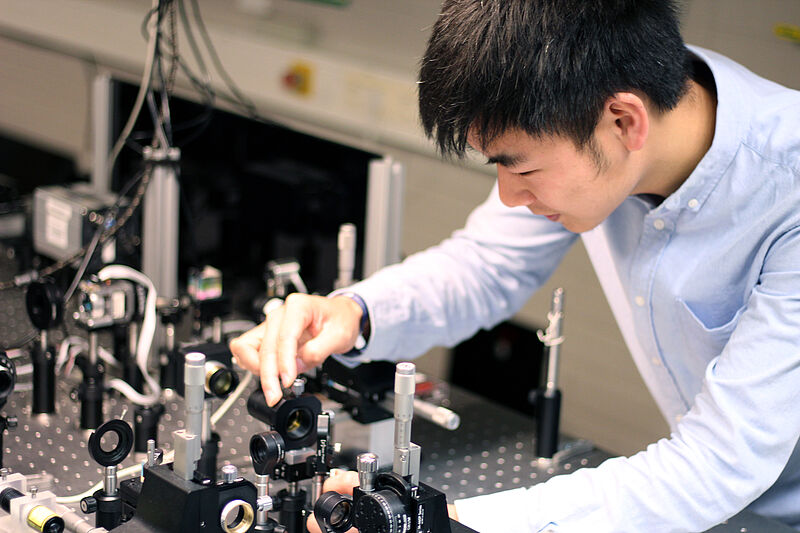
Light not only plays a key role as an information carrier for optical computer chips but also in particular for the next generation of quantum supercomputers. Its lossless guidance around sharp corners on tiny chips and the precise control of its interaction with other light are the focus of research worldwide. Scientists at Paderborn University, one of the fourteen public research universities in the state of North Rhine-Westphalia in Germany, have now demonstrated, for the very first time, the spatial confinement of a light wave to a point smaller than the wavelength in a ‘topological photonic crystal’. These are artificial electromagnetic materials that facilitate robust manipulation of light. The state is protected by special properties and is important for use in quantum chips, for example. The findings have now been published in the academic journal “Science Advances.” Photo (Paderborn University, Thomas Zentgraf): Jinlong Lu taking measurements in the optics lab.

Topological crystals function based on specific structures, the properties of which remain largely unaffected by disturbances and deviations. While in normal photonic crystals the effects needed for light manipulation are fragile and can be affected by defects in the material structure, for example, in topological photonic crystals, they are protected from this. The topological structures allow properties such as unidirectional light propagation and increased robustness for guiding photons, small particles of light – features that are crucial for future light-based technologies.

Photonic crystals influence the propagation of electromagnetic waves with the help of an optical bandgap for photons, which blocks the movement of light in certain directions. Scattering usually occurs – some photons are reflected, while others are reflected away. “With topological light states that span an extended range of photonic crystals, you can prevent this. In normal optical waveguides and fibers, back reflection poses a major problem because it leads to unwanted feedback. Loss during propagation hinders large-scale integration in optical chips, in which photons are responsible for transmitting the information. With the help of topological photonic crystals, novel unidirectional waveguides can be achieved that transmits light without any back reflection, even in the presence of arbitrarily large disorder,” explains Professor Thomas Zentgraf, head of the Ultrafast Nanophotonics research group at Paderborn University. The concept, which has its origins in solid-state physics, has already led to numerous applications, including robust light transmission, topological delay lines, topological lasers, and quantum interference. “It was also recently proven that topological photonic crystals based on a weak topology with a crystal dislocation in the periodic structure also exhibit these special properties and also support what is known as topologically-protected strongly spatially localized light states. When something is topologically protected, any changes in the parameters do not affect the protected properties. Localized light states are extremely useful for non-linear amplification, miniaturization of photonic components, and integration of photonic quantum chips,” adds Zentgraf. In this context, weak topological states are special states for the light that result not only from the topological band structure but also from the formation of the crystal structure.

In a joint experiment, researchers from Paderborn University and RWTH Aachen University used a special near-field optical microscope to demonstrate the existence of such strongly localized light states in topological structures. “We showed that the versatility of weak topology can produce a strongly spatially localized optical field in an intentionally induced structural dislocation,” explains Jinlong Lu, a Ph.D. student in Zentgraf’s group and lead author of the paper. “Our study demonstrates a viable strategy for achieving a topologically-protected, localized zero-dimensional state for light,” adds Zentgraf. With their work, the researchers have proven that near-field microscopy is a valuable tool for characterizing topological structures with nanoscale resolution at optical frequencies.

The findings provide a basis for the use of strongly localized optical light states based on weak topology. Phase-change materials with a tunable refractive index could therefore also be used for the nanostructures used in the experiment to produce robust and active topological photonic elements. “We’re now working on concepts to equip the dislocation centers in the crystal structure with special quantum emitters for single-photon generation,” says Zentgraf, adding: “These could then be used in future optical quantum computers, for which single-photon generation plays an important role.”

Harvard Med researchers model future SARS-CoV-2 mutations; forecasts their ability to evade antibodies, vaccines

Tyler O'Neal, Staff Editor ACADEMIA December 3, 2021, 8:00 am
  • Since the study was completed, several of the predicted mutations appeared in omicron, the most recently identified SARS-CoV-2 variant, offering insight into how omicron might be able to escape immune defense generated by mRNA vaccines and monoclonal antibody treatments for COVID-19.
  • The researchers modeled their predictions of future mutations using a combination of variables, including rare mutations documented in immunocompromised patients, existing SARS-CoV-2 genotypes, and the virus’s current molecular structure and behavior.
  • Findings highlight the ability of SARS-CoV-2 to shape-shift, underscoring the likelihood of new variants that contain multiple high-risk mutations and are capable of evading antibody-based treatments and vaccines.
  • The study highlights the urgent need to help curb viral evolution and future mutations through mitigation measures and by ensuring global immunity through mass vaccination.

To predict the future evolutionary maneuvers of SARS-CoV-2, a research team led by investigators at Harvard Medical School has identified several likely mutations that would allow the virus to evade immune defenses, including natural immunity acquired through infection and developed from vaccination as well as antibody-based treatments.

The study, published Dec. 2 in Science as an accelerated publication for immediate release, was designed to gauge how SARS-CoV-2 might evolve as it continues to adapt to its human hosts and in doing so to help public health officials and scientists prepare for future mutations.

Indeed, as the research was nearing publication, a new variant of concern, dubbed omicron, entered the scene and was subsequently found to contain several of the antibody-evading mutations the researchers predicted in the newly published paper. As of Dec. 1, omicron has been identified in 25 countries in Africa, Asia, Australia, Europe, and North and South America, a list that is growing daily.

The researchers caution that the study findings are not directly applicable to omicron because how this specific variant behaves will depend on the interplay among its own unique set of mutations–at least 30 in the viral spike protein—and on how it competes against other active strains circulating in populations around the world. Nonetheless, the researchers said, the study gives important clues about particular areas of concern with omicron and also serves as a primer on other mutations that might appear in future variants.

“Our findings suggest that great caution is advised with omicron because these mutations have proven quite capable of evading monoclonal antibodies used to treat newly infected patients and antibodies derived from mRNA vaccines,” said study senior author Jonathan Abraham, assistant professor of microbiology in the Blavatnik Institute at HMS and an infectious disease specialist at Brigham and Women’s Hospital. The researchers did not study response to antibodies developed from non-mRNA vaccines.

The longer the virus continues to replicate in humans, Abraham noted, the more likely it is that it will continue to evolve novel mutations that develop new ways to spread in the face of existing natural immunity, vaccines, and treatments. That means that public health efforts to prevent the spread of the virus, including mass vaccinations worldwide as soon as possible, are crucial both to prevent illness and to reduce opportunities for the virus to evolve, Abraham said.

The findings also highlight the importance of ongoing anticipatory research into the potential future evolution of not only SARS-CoV-2 but other pathogens as well, the researchers said.

“To get out of this pandemic, we need to stay ahead of this virus, as opposed to playing catch up,” said study co-lead author Katherine Nabel, a fifth-year student in the Harvard/MIT MD-PhD Program. “Our approach is unique in that instead of studying individual antibody mutations in isolation, we studied them as part of composite variants that contain many simultaneous mutations at once—we thought this might be where the virus was headed. Unfortunately, this seems to be the case with omicron.”

Many studies have looked at the mechanisms developed in newly dominant SARS-CoV-2 strains that enable the virus to resist the protective power of antibodies to prevent infection and serious disease.

This past summer, instead of waiting to see what the next new variant might bring, Abraham set out to determine how possible future mutations might impact the virus’s ability to infect cells and to evade immune defenses—work that he did in collaboration with colleagues from HMS, Brigham and Women’s Hospital, Massachusetts General Hospital, Harvard Pilgrim Health Care Institute, Harvard T.H. Chan School of Public Health, Boston University School of Medicine and National Emerging Infectious Diseases Laboratories (NEIDL), and AbbVie Bioresearch Center.

To estimate how the virus might transform itself next, the researchers followed clues in the chemical and physical structure of the virus and looked for rare mutations found in immunocompromised individuals and a global database of virus sequences. In lab-based studies using non-infectious virus-like particles, the researchers found combinations of multiple, complex mutations that would allow the virus to infect human cells while reducing or neutralizing the protective power of antibodies.

The researchers focused on a part of the coronavirus’s spike protein called the receptor-binding domain, which the virus uses to latch on to human cells. The spike protein allows the virus to enter human cells, where it initiates self-replication and, eventually, leads to infection. Most antibodies function by locking on to the same locations on the virus’s spike protein receptor-binding domain to block it from entering cells and causing infection.

Mutation and evolution are a normal part of a virus’s natural history. Every time a new copy of a virus is made, there’s a chance that a copy error—a genetic typo—might be introduced. As a virus encounters selective pressure from the host’s immune system, copy errors that allow the virus to avoid being blocked by existing antibodies have a better chance of surviving and continuing to replicate. Mutations that allow a virus to evade antibodies in this way are known as escape mutations.

The researchers demonstrated that the virus could develop large numbers of simultaneous escape mutations while retaining the ability to connect to the receptors it needs to infect a human cell. The team worked with so-called pseudotype viruses, lab-made stand-ins for a virus constructed by combining harmless, noninfectious virus-like particles with pieces of the SARS-CoV-2 spike protein containing the suspected escape mutations. The experiments showed that pseudo-type viruses containing up to seven of these escape mutations are more resistant to neutralization by therapeutic antibodies and serum from mRNA vaccine recipients.

This level of complex evolution had not been seen in widespread strains of the virus at the time the researchers began their experiments. But with the emergence of the omicron variant, this level of complex mutation in the receptor-binding domain is no longer hypothetical. The delta variant had only two mutations in its receptor-binding domain, and the pseudotypes Abraham’s team studied had up to seven mutations, omicron appears to have fifteen, including several of the specific mutations that his team analyzed.

In a series of experiments, the researchers performed biochemical assays to see how antibodies would bind to spike proteins containing escape mutations. Several of the mutations, including some of those found in omicron, enabled the pseudotypes to completely evade therapeutic antibodies, including those found in monoclonal antibody cocktail therapies.

The researchers also found one antibody that was able to neutralize all of the tested variants effectively. However, they also noted that the virus would be able to evade that antibody if the spike protein developed a single mutation that adds a sugar molecule at the location where the antibody binds to the virus. That, in essence, would prevent the antibody from doing its job.

The researchers noted that in rare instances, circulating strains of SARS-CoV-2 have been found to gain this mutation. When this happens, it is likely the result of selective pressure from the immune system, the researchers said. Understanding the role of this rare mutation, they added, is critical to being better prepared before it emerges as part of dominant strains.

While the researchers did not directly study the pseudotype virus’s ability to escape immunity from natural infection, findings from the team’s previous work with variants carrying fewer mutations suggest that these newer, highly mutated variants would also adeptly evade antibodies acquired through natural infection.

In another experiment, the pseudotypes were exposed to blood serum from individuals who had received an mRNA vaccine. For some of the highly mutated variants, serum from single-dose vaccine recipients completely lost the ability to neutralize the virus. In samples taken from people who had received a second dose of vaccine, the vaccine retained at least some effectiveness against all variants, including some extensively mutated pseudotypes.

The researchers note that their analysis suggests that repeated immunization even with the original spike protein antigen may be critical to countering highly mutated SARS-CoV-2 spike protein variants.

“This virus is a shape-shifter,” Abraham said. “The great structural flexibility we saw in the SARS-CoV-2 spike protein suggests that omicron is not likely to be the end of the story for this virus.”


  1. University of Toronto study shows a nearly $1 million productivity boost for some manufacturers' predictive analytics investments
  2. Massachusetts General Hospital uses deep learning models to identify people at risk of thoracic aortic aneurysm

Page 92 of 123

  • 87
  • 88
  • 89
  • 90
  • 91
  • 92
  • 93
  • 94
  • 95
  • 96
POPULAR RIGHT NOW
  • Supercomputers uncover a new class of cosmic explosions hidden in plain sight
    Supercomputers uncover a new class of cosmic explosions hidden in plain sight
  • AI supercharges the hunt for stronger magnets: Iowa State researchers launch a new era of intelligent materials discovery
    AI supercharges the hunt for stronger magnets: Iowa State researchers launch a new era of intelligent materials discovery
  • IBM's Historic stock collapse raises questions for the future of enterprise supercomputing
    IBM's Historic stock collapse raises questions for the future of enterprise supercomputing
  • Could a novel dark matter theory simultaneously resolve multiple cosmic enigmas? Supercomputer simulations provide a compelling, albeit currently unverified, potential solution
    Could a novel dark matter theory simultaneously resolve multiple cosmic enigmas? Supercomputer simulations provide a compelling, albeit currently unverified, potential solution
  • Melting icebergs may be reshaping Earth’s greatest ocean current
    Melting icebergs may be reshaping Earth’s greatest ocean current
  • Supercomputers replace ‘bathtub’ flood maps with physics-based digital twins of Britain’s coastline
    Supercomputers replace ‘bathtub’ flood maps with physics-based digital twins of Britain’s coastline
  • Supercomputers push neural quantum simulation beyond previous limits
    Supercomputers push neural quantum simulation beyond previous limits
  • Intel’s AI supercomputing revival: Q2 financial surge signals new era for CPU-powered HPC infrastructure
    Intel’s AI supercomputing revival: Q2 financial surge signals new era for CPU-powered HPC infrastructure
  • AI infrastructure financing fears shake semiconductor sector
    AI infrastructure financing fears shake semiconductor sector
  • AWS supercomputing investment reaches historic scale as Amazon’s AI strategy powers record financial results
    AWS supercomputing investment reaches historic scale as Amazon’s AI strategy powers record financial results
THIS YEAR'S MOST READ
  • Wall Street wants to trade supercomputing power like oil
    Wall Street wants to trade supercomputing power like oil
  • Cosmic ambition at scale: UK’s supercomputer unlocks a 2.5 petabytes universe
    Cosmic ambition at scale: UK’s supercomputer unlocks a 2.5 petabytes universe
  • Hidden order, revealed at scale: Supercomputing, electron ptychography uncover the inner workings of relaxor ferroelectrics
    Hidden order, revealed at scale: Supercomputing, electron ptychography uncover the inner workings of relaxor ferroelectrics
  • Beamforming the future: BeammWave's 6G push signals the rise of orbital-terrestrial wireless networks
    Joakim Axmon
    Joakim Axmon
  • Intel's Q1 results signal supercomputing surge driving Xeon momentum
    Intel's Q1 results signal supercomputing surge driving Xeon momentum
  • When stars fall apart: Supercomputing reveals the hidden physics of black holes
    When stars fall apart: Supercomputing reveals the hidden physics of black holes
  • Multi-layer simulations reveal the hidden supply chain of solar prominences
    Multi-layer simulations reveal the hidden supply chain of solar prominences
  • Japanese scientists decode dolphin speed with supercomputing: Turbulence, vortices, and the hidden physics of propulsion
    Japanese scientists decode dolphin speed with supercomputing: Turbulence, vortices, and the hidden physics of propulsion
  • Cosmic feedback at scale: Supercomputing reveals how quasars regulate the early Universe
    Cosmic feedback at scale: Supercomputing reveals how quasars regulate the early Universe
  • Modeling life at the microscopic scale: A computational breakthrough in oxygen transport
    Modeling life at the microscopic scale: A computational breakthrough in oxygen transport
MOST READ OF ALL-TIME
  • Largest Computational Biology Simulation Mimics The Ribosome
    Details
    112108
    The amino acid (green) slithers into the chemical reaction center, moving through an evolutionarily ancient corridor of the ribosome (purple). The amino acid is delivered to the reaction core by the transfer RNA molecule (yellow).
    The amino acid (green) slithers into the chemical reaction center, moving through an evolutionarily ancient corridor of the ribosome (purple). The amino acid is delivered to the reaction core by the transfer RNA molecule (yellow).
  • Silicon 'neurons' may add a new dimension to chips
    Details
    80994
    Silicon 'neurons' may add a new dimension to chips
  • Linux Networx Accelerators Expected to Drive up to 4x Price/Performance
    Details
    75538
  • Complex Concepts That Really Add Up
    Details
    73637
    Complex Concepts That Really Add Up
  • Blue Sky Studios Donates Animation SuperComputer to Wesleyan
    Details
    68141
    Each rack holds 52 Angstrom Microsystem-brand “blades,” with a memory footprint of 12 or 24 gigabytes each. (Photos by Olivia Bartlett Drake)
    Each rack holds 52 Angstrom Microsystem-brand “blades,” with a memory footprint of 12 or 24 gigabytes each. (Photos by Olivia Bartlett Drake)
  • Humanities, HPC connect at NERSC
    Details
    57947
  • TeraGrid ’09 'Call for Participation'
    Details
    54952
  • Turbulence responsible for black holes' balancing act
    Details
    52312
  • Cray Wins $52 Million SuperComputer Contract
    Details
    50140
  • SDSC Researchers Accurately Predict Protein Docking
    Details
    46080
  • FRONTPAGE
  • LATEST
  • POPULAR
  • REGISTER
  • SOCIAL
  • VIDEO
  • SUBSCRIPTION
  • RSS
  • GUIDELINES
  • PRIVACY
  • TOS
  • ABOUT
  • +1 (816) 799-4488
  • editorial@supercomputingonline.com
© 2001 - 2026 SuperComputingOnline.com, LLC. All rights reserved. This material may not be published, broadcast, rewritten or redistributed without permission.
Sign In
  • FRONT PAGE
  • LATEST
    • MEDIA KIT
    • MOST READ
    • RSS FEED
    • ACADEMIA
    • AEROSPACE
    • APPLICATIONS
    • ASTRONOMY
    • AUTOMOTIVE
    • BIG DATA
    • BIOLOGY
    • CHEMISTRY
    • CLIENTS
    • CLOUD
    • DEFENSE
    • DEVELOPER TOOLS
    • EARTH SCIENCES
    • ECONOMICS
    • ENGINEERING
    • ENTERTAINMENT
    • HEALTH
    • INDUSTRY
    • INTERCONNECTS
    • GAMING
    • GOVERNMENT
    • MANUFACTURING
    • MIDDLEWARE
    • MOVIES
    • NETWORKS
    • OIL & GAS
    • PHYSICS
    • PROCESSORS
    • RETAIL
    • SCIENCE
    • STORAGE
    • SYSTEMS
    • VISUALIZATION
  • VIDEOS
    • ADD YOUR VIDEOS
    • MANAGE VIDEOS
  • COMMUNITY
    • TRADE SHOWS
    • SOCIAL NETWORK VIDEOS
    • SURVEYS
    • APPLICATIONS BROWSER
    • CONVERSATION INBOX
    • SOCIAL ADVERTISER
    • GROUPS
    • MARKETPLACE LISTINGS
    • PAGES
    • LEADERBOARD
    • POINTS LISTING
      • BADGES
    • PRIVACY CONFIRM REQUEST
    • PRIVACY CREATE REQUEST

Hey there! We noticed you’re using an ad blocker.