Miami University researchers develop a new framework that shows Deepwater Horizon oil spill larger than previously thought

Toxic and invisible oil spread well beyond known satellite footprint, fishing closures

Toxic and invisible oil spread well beyond the known satellite footprint of the Deepwater Horizon oil spill, also referred to as the BP oil disaster, according to a new study led by scientists at the University of Miami (UM) Rosenstiel School of Marine and Atmospheric Science. These new findings have important implications for environmental health during future oil spills.

The UM Rosenstiel School-led research team combines oil-transport modeling techniques with remote sensing data and in-water sampling to provide a comprehensive look at the oil spill. The findings revealed that a fraction of the spill was invisible to satellites, and yet toxic to marine wildlife.

"We found that there was a substantial fraction of oil invisible to satellites and aerial imaging," said the study's lead author Igal Berenshtein, a postdoctoral researcher at the UM Rosenstiel School. "The spill was only visible to satellites above a certain oil concentration at the surface leaving a portion unaccounted for." CAPTION On April 20, 2010, the Deepwater Horizon oil rig exploded, releasing 210 million gallons of crude oil into the Gulf of Mexico for a total of 87 days, making it the largest oil spill in U.S. history. Oil slicks from the blowout covered an estimated area of 57,000 square miles (149,000 square kilometers).{module INSIDE STORY}

On April 20, 2010, the Deepwater Horizon oil rig exploded, releasing 210 million gallons of crude oil into the Gulf of Mexico for a total of 87 days, making it the largest oil spill in U.S. history. Oil slicks from the blowout covered an estimated area of 57,000 square miles (149,000 square kilometers).

These new findings, published in Science Advances, showed a much wider extent of the spill beyond the satellite footprint, reaching the West Florida Shelf, the Texas shores, the Florida Keys and along the Gulf Stream towards the East Florida shelf.

"Our results change established perceptions about the consequences of oil spills by showing that toxic and invisible oil can extend beyond the satellite footprint at potentially lethal and sub-lethal concentrations to a wide range of wildlife in the Gulf of Mexico," said Claire Paris, senior author of the study and professor of ocean sciences the UM Rosenstiel School. "This work added a 3rd dimension to what was previously seen as just surface slicks. This additional dimension has been visualized with more realistic and accurate oil spill models developed with a team of chemical engineers and more efficient supercomputing resources."

The new framework developed by the researchers can assist emergency managers and decision-makers in better managing the impacts of future potential oil spills said the authors.

University of Bonn simulates a universe in which Newton's laws are only valid to a limited extent

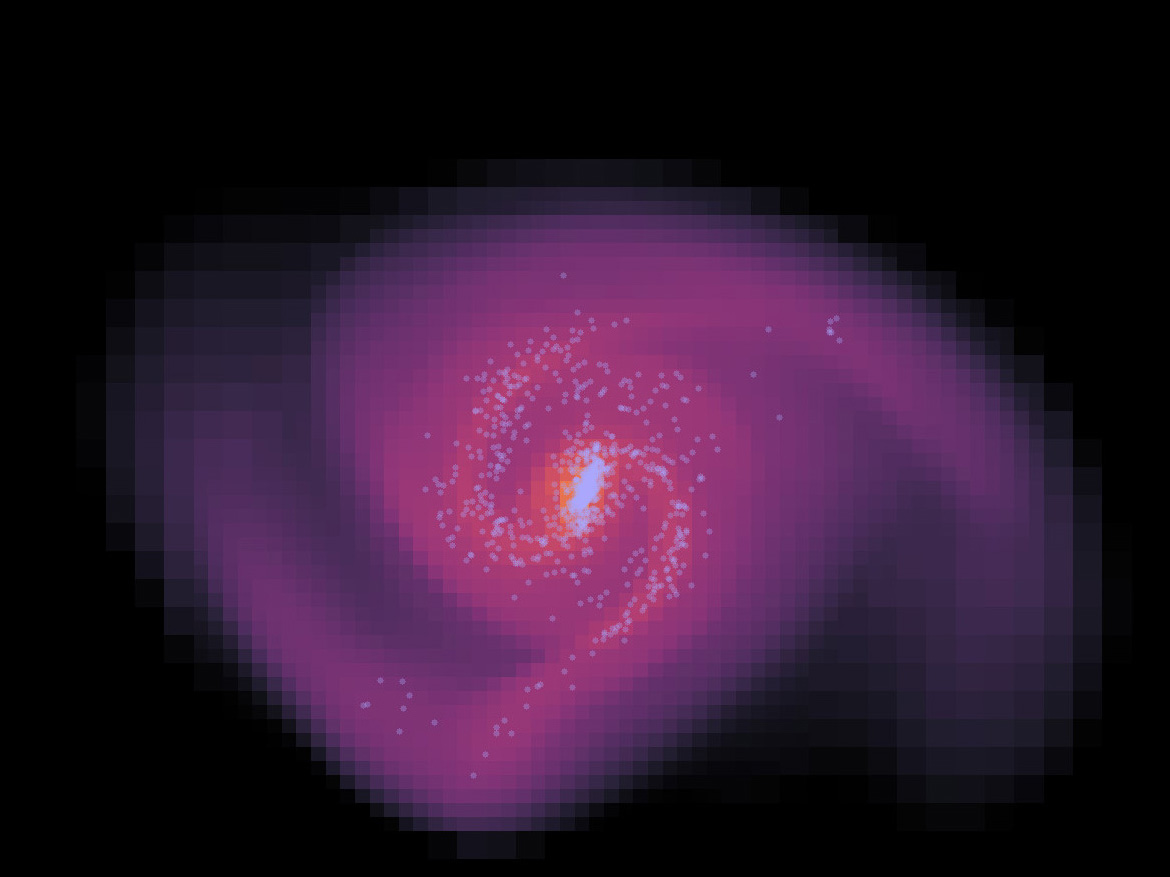
For the first time, researchers from the Universities of Bonn and Strasbourg have simulated the formation of galaxies in a universe without dark matter. To replicate this process on the computer, they have instead modified Newton's laws of gravity. The galaxies that were created in the supercomputer calculations are similar to those we actually see today. According to the scientists, their assumptions could solve many mysteries of modern cosmology. The results are published in the "Astrophysical Journal".

Cosmologists nowadays assume that matter was not distributed entirely evenly after the Big Bang. The denser places attracted more and more matter from their surroundings due to their stronger gravitational forces. Over the course of several billion years, these accumulations of gas eventually formed the galaxies we see today.

An important ingredient of this theory is the so-called dark matter. On the one hand, it is said to be responsible for the initial uneven distribution that led to the agglomeration of the gas clouds. It also explains some puzzling observations. For instance, stars in rotating galaxies often move so fast that they should actually be ejected. It appears that there is an additional source of gravity in the galaxies that prevents this - a kind of "star putty" that cannot be seen with telescopes: dark matter.

However, there is still no direct proof of its existence. "Perhaps the gravitational forces themselves simply behave differently than previously thought," explains Prof. Dr. Pavel Kroupa from the Helmholtz Institute for Radiation and Nuclear Physics at the University of Bonn and the Astronomical Institute of Charles University in Prague. This theory bears the abbreviation MOND (MOdified Newtonian Dynamics); it was discovered by the Israeli physicist Prof. Dr. Mordehai Milgrom. According to the theory, the attraction between two masses obeys Newton's laws only up to a certain point. Under very low accelerations, as is the case in galaxies, it becomes considerably stronger. This is why galaxies do not break apart as a result of their rotational speed. The distribution of matter 1.5 billion years after the start of the simulation. The lighter the color, the higher the density of the gas. The light blue dots show young stars. © AG Kroupa/Uni Bonn{module INSIDE STORY}

Results close to reality

"In cooperation with Dr. Benoit Famaey in Strasbourg, we have now simulated for the first time whether galaxies would form in a MOND universe and if so, which ones," says Kroupa's doctoral student Nils Wittenburg. To do this he used a computer program for complex gravitational calculations which was developed in Kroupa's group. Because with MOND, the attraction of a body depends not only on its own mass but also on whether other objects are in its vicinity.

The scientists then used this software to simulate the formation of stars and galaxies, starting from a gas cloud several hundred thousand years after the Big Bang. "In many aspects, our results are remarkably close to what we actually observe with telescopes," explains Kroupa. For instance, the distribution and velocity of the stars in the computer-generated galaxies follow the same pattern that can be seen in the night sky. "Furthermore, our simulation resulted mostly in the formation of rotating disk galaxies like the Milky Way and almost all other large galaxies we know," says the scientist. "Dark matter simulations, on the other hand, predominantly create galaxies without distinct matter disks - a discrepancy to the observations that are difficult to explain."

Calculations based on the existence of dark matter are also very sensitive to changes in certain parameters, such as the frequency of supernovae and their effect on the distribution of matter in galaxies. In the MOND simulation, however, these factors hardly played a role.

Yet the recently published results from Bonn, Prague, and Strasbourg do not correspond to reality in all points. "Our simulation is only a first step," emphasizes Kroupa. For example, the scientists have so far only made very simple assumptions about the original distribution of matter and the conditions in the young universe. "We now have to repeat the calculations and include more complex influencing factors. Then we will see if the MOND theory actually explains reality."

Florida Atlantic University researchers take body armor to the next level with high energy fibers

FAU's College of Engineering and Computer Science awarded $569,482 from combating terrorism technical support office

It sounds like something out of the movie "Iron Man," where the fictional American superhero builds an armored suit to fight terrorists and overturn his captors. For researchers at Florida Atlantic University's College of Engineering and Computer Science, developing and enhancing materials to improve the performance of military helmets and body armor is definitely not fictional.

They have received $569,482 from the Combating Terrorism Technical Support Office (CTTSO) under the advanced Armor Materials Program, to develop advanced fibers for body armor. Ballistic or bullet-proof armor performance is heavily dependent on the base material properties, which have changed little in recent years. Reinaldo Dos Santos (left) and Vitor Prado Correia, seniors in FAU's Department of Ocean and Mechanical Engineering, extruding fiber in the laboratory under the direction of Hassan Mahfuz, Ph.D., principal investigator, and Oren Masory, Ph.D., co-principal investigator of the body armor project.{module INSIDE STORY}

The CTTSO identifies and develops capabilities to combat terrorism at home and abroad and irregular adversaries and to deliver these capabilities to United States Department of Defense components and interagency partners through rapid research and development, advanced studies and technical innovation, and provision of support to U.S. military operations.

"Composite fiber plays a very important role in the performance of ballistic armor, and its mechanical properties are integrally related with kinetic energy absorption and dissipation," said Stella Batalama, Ph.D., dean of FAU's College of Engineering and Computer Science. "However, in recent years there have not been any significant advances in ballistic fiber properties, resulting in limited improvements of armor performance. With this important effort, our researchers will be able to enhance the properties of the fiber that will potentially lead to greater energy absorption and ballistic performance, and ultimately, greater protection of the women and men who serve in the United States military."

The fibers in an armor absorb ballistic energy and dissipate it as quickly as possible when the projectile strikes. Fiber strength, modulus and fracture strain are key parameters for absorption and dissipation. FAU's two-year project, "Hybridization of Ultrahigh Molecular Weight Polyethylene (UHMWPE) with Nylon and Carbon Nanotubes for Improved Ballistic Performance," is aimed at improving the properties of UHMWPE fibers that are used in ballistic applications. The project involves two phases consisting of both experimental and computational approaches to investigate manufacturing, testing, and predicting the performance of the modified fiber. Testing of fibers will be performed at various rates of strain ranging from quasi-static to ballistic.

"Although current body armor provides increasingly advanced protection to our soldiers, it comes at a cost. It's heavy, cumbersome, and way above the desired aerial density, which limits mobility and physical performance of our soldiers," said Hassan Mahfuz, Ph.D., principal investigator, an expert in nanocomposite and structured materials and a professor in FAU's Department of Ocean and Mechanical Engineering. "For more than a decade, considerable efforts have been made in carrying out various experimental, analytical and numerical investigations to identify and explain penetration-failure mechanisms under ballistic loading. We are hopeful the hybridized nanocomposite fiber we are developing will help to take body armor to the next level. We expect that it will possess excellent strength, modulus and fracture strain, which will lead to high energy absorption, and fast dissipation."

The FAU project is led by Mahfuz, Oren Masory, Ph.D., a professor and an expert in robotics, rehabilitation engineering, and computerized manufacturing; and Leif A. Carlsson, Ph.D., the J.M. Rubin Foundation Professor and an expert in composite materials and solid mechanics, both in FAU's Department of Ocean and Mechanical Engineering, in collaboration with the Naval Surface Warfare Center Panama City Division, and North Carolina State University.