Michigan physicist suggests a fix to the cosmological cornerstone Hubble constant

More than 90 years ago, astronomer Edwin Hubble observed the first hint of the rate at which the universe expands, called the Hubble constant.

Almost immediately, astronomers began arguing about the actual value of this constant, and over time, realized that there was a discrepancy in this number between early universe observations and late universe observations.

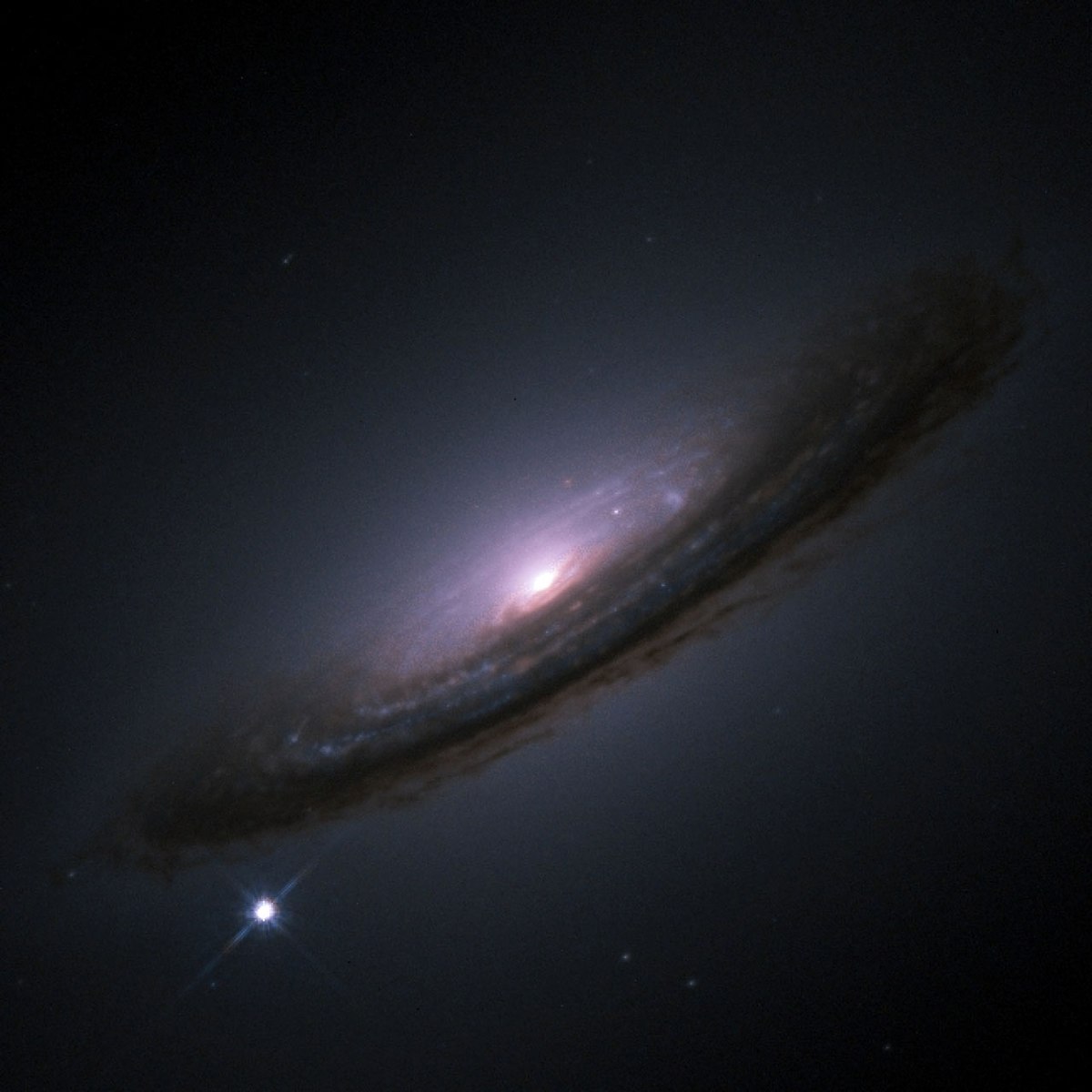
Early in the universe's existence, the light moved through plasma--there were no stars yet--and from oscillations similar to sound waves created by this, scientists deduced that the Hubble constant was about 67. This means the universe expands about 67 kilometers per second faster every 3.26 million light-years. Pictured is the supernova of the type Ia star 1994D, in galaxy NGC 4526. The supernova is the bright spot in the lower left corner of the image.

But this observation differs when scientists look at the universe's later life after stars were born and galaxies formed. The gravity of these objects causes what's called gravitational lensing, which distorts light between a distant source and its observer.

Other phenomena in this late universe include extreme explosions and events related to the end of a star's life. Based on these later life observations, scientists calculated a different value, around 74. This discrepancy is called the Hubble tension.

Now, an international team including a University of Michigan physicist has analyzed a database of more than 1,000 supernovae explosions, supporting the idea that the Hubble constant might not actually be constant.

Instead, it may change based on the expansion of the universe, growing as the universe expands. This explanation likely requires new physics to explain the increasing rate of expansion, such as a modified version of Einstein's gravity.

The team's results are published in the Astrophysical Journal.

"The point is that there seems to be a tension between the larger values for late universe observations and lower values for early universe observation," said Enrico Rinaldi, a research fellow in the U-M Department of Physics. "The question we asked in this paper is: What if the Hubble constant is not constant? What if it actually changes?"

The researchers used a dataset of supernovae--spectacular explosions that mark the final stage of a star's life. When they shine, they emit a specific type of light. Specifically, the researchers were looking at Type Ia supernovae.

These types of supernovae stars were used to discover that the universe was expanding and accelerating, Rinaldi said, and they are known as "standard candles," like a series of lighthouses with the same lightbulb. If scientists know their luminosity, they can calculate their distance by observing their intensity in the sky.

Next, the astronomers use what's called the "redshift" to calculate how the universe's rate of expansion might have increased over time. Redshift is the name of the phenomenon that occurs when light stretches as the universe expands.

The essence of Hubble's original observation is that the further away from the observer, the more wavelength becomes lengthened--like you tacked a Slinky to a wall and walked away from it, holding one end in your hands. Redshift and distance are related.

In Rinaldi's team's study, each bin of stars has a fixed reference value of redshift. By comparing the redshift of each bin of stars, the researchers can extract the Hubble constant for each of the different bins.

In their analysis, the researchers separated these stars based on intervals of redshift. They placed the stars at one interval of distance in one "bin," than an equal number of stars at the next interval of distance in another bin, and so on. The closer the bin to Earth, the younger the stars are.

"If it's a constant, then it should not be different when we extract it from bins of different distances. But our main result is that it actually changes with distance," Rinaldi said. "The tension of the Hubble constant can be explained by some intrinsic dependence of this constant on the distance of the objects that you use."

Additionally, the researchers found that their analysis of the Hubble constant changing with redshift allows them to smoothly "connect" the value of constant from the early universe probes and the value from the late universe probes, Rinaldi said.

"The extracted parameters are still compatible with the standard cosmological understanding that we have," he said. "But this time they just shift a little bit as we change the distance, and this small shift is enough to explain why we have this tension."

The researchers say there are several possible explanations for this apparent change in the Hubble constant--one being the possibility of observational biases in the data sample. To help correct for potential biases, astronomers are using Hyper Suprime-Cam on the Subaru Telescope to observe fainter supernovae over a wide area. Data from this instrument will increase the sample of observed supernovae from remote regions and reduce the uncertainty in the data.

ALMA discovers the most ancient galaxy with spiral morphology

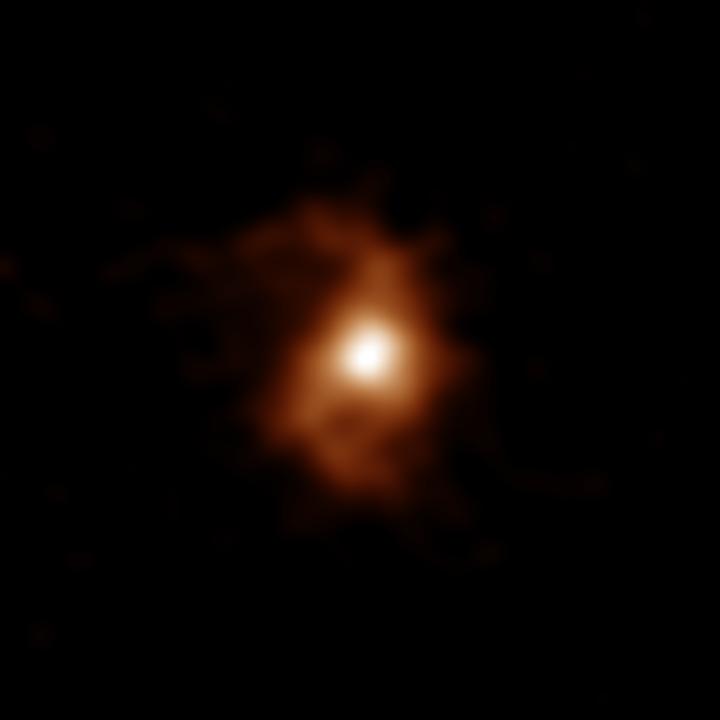
Analyzing data obtained with the Atacama Large Millimeter/submillimeter Array (ALMA), researchers found a galaxy with a spiral morphology by only 1.4 billion years after the Big Bang. This is the most ancient galaxy of its kind ever observed. The discovery of a galaxy with a spiral structure at such an early stage is an important clue to solving the classic questions of astronomy: "How and when did spiral galaxies form?"

"I was excited because I had never seen such clear evidence of a rotating disk, spiral structure, and centralized mass structure in a distant galaxy in any previous literature," says Takafumi Tsukui, a graduate student at SOKENDAI and the lead author of the research paper published in the journal Science. "The quality of the ALMA data was so good that I was able to see so much detail that I thought it was a nearby galaxy."

The Milky Way Galaxy, where we live, is a spiral galaxy. Spiral galaxies are fundamental objects in the Universe, accounting for as much as 70% of the total number of galaxies. However, other studies have shown that the proportion of spiral galaxies declines rapidly as we look back through the history of the Universe. So, when were the spiral galaxies formed? ALMA detected emissions from carbon ions in the galaxy. Spiral arms are visible on both sides of the compact, bright area in the center of the galaxy.  CREDIT ALMA (ESO/NAOJ/NRAO), T. Tsukui & S. Iguchi

Tsukui and his supervisor Satoru Iguchi, a professor at SOKENDAI and the National Astronomical Observatory of Japan, noticed a galaxy called BRI 1335-0417 in the ALMA Science Archive. The galaxy existed 12.4 billion years ago and contained a large amount of dust, which obscures the starlight. This makes it difficult to study this galaxy in detail with visible light. On the other hand, ALMA can detect radio emissions from carbon ions in the galaxy, which enables us to investigate what is going on in the galaxy.

The researchers found a spiral structure extending 15,000 light-years from the center of the galaxy. This is one-third of the size of the Milky Way Galaxy. The estimated total mass of the stars and interstellar matter in BRI 1335-0417 is roughly equal to that of the Milky Way.

"As BRI 1335-0417 is a very distant object, we might not be able to see the true edge of the galaxy in this observation," comments Tsukui. "For a galaxy that existed in the early Universe, BRI 1335-0417 was a giant."

Then the question becomes, how was this distinct spiral structure formed in only 1.4 billion years after the Big Bang? The researchers considered multiple possible causes and suggested that it could be due to an interaction with a small galaxy. BRI 1335-0417 is actively forming stars and the researchers found that the gas in the outer part of the galaxy is gravitationally unstable, which is conducive to star formation. This situation is likely to occur when a large amount of gas is supplied from outside, possibly due to collisions with smaller galaxies.

The fate of BRI 1335-0417 is also shrouded in mystery. Galaxies that contain large amounts of dust and actively produce stars in the ancient Universe are thought to be the ancestors of the giant elliptical galaxies in the present Universe. In that case, BRI 1335-0417 changes its shape from a disk galaxy to an elliptical one in the future. Or, contrary to the conventional view, the galaxy may remain a spiral galaxy for a long time. BRI 1335-0417 will play an important role in the study of galaxy shape evolution over the long history of the Universe.

"Our Solar System is located in one of the spiral arms of the Milky Way," explains Iguchi. "Tracing the roots of spiral structure will provide us with clues to the environment in which the Solar System was born. I hope that this research will further advance our understanding of the formation history of galaxies."

These research results are presented in T. Tsukui & S. Iguchi "Spiral morphology in an intensely star-forming disk galaxy more than 12 billion years ago" published online by the journal Science on Thursday, 20 May 2021.

Tohoku researchers develop a numerical method that paves the way for simulating landslide tsunamis

Landslides occurring on land or underneath the sea - known as subaerial and submarine landslides respectively - can cause devastating tsunamis. They also pose other hazards such as severing submarine cables and pipelines.

Yet the mechanisms at play behind these landslides are less well understood, partly due to the multifaceted interactions taking place: a collapse of the seabed and/or the interaction between soil and water. Conventional approaches make it difficult to predict the behaviors of soil and seawater with high accuracy.

The researchers' breakthrough proposes a new hybrid simulation method that can express the complex interaction between soil structures - referred to as granular masses - and liquids.

"Our novel method couples together two computational methods that analyze the interactions of solids and liquids: the finite element method (FEM) along with the material point method (MEM)," said Kenjiro Terada, professor at Tohoku University's International Research Institute of Disaster Science and co-author of the study.

Simulated wave propagation, mimicking tsunami, induced by underwater granular collapse: deposited granular mass and water surface profile ⒸKenjiro Terada

Using the newly created algorithm, the researchers were able to simulate a wave mimicking a submarine granular collapse and a wave induced by a subaerial slide over an inclined plane. To their delight, the simulations were in reasonable agreement with the numerical measurements.

Several numerical examples also revealed that the proposed method can be applied to other types of potentially dangerous natural events that involve the interaction of air, water, and solids.

Looking ahead, Terada and his team aim to improve the accuracy of their experimental measurements and apply it to larger-scale real data.