University of Arizona professor Gregory Ditzler Wins NSF CAREER Award

Electrical and computer engineering researcher is making sure machine learning technologies like autonomous vehicles and facial recognition stay secure.

University of Arizona electrical and computer engineering assistant professor Gregory Ditzler has received a five-year, $500,000 National Science Foundation Faculty Early Career Development Award to support his machine learning research. The CAREER award is the NSF's most prestigious award in support of exceptional early-career faculty.

"This is about establishing my career moving forward -- not just about five years, but how I see things progressing over the next 10 years," Ditzler said. "I can use this opportunity to shape my entire career." 226446 web 0cf7b{module INSIDE STORY} 
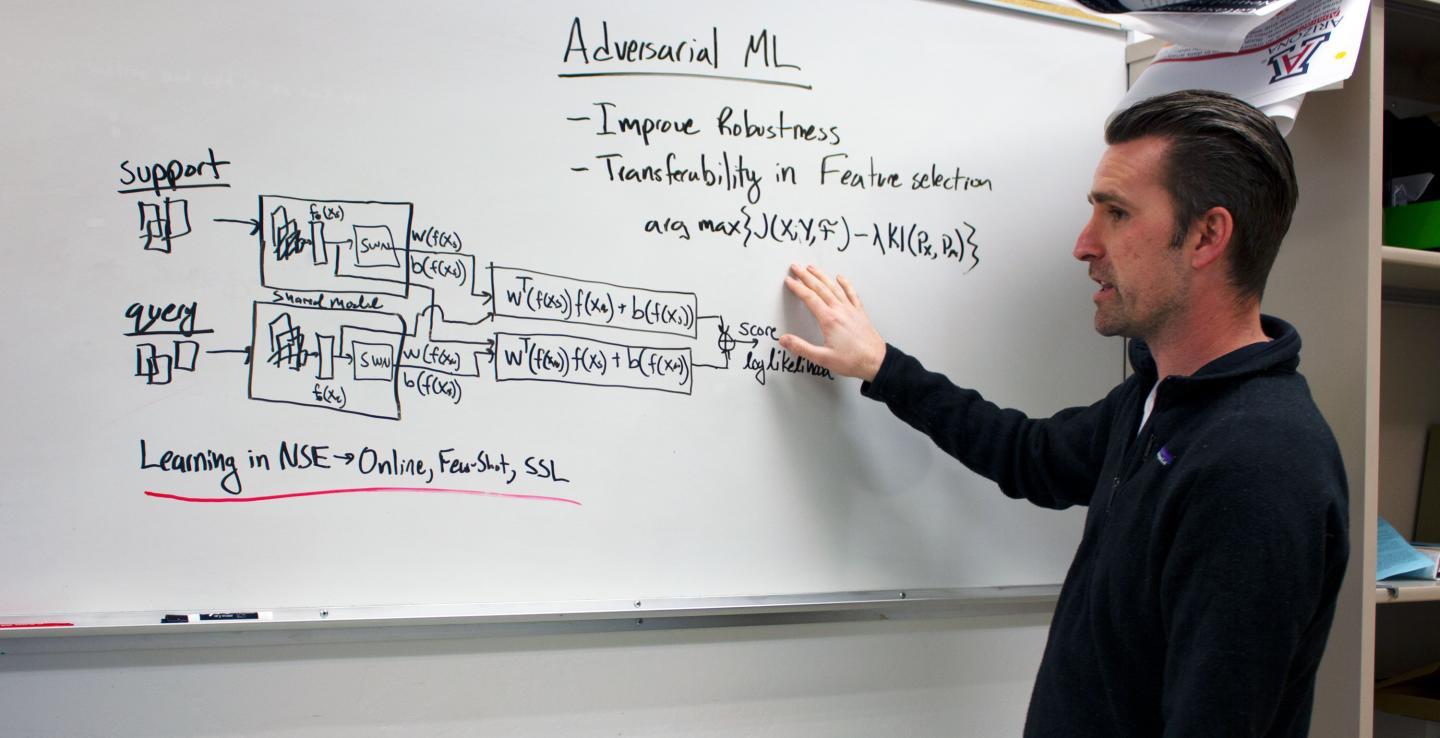
Ditzler's work is all about developing mathematical models and algorithms that computers use to recognize patterns identify relevant features.

Practice Makes Perfect Inside the Minds of Machines

For example, researchers might show a computer a series of electronic medical records taken from patients -- some with and some without cancer. Over time, the computer learns to recognize which features are indicative of the disease and which aren't relevant.

"Our goal is to develop a mathematical model the computer can use so if we give it a new item it has never seen before, the machine can infer whether that individual has cancer," Ditzler said. "Machine learning is such a hot topic right now because it's integrated into everything we use in our daily lives -- from the computers we use to create Word documents to the cell phones we use to make phone calls, take photos and text."

Machine learning also helps GPS navigation services make traffic predictions, cell phones unlock at the sight of the owners' faces, email inboxes recognize spam, and internet bank accounts identify fraudulent activity. With so much personal and financial information living online, it is quickly becoming critical to apply machine learning techniques to cybersecurity.

"Greg's machine learning work is of critical importance in today's world, where all of us rely on digital technology," said Tamal Bose, head of electrical and computer engineering. "This award is a reflection of Greg's commitment to both research and teaching, which I have witnessed during our collaborations."

Lifelong Machine Learning Is Key

With his CAREER Award, Ditzler is tackling two areas of adversarial machine learning and applying his methods and algorithms to cybersecurity. For one, he is examining why feature selection -- the process by which a machine decides what elements of information are important to focus on -- can fail in the presence of adversaries. An adversary introduces false data into a learning environment to trick a model into misidentifying features.

Autonomous vehicles, for example, use machine learning to learn how to recognize objects around them and react appropriately -- like slowing down when approaching another car or stopping at a stop sign. However, researchers have demonstrated that something as simple as placing a sticky note on a stop sign can trick an autonomous vehicle into seeing a speed limit sign instead. Ditzler is investigating what causes this confusion and how it can be prevented.

His project also addresses the problem of machine learning in nonstationary environments. While researchers can develop algorithms that recognize security threats, new forms of threats come up all the time. So, it's critical that these systems be able to learn continuously.

"If you took data from 10 years ago to make a model for investing in the stock market and apply it to today's economy, it wouldn't work," Ditzler explained. "Many algorithms are static. You train them and deploy them, but realistically they have to be able to change over time."

STEM Outreach to Guide the Next Generation

For the educational and community outreach component of the NSF CAREER award, Ditzler is using low-cost robotics to engage Tucson middle school students in science and engineering. He hopes to reach students at an age when many are first starting to think about their career paths.

"This is an opportunity to sit down with students and have them participate in programming and explain that things like autonomous cars are being driven by machine learning and artificial intelligence," said Ditzler.


Hokkaido University researchers show how metal-organic frameworks can separate gases despite the presence of water

Metal-organic frameworks (MOFs) are promising materials for inexpensive and less energy-intensive gas separation even in the presence of impurities such as water.

Experimental analyses of the performance of metal-organic frameworks (MOFs) for the separation of propane and propene under real-world conditions revealed that the most commonly used theory to predict the selectivity does not yield accurate estimates, and also that water as an impurity does not have a detrimental effect on the material's performance.

Short-chain hydrocarbons are produced in mixtures after the treatment of crude oil in refineries and need to be separated in order to be industrially useful. For example, propane is used as fuel and propene as a raw material for chemical synthesis such as the production of polymers. However, the separation process usually requires high temperatures and pressures, and additionally, the removal of other impurities such as water makes the process costly and energy-consuming. {module INSIDE STORY}

The structure of the studied MOF offers a long-lived, adaptable, and most importantly efficient separation alternative at ambient conditions. They build on the fact that unsaturated molecules such as propene can be complexed with the material's exposed metal atoms, while saturated ones such as propane fail to do so. While research has focused on developing different metal-organic frameworks for different separation processes, the feasibility of using these materials on industrial-scale applications is commonly only gauged by relying on a theory that makes many idealizing assumptions on both the material and the purity of the gasses. Thus, it has not been clear whether these predictions hold under more complicated but also more realistic conditions.

A team of Hokkaido University researchers around Professor Shin-ichiro Noro in collaboration with Professor Roland A. Fischer's group at the Technical University of Munich conducted a series of measurements on the performance of a prototypical MOF to ascertain the material's real-world selectivity, for both completely dry frameworks and ones pre-exposed to water.

Their results recently published in ACS Applied Materials & Interfaces show that the predicted selectivities of the material are too high compared to the real-world results. It also demonstrated that water does not drastically decrease the selectivity, although it does reduce the material's capacity to adsorb gas. The team then performed quantum-chemical computations to understand why and realized that the water molecules themselves offer new binding sites to unsaturated hydrocarbons, such as propene (but not propane), thus retaining the material's functionality.

The researchers state: "We showed the power of multi-component adsorption experiments to analyze the feasibility of using a MOF system." They thus want to raise awareness of the shortcomings of commonly used theories and motivate other groups to also use a combination of different real-world measurements.

Stockholm University scientists 'film' a quantum measurement

Quantum physics describes the inner world of individual atoms, a world very different from our everyday experience. One of the many strange yet fundamental aspects of quantum mechanics is the role of the observer - measuring the state of a quantum system causes it to change. Despite the importance of the measurement process within the theory, it still holds unanswered questions: Does a quantum state collapse instantly during a measurement? If not, how much time does the measurement process take and what is the quantum state of the system at any intermediate step?

A collaboration of researchers from Sweden, Germany, and Spain has answered these questions using a single atom - a strontium ion trapped in an electric field. The measurement on the ion lasts only a millionth of a second. By producing a "film" consisting of pictures taken at different times of the measurement they showed that the change of the state happens gradually under the measurement influence.

Atoms follow the laws of quantum mechanics which often contradict our normal expectations. The internal quantum state of an atom is formed by the state of the electrons circling around the atomic core. The electron can circle around the core in an orbit closer or further away. Quantum mechanics, however, also allows so-called superposition states, where the electron occupies both orbits at once, but each orbit only with some probability. CAPTION Strontium ion trapped in an electric field. The measurement on the ion lasts only a millionth of a second.  CREDIT F. Pokorny et al.,{module INSIDE STORY}

"Every time when we measure the orbit of the electron, the answer of the measurement will be that the electron was either in a lower or higher orbit, never something in between. This is true even when the initial quantum state was a superposition of both possibilities. The measurement in a sense forces the electron to decide in which of the two states it is", says Fabian Pokorny, a researcher at the Department of Physics, Stockholm University.

The "film" displays the evolution during the measurement process. The individual pictures show tomography data where the height of the bars reveals the degree of superposition that is still preserved. During the measurement, some of the superpositions are lost - and this loss happens gradually - while others are preserved as they should be for ideal quantum measurement.

"These findings shed new light onto the inner workings of nature and are consistent with the predictions of modern quantum physics", says Markus Hennrich, group leader of the team in Stockholm.

These results are also important beyond fundamental quantum theory. Quantum measurement is an essential part of quantum supercomputers. The group at Stockholm University is working on supercomputers based on trapped ions, where the measurements are used to read out the result at the end of a quantum calculation.