Tokyo Tech-led study shows how icy outer solar system satellites may have formed

Scientists use sophisticated supercomputer simulations and observations of trans-Neptunian objects to understand the formation of the solar system

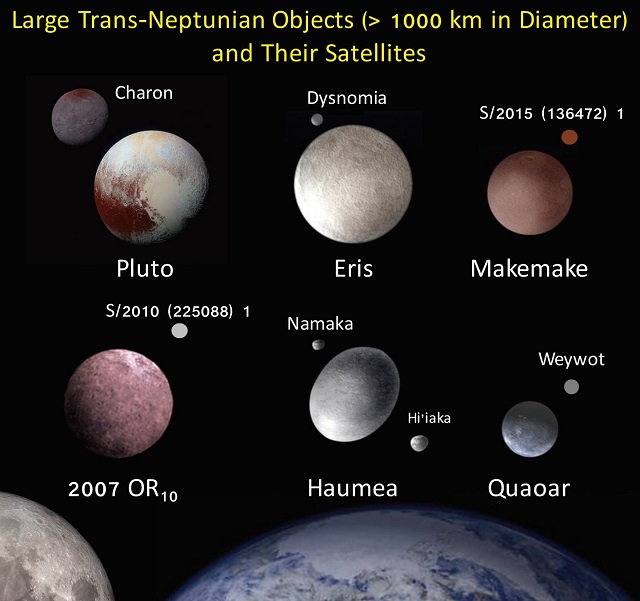
Using sophisticated supercomputer simulations and observations, a team led by researchers from the Earth-Life Science Institute (ELSI) at Tokyo Institute of Technology has shown how the so-called trans-Neptunian Objects (or TNOs) may have formed. TNOs, which include the dwarf planet Pluto, are a group of icy and rocky small bodies--smaller than planets but larger than comets--that orbit the Solar System beyond the planet Neptune. TNOs likely formed at the same time as the Solar System, and understanding their origin could provide important clues as to how the entire Solar System originated. The masses of the satellite(s) range from 1/10 to 1/1000 of the corresponding TNOs. For comparison, Earth and Moon are also shown.{module In-article}

Like many solar system bodies, including the Earth, TNOs often have their own satellites, which likely formed early on from collisions among the building blocks of the Solar System. Understanding the origin of TNOs along with their satellites may help understand the origin and early evolution of the entire Solar System. The properties of TNOs and their satellites--for example, their orbital properties, composition and rotation rates--provide a number of clues for understanding their formation. These properties may reflect their formation and collisional history, which in turn may be related to how the orbits of the giant planets Jupiter, Saturn, Neptune, and Uranus changed over time since the Solar System formed.

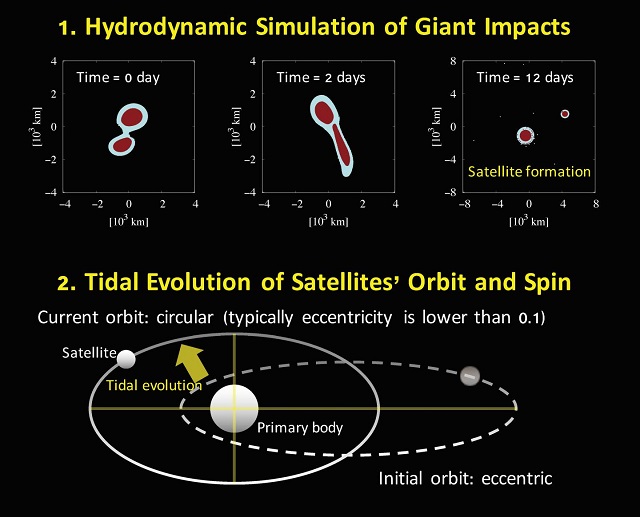
The New Horizons spacecraft flew by Pluto, the most famous TNO, in 2015. Since then, Pluto and its satellite Charon have attracted a lot of attention from planetary scientists, and many new small satellites around other large TNOs have been found. In fact, all known TNOs larger than 1000 km in diameter are now known to have satellite systems. Interestingly, the range of the estimated mass ratio of these satellites to their host systems ranges from 1/10 to 1/1000, encompassing the Moon-to-Earth mass ratio (~1/80). This may be significant because Earth's Moon and Charon are thought to have formed from a giant impactor. Top panels show snapshots for the satellite-forming giant impact with about 1 km/s of the impact velocity and 75 degree of the impact angle. Bottom panel shows the schematic view for the circularization of the satellite's orbit due to tidal interaction after satellite formation.{module In-article}

To study the formation and evolution of TNO satellite systems, the research team performed more than 400 giant impact simulations and tidal evolution calculations. "This is really hard work," says the study's senior author, Professor Hidenori Genda from the Earth-Life Science Institute (ELSI) at Tokyo Institute of Technology. Other Tokyo Tech team members included Sota Arakawa and Ryuki Hyodo.

The Tokyo Tech study found that the size and orbit of the satellite systems of large TNOs are best explained if they formed from impacts of molten progenitors. They also found that TNOs which are big enough can retain internal heat and remain molten for a span of only a few million years; especially if their internal heat source is short-lived radioactive isotopes such as Aluminum-26, which has also been implicated in the internal heating of the parent bodies of meteorites. Since these progenitors would need to have a high short-lived radionuclide content in order to be molten, these results suggest that TNO-satellite systems formed before the outward migration of the outer planets, including Neptune, or in the first ~ 700 million years of Solar System history.

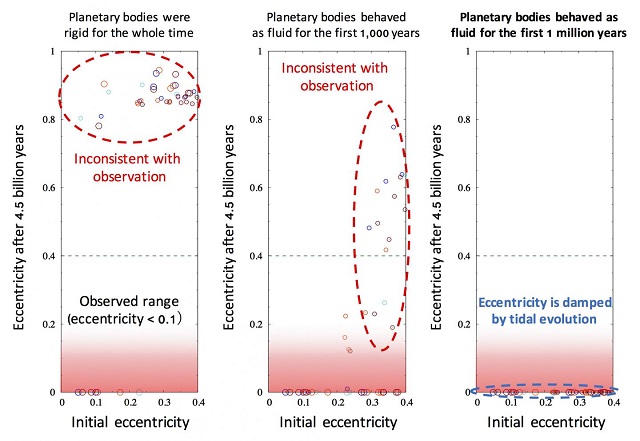
Previous planet formation theories had suggested the growth of TNOs took much longer than the lifetime of short-lived radionuclides, and thus TNOs must not have been molten when they formed. These scientists found, however, that rapid TNO formation is consistent with recent planet formation studies which suggest TNOs formed via accretion of small solids to pre-existing bodies. The rapid formation of large TNOs is consistent with recent planet formation studies; however, other analyses suggest comets formed well after most short-lived radionuclides had decayed. Thus the authors note that there is still much work to be done to produce a unified model for the origin of the Solar System's planetary bodies. The relationship between the initial eccentricity of the formed satellites and the final eccentricity after 4.5-billion-year tidal evolution are shown for three cases. When planetary bodies are rigid for the whole time (right figure) or they behave as a fluid for the first 1000 years (middle figure), most of the eccentricities were not damped, which is not inconsistent with the observation. When they behave as a fluid for the first > 1 million years, the resultant eccentricities are consistent with the observation.{module In-article}

UConn researchers tap into the way cells communicate

A new technology discovered by UConn School of Dental Medicine researchers records cellular communication in real time - providing a closer look into the dynamics of cell secretion and a greater understanding of how cells repair tissue.

In a study published today in the Proceedings of the National Academy of Sciences, Kshitiz Gupta, an assistant professor (who goes by just his first name), and Yashir Suhail, a postdoctoral fellow, in the Dental School's Department of Biomedical Engineering, unlocked a breakthrough technology platform.

Now for the first time, scientists can record cells communicating in real time, opening the floodgates for new developments in cell therapy and other areas within cell biology.

Cells - like humans - are in constant communication with each other. Whereas humans exchange words, cells deliver and receive messages through secreting proteins and changing their behavior accordingly. When we listen to humans speak to each other, we can understand how words are placed into sentences and how the conversation moves back and forth. When it comes to recording communication between cells, however, the key characteristics of the conversation have been largely unknown until now.

Communication between cells is necessary to maintain most functions in the body and can also help the body properly respond to an external cue - such as an ailment or injury. Current technology only allows broad snapshots of these protein secretions. {module In-article}"This is akin to detecting what words were spoken in a sentence, but not really knowing their placement, the inflection, and tone of the message," says Kshitiz. Prior to the current findings, he adds, understanding of the language of communication between cells has been very limited and did not capture the complexity of messaging involved.

Using a combination of microfluidics and supercomputer modeling, researchers created a platform to record cell messages in depth, uncovering the precise ways in which the words and messages are arranged in these intercellular conversations.

In the study, which was funded by the American Heart Association and the National Cancer Institute, Kshitiz and his team looked at stem cells from bone marrow that can be used to treat myocardial infarction, commonly known as a heart attack. Using the platform, the researchers recorded the proteins that were secreted by these stem cells, and how these secretions changed with time.

The information was used to create a protein cocktail that led to a second discovery - the possibility of aiding an injury without the use of stem cells. Since the researchers recorded in depth the conversations between the stem cells, they were able to copy the stem cells' exact behavior.

Stem cells - the researchers witnessed - are flexible enough to change their behavior depending on the injury present. These cells only act as "Good Samaritans," the researchers discovered, when they see injured tissue.

This information created a way to make a "cell-less" therapy by copying what stem cells do when they see a tissue injury and creating a new protein cocktail that aided in repairing cardiac tissue. The discovery of cell-less therapy can potentially reduce many complications associated with stem cell transplantation in the future.

"The findings solve a fundamental problem afflicting systems biology: measuring how cells communicate with each other," says Suhail. "The platform technology will open new lines of inquiry into research, by providing a unique way to detect how cells talk to each other at a deeper level than what is possible today."

New York Genome Center awarded $1.5M CZI grant for single-cell analysis toolkit

Combining multimodal methods to identify disease-causing genes of interest and extract more information at a significantly reduced cost

Scientists at the New York Genome Center (NYGC) and the Icahn School of Medicine at Mount Sinai have been awarded a $1.5 million collaborative grant over three years from the Chan Zuckerberg Initiative (CZI) to support the development of a toolkit for integrated multimodal cell profiling. The project involves the development of new methods and tools that leverage the strengths of existing single-cell modalities and innovative computational methods to enable a more robust and efficient characterization of human immune cells. The team's new toolkit will be made freely available to the scientific community.

The award-winning project, "Multi-Modal Cell Profiling and Data Integration to Atlas the Immune System," is led by Peter Smibert, Ph.D., Manager, NYGC Technology Innovation Lab. Rahul Satija, Ph.D., Core Faculty Member at the New York Genome Center and Assistant Professor of Biology at New York University, and Adeeb Rahman, PhD, Director of Technology Development, Human Immune Monitoring Center and Associate Professor of Genetics and Genomic Sciences at Icahn School of Medicine at Mount Sinai, are co-principal investigators. The toolkit under development aims to leverage the particular strengths of individual technologies including scale, depth, and spatial resolution and use computational integration of the different data types for a more comprehensive view of single cells. {module In-article}

"We are deeply grateful to CZI for their support of our innovative and collaborative research to develop and deploy next-generation genomic tools that further enhance interrogation of individual cells," said Tom Maniatis, Ph.D., NYGC's Scientific Director and CEO. "Single-cell multimodal analysis is poised to play a key role in the detailed characterization of cells central to the Human Cell Atlas."

"Our aim is to both develop new methods for measuring important molecules in cells and exploit the advantages of existing methods," said Dr. Smibert. "By integrating the output of different technologies, we can cost-effectively interrogate cells in their appropriate tissue context." He noted his collaborators' expertise in single-cell modalities and computational methods is essential to the success of the project. The collaborative project will take advantage of the strengths of each of the core technologies: multimodal RNA and protein data from CITE-seq, developed in the NYGC Technology Innovation Lab, will inform the much higher throughput protein data from Mass cytometry (CyTOF), and together will inform the spatial data obtained by Multiplexed Ion Beam Imaging (MIBI) to identify cell interactions and neighborhoods. Dr. Rahman is an early adopter of CITE-seq and has deep experience deploying CyTOF and MIBI in his research. Dr. Satija is a leading developer of computational methods to effectively harness and integrate single-cell analysis methods.

The grant is part of CZI's Seed Networks for the Human Cell Atlas program, which aims to support foundational tools and resources for the Human Cell Atlas project, a scientific-led global initiative to create a reference map of all cell types in the human body and generate a fundamental reference for biomedical research. CZI's Seed Networks projects will generate new tools, open source analysis methods, and significant contributions of diverse data types to the Human Cell Atlas Data Coordination Platform, a resource that will enable broad data sharing across researchers and research institutes. Drs. Smibert and Satija were recipients of a 2017 CZI one-year pilot grant to develop a toolkit for the Human Cell Atlas research community on CITE-seq, and Dr. Satija has a separate pilot Human Cell Atlas grant for the integration of single-cell data from 2018.

The NYGC Technology Innovation Lab is a dedicated incubator within the NYGC comprised of a multidisciplinary team in which staff scientists and faculty, as well as many research collaborators, can explore and test breakthrough genomic tools and ideas.