German theoretical physicists discover immortal quantum particles

Oscillating quasiparticles: the cycle of decay and rebirth

As the saying goes, nothing lasts forever. The laws of physics confirm this: on our planet, all processes increase entropy, thus molecular disorder. For example, a broken glass would never put itself back together again.

Theoretical physicists at the Technical University of Munich (TUM) and the Max Planck Institute for the Physics of Complex Systems have discovered that things which seem inconceivable in the everyday world are possible on a microscopic level.

"Until now, the assumption was that quasiparticles in interacting quantum systems decay after a certain time. We now know that the opposite is the case: strong interactions can even stop decay entirely," explains Frank Pollmann, Professor for Theoretical Solid-State Physics at the TUM. Collective lattice vibrations in crystals, so-called phonons, are one example of such quasiparticles. CAPTION Strong quantum interactions prevent quasiparticles from decay. CREDIT K. Verresen / TUM{module In-article}

The concept of quasiparticles was coined by the physicist and Nobel prize winner Lev Davidovich Landau. He used it to describe collective states of lots of particles or rather their interactions due to electrical or magnetic forces. Due to this interaction, several particles act like one single one.

Numeric methods open up new perspectives

Up until now, it wasn't known in detail which processes influence the fate of these quasiparticles in interacting systems," says Pollmann. "It is only now that we possess numerical methods with which we can calculate complex interactions as well as computers with a performance which is high enough to solve these equations."

"The result of the elaborate simulation: admittedly, quasiparticles do decay, however new, identical particle entities emerge from the debris," says the lead author, Ruben Verresen. "If this decay proceeds very quickly, an inverse reaction will occur after a certain time and the debris will converge again. This process can recur endlessly and a sustained oscillation between decay and rebirth emerges."

From a physical point of view, this oscillation is a wave which is transformed into matter, which, according to quantum mechanical wave-particle duality, is possible. Therefore, the immortal quasiparticles do not transgress the second law of thermodynamics. Their entropy remains constant, decay has been stopped.

The reality check

The discovery also explains phenomena which were baffling until now. Experimental physicists had measured that the magnetic compound Ba3CoSB2O9 is astonishingly stable. Magnetic quasiparticles, magnons, are responsible for it. Other quasiparticles, rotons, ensure that helium which is a gas on the earth's surface becomes a liquid at absolute zero which can flow unrestricted.

"Our work is purely basic research," emphasizes Pollmann. However, it is perfectly possible that one day the results will even allow for applications, for example the construction of durable data memories for future quantum supercomputers.

Small currents for big gains in spintronics

A new low-power magnetic switching component could aid spintronic devices

University of Tokyo researchers have created an electronic component that demonstrates functions and abilities important to future generations of computational logic and memory devices. It is between one and two orders of magnitude more power efficient than previous attempts to create a component with the same kind of behavior. This fact could help it realize developments in spintronics.

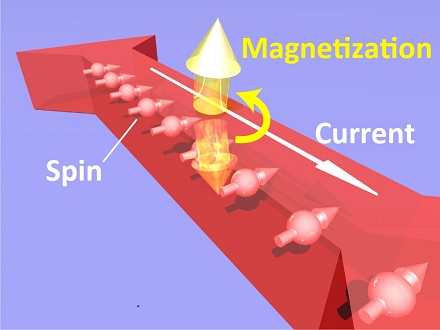
If you're a keen technophile and like to keep up to date with current and future developments in the field of supercomputing, you might have come across the emerging field of spintronic devices. In a nutshell, spintronics explores the possibility of high-performance, low-power components for logic and memory. It's based around the idea of encoding information into the spin -- a property related to angular momentum -- of an electron, rather than by using packets of electrons to represent logical bits, 1s, and 0s. This diagram shows how magnetization reverses in a GaMnAs crystal.{module In-article}

One of the keys to unlock the potential of spintronics lies in the ability to quickly and efficiently magnetize materials. University of Tokyo Professor Masaaki Tanaka and colleagues have made an important breakthrough in this area. The team has created a component -- a thin film of ferromagnetic material -- the magnetization of which can be fully reversed with the application of very small current densities. These are between one and two orders of magnitude smaller than the current densities required by previous techniques, so this device is far more efficient.

"We are trying to solve the problem of the large power consumption required for magnetization reversal in magnetic memory devices," said Tanaka. "Our ferromagnetic semiconductor material -- gallium manganese arsenide (GaMnAs) -- is ideal for this task as it is a high-quality single crystal. Less ordered films have an undesirable tendency to flip electron spins. This is akin to resistance in electronic materials and it's the kind of inefficiency we try to reduce."

The GaMnAs film the team used for their experiment is special in another way too. It is especially thin thanks to a fabrication process known as molecular beam epitaxy. With this method, devices can be constructed more simply than other analogous experiments which try and use multiple layers rather than single-layer thin films.

"We did not expect that the magnetization can be reversed in this material with such a low current density; we were very surprised when we found this phenomenon," concludes Tanaka. "Our study will promote research of material development for more efficient magnetization reversal. And this in turn will help researchers realize promising developments in spintronics."

The whisper of schizophrenia: Machine learning finds 'sound' words predict psychosis

A machine-learning method discovered a hidden clue in people's language predictive of the later emergence of psychosis

A machine-learning method discovered a hidden clue in people's language predictive of the later emergence of psychosis -- the frequent use of words associated with sound. A paper published by the journal npj Schizophrenia published the findings by scientists at Emory University and Harvard University.

The researchers also developed a new machine-learning method to more precisely quantify the semantic richness of people's conversational language, a known indicator for psychosis.

Their results show that automated analysis of the two language variables -- more frequent use of words associated with sound and speaking with low semantic density, or vagueness -- can predict whether an at-risk person will later develop psychosis with 93 percent accuracy. {module In-article}

Even trained clinicians had not noticed how people at risk for psychosis use more words associated with sound than the average, although abnormal auditory perception is a pre-clinical symptom.

"Trying to hear these subtleties in conversations with people is like trying to see microscopic germs with your eyes," says Neguine Rezaii, first author of the paper. "The automated technique we've developed is a really sensitive tool to detect these hidden patterns. It's like a microscope for warning signs of psychosis."

Rezaii began work on the paper while she was a resident at Emory School of Medicine's Department of Psychiatry and Behavioral Sciences. She is now a fellow at Harvard Medical School's Department of Neurology.

"It was previously known that subtle features of future psychosis are present in people's language, but we've used machine learning to actually uncover hidden details about those features," says senior author Phillip Wolff, a professor of psychology at Emory. Wolff's lab focuses on language semantics and machine learning to predict decision-making and mental health.

"Our finding is novel and adds to the evidence showing the potential for using machine learning to identify linguistic abnormalities associated with mental illness," says co-author Elaine Walker, an Emory professor of psychology and neuroscience who researches how schizophrenia and other psychotic disorders develop.

The onset of schizophrenia and other psychotic disorders typically occurs in the early 20s, with warning signs -- known as prodromal syndrome -- beginning around age 17. About 25 to 30 percent of youth who meet criteria for a prodromal syndrome will develop schizophrenia or another psychotic disorder.

Using structured interviews and cognitive tests, trained clinicians can predict psychosis with about 80 percent accuracy in those with a prodromal syndrome. Machine-learning research is among the many ongoing efforts to streamline diagnostic methods, identify new variables, and improve the accuracy of predictions.

Currently, there is no cure for psychosis. {module In-article}

"If we can identify individuals who are at risk earlier and use preventive interventions, we might be able to reverse the deficits," Walker says. "There are good data showing that treatments like cognitive-behavioral therapy can delay onset, and perhaps even reduce the occurrence of psychosis."

For the current paper, the researchers first used machine learning to establish "norms" for conversational language. They fed a computer software program the online conversations of 30,000 users of Reddit, a social media platform where people have informal discussions about a range of topics. The software program, known as Word2Vec, uses an algorithm to change individual words to vectors, assigning each one a location in a semantic space based on its meaning. Those with similar meanings are positioned closer together than those with far different meanings.

The Wolff lab also developed a computer program to perform what the researchers dubbed "vector unpacking," or analysis of the semantic density of word usage. Previous work has measured semantic coherence between sentences. Vector unpacking allowed the researchers to quantify how much information was packed into each sentence.

After generating a baseline of "normal" data, the researchers applied the same techniques to diagnostic interviews of 40 participants that had been conducted by trained clinicians, as part of the multi-site North American Prodrome Longitudinal Study (NAPLS), funded by the National Institutes of Health. NAPLS is focused on young people at clinical high risk for psychosis. Walker is the principal investigator for NAPLS at Emory, one of nine universities involved in the 14-year project. {module In-article}

The automated analyses of the participant samples were then compared to the normal baseline sample and the longitudinal data on whether the participants converted to psychosis.

The results showed that higher than normal usage of words related to sound, combined with a higher rate of using words with similar meaning, meant that psychosis was likely on the horizon.

Strengths of the study include the simplicity of using just two variables -- both of which have a strong theoretical foundation -- the replication of the results in a holdout dataset, and the high accuracy of its predictions, at above 90 percent.

"In the clinical realm, we often lack precision," Rezaii says. "We need more quantified, objective ways to measure subtle variables, such as those hidden within language usage."

Rezaii and Wolff are now gathering larger data sets and testing the application of their methods on a variety of neuropsychiatric diseases, including dementia.

"This research is interesting not just for its potential to reveal more about mental illness, but for understanding how the mind works -- how it puts ideas together," Wolff says. "Machine learning technology is advancing so rapidly that it's giving us tools to data mine the human mind."