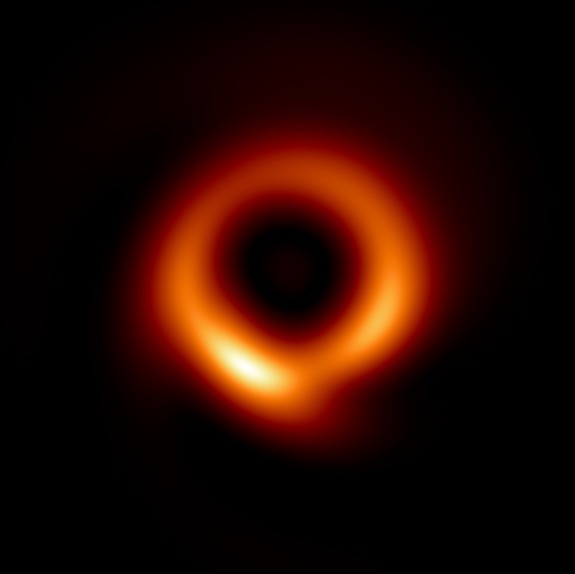
Medeiros et al. 2023 New image of M87 supermassive black hole generated by the PRIMO algorithm using 2017 EHT data

Medeiros reconstructs the iconic image of the fuzzy, orange donut of M87 with the help of PRIMO

The iconic image of the supermassive black hole at the center of M87—sometimes referred to as the “fuzzy, orange donut”—has gotten its first official makeover with the help of machine learning. The new image further exposes a central region that is larger and darker, surrounded by the bright accreting gas shaped like a “skinny donut.” The team used the data obtained by the Event Horizon Telescope (EHT) collaboration in 2017 and achieved, for the first time, the full resolution of the array. 

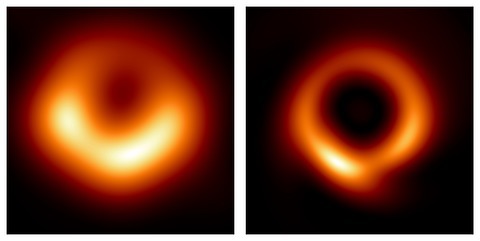
In 2017, the EHT collaboration used a network of seven pre-existing telescopes around the world to gather data on M87, creating an “Earth-sized telescope.” However, since it is infeasible to cover the Earth’s entire surface with telescopes, gaps arise in the data—like missing pieces in a jigsaw puzzle. Medeiros et al. 2023 M87 supermassive black hole originally imaged by the EHT collaboration in 2019 (left); and new image generated by the PRIMO algorithm using the same data set (right)

“With our new machine learning technique, PRIMO, we were able to achieve the maximum resolution of the current array,” says lead author Lia Medeiros of the Institute for Advanced Study. “Since we cannot study black holes up close, the detail of an image plays a critical role in our ability to understand its behavior. The width of the ring in the image is now smaller by about a factor of two, which will be a powerful constraint for our theoretical models and tests of gravity.”

PRIMO, which stands for principal-component interferometric modeling, was developed by EHT members Lia Medeiros (Institute for Advanced Study), Dimitrios Psaltis (Georgia Tech), Tod Lauer (NOIRLab), and Feryal Özel (Georgia Tech). Their publication, “The Image of the M87 Black Hole Reconstructed with PRIMO,” is now available in The Astrophysical Journal Letters.

“PRIMO is a new approach to the difficult task of constructing images from EHT observations,” said Lauer. “It provides a way to compensate for the missing information about the object being observed, which is required to generate the image that would have been seen using a single gigantic radio telescope the size of the Earth.” 

{media id=305,layout=solo}

PRIMO relies on dictionary learning, a branch of machine learning which enables computers to generate rules based on large sets of training material. For example, if a computer is fed a series of different banana images—with sufficient training—it may be able to determine if an unknown image is or is not a banana. Beyond this simple case, the versatility of machine learning has been demonstrated in numerous ways: from creating Renaissance-style works of art to completing the unfinished work of Beethoven. So how might machines help scientists to render a black hole image? The research team has answered this very question.

With PRIMO, supercomputers analyzed over 30,000 high-fidelity simulated images of black holes accreting gas. The ensemble of simulations covered a wide range of models for how the black hole accretes matter, looking for common patterns in the structure of the images. The various patterns of the structure were sorted by how commonly they occurred in the simulations and were then blended to provide a highly accurate representation of the EHT observations, simultaneously providing a high-fidelity estimate of the missing structure of the images. A paper about the algorithm itself was published in The Astrophysical Journal on February 3, 2023.

“We are using physics to fill in regions of missing data in a way that has never been done before by using machine learning,” added Medeiros. “This could have important implications for interferometry, which plays a role in fields from exo-planets to medicine.”

The team confirmed that the newly rendered image is consistent with the EHT data and theoretical expectations, including the bright ring of emission expected to be produced by hot gas falling into the black hole. Generating an image required assuming an appropriate form of the missing information, and PRIMO did this by building on the 2019 discovery that the M87 black hole in broad detail looked as predicted.

“Approximately four years after the first horizon-scale image of a black hole was unveiled by EHT in 2019, we have marked another milestone, producing an image that utilizes the full resolution of the array for the first time,” stated Psaltis. “The new machine learning techniques we have developed provide a golden opportunity for our collective work to understand black hole physics.”

The new image should lead to more accurate determinations of the mass of the M87 black hole and the physical parameters that determine its present appearance. The data also provides an opportunity for researchers to place greater constraints on alternatives to the event horizon (based on the darker central brightness depression) and perform more robust tests of gravity (based on the narrower ring size). PRIMO can also be applied to additional EHT observations, including those of Sgr A*, the central black hole in our own Milky Way galaxy.

M87 is a massive, relatively nearby, galaxy in the Virgo cluster of galaxies. Over a century ago, a mysterious jet of hot plasma was observed to emanate from its center. Beginning in the 1950s, the then-new technique of radio astronomy showed the galaxy to have a compact bright radio source at its center. During the 1960s, M87 had been suspected of having a massive black hole at its center powering this activity. Measurements made from ground-based telescopes starting in the 1970s, and later the Hubble Space Telescope starting in the 1990s, provided strong support that M87 indeed harbored a black hole weighing several billion times the mass of the Sun based on observations of the high velocities of stars and gas orbiting its center. The 2017 EHT observations of M87 were obtained over several days from several different radio telescopes linked together at the same time to obtain the highest possible resolution. The now iconic “orange donut” picture of the M87 black hole, released in 2019, reflected the first attempt to produce an image from these observations.

“The 2019 image was just the beginning,” stated Medeiros. “If a picture is worth a thousand words, the data underlying that image have many more stories to tell. PRIMO will continue to be a critical tool in extracting such insights.”

Development of the PRIMO algorithm was enabled through the support of the National Science Foundation Astronomy and Astrophysics Postdoctoral Fellowship.

PRIMO Black Hole Simulations

Overview of simulations that were generated for the training set of the PRIMO algorithm. Credit: Medeiros et al. 2023

Read more

A photo of the huge elliptical galaxy M87 [left] is compared to its three-dimensional shape as gleaned from meticulous observations made with the Hubble and Keck telescopes [right]. Because the galaxy is too far away for astronomers to employ stereoscopic vision, they instead followed the motion of stars around the center of M87, like bees around a hive. This created a three-dimensional view of how stars are distributed within the galaxy.  CREDIT ILLUSTRATION: NASA, ESA, Joseph Olmsted (STScI), Frank Summers (STScI) SCIENCE: Chung-Pei Ma (UC Berkeley)
A photo of the huge elliptical galaxy M87 [left] is compared to its three-dimensional shape as gleaned from meticulous observations made with the Hubble and Keck telescopes [right]. Because the galaxy is too far away for astronomers to employ stereoscopic vision, they instead followed the motion of stars around the center of M87, like bees around a hive. This created a three-dimensional view of how stars are distributed within the galaxy. CREDIT ILLUSTRATION: NASA, ESA, Joseph Olmsted (STScI), Frank Summers (STScI) SCIENCE: Chung-Pei Ma (UC Berkeley)

UC Berkeley measures the 3D shape of one of the biggest, closest elliptical galaxies to us

Though we live in a vast three-dimensional universe, celestial objects seen through a telescope look flat because everything is so far away. Now for the first time, astronomers have measured the three-dimensional shape of one of the biggest and closest elliptical galaxies to us, M87. This galaxy turns out to be "triaxial," or potato-shaped. This stereo vision was made possible by combining the power of NASA's Hubble Space Telescope and the ground-based W. M. Keck Observatory in Maunakea, Hawaii.

In most cases, astronomers must use their intuition to figure out the true shapes of deep-space objects. For example, the whole class of huge galaxies called "ellipticals" look like blobs in pictures. Determining the true shape of giant elliptical galaxies will help astronomers understand better how large galaxies and their central large black holes form.

Scientists made the 3D plot by measuring the motions of stars that swarm around the galaxy's supermassive central black hole. The stellar motion was used to provide new insights into the shape of the galaxy and its rotation, and it also yielded a new measurement of the black hole's mass. Tracking the stellar speeds and position allowed researchers to build a three-dimensional view of the galaxy.

Astronomers at the University of California, Berkeley, were able to determine the mass of the black hole at the galaxy's core to high precision, estimating it at 5.4 billion times the mass of the Sun. Hubble observations in 1995 first measured the M87 black hole as being 2.4 billion solar masses, which astronomers deduced by clocking the speed of the gas swirling around the black hole. When the Event Horizon Telescope, an international collaboration of ground-based telescopes, released the first-ever image of the same black hole in 2019, the size of its pitch-black event horizon allowed researchers to calculate a mass of 6.5 billion solar masses using Einstein's theory of general relativity.

The stereo model of M87 and the more precise mass of the central black hole could help astrophysicists learn the black hole's spin rate. "Now that we know the direction of the net rotation of stars in M87 and have an updated mass of the black hole, we can combine this information with data from the Event Horizon Telescope to constrain the spin," said Chung-Pei Ma, a UC Berkeley lead investigator on the research.

Over ten times the mass of the Milky Way, M87 probably grew from the merger of many other galaxies. That's likely the reason M87's central black hole is so large – it assimilated the central black holes of one or more galaxies it swallowed.

Ma, together with UC Berkeley graduate student Emily Liepold and Jonelle Walsh at Texas A&M University was able to determine the 3D shape of M87 thanks to a new precision instrument mounted on the Keck II Telescope. They pointed Keck at 62 adjacent locations of the galaxy, mapping out the spectra of stars over a region about 70,000 light-years across. This region spans the central 3,000 light-years where gravity is largely dominated by the supermassive black hole. Though the telescope cannot resolve individual stars because of M87's great distance, the spectra can reveal the range of velocities to calculate the mass of the object they're orbiting.

"It's sort of like looking at a swarm of 100 billion bees," said Ma. "Though we are looking at them from a distance and can't discern individual bees, we are getting very detailed information about their collective velocities." 

{media id=304,layout=solo}

The researchers took the data between 2020 and 2022, as well as earlier star brightness measurements of M87 from Hubble, and compared them to supercomputer model predictions of how stars move around the center of the triaxial-shaped galaxy. The best fit to this data allowed them to calculate the black hole's mass. "Knowing the 3D shape of the 'swarming bees' enabled us to obtain a more robust dynamical measurement of the mass of the central black hole that is governing the bees' orbiting velocities," said Ma.

In the 1920s, astronomer Edwin Hubble first classified galaxies according to their shapes. Flat disk spiral galaxies could be viewed from various projection angles of the sky: face-on, oblique, or edge-on. But the "blobby-looking" galaxies were more problematic to characterize. Hubble came up with the term elliptical. They could only be sorted out by how great the ellipticity was. They didn't have any apparent dust or gas inside of them to better distinguish between them. Now, a century later astronomers have a stereoscopic look at a prototypical elliptical galaxy.

The Hubble Space Telescope is a project of international cooperation between NASA and ESA. NASA's Goddard Space Flight Center in Greenbelt, Maryland, manages the telescope. The Space Telescope Science Institute (STScI) in Baltimore, Maryland, conducts Hubble and Webb science operations. STScI is operated for NASA by the Association of Universities for Research in Astronomy, in Washington, D.C.