Brown-built model shows how non-drug interventions for patients with Alzheimer’s are both effective, economical

A Brown-led research team used a supercomputer simulation to show that compared to usual care, four dementia-care interventions saved up to $13,000 in costs, reduced nursing home admissions, and improved quality of life.

While new drugs to treat Alzheimer’s disease tend to receive the most public attention, many well-researched ways to care for people with dementia don’t involve medication. A new evaluation compared the cost-effectiveness of four non-drug interventions to the usual care received by people with dementia and found that the interventions not only resulted in a better quality of life but also saved money.

In a study published April 6 in Alzheimer's & Dementia: The Journal of the Alzheimer's Association, researchers used a supercomputer simulation model to show that the four dementia-care interventions saved between $2,800 and $13,000 in societal costs, depending on the type of intervention, and all reduced nursing home admissions and improved quality of life compared to usual care.

Alzheimer’s drugs hold great promise, but they still need additional research and improvement, said lead study author Eric Jutkowitz, an associate professor at Brown University’s School of Public Health. In the meantime, he said, several non-drug interventions are effective in clinical trials in improving the quality of life for people with dementia and helping them stay safe at home longer.

“Now that we can show that these effective interventions can also save money, it just makes sense to find ways to make them available to more families,” Jutkowitz said. “These interventions can be used to help people with dementia starting today.”

The four interventions studied included the following: Maximizing Independence at Home, an at-home, care coordination intervention that consists of care planning, skill-building, referrals to services, and careful monitoring; New York University Caregiver, which is implemented in an outpatient clinic and provides caregivers with six counseling sessions over four months plus lifetime ad-hoc support and access to weekly support groups; Alzheimer’s and Dementia Care, in which a health care system provides people living with dementia and their caregivers a needs assessment, individual care plans and round-the-clock access to a care manager; and Adult Day Service Plus, which augments adult day care services with staff providing face-to-face caregiver support, disease education, care management, skill-building, and resource referrals.

Nonpharmacological interventions like these provide family caregivers with knowledge, skills, and support tailored to their care challenges. They have been shown to improve the quality of life for the caregiver and the person living with dementia, as well as to reduce nursing home admissions, and they are not associated with adverse events such as hospitalizations and mortality. For these reasons, nonpharmacological interventions are recommended as first-line therapies for the management of Alzheimer’s and dementia.

While non-drug interventions are well-studied, Jutkowitz said they haven't been widely implemented in clinical care centers. He added that there isn’t currently an infrastructure in place to support these methods of care — for example, there are limited mechanisms for providers to be reimbursed for these types of interventions.

To conduct the study, the researchers used a supercomputer simulation to model the likelihood of nursing home admission for four evidence-based Alzheimer’s and dementia nonpharmacological interventions compared to usual care. For each, the study evaluated societal costs, quality-adjusted life-years, and cost-effectiveness. The inputs in the simulation were based on data from Medicare, clinical trials, and national surveys with families of people with dementia.

Jutkowitz noted that the researchers benefited not only from Brown University supercomputing resources that could handle intensive analytic tasks but also access to data from the government’s Centers for Medicare and Medicaid Services, which was crucial to the analysis.

In addition to finding that the interventions were cost-effective from a societal perspective, the researchers also found that from a healthcare payer perspective, the interventions involved little to no additional cost, compared to usual care, while increasing patient quality of life.

Based on the study findings, the authors concluded that health insurance policies should find ways to incentivize providers and health systems to implement nonpharmacological interventions.

The importance of understanding the cost-effectiveness of non-drug Alzheimer’s and dementia interventions is further highlighted by changes in Medicare payment models and emerging Alzheimer’s therapeutics, the researchers noted. The Centers for Medicare and Medicaid Services is in the process of determining coverage for new Alzheimer’s and related dementia drugs.

“As the Centers for Medicare and Medicaid Services determine coverage for new Alzheimer’s and related dementia drugs, we strongly believe that CMS should also consider the benefits of nonpharmacologic interventions,” Jutkowitz said.

While this study focused on non-drug interventions that reduce nursing home admissions, a future analysis will look at similar interventions that reduce or maintain functional decline and challenging behaviors. The researchers are also working on designing a trial that would test the interventions with patients in a healthcare setting.

Additional Brown contributors included Peter Shewmaker and Gary Epstein-Lubow.

This research was supported by the National Institute on Aging (1R21AG059623-01, 1R01AG060871-01, 1RF1AG069771, R01AG049692).


Tokyo Tech deploys database online aimed at boosting drug design using cyclic peptides

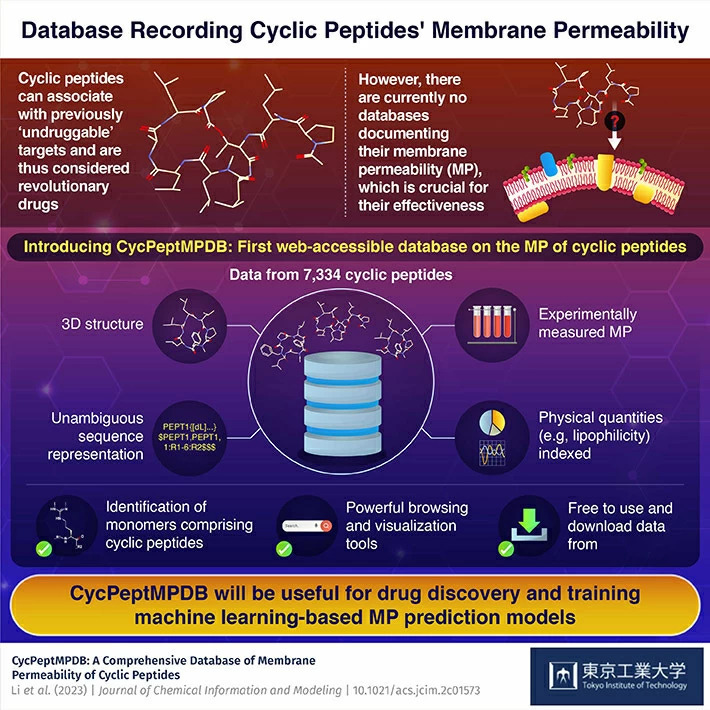
CycPeptMPDB, a novel database created by Tokyo Tech researchers focused on the membrane permeability of cyclic peptides, could accelerate the development of drugs based on these promising compounds. This database was created by gathering published information on thousands of cyclic peptides and organizing it neatly in an online-accessible platform. Thanks to its search and visualization capabilities, CycPeptMPDB could pave the way to new super-computational machine-learning methods for screening and designing drugs with cyclic peptides.

One of the greatest challenges in modern drug design is to find compounds that satisfy somewhat contradictory requirements—they need to be small enough to permeate human cell membranes while being large enough to target various protein surfaces and protein–protein interactions. This is a fine balance to achieve—if the compounds are too large, they may not pass through the cell membrane, and their bioavailability would be affected; if they are too small, they would not retain high specificity to the target protein (or proteins).  Scientists estimate that over 80% of all known proteins associated with diseases cannot be targeted by conventional small-molecule drugs or antibody-based drugs. That is why, in recent years, cyclic peptides have become a very active research area. In principle, these compounds can achieve the fine balance required of modern drugs.

A cyclic peptide is a type of organic molecule that consists of amino acids linked together in a circular or lariat shape. What makes them particularly attractive is that they can target intracellular protein–protein interactions, which have been considered “undruggable” for decades. Moreover, cyclic peptides are inexpensive to synthesize compared to antibody-based drugs, prompting many pharmaceutical companies to conduct extensive research on these compounds.

However, one of the biggest hurdles to overcome in cyclic peptide research is that their membrane permeability—which controls their bioavailability and efficiency as drugs—is low in general, and the mechanisms behind this are not completely understood. Thus, during drug design, it is difficult for researchers to select candidate peptides that are likely to make it through the cell membrane. On top of this, there are currently no openly accessible databases documenting the membrane permeabilities of known cyclic peptides.

Against this backdrop, a team of researchers from the Tokyo Institute of Technology (Tokyo Tech), Japan, including Professor Yutaka Akiyama, decided to take a step towards making cyclic peptide research easier for everyone. As explained in their latest paper published in the Journal of Chemical Information and Modeling, the team created an online database called CycPeptMPDB that contains information on thousands of cyclic peptides, including their membrane permeability.

To build the database, they gathered data from previously published papers and pharmaceutical patents. After inspecting over 40 publications, they collected information on 7,334 cyclic peptides with widely different chemical structures. They loaded the membrane permeability values and important physical parameters such as the lipophilicity of these peptides onto the database.

Moreover, to make further analysis and visualization of the molecules possible, the researchers calculated the most likely 3D conformation of each peptide and added it to the database. They also encoded the chemical structure of each cyclic peptide in a novel descriptive notation (called HELM), making it possible to unambiguously refer to any cyclic peptide in the database using a short string of text.

The team has high hopes for its platform and believes that it could become a game changer in the design and development of cyclic peptide drugs. “CycPeptMPDB provides several functions, including data storage, statistics and visualization, searching and analysis, and downloading. We expect it will become a valuable tool to support membrane permeability research on cyclic peptides,” remarks Prof. Akiyama. It is also worth noting, that databases such as CycPeptMPDB are essential for training machine learning models, which can accelerate the selection of drug candidates and reveal hidden patterns in the data.

“We will continue to collect membrane permeability data of cyclic peptides and record them in CycPeptMPDB. Additionally, future improvements to the database’s online analysis platform will include an improved user-friendly interface and more integrative functions,” comments Prof. Akiyama.

Pipeline in Alaska (Photo: Moritz Langer)

German team shows how the Arctic faces problems from legacy industrial contamination, pollutants when permafrost thaws

A previously underestimated risk lurks in the frozen soil of the Arctic. When the ground thaws and becomes unstable in response to climate change, it can lead to the collapse of industrial infrastructure, and in turn to the increased release of pollutants. Moreover, contaminations already present will be able to more easily spread throughout ecosystems. A team led by Moritz Langer and Guido Grosse from the Alfred Wegener Institute (AWI) in Potsdam, Germany, investigated the potential scale of this problem. According to their findings, there are at least 13,000 to 20,000 contaminated sites in the Arctic that could pose a serious risk in the future. Accordingly, long-term strategies for handling this volatile legacy are urgently called for, as the experts explained.

Many of us picture the Arctic as largely untouched wilderness. But that has long since ceased to be true for all of the continents. It is also home to oilfields and pipelines, mines, and various other industrial activities. The corresponding facilities were built on a foundation once considered to be particularly stable and reliable: permafrost. This unique type of soil, which can be found in large expanses of the Northern Hemisphere, only thaws at the surface in summer. The remainder, extending up to hundreds of meters down, remains frozen year-round.

Accordingly, permafrost has not only been viewed as a solid platform for buildings and infrastructure. “Traditionally, it’s also been considered a natural barrier that prevents the spread of pollutants,” explains Moritz Langer from the Alfred Wegener Institute, Helmholtz Centre for Polar and Marine Research (AWI). “Consequently, industrial waste from defunct or active facilities was often simply left on-site, instead of investing the considerable effort and expense needed to remove it.” As a result of the industrial expansion during the cold war, over the decades this led to micro-dumps full of toxic sludge from oil and gas exploration, stockpiles of mining debris, abandoned military installations, and lakes in which pollutants were intentionally poured. “In many cases, the assumption was that the permafrost would reliably and permanently seal off these toxic substances, which meant there was no need for costly disposal efforts,” says Guido Grosse, who heads the AWI’s Permafrost Research Section. “Today, this industrial legacy still lies buried in the permafrost or on its surface. The substances involved range from toxic diesel fuel to heavy metals and even radioactive waste.”

But as climate change progresses, this “sleeping giant” could soon become an acute threat: since the permafrost regions are warming between twice as fast and four times as fast as the rest of the world, the frozen soil is increasingly thawing. When this happens, it changes the hydrology of the region in question, and the permafrost no longer provides an effective barrier. As a result, contaminants that have accumulated in the Arctic over decades can be released, spreading across larger regions. Oil pipeline crosses the tundra (Photo: Guido Grosse)

In addition, thawing permafrost becomes more and more unstable, which can lead to further contamination. When the ground collapses, it can damage pipelines, chemical stockpiles, and depots. Just how real this risk already is can be seen in a major incident from May 2020 near the industrial city Norilsk in northern Siberia: a destabilized storage tank released 17,000 metric tons of diesel, which polluted the surrounding rivers, lakes, and tundra. According to Langer: “Incidents like this could easily become more frequent in the future.”

To more accurately assess such risks, he and an international team of experts from Germany, the Netherlands, and Norway took a closer look at industrial activities in the High North. To do so, they first analyzed freely available data from the portal OpenStreetMap and from the Atlas of Population, Society, and Economy in the Arctic. According to these sources, the Arctic permafrost regions contain ca. 4,500 industrial sites that either store or use potentially hazardous substances.

“But this alone didn’t tell us what types of facilities they were, or how badly they could potentially pollute the environment,” says Langer. More detailed information on contaminated sites is currently only available for North America, where roughly 40 percent of the global permafrost lies. The data from Canada and Alaska showed that using the location and type of facility, it should be possible to accurately estimate where hazardous substances were most likely to be found.

For Alaska, the Contaminated Sites Program also offers insights into the respective types of contaminants. For example, roughly half of the contaminations listed can be attributed to fuels like diesel, kerosene, and petrol. Mercury, lead, and arsenic are also in the top 20 documented environmental pollutants. And the problem isn’t limited to the legacy of past decades: although the number of newly registered contaminated sites in the northernmost state of the USA declined from ca. 90 in 1992 to 38 in 2019, the number of affected sites continues to rise.

There are no comparable databases for Siberia’s extensive permafrost regions. “As such, our only option there was to analyze reports on environmental problems that were published in the Russian media or other freely accessible sources between 2000 and 2020,” says Langer. “But the somewhat sparse information available indicates that industrial facilities and contaminated sites are also closely linked in Russia’s permafrost regions.”

Using supercomputer models, the team calculated the occurrence of contaminated sites for the Arctic as a whole. According to the results, the 4,500 industrial facilities in the permafrost regions have most likely produced between 13,000 and 20,000 contaminated sites. 3,500 to 5,200 of them are located in regions where the permafrost is still stable but will start to thaw before the end of the century. “But without more extensive data, these findings should be considered a rather conservative estimate,” Langer emphasizes. “The true scale of the problem could be even greater.”

Making matters worse, the interest in pursuing commercial activities in the Arctic continues to grow. As a result, more and more industrial facilities are being constructed, which could also release toxic substances into nearby ecosystems. Further, this is happening at a time when removing such environmental hazards is getting harder and harder – after all, doing so often requires vehicles and heavy gear, which can hardly be used on vulnerable tundra soils that are increasingly affected by the thaw.

“In a nutshell, what we’re seeing here is a serious environmental problem that is sure to get worse,” summarises Guido Grosse. What is urgently called for, according to the experts: is more data, and a monitoring system for hazardous substances in connection with industrial activities in the Arctic. “These pollutants can, via rivers and the ocean, ultimately find their way back to people living in the Arctic, or to us.” Other important aspects are intensified efforts to prevent the release of pollutants and undo the damage in those areas that are already contaminated. And lastly, the experts no longer consider it appropriate to leave industrial waste behind in the Arctic without secure disposal options. After all, the permafrost can no longer be relied upon to counter the associated risks.