A previously underestimated risk lurks in the frozen soil of the Arctic. When the ground thaws and becomes unstable in response to climate change, it can lead to the collapse of industrial infrastructure, and in turn to the increased release of pollutants. Moreover, contaminations already present will be able to more easily spread throughout ecosystems. A team led by Moritz Langer and Guido Grosse from the Alfred Wegener Institute (AWI) in Potsdam, Germany, investigated the potential scale of this problem. According to their findings, there are at least 13,000 to 20,000 contaminated sites in the Arctic that could pose a serious risk in the future. Accordingly, long-term strategies for handling this volatile legacy are urgently called for, as the experts explained.
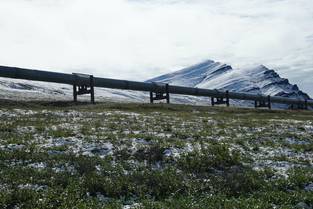
Many of us picture the Arctic as largely untouched wilderness. But that has long since ceased to be true for all of the continents. It is also home to oilfields and pipelines, mines, and various other industrial activities. The corresponding facilities were built on a foundation once considered to be particularly stable and reliable: permafrost. This unique type of soil, which can be found in large expanses of the Northern Hemisphere, only thaws at the surface in summer. The remainder, extending up to hundreds of meters down, remains frozen year-round.
Accordingly, permafrost has not only been viewed as a solid platform for buildings and infrastructure. “Traditionally, it’s also been considered a natural barrier that prevents the spread of pollutants,” explains Moritz Langer from the Alfred Wegener Institute, Helmholtz Centre for Polar and Marine Research (AWI). “Consequently, industrial waste from defunct or active facilities was often simply left on-site, instead of investing the considerable effort and expense needed to remove it.” As a result of the industrial expansion during the cold war, over the decades this led to micro-dumps full of toxic sludge from oil and gas exploration, stockpiles of mining debris, abandoned military installations, and lakes in which pollutants were intentionally poured. “In many cases, the assumption was that the permafrost would reliably and permanently seal off these toxic substances, which meant there was no need for costly disposal efforts,” says Guido Grosse, who heads the AWI’s Permafrost Research Section. “Today, this industrial legacy still lies buried in the permafrost or on its surface. The substances involved range from toxic diesel fuel to heavy metals and even radioactive waste.”
But as climate change progresses, this “sleeping giant” could soon become an acute threat: since the permafrost regions are warming between twice as fast and four times as fast as the rest of the world, the frozen soil is increasingly thawing. When this happens, it changes the hydrology of the region in question, and the permafrost no longer provides an effective barrier. As a result, contaminants that have accumulated in the Arctic over decades can be released, spreading across larger regions. 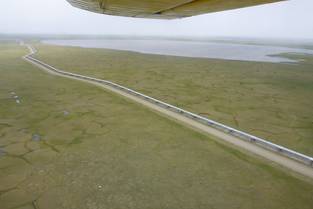
In addition, thawing permafrost becomes more and more unstable, which can lead to further contamination. When the ground collapses, it can damage pipelines, chemical stockpiles, and depots. Just how real this risk already is can be seen in a major incident from May 2020 near the industrial city Norilsk in northern Siberia: a destabilized storage tank released 17,000 metric tons of diesel, which polluted the surrounding rivers, lakes, and tundra. According to Langer: “Incidents like this could easily become more frequent in the future.”
To more accurately assess such risks, he and an international team of experts from Germany, the Netherlands, and Norway took a closer look at industrial activities in the High North. To do so, they first analyzed freely available data from the portal OpenStreetMap and from the Atlas of Population, Society, and Economy in the Arctic. According to these sources, the Arctic permafrost regions contain ca. 4,500 industrial sites that either store or use potentially hazardous substances.
“But this alone didn’t tell us what types of facilities they were, or how badly they could potentially pollute the environment,” says Langer. More detailed information on contaminated sites is currently only available for North America, where roughly 40 percent of the global permafrost lies. The data from Canada and Alaska showed that using the location and type of facility, it should be possible to accurately estimate where hazardous substances were most likely to be found.
For Alaska, the Contaminated Sites Program also offers insights into the respective types of contaminants. For example, roughly half of the contaminations listed can be attributed to fuels like diesel, kerosene, and petrol. Mercury, lead, and arsenic are also in the top 20 documented environmental pollutants. And the problem isn’t limited to the legacy of past decades: although the number of newly registered contaminated sites in the northernmost state of the USA declined from ca. 90 in 1992 to 38 in 2019, the number of affected sites continues to rise.
There are no comparable databases for Siberia’s extensive permafrost regions. “As such, our only option there was to analyze reports on environmental problems that were published in the Russian media or other freely accessible sources between 2000 and 2020,” says Langer. “But the somewhat sparse information available indicates that industrial facilities and contaminated sites are also closely linked in Russia’s permafrost regions.”
Using supercomputer models, the team calculated the occurrence of contaminated sites for the Arctic as a whole. According to the results, the 4,500 industrial facilities in the permafrost regions have most likely produced between 13,000 and 20,000 contaminated sites. 3,500 to 5,200 of them are located in regions where the permafrost is still stable but will start to thaw before the end of the century. “But without more extensive data, these findings should be considered a rather conservative estimate,” Langer emphasizes. “The true scale of the problem could be even greater.”
Making matters worse, the interest in pursuing commercial activities in the Arctic continues to grow. As a result, more and more industrial facilities are being constructed, which could also release toxic substances into nearby ecosystems. Further, this is happening at a time when removing such environmental hazards is getting harder and harder – after all, doing so often requires vehicles and heavy gear, which can hardly be used on vulnerable tundra soils that are increasingly affected by the thaw.
“In a nutshell, what we’re seeing here is a serious environmental problem that is sure to get worse,” summarises Guido Grosse. What is urgently called for, according to the experts: is more data, and a monitoring system for hazardous substances in connection with industrial activities in the Arctic. “These pollutants can, via rivers and the ocean, ultimately find their way back to people living in the Arctic, or to us.” Other important aspects are intensified efforts to prevent the release of pollutants and undo the damage in those areas that are already contaminated. And lastly, the experts no longer consider it appropriate to leave industrial waste behind in the Arctic without secure disposal options. After all, the permafrost can no longer be relied upon to counter the associated risks.