

SUPERCOMPUTING NEWS SUPERCOMPUTING NEWS
    • MEDIA KIT
    • MOST READ
    • RSS FEED
    • ACADEMIA
    • AEROSPACE
    • APPLICATIONS
    • ASTRONOMY
    • AUTOMOTIVE
    • BIG DATA
    • BIOLOGY
    • CHEMISTRY
    • CLIENTS
    • CLOUD
    • DEFENSE
    • DEVELOPER TOOLS
    • EARTH SCIENCES
    • ECONOMICS
    • ENGINEERING
    • ENTERTAINMENT
    • GAMING
    • GOVERNMENT
    • HEALTH
    • OIL & GAS
    • INDUSTRY
    • INTERCONNECTS
    • MANUFACTURING
    • MIDDLEWARE
    • MOVIES
    • NETWORKS
    • PHYSICS
    • PROCESSORS
    • RETAIL
    • SCIENCE
    • STORAGE
    • SYSTEMS
    • VISUALIZATION
    • AcyMailing subscription form

    • ADD YOUR VIDEOS
    • MANAGE VIDEOS
    • CONVERSATION INBOX
    • SOCIAL ADVERTISER
    • SOCIAL NETWORK VIDEOS
    • SURVEYS
    • GROUPS
    • PAGES
    • MARKETPLACE LISTINGS
    • APPLICATIONS BROWSER
    • PRIVACY CONFIRM REQUEST
    • PRIVACY CREATE REQUEST
    • LEADERBOARD
    • POINTS LISTING
      • BADGES
    • TRADE SHOWS
Sign In
Tyler O'Neal, Staff Editor BIOLOGY September 28, 2021, 12:00 pm

MU researchers identify mutations of Delta, Delta Plus variants

Findings help explain COVID-19 reinfections, Delta variant infections despite vaccination efforts

When Kamlendra Singh flew back to Missouri from India in April, he developed a cough and fever on the plane, despite being vaccinated for COVID-19 and testing negative for the virus right before departure.

Still, Singh tested positive for COVID-19, most likely due to infection from the Delta variant, upon his arrival home in Boone County – a diagnosis other fully vaccinated people and those who have already tested positive for the contagious virus were experiencing. He wanted to know why.

Following his recovery at home, Singh, a professor in the MU College of Veterinary Medicine and Bond Life Sciences Center, teamed up with MU undergraduate student Austin Spratt, Saathvik Kannan, a freshman at Hickman High School, and Siddappa Byrareddy, a professor at the University of Nebraska Medical Center, to analyze protein sequences for more than 300,000 COVID-19 samples of two emerging variants around the world, known as Delta and Delta Plus.

Using bioinformatics tools and programming, the team identified five specific mutations that are far more prevalent in Delta Plus infections compared to Delta infections, including one mutation, K417N, that is present in all Delta Plus infections but not present in nearly any Delta infections. The findings provide important clues to researchers about the structural changes to the virus recently and highlight the need to expand the toolbox in the fight against COVID-19.

“Whether it is natural antibodies produced from previously having COVID-19 or the antibodies produced from the vaccine, we are showing structurally how dangerous and clever the virus is by being able to mutate in a way that the antibodies don’t seem to recognize and defend against these new variants,” Spratt said. “These findings help explain why there have been so many people testing positive for the Delta variants despite being vaccinated or having previously been infected with COVID-19.” Dr. Singh

Singh explained that while COVID-19 vaccines have been effective, another possible tool in responding to the pandemic could be the development of antiviral drugs that target specific areas of the virus that remain unchanged by mutations.

“There has not yet been a vaccine for HIV due to the unpredictable variability that often comes with viruses that mutate frequently,” Singh said. “If we can develop small molecule drugs that target the part of the virus that does not mutate, that will be the ultimate solution for combatting the virus.”

UK researchers discover superconducting single-crystal flake devices that outperform components in quantum supercomputers

Tyler O'Neal, Staff Editor BIOLOGY September 28, 2021, 7:00 am

The UK team at the University of Bath's Department of Physics made its discovery while exploring the junction between two layers of the superconductor niobium diselenide (NbSe₂) after these layers had been cleaved apart, twisted about 30 degrees with respect to one another, then stamped back together. In cleaving, twisting, and recombining the two layers, the researchers were able to build a Superconducting Quantum Interferometer Device (SQUID) – an extremely sensitive sensor used to measure incredibly tiny magnetic fields.

SQUIDs have a wide range of important applications in areas that include healthcare (as seen in cardiology and magnetoencephalography – a test that maps brain function) and mineral exploration. With its extremely thin single crystals, the Bath University superconductor shows promise as a component for flexible electronics.

SQUIDS are also the building blocks of today’s quantum supercomputers – machines that perform certain computational tasks much more rapidly than classical computers. Quantum supercomputing is still in its infancy but in the next decade, it is likely to transform the problem-solving capacity of companies and organizations across many sectors – for instance by fast-tracking the discovery of new drugs and materials.

“Due to their atomically perfect surfaces, which are almost entirely free of defects, we see the potential for our crystalline flakes to play a significant role in building quantum computers of the future,” said Professor Simon Bending, who carried out the research together with his Ph.D. student Liam Farrar. “Also, SQUIDs are ideal for studies in biology – for instance, they are now being used to trace the path of magnetically-labeled drugs through the intestine – so we’re very excited to see how our devices could be developed in this field too.”

As Professor Bending is quick to point out, however, his work on SQUIDs made using NbSe₂ flakes is very much at the start of its journey. “This is a completely new and unexplored approach to making SQUIDs and a lot of research will still have to be done before these applications become a reality,” he said.

Extremely thin single crystals

The flakes from which the Bath superconductors are fabricated are extremely thin single crystals (10,000 times thinner than a human hair) that bend easily, which also makes them suitable for incorporation into flexible electronics, as used in computer keyboards, optical displays, solar cells, and various automotive components.

Because the bonds between layers of NbSe₂ are so weak, cleaved flakes – with their perfectly flat, defect-free surfaces – create atomically sharp interfaces when pushed back together again. This makes them excellent candidates for the components used in quantum computing.

While this is not the first time NbSe₂ layers have been stamped together to create a weak superconducting link, this is the first demonstration of quantum interference between two such junctions patterned in a pair of twisted flakes. This quantum interference has allowed the researchers to modulate the maximum supercurrent that can flow through their SQUIDs by applying a small magnetic field, creating an extremely sensitive field sensor. They were also able to show that the properties of their devices could be systematically tuned by varying the twist angle between the two flakes.

German researchers use supercomputer simulation to investigate models of living systems

Tyler O'Neal, Staff Editor BIOLOGY September 27, 2021, 6:58 pm

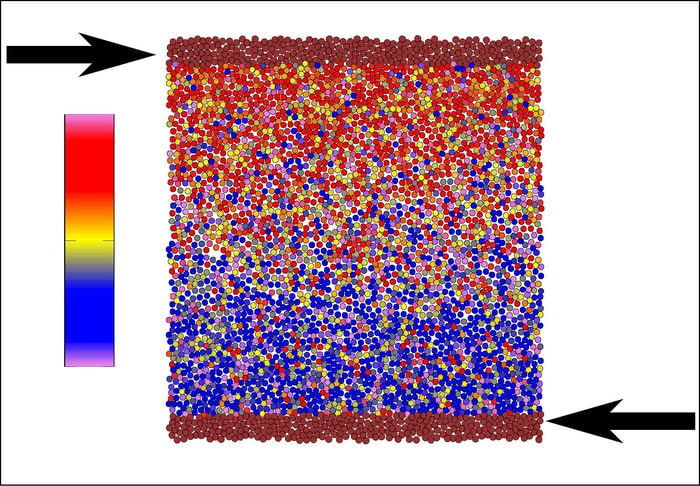
Living or biological systems cannot be easily understood using the standard laws of physics, such as thermodynamics, as scientists would for gases, liquids, or solids. Living systems are active, demonstrating fascinating properties such as adapting to their environment or repairing themselves. Exploring the questions posed by living systems using supercomputer simulations, researchers at the University of Göttingen in Germany have now discovered a novel type of ordering effect generated and sustained by a simple mechanical deformation, specifically steady shear. A snapshot of the researchers’ simulation showing orientational ordering under steady shear deformation. Colours code the orientation of the self-propulsion forces, e.g. blue for downward and red for upward; neighbouring particles tend to be oriented in similar directions.  CREDIT Dr Rituparno Mandal

Understanding living systems, such as tissues formed by cells, poses a significant challenge because of their unique properties, such as adaptation, self-repair, and self-propulsion. Nonetheless, they can be studied using models that treat them as just an unusual, “active” form of physical matter. This can reveal extraordinary dynamical or mechanical properties. One of the puzzles is how active materials behave under shear (the deformation produced by moving the top and bottom layers sideways in opposite directions, like sliding microscope cover plates against each other). Researchers at the Institute for Theoretical Physics, University of Göttingen explored this question and discovered a novel type of ordering effect that is generated and sustained by steady shear deformation. The researchers used a computer model of self-propelling particles where each particle is driven by a propulsion force that changes direction slowly and randomly. They found that while the flow of the particles looks similar to that in ordinary liquids, there is a hidden order revealed by looking at the force directions: these tend to point towards the nearest (top or bottom) plate, while particles with sideways forces aggregate in the middle of the system.

 “We were exploring the response of a model active material under steady driving, where the system is sandwiched between two walls, one stationary and the other moving to generate shear deformation. What we saw was that at a sufficiently strong driving force, an interesting ordering effect emerges,” comments Dr. Rituparno Mandal, Institute for Theoretical Physics at the University of Göttingen. “We now also understand the ordering effect using a simple analytical theory and the predictions from this theory match surprisingly well with the simulation.”

Senior author Professor Peter Sollich, also from the Institute for Theoretical Physics, University of Göttingen, explains, “Often an external force or driving force destroys order. But here the driving by shear flow is key in providing mobility to the particles that make up the active material, and they actually need this mobility to achieve the observed order. The results will open up exciting possibilities for researchers investigating the mechanical responses of living matter.”

  1. German, Chinese team develops a new approach for efficient data processing
  2. Machine learning uncovers genes of importance in agriculture, medicine

Page 7 of 17

  • 2
  • 3
  • 4
  • 5
  • 6
  • 7
  • 8
  • 9
  • 10
  • 11
POPULAR RIGHT NOW
  • AI supercharges the hunt for stronger magnets: Iowa State researchers launch a new era of intelligent materials discovery
    AI supercharges the hunt for stronger magnets: Iowa State researchers launch a new era of intelligent materials discovery
  • IBM's Historic stock collapse raises questions for the future of enterprise supercomputing
    IBM's Historic stock collapse raises questions for the future of enterprise supercomputing
  • Could a novel dark matter theory simultaneously resolve multiple cosmic enigmas? Supercomputer simulations provide a compelling, albeit currently unverified, potential solution
    Could a novel dark matter theory simultaneously resolve multiple cosmic enigmas? Supercomputer simulations provide a compelling, albeit currently unverified, potential solution
  • Melting icebergs may be reshaping Earth’s greatest ocean current
    Melting icebergs may be reshaping Earth’s greatest ocean current
  • Supercomputers replace ‘bathtub’ flood maps with physics-based digital twins of Britain’s coastline
    Supercomputers replace ‘bathtub’ flood maps with physics-based digital twins of Britain’s coastline
  • Supercomputers push neural quantum simulation beyond previous limits
    Supercomputers push neural quantum simulation beyond previous limits
  • Intel’s AI supercomputing revival: Q2 financial surge signals new era for CPU-powered HPC infrastructure
    Intel’s AI supercomputing revival: Q2 financial surge signals new era for CPU-powered HPC infrastructure
  • AI infrastructure financing fears shake semiconductor sector
    AI infrastructure financing fears shake semiconductor sector
  • AWS supercomputing investment reaches historic scale as Amazon’s AI strategy powers record financial results
    AWS supercomputing investment reaches historic scale as Amazon’s AI strategy powers record financial results
  • Catching the wave of the future: Supercomputers unlock the hidden dynamics of Venus
    Catching the wave of the future: Supercomputers unlock the hidden dynamics of Venus
THIS YEAR'S MOST READ
  • Wall Street wants to trade supercomputing power like oil
    Wall Street wants to trade supercomputing power like oil
  • Beamforming the future: BeammWave's 6G push signals the rise of orbital-terrestrial wireless networks
    Joakim Axmon
    Joakim Axmon
  • Cosmic ambition at scale: UK’s supercomputer unlocks a 2.5 petabytes universe
    Cosmic ambition at scale: UK’s supercomputer unlocks a 2.5 petabytes universe
  • Hidden order, revealed at scale: Supercomputing, electron ptychography uncover the inner workings of relaxor ferroelectrics
    Hidden order, revealed at scale: Supercomputing, electron ptychography uncover the inner workings of relaxor ferroelectrics
  • Intel's Q1 results signal supercomputing surge driving Xeon momentum
    Intel's Q1 results signal supercomputing surge driving Xeon momentum
  • When stars fall apart: Supercomputing reveals the hidden physics of black holes
    When stars fall apart: Supercomputing reveals the hidden physics of black holes
  • Multi-layer simulations reveal the hidden supply chain of solar prominences
    Multi-layer simulations reveal the hidden supply chain of solar prominences
  • Japanese scientists decode dolphin speed with supercomputing: Turbulence, vortices, and the hidden physics of propulsion
    Japanese scientists decode dolphin speed with supercomputing: Turbulence, vortices, and the hidden physics of propulsion
  • Cosmic feedback at scale: Supercomputing reveals how quasars regulate the early Universe
    Cosmic feedback at scale: Supercomputing reveals how quasars regulate the early Universe
  • Modeling life at the microscopic scale: A computational breakthrough in oxygen transport
    Modeling life at the microscopic scale: A computational breakthrough in oxygen transport
MOST READ OF ALL-TIME
  • Largest Computational Biology Simulation Mimics The Ribosome
    Details
    112127
    The amino acid (green) slithers into the chemical reaction center, moving through an evolutionarily ancient corridor of the ribosome (purple). The amino acid is delivered to the reaction core by the transfer RNA molecule (yellow).
    The amino acid (green) slithers into the chemical reaction center, moving through an evolutionarily ancient corridor of the ribosome (purple). The amino acid is delivered to the reaction core by the transfer RNA molecule (yellow).
  • Silicon 'neurons' may add a new dimension to chips
    Details
    81040
    Silicon 'neurons' may add a new dimension to chips
  • Linux Networx Accelerators Expected to Drive up to 4x Price/Performance
    Details
    75563
  • Complex Concepts That Really Add Up
    Details
    73693
    Complex Concepts That Really Add Up
  • Blue Sky Studios Donates Animation SuperComputer to Wesleyan
    Details
    68166
    Each rack holds 52 Angstrom Microsystem-brand “blades,” with a memory footprint of 12 or 24 gigabytes each. (Photos by Olivia Bartlett Drake)
    Each rack holds 52 Angstrom Microsystem-brand “blades,” with a memory footprint of 12 or 24 gigabytes each. (Photos by Olivia Bartlett Drake)
  • Humanities, HPC connect at NERSC
    Details
    57973
  • TeraGrid ’09 'Call for Participation'
    Details
    54976
  • Turbulence responsible for black holes' balancing act
    Details
    52339
  • Cray Wins $52 Million SuperComputer Contract
    Details
    50162
  • SDSC Researchers Accurately Predict Protein Docking
    Details
    46115
  • FRONTPAGE
  • LATEST
  • POPULAR
  • REGISTER
  • SOCIAL
  • VIDEO
  • SUBSCRIPTION
  • RSS
  • GUIDELINES
  • PRIVACY
  • TOS
  • ABOUT
  • +1 (816) 799-4488
  • editorial@supercomputingonline.com
© 2001 - 2026 SuperComputingOnline.com, LLC. All rights reserved. This material may not be published, broadcast, rewritten or redistributed without permission.
Sign In
  • FRONT PAGE
  • LATEST
    • MEDIA KIT
    • MOST READ
    • RSS FEED
    • ACADEMIA
    • AEROSPACE
    • APPLICATIONS
    • ASTRONOMY
    • AUTOMOTIVE
    • BIG DATA
    • BIOLOGY
    • CHEMISTRY
    • CLIENTS
    • CLOUD
    • DEFENSE
    • DEVELOPER TOOLS
    • EARTH SCIENCES
    • ECONOMICS
    • ENGINEERING
    • ENTERTAINMENT
    • HEALTH
    • INDUSTRY
    • INTERCONNECTS
    • GAMING
    • GOVERNMENT
    • MANUFACTURING
    • MIDDLEWARE
    • MOVIES
    • NETWORKS
    • OIL & GAS
    • PHYSICS
    • PROCESSORS
    • RETAIL
    • SCIENCE
    • STORAGE
    • SYSTEMS
    • VISUALIZATION
  • VIDEOS
    • ADD YOUR VIDEOS
    • MANAGE VIDEOS
  • COMMUNITY
    • TRADE SHOWS
    • SOCIAL NETWORK VIDEOS
    • SURVEYS
    • APPLICATIONS BROWSER
    • CONVERSATION INBOX
    • SOCIAL ADVERTISER
    • GROUPS
    • MARKETPLACE LISTINGS
    • PAGES
    • LEADERBOARD
    • POINTS LISTING
      • BADGES
    • PRIVACY CONFIRM REQUEST
    • PRIVACY CREATE REQUEST

Hey there! We noticed you’re using an ad blocker.