

SUPERCOMPUTING NEWS SUPERCOMPUTING NEWS
    • MEDIA KIT
    • MOST READ
    • RSS FEED
    • ACADEMIA
    • AEROSPACE
    • APPLICATIONS
    • ASTRONOMY
    • AUTOMOTIVE
    • BIG DATA
    • BIOLOGY
    • CHEMISTRY
    • CLIENTS
    • CLOUD
    • DEFENSE
    • DEVELOPER TOOLS
    • EARTH SCIENCES
    • ECONOMICS
    • ENGINEERING
    • ENTERTAINMENT
    • GAMING
    • GOVERNMENT
    • HEALTH
    • OIL & GAS
    • INDUSTRY
    • INTERCONNECTS
    • MANUFACTURING
    • MIDDLEWARE
    • MOVIES
    • NETWORKS
    • PHYSICS
    • PROCESSORS
    • RETAIL
    • SCIENCE
    • STORAGE
    • SYSTEMS
    • VISUALIZATION
    • AcyMailing subscription form

    • ADD YOUR VIDEOS
    • MANAGE VIDEOS
    • CONVERSATION INBOX
    • SOCIAL ADVERTISER
    • SOCIAL NETWORK VIDEOS
    • SURVEYS
    • GROUPS
    • PAGES
    • MARKETPLACE LISTINGS
    • APPLICATIONS BROWSER
    • PRIVACY CONFIRM REQUEST
    • PRIVACY CREATE REQUEST
    • LEADERBOARD
    • POINTS LISTING
      • BADGES
    • TRADE SHOWS
Sign In
Tyler O'Neal, Staff Editor EARTH SCIENCES May 3, 2022, 5:39 pm

Some exoplanets found thus far may be too old to support temperate, Earth-like climates

As the scientific community searches for worlds orbiting nearby stars that could potentially harbor life, new Southwest Research Institute-led research suggests that younger rocky exoplanets are more likely to support temperate, Earth-like climates. Courtesy of NASA/JPL-Caltech An SwRI-led study suggests that host-star age and radionuclide abundance will help determine both an exoplanet’s history and its current likelihood of being temperate today. For example, the red dwarf star TRAPPIST-1 is home to the largest group of roughly Earth-sized planets ever found in a single stellar system with seven rocky siblings including four in the habitable zone. But at around 8 billion years old, these worlds are roughly 2 billion years older than the most optimistic degassing lifetime predicted by this study and unlikely to support a temperate climate today.
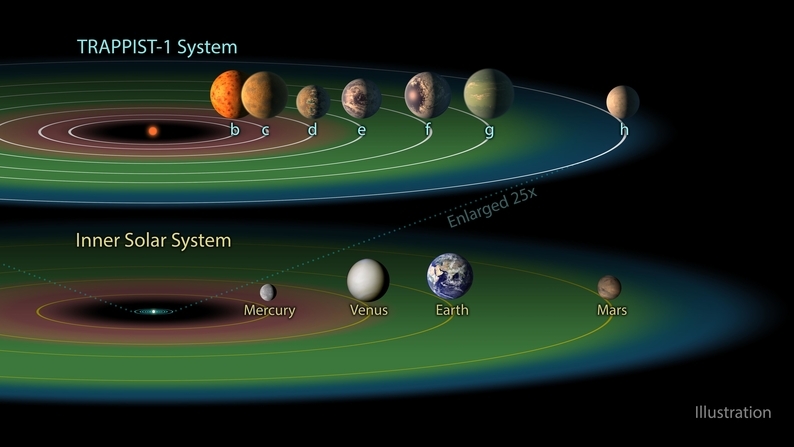
In the past, scientists have focused on planets situated within a star’s habitable zone, where it is neither too hot nor too cold for liquid surface water to exist. However, even within this so-called “Goldilocks zone,” planets can still develop climates inhospitable to life. Sustaining temperate climates also requires a planet have sufficient heat to power a planetary-scale carbon cycle. A key source of this energy is the decay of the radioactive isotopes of uranium, thorium, and potassium. This critical heat source can power a rocky exoplanet’s mantle convection, a slow creeping motion of the region between a planet’s core and a crust that eventually melts at the surface. Surface volcanic degassing is a primary source of CO2 to the atmosphere, which helps keep a planet warm. Without mantle degassing, planets are unlikely to support temperate, habitable climates like the Earth’s.

“We know these radioactive elements are necessary to regulate climate, but we don’t know how long these elements can do this, because they decay over time,” said Dr. Cayman Unterborn, lead author of an Astrophysical Journal Letters paper about the research. “Also, radioactive elements aren’t distributed evenly throughout the Galaxy, and as planets age, they can run out of heat, and degassing will cease. Because planets can have more or less of these elements than the Earth, we wanted to understand how this variation might affect just how long rocky exoplanets can support temperate, Earth-like climates.”

Studying exoplanets is challenging. Today’s technology cannot measure the composition of an exoplanet’s surface, much less that of its interior. Scientists can, however, measure the abundance of elements in a star spectroscopically by studying how light interacts with the elements in a star’s upper layers. Using these data, scientists can infer what a star’s orbiting planets are made of using the stellar composition as a rough proxy for its planets.

“Using host stars to estimate the amount of these elements that would go into planets throughout the history of the Milky Way, we calculated how long we can expect planets to have enough volcanism to support a temperate climate before running out of power,” Unterborn said. “Under the most pessimistic conditions, we estimate that this critical age is only around 2 billion years old for an Earth-mass planet and reaching 5–6 billion years for higher-mass planets under more optimistic conditions. For the few planets we do have ages for, we found only a few were young enough for us to confidently say they can have surface degassing of carbon today when we’d observe it with, say, the James Webb Space Telescope.”

This research combined direct and indirect observational data with dynamical models to understand which parameters most affect an exoplanet’s ability to support a temperate climate. More laboratory experiments and computational modeling will quantify the reasonable range of these parameters, particularly in the era of the James Webb Space Telescope, which will provide a more in-depth characterization of individual targets. With the Webb telescope, it will be possible to measure the three-dimensional variation of exoplanet atmospheres. These measurements will deepen the knowledge of atmospheric processes and their interactions with the planet’s surface and interior, which will allow scientists to better estimate whether a rocky exoplanet in habitable zones is too old to be Earth-like.

“Exoplanets without active degassing are more likely to be cold, snowball planets,” Unterborn said. “While we can’t say the other planets aren’t degassing today, we can say that they would require special conditions to do so, such as having tidal heating or undergoing plate tectonics. This includes the high-profile rocky exoplanets discovered in the TRAPPIST-1 star system. Regardless, younger planets with temperate climates may be the simplest places to look for other Earths.”

Washington shows how ice shards in Antarctic clouds let more solar energy reach Earth’s surface

Tyler O'Neal, Staff Editor EARTH SCIENCES April 14, 2022, 5:00 am

Clouds come in myriad shapes, sizes, and types, which control their effects on climate. New research led by the University of Washington shows that the splintering of frozen liquid droplets to form ice shards inside Southern Ocean clouds dramatically affects the clouds’ ability to reflect sunlight back to space.

The paper, published March 4 in the open-access journal AGU Advances, shows that including this ice-splintering process improves the ability of high-resolution global models to simulate clouds over the Southern Ocean – and thus the models’ ability to simulate Earth’s climate. Clouds observed over the Southern Ocean on Jan. 29, 2018, during a field campaign involving the University of Washington that studied summer cloud cover around Antarctica.

“Southern Ocean low clouds shouldn’t be treated as liquid clouds,” said lead author Rachel Atlas, a UW doctoral student in atmospheric sciences. “Ice formation in Southern Ocean low clouds has a substantial effect on the cloud properties and needs to be accounted for in global models.”

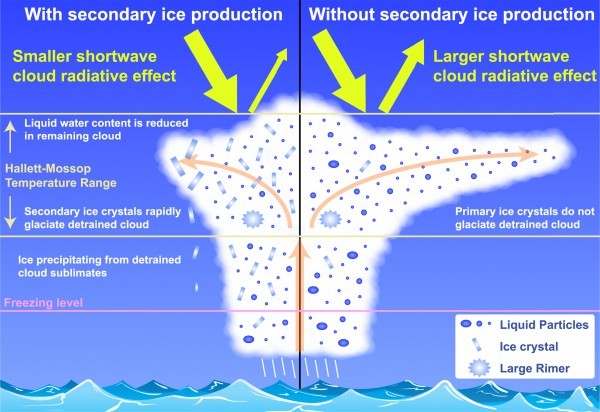
Results show that it’s important to include the process whereby icy particles collide with supercooled droplets of water causing them to freeze and then shatter, forming many more shards of ice. Doing so makes the clouds dimmer, or decreases their reflectance, allowing more sunlight to reach the ocean’s surface. 

The difference between including the details of ice formation inside the clouds versus not including them was 10 Watts per square meter between 45 degrees south and 65 degrees south in the summer, which is enough energy to have a significant effect on temperature.

The study used observations from a 2018 field campaign that flew through Southern Ocean clouds, as well as data from NASA’s CERES satellite and the Japanese satellite Himawari-8.

Ice formation reduces clouds’ reflectance because the ice particles form, grow and fall out of the cloud very efficiently.

“The ice crystals deplete much of the thinner cloud entirely, therefore reducing the horizontal coverage,” Atlas said. “Ice crystals also deplete some of the liquid in the thick cores of the cloud. So the ice particles both reduce the cloud cover and dim the remaining cloud.” How ice behaves inside clouds affects the clouds’ 3-D shape and how much sunlight is reflected back to space. Arrows at the top show that the cloud on the left reflects less sunlight (smaller arrow) than the cloud on the right, so more solar energy reaches the ocean’s surface. On the left, a large rimer, or ice chunk (blue sunburst) attracts liquid water, which freezes and then shatters to create shards (blue rectangles). These shards grow as more water freezes to them, so shattering allows ice particles to grow in clouds at the expense of liquid drops. As these faster-growing, larger, ice shards fall (left side) less liquid water is left to spread out and disperse horizontally (right side).

In February, which is summer in the Southern Ocean, about 90% of the skies are covered with clouds, and at least 25% of those clouds are affected by the type of ice formation that was the focus of the study. Getting clouds right, especially in the new models that use smaller grid spacing to include clouds and storms, is important for calculating how much solar radiation reaches Earth.

“The Southern Ocean is a massive global heat sink, but its ability to take heat from the atmosphere depends on the temperature structure of the upper ocean, which relates to the cloud cover,” Atlas said.

Groundbreaking earthquake discovery: Risk models overlook an important element

Tyler O'Neal, Staff Editor EARTH SCIENCES March 15, 2022, 9:00 am

Earthquakes themselves affect the movement of Earth's tectonic plates, which in turn could impact future earthquakes, according to new research from the University of Copenhagen. This new knowledge should be incorporated in computer models used to gauge earthquake risk, according to the researchers behind the study.

Like a gigantic puzzle, Earth’s tectonic plates divide the surface of our planet into larger and smaller pieces. These pieces are in constant motion due to the fluid-like part of Earth’s mantle, upon which they slowly sail. These movements regularly trigger earthquakes, some of which can devastate cities and cost thousands of lives. In 1999, the strongest European earthquake in recent years struck the town of İzmit, Turkey – taking the lives of 17,000 of its residents.

Among researchers and earthquake experts, it is well accepted that earthquakes are caused by a one-way mechanism: as plates move against one another, energy is slowly accrued along plate margins, and then suddenly released via earthquakes. This happens time and again over decades- or century-long intervals, in a constant stick-slip motion.

But in a new study, researchers from the Geology Section at the University of Copenhagen’s Department of Geosciences and Natural Resource Management demonstrate that the behavior of tectonic plates can change following an earthquake.

Using extensive GPS data and analysis of the 1999 İzmit earthquake, the researchers have been able to conclude that the Anatolian continental plate that Turkey sits upon has changed direction since the earthquake. Data also show that this influenced the frequency of quakes around Turkey after 1999.

"It appears that the link between plate motion - earthquake occurrence is not a one-way street. Earthquakes themselves feedback, as they can cause plates to move differently afterward," explains the study’s lead author, postdoc Juan Martin De Blas, who adds:

"As the plate movements change, it somewhat affects the pattern of the later earthquakes. If a tectonic plate shifts direction or moves at a different rate than before, this potentially impacts onto the seismicity of its margins with neighboring plates."

Quake models  can be improved

According to the researchers, the new findings provide a clear basis for reevaluating the risk models that interpret data gathered from the monitoring of tectonic plate movements. This data is used to assess the risk of future earthquakes in terms of probability, somehow like the nice/bad weather forecast.  

"An important aspect of these models is that they operate under the assumption that plate movements remain constant. With this study, we can see that this isn’t the case. Therefore, the models can now be further evolved so they take the feedback mechanism that occurs following an earthquake into account, where plates shift direction and speed," says Associate Professor Giampiero Iaffaldano, the study’s co-author.

The assumption that plate movements are constant has largely been a "necessary" assumption according to the researchers because monitoring plate motions over a few years were once impossible. But with the advent of geodesy in Geosciences and the extensive and ever-growing use of GPS devices over the last 20 years, we can track plate motion changes over year-long periods.

Could make us better at assessing risk

How tectonic plates are monitored varies greatly from place to place. Often GPS transmitters are positioned preferentially near the edges of a tectonic plate. This allows public agencies and researchers to track the movement of plate boundaries. But according to the researchers, we can also benefit from even more GPS devices continuously monitoring plate interiors, away from their margins.

"Plate boundaries undergo constant deformation and poorly represent the movement of plates as a whole. Therefore, GPS data from monitors positioned farther away from the plate boundaries should be used to a much greater degree. This can better inform us weather plates are changing motion and how, and provide information useful for assessing the risk of future events somewhere other than the known hot-spots," says Giampiero Iaffaldano.

The researchers point out that their study is limited to the Anatolian continental plate, as the İzmit earthquake is one of the few events for which a combination of sufficient seismic and GPS data is available. However, they expect that the picture is the same for other tectonic plates around the planet.

  1. Almeida builds a new model of a fundamental process of Earth’s global dynamics
  2. Molecular dynamics simulations of Earth's core show a mixture of solid Fe, liquid-like light elements

Page 13 of 23

  • 8
  • 9
  • 10
  • 11
  • 12
  • 13
  • 14
  • 15
  • 16
  • 17
POPULAR RIGHT NOW
  • AI supercharges the hunt for stronger magnets: Iowa State researchers launch a new era of intelligent materials discovery
    AI supercharges the hunt for stronger magnets: Iowa State researchers launch a new era of intelligent materials discovery
  • IBM's Historic stock collapse raises questions for the future of enterprise supercomputing
    IBM's Historic stock collapse raises questions for the future of enterprise supercomputing
  • Could a novel dark matter theory simultaneously resolve multiple cosmic enigmas? Supercomputer simulations provide a compelling, albeit currently unverified, potential solution
    Could a novel dark matter theory simultaneously resolve multiple cosmic enigmas? Supercomputer simulations provide a compelling, albeit currently unverified, potential solution
  • Melting icebergs may be reshaping Earth’s greatest ocean current
    Melting icebergs may be reshaping Earth’s greatest ocean current
  • Supercomputers replace ‘bathtub’ flood maps with physics-based digital twins of Britain’s coastline
    Supercomputers replace ‘bathtub’ flood maps with physics-based digital twins of Britain’s coastline
  • Supercomputers push neural quantum simulation beyond previous limits
    Supercomputers push neural quantum simulation beyond previous limits
  • Intel’s AI supercomputing revival: Q2 financial surge signals new era for CPU-powered HPC infrastructure
    Intel’s AI supercomputing revival: Q2 financial surge signals new era for CPU-powered HPC infrastructure
  • AI infrastructure financing fears shake semiconductor sector
    AI infrastructure financing fears shake semiconductor sector
  • AWS supercomputing investment reaches historic scale as Amazon’s AI strategy powers record financial results
    AWS supercomputing investment reaches historic scale as Amazon’s AI strategy powers record financial results
  • Catching the wave of the future: Supercomputers unlock the hidden dynamics of Venus
    Catching the wave of the future: Supercomputers unlock the hidden dynamics of Venus
THIS YEAR'S MOST READ
  • Wall Street wants to trade supercomputing power like oil
    Wall Street wants to trade supercomputing power like oil
  • Beamforming the future: BeammWave's 6G push signals the rise of orbital-terrestrial wireless networks
    Joakim Axmon
    Joakim Axmon
  • Cosmic ambition at scale: UK’s supercomputer unlocks a 2.5 petabytes universe
    Cosmic ambition at scale: UK’s supercomputer unlocks a 2.5 petabytes universe
  • Hidden order, revealed at scale: Supercomputing, electron ptychography uncover the inner workings of relaxor ferroelectrics
    Hidden order, revealed at scale: Supercomputing, electron ptychography uncover the inner workings of relaxor ferroelectrics
  • Intel's Q1 results signal supercomputing surge driving Xeon momentum
    Intel's Q1 results signal supercomputing surge driving Xeon momentum
  • When stars fall apart: Supercomputing reveals the hidden physics of black holes
    When stars fall apart: Supercomputing reveals the hidden physics of black holes
  • Multi-layer simulations reveal the hidden supply chain of solar prominences
    Multi-layer simulations reveal the hidden supply chain of solar prominences
  • Japanese scientists decode dolphin speed with supercomputing: Turbulence, vortices, and the hidden physics of propulsion
    Japanese scientists decode dolphin speed with supercomputing: Turbulence, vortices, and the hidden physics of propulsion
  • Cosmic feedback at scale: Supercomputing reveals how quasars regulate the early Universe
    Cosmic feedback at scale: Supercomputing reveals how quasars regulate the early Universe
  • Modeling life at the microscopic scale: A computational breakthrough in oxygen transport
    Modeling life at the microscopic scale: A computational breakthrough in oxygen transport
MOST READ OF ALL-TIME
  • Largest Computational Biology Simulation Mimics The Ribosome
    Details
    112127
    The amino acid (green) slithers into the chemical reaction center, moving through an evolutionarily ancient corridor of the ribosome (purple). The amino acid is delivered to the reaction core by the transfer RNA molecule (yellow).
    The amino acid (green) slithers into the chemical reaction center, moving through an evolutionarily ancient corridor of the ribosome (purple). The amino acid is delivered to the reaction core by the transfer RNA molecule (yellow).
  • Silicon 'neurons' may add a new dimension to chips
    Details
    81040
    Silicon 'neurons' may add a new dimension to chips
  • Linux Networx Accelerators Expected to Drive up to 4x Price/Performance
    Details
    75563
  • Complex Concepts That Really Add Up
    Details
    73693
    Complex Concepts That Really Add Up
  • Blue Sky Studios Donates Animation SuperComputer to Wesleyan
    Details
    68166
    Each rack holds 52 Angstrom Microsystem-brand “blades,” with a memory footprint of 12 or 24 gigabytes each. (Photos by Olivia Bartlett Drake)
    Each rack holds 52 Angstrom Microsystem-brand “blades,” with a memory footprint of 12 or 24 gigabytes each. (Photos by Olivia Bartlett Drake)
  • Humanities, HPC connect at NERSC
    Details
    57973
  • TeraGrid ’09 'Call for Participation'
    Details
    54976
  • Turbulence responsible for black holes' balancing act
    Details
    52339
  • Cray Wins $52 Million SuperComputer Contract
    Details
    50162
  • SDSC Researchers Accurately Predict Protein Docking
    Details
    46115
  • FRONTPAGE
  • LATEST
  • POPULAR
  • REGISTER
  • SOCIAL
  • VIDEO
  • SUBSCRIPTION
  • RSS
  • GUIDELINES
  • PRIVACY
  • TOS
  • ABOUT
  • +1 (816) 799-4488
  • editorial@supercomputingonline.com
© 2001 - 2026 SuperComputingOnline.com, LLC. All rights reserved. This material may not be published, broadcast, rewritten or redistributed without permission.
Sign In
  • FRONT PAGE
  • LATEST
    • MEDIA KIT
    • MOST READ
    • RSS FEED
    • ACADEMIA
    • AEROSPACE
    • APPLICATIONS
    • ASTRONOMY
    • AUTOMOTIVE
    • BIG DATA
    • BIOLOGY
    • CHEMISTRY
    • CLIENTS
    • CLOUD
    • DEFENSE
    • DEVELOPER TOOLS
    • EARTH SCIENCES
    • ECONOMICS
    • ENGINEERING
    • ENTERTAINMENT
    • HEALTH
    • INDUSTRY
    • INTERCONNECTS
    • GAMING
    • GOVERNMENT
    • MANUFACTURING
    • MIDDLEWARE
    • MOVIES
    • NETWORKS
    • OIL & GAS
    • PHYSICS
    • PROCESSORS
    • RETAIL
    • SCIENCE
    • STORAGE
    • SYSTEMS
    • VISUALIZATION
  • VIDEOS
    • ADD YOUR VIDEOS
    • MANAGE VIDEOS
  • COMMUNITY
    • TRADE SHOWS
    • SOCIAL NETWORK VIDEOS
    • SURVEYS
    • APPLICATIONS BROWSER
    • CONVERSATION INBOX
    • SOCIAL ADVERTISER
    • GROUPS
    • MARKETPLACE LISTINGS
    • PAGES
    • LEADERBOARD
    • POINTS LISTING
      • BADGES
    • PRIVACY CONFIRM REQUEST
    • PRIVACY CREATE REQUEST

Hey there! We noticed you’re using an ad blocker.