

SUPERCOMPUTING NEWS SUPERCOMPUTING NEWS
    • MEDIA KIT
    • MOST READ
    • RSS FEED
    • ACADEMIA
    • AEROSPACE
    • APPLICATIONS
    • ASTRONOMY
    • AUTOMOTIVE
    • BIG DATA
    • BIOLOGY
    • CHEMISTRY
    • CLIENTS
    • CLOUD
    • DEFENSE
    • DEVELOPER TOOLS
    • EARTH SCIENCES
    • ECONOMICS
    • ENGINEERING
    • ENTERTAINMENT
    • GAMING
    • GOVERNMENT
    • HEALTH
    • OIL & GAS
    • INDUSTRY
    • INTERCONNECTS
    • MANUFACTURING
    • MIDDLEWARE
    • MOVIES
    • NETWORKS
    • PHYSICS
    • PROCESSORS
    • RETAIL
    • SCIENCE
    • STORAGE
    • SYSTEMS
    • VISUALIZATION
    • AcyMailing subscription form

    • ADD YOUR VIDEOS
    • MANAGE VIDEOS
    • CONVERSATION INBOX
    • SOCIAL ADVERTISER
    • SOCIAL NETWORK VIDEOS
    • SURVEYS
    • GROUPS
    • PAGES
    • MARKETPLACE LISTINGS
    • APPLICATIONS BROWSER
    • PRIVACY CONFIRM REQUEST
    • PRIVACY CREATE REQUEST
    • LEADERBOARD
    • POINTS LISTING
      • BADGES
    • TRADE SHOWS
Sign In
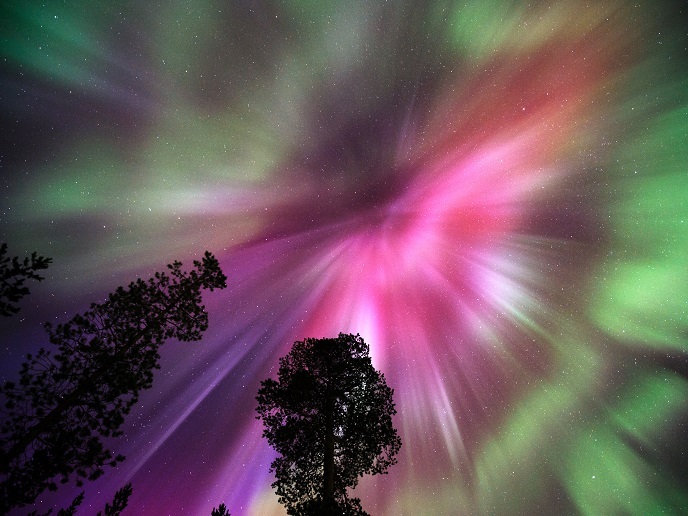
© Erkki Makkonen/Shutterstock.com
Tyler O'Neal, Staff Editor EARTH SCIENCES November 23, 2022, 9:00 am

Palmroth relies on supercomputing to protect Earth from space weather

In early September 1859, the Northern Lights could suddenly be seen as far south as the Caribbean. The cause was a geomagnetic solar storm – specifically a coronal mass ejection, now dubbed the Carrington Event, after the astronomer who recorded it.

The solar eruption reached Earth in 17.6 hours, with disturbances lasting for around three days. “Contemporary accounts talk of telegraph equipment either not working, functioning without batteries switched on – thanks to this independent electromagnetic power source, or simply catching fire,” says Palmroth, of the University of Helsinki.

Given our increased dependence on electronics, if a similar magnitude event were to happen today, would the impact be more wide-ranging and long-lasting? “We assume so, but don’t really know, and that’s what I am investigating,” adds Palmroth, a former Chair of the EU’s Space Advisory Group. “The historical records suggest that events of such magnitude can be expected every 100–150 years. I think I’ll witness the next one.”

What causes solar storms?

The sun constantly releases a stream of charged particles into space, both from fast bursts of high-energy but low-density particles from solar flares, or more slowly as plasma clouds, comprising lower-energy but high-density particles.

Earth’s magnetic field deflects these particles to its polar regions, creating the polar aurora – although the impact stretches further. “Even if space is defined as starting at around 100 km from the ground, space weather can have effects back on the ground,” Palmroth explains.

In 2012, NASA’s STEREO satellite observed a Carrington-scale solar eruption; luckily it missed Earth by a couple of days. If it had reached Earth’s magnetosphere, there would have likely been significant disruption to communication, power, and transport networks.

“Such changes to Earth’s magnetic field produce geomagnetically induced currents (GICs), while solar particles impede ionospheric radio signals and increase near-Earth space radiation due to trapped particles,” Palmroth summarises.

Supercharged GICs can create extra direct currents (DCs) in power networks, shutting them down, as happened in Malmö, Sweden, in 2003.

Solar particles disrupt communication signals by creating variable ionospheric density, compromising devices that use high-frequency bandwidths, such as radar. This would also render phone or car GPS navigation unreliable, and cause the loss of satellite time stamps essential to financial services and other industries.

Increased near-Earth space radiation would have a direct impact on satellites used for weather, navigation, and Earth observation. Depending on their orbit, materials could be degraded by radiation exposure or destroyed by direct hits from high-energy charged particles traveling at the speed of light.

“But this is informed speculation,” cautions Palmroth. “While we have many monitoring devices for terrestrial weather, for likely impacts on infrastructure from space weather we rely largely on modeling.”

Forecasting space weather
Thanks to an ERC grant over 15 years ago, Palmroth created a space environment modeling tool designed to take advantage of supercomputers that, at the time, didn’t yet exist. The resulting Vlasiator simulator recently augmented through the PRESTISSIMO project, charts the location, speed, and trajectory of high-energy particles flying through space.

“To begin with, people thought I was crazy. Now we have the world’s most accurate space environment simulator using Europe’s largest supercomputers to visualize phenomena not possible before. Because Vlasiator is open-source, others are using it, including to model other planets,” adds Palmroth.

Palmroth is now assessing likely Earth impacts from space weather, prioritizing two main research questions: how GICs could impact power grids, and how particle flux and energy influence satellites.

Both are difficult to research as they require commercially and politically sensitive information about the configuration of the power grids and satellites, so the team is currently working with Finnish data.

“We know Finland’s power grids can withstand the most likely space weather effects because our transformers accommodate extra DCs better than most European countries,” says Palmroth. “Does that mean that in the worst-case scenario, across Europe only Finland keeps its lights on? We don’t know.”

The CARRINGTON project is cooperating with the Finnish preparedness community to work on risk mitigation. “Against a Carrington-scale event, the question is: What can you do in 17 hours? You need a plan ready,” says Palmroth.
Hubble spots a super-speedy jet blasting from star collision

Tyler O'Neal, Staff Editor EARTH SCIENCES October 12, 2022, 1:00 pm

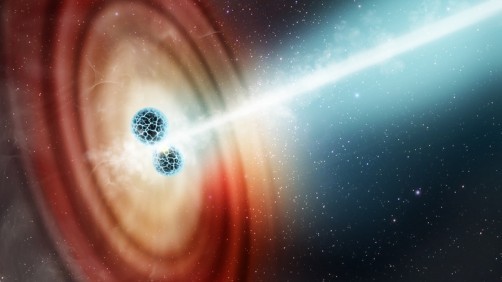
This is an artist's impression of two neutron stars colliding. The smashup between two dense stellar remnants unleashes the energy of 1,000 standard stellar nova explosions. In the aftermath of the collision a blowtorch jet of radiation is ejected at nearly the speed of light. The jet is directed along a narrow beam confined by powerful magnetic fields. The roaring jet plowed into and swept up material in the surrounding interstellar medium.  Credit: ARTWORK: NASA, ESA, Elizabeth Wheatley (STScI)Astronomers using NASA's Hubble Space Telescope have made a unique measurement that indicates a jet, plowing through space at speeds greater than 99.97% the speed of light, was propelled by the titanic collision between two neutron stars.

The explosive event, named GW170817, was observed in August 2017. The blast released energy comparable to that of a supernova explosion. It was the first combined detection of gravitational waves and gamma radiation from a binary neutron star merger.

This was a major watershed in the ongoing investigation of these extraordinary collisions. The aftermath of this merger was collectively seen by 70 observatories around the globe and in space, across a broad swath of the electromagnetic spectrum in addition to gravitational wave detection. This heralded a significant breakthrough for the emerging field of Time Domain and Multi-Messenger Astrophysics, the use of multiple "messengers" like light and gravitational waves to study the universe as it changes over time.

Scientists quickly aimed Hubble at the site of the explosion just two days later. The neutron stars collapsed into a black hole whose powerful gravity began pulling material toward it. That material formed a rapidly-spinning disk that generated jets moving outward from its poles. The roaring jet smashed into and swept up material in the expanding shell of explosion debris. This included a blob of material through which a jet emerged.

While the event took place in 2017, it has taken several years for scientists to come up with a way to analyze the Hubble data and data from other telescopes to paint this full picture.

The Hubble observation was combined with observations from multiple National Science Foundation radio telescopes working together for very long baseline interferometry (VLBI). The radio data were taken 75 days and 230 days after the explosion. 

"I'm amazed that Hubble could give us such a precise measurement, which rivals the precision achieved by powerful radio VLBI telescopes spread across the globe," said Kunal P. Mooley of Caltech in Pasadena, California.

The authors used Hubble data together with data from ESA's (the European Space Agency) Gaia satellite, in addition to VLBI, to achieve extreme precision. "It took months of careful analysis of the data to make this measurement," said Jay Anderson of the Space Telescope Science Institute in Baltimore, Maryland.

By combining the different observations, they were able to pinpoint the explosion site. The Hubble measurement showed the jet was moving at an apparent velocity of seven times the speed of light. The radio observations show the jet later decelerated to an apparent speed of four times faster than the speed of light.

In reality, nothing can exceed the speed of light, so this "superluminal" motion is an illusion. Because the jet is approaching Earth at nearly the speed of light, the light it emits at a later time has a shorter distance to go. In essence, the jet is chasing its own light. In actuality, more time has passed between the jet's emission of the light than the observer thinks. This causes the object's velocity to be overestimated — in this case seemingly exceeding the speed of light.

"Our result indicates that the jet was moving at least at 99.97% the speed of light when it was launched," said Wenbin Lu of the University of California, Berkeley.

The Hubble measurements, combined with the VLBI measurements, announced in 2018, greatly strengthen the long-presumed connection between neutron star mergers and short-duration gamma-ray bursts. That connection requires a fast-moving jet to emerge, which has now been measured in GW170817.

This work paves the way for more precision studies of neutron star mergers, detected by the LIGO, Virgo, and KAGRA gravitational wave observatories. With a large enough sample over the coming years, relativistic jet observations might provide another line of inquiry into measuring the universe's expansion rate, associated with a number known as the Hubble constant.

At present, there is a discrepancy between Hubble constant values as estimated for the early universe and the nearby universe — one of the biggest mysteries in astrophysics today. The differing values are based on extremely precise measurements of Type Ia supernovae by Hubble and other observatories, and Cosmic Microwave Background measurements by ESA's Planck satellite. More views of relativistic jets could add information for astronomers trying to solve the puzzle.

The Hubble Space Telescope is a project of international cooperation between NASA and ESA. NASA's Goddard Space Flight Center in Greenbelt, Maryland, manages the telescope. The Space Telescope Science Institute (STScI) in Baltimore, Maryland, conducts Hubble science operations. STScI is operated for NASA by the Association of Universities for Research in Astronomy, in Washington, D.C.

Australian astronomers' model explains baffling 'spiderweb' star is a nesting binary

Tyler O'Neal, Staff Editor EARTH SCIENCES October 12, 2022, 12:00 pm

WR140 JWST image of concentric dust rings emanating from the WR140 binary [Credit/NASA-ESA-CSA-STScI-JPL-Caltech]  CREDIT NASA/ESA/CSA/STScI/JPL-CaltechPuzzling image from the James Webb Space Telescope explained in two new studies

A bizarre image of the distant star known as WR140 surrounded by concentric geometric ripples, captured by the James Webb Space Telescope (JWST) in July, has baffled astronomers worldwide – even triggering frenzied internet speculation that it might be evidence of alien megastructure light-years across.

The puzzling image was captured shortly after JWST started science operations and released its first full batch of images. It quickly provoked spirited discussion online, with the wild corners of the internet theorizing the giant ripples might have alien origins. Mark McCaughrean, a senior adviser for science and exploration at the European Space Agency and a member of the James Webb Space Telescope Science Working Group, described the image as “bonkers”.

But in two companion studies, two Australian astronomers explain that the 17 concentric rings seen girdling the star are actually a series of mammoth dust shells created by the cyclic interaction between a pair of hot stars, one of them a dying Wolf-Rayet, locked together in a tight orbit.

“Like clockwork, WR140 puffs out a sculpted smoke ring every eight years, which is then inflated in the stellar wind like a balloon,” said Professor Peter Tuthill from the Sydney Institute for Astronomy at the University of Sydney, a co-author in both papers. “Eight years later, as the binary returns in its orbit, another ring appears, the same as the one before, streaming out into space inside the bubble of the previous one, like a set of giant nested Russian dolls.”

The WR140 binary is comprised of a huge Wolf-Rayet star and an even bigger blue supergiant star, gravitationally bound in an eight-year orbit. And while all stars generate stellar winds, those from Wolf-Rayet stars can be more likened to a stellar hurricane. Elements such as carbon in the wind condense out as soot, which remains hot enough to glow brightly in the infrared. Like smoke captured by wind, the dust clouds give telescopes something to observe, following the flow.

Because the two stars are in elliptical rather than circular orbits, dust production turns on and off as WR140’s binary companion nears and then departs the point of closest approach. Based on data collected with other telescopes since 2006, Professor Tuthill and his former student Yinuo Han – now at the University of Cambridge’s Institute of Astronomy – created a three-dimensional model of the dust plume’s geometry.

That model turned out to perfectly explain the bizarre results obtained by the JWST in July. Thanks to this and other contributions, both Han and Professor Tuthill also became co-authors of the Nature Astronomy paper with the new Webb data.

What’s more, in their Nature paper, Han and Professor Tuthill showed – for the first time – direct evidence of intense starlight driving into the matter and accelerating it, after tracking titanic plumes of dust generated by the violent interactions between two colossal stars over 16 years. 

It’s known that starlight carries momentum, exerting a push on the matter known as ‘radiation pressure. Astronomers often see the aftermath of this in the form of matter coasting at high speed around the cosmos, but have never caught the process in the act. Direct observation of acceleration due to forces other than gravity is rarely witnessed, and never in a stellar environment like this. 

“It's hard to see starlight causing acceleration because the force fades with distance, and other forces quickly take over,” said Han. “To witness acceleration at the level that it becomes measurable, the material needs to be reasonably close to the star or the source of the radiation pressure needs to be extra strong. WR140 is a binary star whose ferocious radiation field supercharges these effects, placing them within reach of our high-precision data.”

Using imaging technology known as interferometry, which was able to act like a zoom lens for the 10-meter mirror of the Keck telescope in Hawaii, the Australians were able to recover sufficiently sharp images of WR140 for the study. 

They discovered that the dust does not stream out from the star with the wind forming a hazy ball, as had been thought. Instead, the dust condenses adjacent to where the winds from the two stars collide, on the surface of a cone-shaped shock front between them. Because the orbiting binary star is in constant motion, the shock front also rotates. The sooty plume gets wrapped into a spiral, in the same way, that droplets form a spiral in a garden sprinkler.

“In the absence of external forces, each dust spiral should expand at a constant speed,” said Han. “We were puzzled at first because we could not get our model to fit the observations until we finally realized that we were seeing something new. The data did not fit because the expansion speed wasn’t constant, but rather that it was accelerating. We’d caught that for the first time on camera.”

Once they added the acceleration of dust by starlight into their three-dimensional model of the WR140 binary, it explained their observational data perfectly. And also ended up explaining the strange concentric rings later spotted with JWST. 

“In one sense, we always knew this must be the reason for the outflow, but I never dreamed we’d be able to see the physics at work like this,” said Professor Tuthill. “When I look at the data now, I see WR140’s plume unfurling a like giant sail made of dust. When it catches the photon wind streaming from the star, like a yacht catching a gust, it makes a sudden leap forward.”

With JWST now in operation, researchers will be able to learn much more about WR140 and similar systems. “The Webb telescope offers new extremes of stability and sensitivity,” said Dr Ryan Lau, Assistant Astronomer at the U.S. National Optical-Infrared Astronomy Research Laboratory and lead author of the JWST study. “We’ll now be able to make observations like this much more easily than from the ground, opening a new window into the world of Wolf-Rayet physics.”

  1. Swedish researchers present a breakthrough in the calculation of the atomic nucleus of the element lead
  2. Portland State evaluates climate models' accuracy in simulating Pacific Northwest weather patterns

Page 8 of 23

  • 3
  • 4
  • 5
  • 6
  • 7
  • 8
  • 9
  • 10
  • 11
  • 12
POPULAR RIGHT NOW
  • AI supercharges the hunt for stronger magnets: Iowa State researchers launch a new era of intelligent materials discovery
    AI supercharges the hunt for stronger magnets: Iowa State researchers launch a new era of intelligent materials discovery
  • IBM's Historic stock collapse raises questions for the future of enterprise supercomputing
    IBM's Historic stock collapse raises questions for the future of enterprise supercomputing
  • Could a novel dark matter theory simultaneously resolve multiple cosmic enigmas? Supercomputer simulations provide a compelling, albeit currently unverified, potential solution
    Could a novel dark matter theory simultaneously resolve multiple cosmic enigmas? Supercomputer simulations provide a compelling, albeit currently unverified, potential solution
  • Melting icebergs may be reshaping Earth’s greatest ocean current
    Melting icebergs may be reshaping Earth’s greatest ocean current
  • Supercomputers replace ‘bathtub’ flood maps with physics-based digital twins of Britain’s coastline
    Supercomputers replace ‘bathtub’ flood maps with physics-based digital twins of Britain’s coastline
  • Supercomputers push neural quantum simulation beyond previous limits
    Supercomputers push neural quantum simulation beyond previous limits
  • Intel’s AI supercomputing revival: Q2 financial surge signals new era for CPU-powered HPC infrastructure
    Intel’s AI supercomputing revival: Q2 financial surge signals new era for CPU-powered HPC infrastructure
  • AI infrastructure financing fears shake semiconductor sector
    AI infrastructure financing fears shake semiconductor sector
  • AWS supercomputing investment reaches historic scale as Amazon’s AI strategy powers record financial results
    AWS supercomputing investment reaches historic scale as Amazon’s AI strategy powers record financial results
  • Catching the wave of the future: Supercomputers unlock the hidden dynamics of Venus
    Catching the wave of the future: Supercomputers unlock the hidden dynamics of Venus
THIS YEAR'S MOST READ
  • Wall Street wants to trade supercomputing power like oil
    Wall Street wants to trade supercomputing power like oil
  • Beamforming the future: BeammWave's 6G push signals the rise of orbital-terrestrial wireless networks
    Joakim Axmon
    Joakim Axmon
  • Cosmic ambition at scale: UK’s supercomputer unlocks a 2.5 petabytes universe
    Cosmic ambition at scale: UK’s supercomputer unlocks a 2.5 petabytes universe
  • Hidden order, revealed at scale: Supercomputing, electron ptychography uncover the inner workings of relaxor ferroelectrics
    Hidden order, revealed at scale: Supercomputing, electron ptychography uncover the inner workings of relaxor ferroelectrics
  • Intel's Q1 results signal supercomputing surge driving Xeon momentum
    Intel's Q1 results signal supercomputing surge driving Xeon momentum
  • When stars fall apart: Supercomputing reveals the hidden physics of black holes
    When stars fall apart: Supercomputing reveals the hidden physics of black holes
  • Multi-layer simulations reveal the hidden supply chain of solar prominences
    Multi-layer simulations reveal the hidden supply chain of solar prominences
  • Japanese scientists decode dolphin speed with supercomputing: Turbulence, vortices, and the hidden physics of propulsion
    Japanese scientists decode dolphin speed with supercomputing: Turbulence, vortices, and the hidden physics of propulsion
  • Cosmic feedback at scale: Supercomputing reveals how quasars regulate the early Universe
    Cosmic feedback at scale: Supercomputing reveals how quasars regulate the early Universe
  • Modeling life at the microscopic scale: A computational breakthrough in oxygen transport
    Modeling life at the microscopic scale: A computational breakthrough in oxygen transport
MOST READ OF ALL-TIME
  • Largest Computational Biology Simulation Mimics The Ribosome
    Details
    112127
    The amino acid (green) slithers into the chemical reaction center, moving through an evolutionarily ancient corridor of the ribosome (purple). The amino acid is delivered to the reaction core by the transfer RNA molecule (yellow).
    The amino acid (green) slithers into the chemical reaction center, moving through an evolutionarily ancient corridor of the ribosome (purple). The amino acid is delivered to the reaction core by the transfer RNA molecule (yellow).
  • Silicon 'neurons' may add a new dimension to chips
    Details
    81040
    Silicon 'neurons' may add a new dimension to chips
  • Linux Networx Accelerators Expected to Drive up to 4x Price/Performance
    Details
    75563
  • Complex Concepts That Really Add Up
    Details
    73693
    Complex Concepts That Really Add Up
  • Blue Sky Studios Donates Animation SuperComputer to Wesleyan
    Details
    68166
    Each rack holds 52 Angstrom Microsystem-brand “blades,” with a memory footprint of 12 or 24 gigabytes each. (Photos by Olivia Bartlett Drake)
    Each rack holds 52 Angstrom Microsystem-brand “blades,” with a memory footprint of 12 or 24 gigabytes each. (Photos by Olivia Bartlett Drake)
  • Humanities, HPC connect at NERSC
    Details
    57973
  • TeraGrid ’09 'Call for Participation'
    Details
    54976
  • Turbulence responsible for black holes' balancing act
    Details
    52339
  • Cray Wins $52 Million SuperComputer Contract
    Details
    50162
  • SDSC Researchers Accurately Predict Protein Docking
    Details
    46115
  • FRONTPAGE
  • LATEST
  • POPULAR
  • REGISTER
  • SOCIAL
  • VIDEO
  • SUBSCRIPTION
  • RSS
  • GUIDELINES
  • PRIVACY
  • TOS
  • ABOUT
  • +1 (816) 799-4488
  • editorial@supercomputingonline.com
© 2001 - 2026 SuperComputingOnline.com, LLC. All rights reserved. This material may not be published, broadcast, rewritten or redistributed without permission.
Sign In
  • FRONT PAGE
  • LATEST
    • MEDIA KIT
    • MOST READ
    • RSS FEED
    • ACADEMIA
    • AEROSPACE
    • APPLICATIONS
    • ASTRONOMY
    • AUTOMOTIVE
    • BIG DATA
    • BIOLOGY
    • CHEMISTRY
    • CLIENTS
    • CLOUD
    • DEFENSE
    • DEVELOPER TOOLS
    • EARTH SCIENCES
    • ECONOMICS
    • ENGINEERING
    • ENTERTAINMENT
    • HEALTH
    • INDUSTRY
    • INTERCONNECTS
    • GAMING
    • GOVERNMENT
    • MANUFACTURING
    • MIDDLEWARE
    • MOVIES
    • NETWORKS
    • OIL & GAS
    • PHYSICS
    • PROCESSORS
    • RETAIL
    • SCIENCE
    • STORAGE
    • SYSTEMS
    • VISUALIZATION
  • VIDEOS
    • ADD YOUR VIDEOS
    • MANAGE VIDEOS
  • COMMUNITY
    • TRADE SHOWS
    • SOCIAL NETWORK VIDEOS
    • SURVEYS
    • APPLICATIONS BROWSER
    • CONVERSATION INBOX
    • SOCIAL ADVERTISER
    • GROUPS
    • MARKETPLACE LISTINGS
    • PAGES
    • LEADERBOARD
    • POINTS LISTING
      • BADGES
    • PRIVACY CONFIRM REQUEST
    • PRIVACY CREATE REQUEST

Hey there! We noticed you’re using an ad blocker.