NASA's Fermi animates the dynamic gamma-ray sky which required about three months of processing time

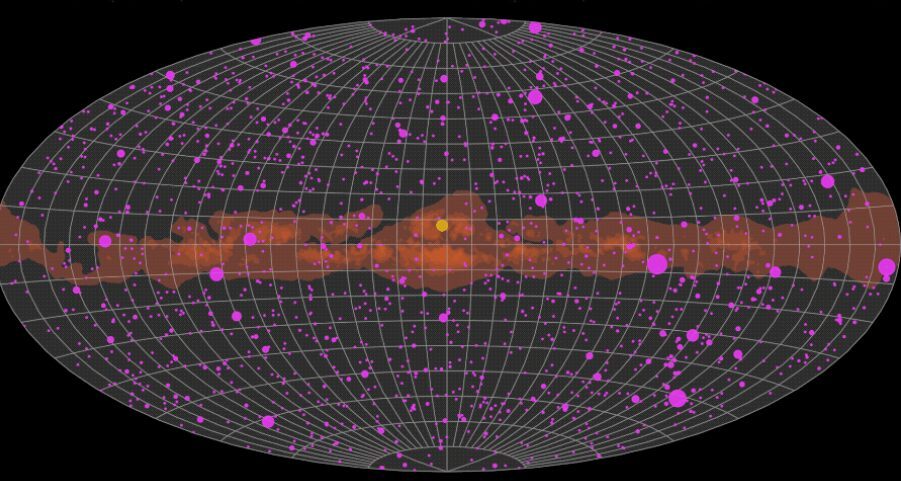
Cosmic fireworks, invisible to our eyes, fill the night sky. We can get a glimpse of this elusive light show thanks to the Large Area Telescope (LAT) aboard NASA’s Fermi Gamma-ray Space Telescope, which observes the sky in gamma rays, the highest-energy form of light. Watch a cosmic gamma-ray fireworks show in this animation using just a year of data from the Large Area Telescope (LAT) aboard NASA’s Fermi Gamma-ray Space Telescope. Each object’s magenta circle grows as it brightens and shrinks as it dims. The yellow circle represents the Sun following its apparent annual path across the sky. The animation shows a subset of the LAT gamma-ray records now available for more than 1,500 objects in a new, continually updated repository. Over 90% of these sources are a type of galaxy called a blazar, powered by the activity of a supermassive black hole. Credits: NASA's Marshall Space Flight Center/Daniel Kocevski

This animation shows the gamma-ray sky’s frenzied activity during a year of observations from February 2022 to February 2023. The pulsing circles represent just a subset of more than 1,500 light curves – records of how sources change in brightness over time – collected by the LAT over nearly 15 years in space.

Thanks to the work of an international team of astronomers, this data is now publicly available in a continually updated interactive library. A paper about the repository was published on March 15, 2023, in The Astrophysical Journal Supplement Series.

“We were inspired to put this database together by astronomers who study galaxies and wanted to compare visible and gamma-ray light curves over long time scales,” said Daniel Kocevski, a repository co-author and an astrophysicist at NASA’s Marshall Space Flight Center in Huntsville, Alabama. “We were getting requests to process one object at a time. Now the scientific community has access to all the analyzed data for the whole catalog.”

Over 90% of the sources in the dataset are blazars, central regions of galaxies hosting active supermassive black holes that produce powerful particle jets pointed almost directly at Earth. Ground-based observatories, like the National Science Foundation’s IceCube Neutrino Observatory in Antarctica, can sometimes detect high-energy particles produced in these jets. Blazars are important sources for multimessenger astronomy, where scientists use combinations of light, particles, and space-time ripples to study the cosmos.

“In 2018, astronomers announced a candidate joint detection of gamma rays and a high-energy particle called a neutrino from a blazar for the first time, thanks to Fermi LAT and IceCube,” said co-author Michela Negro, an astrophysicist at the University of Maryland, Baltimore County, and NASA’s Goddard Space Flight Center in Greenbelt, Maryland. “Having the historical light curve database could lead to new multimessenger insights into past events.”

In the animation, each frame represents three days of observations. Each object's magenta circle grows as it brightens and shrinks as it dims. Some objects fluctuate throughout the entire year. The reddish-orange band running across the middle of the sky is the central plane of our Milky Way galaxy, a consistent gamma-ray producer. Lighter colors there indicate a brighter glow. The yellow circle shows the Sun’s apparent annual trajectory across the sky.

Processing the full catalog required about three months, or more than 400 computer years of processing time distributed over 1,000 nodes on a supercomputer cluster located at the SLAC National Accelerator Laboratory in Menlo Park, California.

The LAT, Fermi’s primary instrument, scans the entire sky every three hours. It detects gamma rays with energies ranging from 20 million to over 300 billion electron volts. For comparison, the energy of visible light mostly falls between 2 to 3 electron volts.

The Fermi Gamma-ray Space Telescope is an astrophysics and particle physics partnership managed by Goddard. Fermi was developed in collaboration with the U.S. Department of Energy, with important contributions from academic institutions and partners in France, Germany, Italy, Japan, Sweden, and the United States.

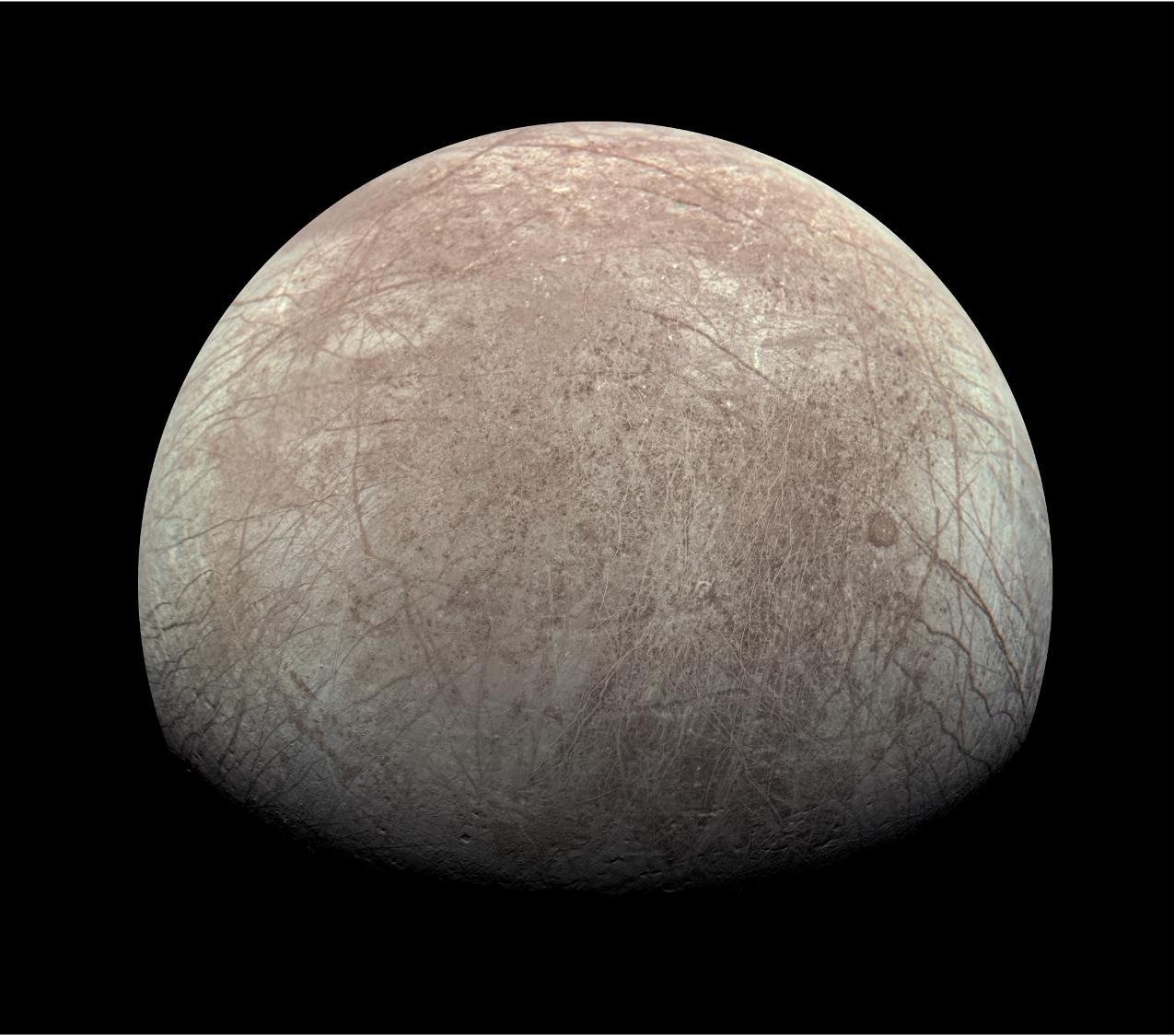
This view of Jupiter’s icy moon Europa was captured by the JunoCam imager aboard NASA’s Juno spacecraft during the mission’s close flyby on Sept. 29, 2022. The agency’s Europa Clipper spacecraft will explore the moon when it reaches orbit around Jupiter in 2030. Credit: Image data: NASA/JPL-Caltech/SwRI/MSSSImage processing: Kevin M. Gill CC BY 3.0

NASA supercomputing shows ocean currents may affect the rotation of Europa’s icy crust

Research reveals a new explanation for how the icy shell of Jupiter’s moon Europa rotates at a different rate than its interior. NASA’s Europa Clipper will take a closer look.

NASA scientists have strong evidence that Jupiter’s moon Europa has an internal ocean under its icy outer shell – an enormous body of salty water swirling around the moon’s rocky interior. New supercomputer modeling suggests the water may be pushing the ice shell along, possibly speeding up and slowing down the rotation of the moon’s icy shell over time.

Scientists have known that Europa’s shell is probably free-floating, rotating at a different rate than the ocean below and the rocky interior. The new modeling is the first to show that Europa’s ocean currents could be contributing to the rotation of its icy shell.

A key element of the study involved calculating drag – the horizontal force that the moon’s ocean exerts on the ice above it. The research hints at how the power of the ocean flow and its drag against the ice layer could even account for some of the geology seen on Europa’s surface. Cracks and ridges could result from the icy shell slowly stretching and collapsing over time as it is pushed and tugged by the ocean currents.

“Before this, it was known through laboratory experiments and modeling that heating and cooling of Europa’s ocean may drive currents,” said Hamish Hay, a researcher at the University of Oxford and lead author of the study published in JGR: Planets. Hay performed the research while a postdoctoral research associate at NASA’s Jet Propulsion Laboratory in Southern California. “Now our results highlight a coupling between the ocean and the rotation of the icy shell that was never previously considered.”

It might even be possible, using measurements gathered by NASA’s upcoming Europa Clipper mission, to determine with precision how fast the icy shell rotates. When scientists compare images gathered by Europa Clipper with those captured in the past by NASA’s Galileo and Voyager missions, they will be able to examine locations of ice surface features and potentially determine if the position of the moon’s icy shell has changed over time.

For decades, planetary scientists have debated whether Europa’s icy shell might be rotating faster than the deep interior. But rather than tying it to the ocean’s movement, scientists focused on an outside force: Jupiter. They theorized that as the gas giant’s gravity pulls on Europa, it also tugs on the moon’s shell and causes it to spin slightly faster.

“To me, it was completely unexpected that what happens in the ocean’s circulation could be enough to affect the icy shell. That was a huge surprise,” said co-author and Europa Clipper Project Scientist Robert Pappalardo of JPL. “And the idea that the cracks and ridges we see on Europa’s surface could be tied to the circulation of the ocean below – geologists don’t usually think, ‘Maybe it’s the ocean doing that.’”

Europa Clipper, now in its assembly, test, and launch operations phase at JPL, is set to launch in 2024. The spacecraft will begin orbiting Jupiter in 2030 and will use its suite of sophisticated instruments to gather science data as it flies by the moon about 50 times. The mission aims to determine if Europa, with its deep internal ocean, has conditions that could be suitable for life.

Like a Pot of Water

Using techniques developed to study Earth’s oceans, the paper’s authors relied on NASA supercomputers to make large-scale models of Europa’s oceans. They explored the complexities of how the water circulates, and how heating and cooling affect that movement.

Scientists believe that Europa’s internal ocean is heated from below, due to radioactive decay and tidal heating within the moon’s rocky core. Like water heating in a pot on a stove, Europa’s warm water rises to the top of the ocean.

In the simulations, the circulation initially moved vertically, but the rotation of the moon as a whole caused the flowing water to veer in a more horizontal direction – in east-west and west-east currents. The researchers, by including drag in their simulations, were able to determine that if the currents are fast enough, there could be an adequate drag on the ice above to speed up or slow down the shell’s rotation speed. The amount of interior heating – and thus, circulation patterns in the ocean – may change over time, potentially speeding up or slowing the rotation of the icy shell above.

“The work could be important in understanding how other ocean worlds’ rotation speeds may have changed over time,” Hay said. “And now that we know about the potential coupling of interior oceans with the surfaces of these bodies, we may learn more about their geological histories as well as Europa’s.”


Using these sensors, scientists were able to generate a secret key at a rate of 64 megabits per second over 10 km of fibre optic cable. © M. Perrenoud - G. Resta / UNIGE

Swiss team develops single-photon detectors with unprecedented performance to combat spies

How can we combat data theft, which is a real issue for society? Quantum physics has the solution. Its theories make it possible to encode information (a qubit) in single particles of light (a photon) and to circulate them in an optical fiber in a highly secure way. However, the widespread use of this telecommunications technology is hampered in particular by the performance of the single-photon detectors. A team from the University of Geneva (UNIGE), together with the company ID Quantique, has succeeded in increasing their speed by a factor of twenty. This innovation makes it possible to achieve unprecedented performances in quantum key distribution. Using these sensors, scientists were able to generate a secret key at a rate of 64 megabits per second over 10 km of fibre optic cable. © M. Perrenoud - G. Resta / UNIGE

Buying a train ticket, booking a taxi, getting a meal delivered: these are all transactions carried out daily via mobile applications. These are based on payment systems involving an exchange of secret information between the user and the bank. To do this, the bank generates a public key, which is transmitted to their customer, and a private key, which it keeps secret. With the public key, the user can modify the information, make it unreadable and send it to the bank. With the private key, the bank can decipher it.

This system is now threatened by the power of quantum supercomputers. To resolve this, quantum cryptography - or quantum key distribution (QKD) - is the best option. It allows two parties to generate shared secret keys and transmit them via optical fibers in a highly secure way. This is because the laws of quantum mechanics state that measurement affects the state of the system being measured. Thus, if a spy tries to measure the photons to steal the key, the information will be instantly altered and the interception revealed.

Current limitations

One limitation to the application of this system is the speed of the single-photon detectors used to receive the information. In fact, after each detection, the detectors must recover for about 30 nanoseconds, which limits the throughput of the secret keys to about 10 megabits per second. A UNIGE team led by Hugo Zbinden, associate professor in the Department of Applied Physics at the UNIGE Faculty of Science, has succeeded in overcoming this limit by developing a detector with better performance. This work was carried out in collaboration with the team of Félix Bussières from the company ID Quantique, a spin-off of the university.

‘‘Currently, the fastest detectors for our application are superconducting nanowire single-photon detectors,’’ explains Fadri Grünenfelder, a former doctoral student in the Department of Applied Physics at the UNIGE Faculty of Science and first author of the study. ‘‘These devices contain a tiny superconducting wire cooled to -272°C. If a single photon hits it, it heats up and ceases to be superconducting for a short time, thus generating a detectable electrical signal. When the wire becomes cold again, another photon can be detected.’’

Record performance

By integrating not one but fourteen nanowires into their detector, the researchers were able to achieve record detection rates. ‘‘Our detectors can count twenty times faster than a single-wire device,’’ explains Hugo Zbinden. ‘‘If two photons arrive within a short time in these new detectors, they can touch different wires and both be detected. With a single wire, this is impossible’’. The nanowires used are also shorter, which helps to decrease their recovery time.

Using these sensors, scientists were able to generate a secret key at a rate of 64 megabits per second over 10 km of fiber optic cable. This rate is high enough to secure, for example, a videoconference with several participants. This is five times the performance of current technology over this distance. As a bonus, these new detectors are no more complex to produce than the current devices available on the market.

These results open up new perspectives for ultra-secure data transfer, which is crucial for banks, healthcare systems, governments, and the military. They can also be applied in many other fields where light detection is a key element, such as astronomy and medical imaging.