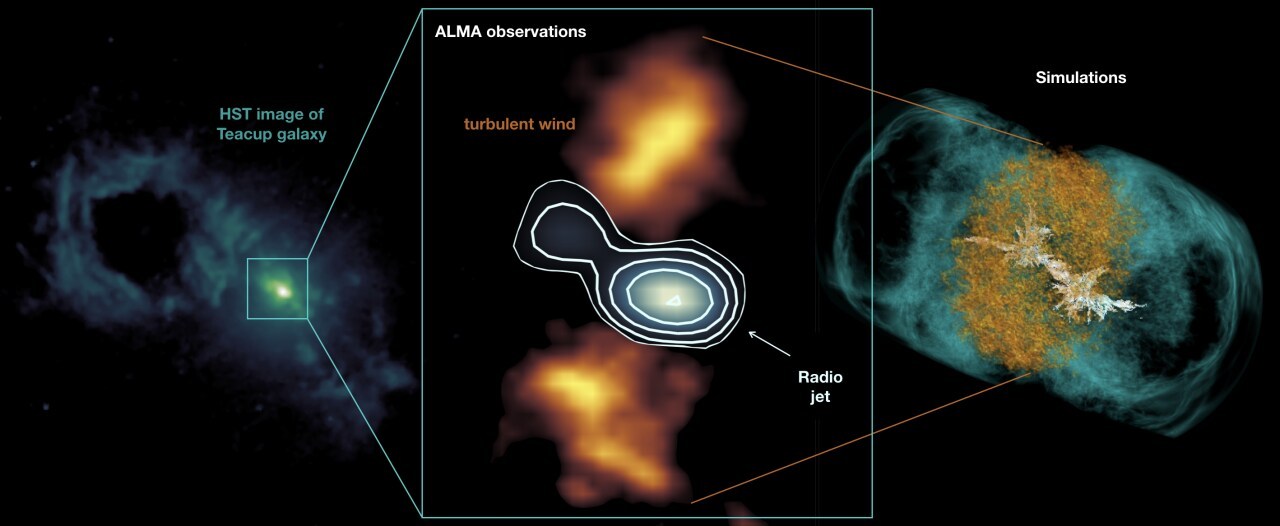
The compact radio jet in the center of the Teacup galaxy blows a lateral turbulent wind in the cold dense gas, as predicted by the simulations. Credit: HST/ ALMA/ VLA/ M. Meenakshi/ D. Mukherjee/ A. Audibert

Audibert discovers relativistic jets blowing bubbles in the central region of the Teacup Galaxy

A study led by Anelise Audibert, a researcher at the Instituto de Astrofísica de Canarias (IAC) in the Canary Islands, Spain, reveals a process that explains the peculiar morphology of the central region of the Teacup galaxy, a massive quasar located 1.3 billion light-years away from us. This object is characterized by the presence of expanding gas bubbles produced by winds emanating from its central supermassive black hole. The study confirms that a compact jet, only visible at radio waves, is altering the shape and increasing the temperature of the surrounding gas, blowing bubbles that expand laterally. These findings, based on observations from the ALMA telescope in Chile and hydrodynamical simulations, are published today in the journal Astronomy & Astrophysics Letters.

When matter falls into supermassive black holes in the centers of galaxies, it unleashes enormous amounts of energy and is called active galactic nuclei (or AGN). A fraction of AGN releases part of this energy as jets that are detectable in radio wavelengths that travel at velocities close to light speed. While the jet travels across the galaxy, it collides with the clouds and gas around it and in some cases may push this material away in the form of winds. However, which conditions preferentially trigger these winds to blow out the gas from galaxies is still poorly understood.

The effect of jets impacting the content of the galaxies, like the stars, dust, and gas, plays an important role in how galaxies evolve in the Universe. The most powerful radio jets, hosted in ´radio-loud’ galaxies, are responsible for drastically changing the fate of galaxies because they heat the gas, preventing new star formation and galaxy growth. Supercomputer simulations of relativistic jets piercing into disk galaxies predict that jets alter the shape of the surrounding gas by blowing bubbles as they penetrate further into the galaxy. One of the key elements in the simulations that make the jets efficient in driving winds is the angle between the gaseous disk and the jet’s direction of propagation. Surprisingly, less powerful jets, like the ones in ‘radio-quiet’ galaxies, are able to inflict more damage on the surrounding medium than the very powerful ones.

An international scientific team, led by the IAC researcher Anelise Audibert, discovered an ideal case in which to study the interaction of the radio jet with the cold gas around a massive quasar: the Teacup galaxy. The Teacup is a radio-quiet quasar located 1.3 billion light years from us and its nickname comes from the expanding bubbles seen in the optical and radio images, one of which is shaped like the handle of a teacup. In addition, the central region (around 3300 light-years in size) harbors a compact and young radio jet that has a small inclination relative to the galaxy disk. 

Effects on star formation

Using observations performed in the Chilean desert with the Atacama Large Millimeter/submillimeter Array (ALMA), the team was able to characterize with an unprecedented level of detail the cold, dense gas in the central part of the Teacup. In particular, they detected the emission of carbon monoxide molecules that can only exist under certain conditions of density and temperature. Based on these observations, the team found that the compact jet, despite its low power, is not only clearly disrupting the distribution of the gas and heating it, but also accelerating it in an unusual way. 

The team expected to detect extreme conditions in the impacted regions along the jet, but when they analyzed the observations, they found that the cold gas is more turbulent and warmer in the directions perpendicular to the jet propagation. “This is caused by the shocks induced by the jet-driven bubble, which heats up and blows the gas in its lateral expansion”, explains A. Audibert “Supported by the comparison with computer simulations, we believe that the orientation between the cold gas disk and the jet is a crucial factor in efficiently driving these lateral winds”, she adds.

“It was previously believed that low-power jets had a negligible impact on the galaxy, but works like ours show that, even in the case of radio-quiet galaxies, jets can redistribute and disrupt the surrounding gas, and this will have an impact on the galaxy's ability to form new stars”, says Cristina Ramos Almeida, an IAC researcher, and co-author of the study. 

The next step is to observe a larger sample of radio-quiet quasars with MEGARA, an instrument installed on the Gran Telescopio CANARIAS (GTC or Grantecan). The observations will help us to understand the impact of the jets on the more tenuous and hot gas, and to measure changes in star formation caused by winds. This is one of the goals of the QSOFEED project, developed by an international team led by C. Ramos Almeida at the IAC, whose aim is to discover how winds from supermassive black holes affect the galaxies that host them.

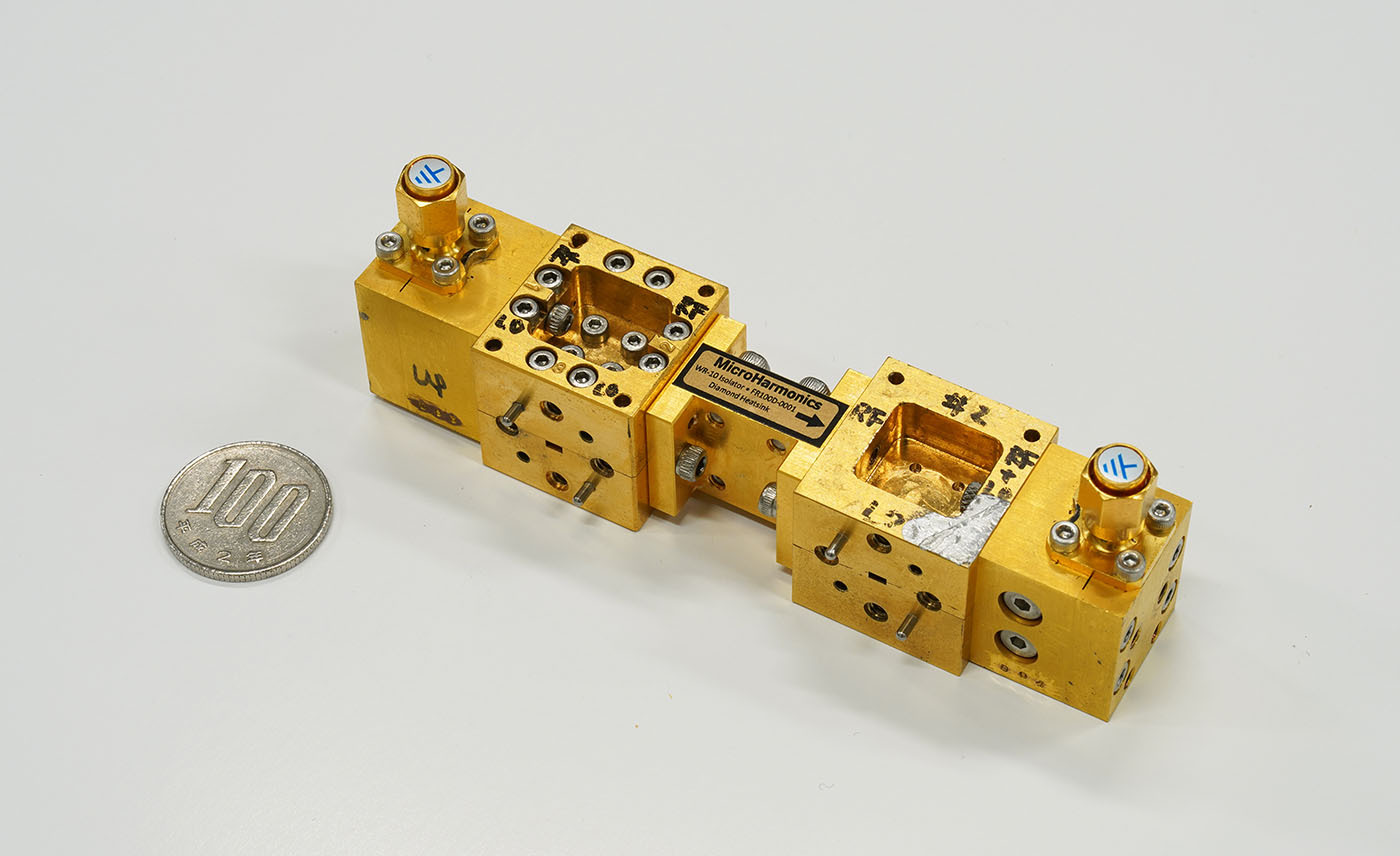
An “SIS amplifier” using two SIS mixers, one at each ends. (Credit: NAOJ)

Japanese prof Kojima builds small but mighty superconducting amplifiers that deliver high performance at lower power consumption

Researchers have devised a new concept of superconducting microwave low-noise amplifiers for use in radio wave detectors for radio astronomy observations and successfully demonstrated a high-performance cooled amplifier with power consumption three orders of magnitude lower than that of conventional cooled semiconductor amplifiers. This result is expected to contribute to the realization of large-scale multi-element radio cameras and error-tolerant quantum supercomputers, both of which require a large number of low-noise microwave amplifiers.

The device they used is called an SIS mixer. The SIS mixer is named after its structure, a skinny film of insulator material sandwiched between two layers of superconductors (S-I-S). In a radio telescope, cosmic radio waves collected by an antenna are fed into an SIS mixer, and the output signal is amplified by low-noise semiconductor amplifiers. An SIS mixer operates in a very low-temperature environment, as low as 4 Kelvin (-269 degrees Celsius), and the amplifiers are also used at that temperature.

To improve the performance of radio telescopes, researchers are developing a large-format radio camera equipped with 2D arrays of SIS mixers and amplifiers. However, power consumption is a limiting factor. The typical power consumption of a semiconductor amplifier is about 10 mW, and by assembling 100 sets of detectors, the total power consumption reaches the maximum cooling capacity of a 4 Kelvin refrigerator.

The research team led by Takafumi Kojima, an associate professor at the National Astronomical Observatory of Japan (NAOJ), has come up with a simple but innovative idea to realize a superconductor amplifier by connecting two SIS mixers. The team exploits the basic functions of the SIS mixer: frequency conversion and signal amplification. “The most important point is that the power consumption of an SIS mixer is, in principle, as low as microwatts,” says Kojima. “This is three orders of magnitude less than that of a cooled semiconductor amplifier.”

After obtaining successful preliminary results in 2018, the team advanced both the theoretical studies of the system and the physical implementation of its various components. In the end, the research team optimized the system and realized an “SIS amplifier” with 5 - 8 dB (three to six times) gain below the frequency of 5 GHz and a typical noise temperature of 10 K, which is comparable to the current cooled semiconductor amplifiers such as HEMT and HBT, but with much lower power consumption.

“By changing the configuration of the components, we can further improve the gain and low-noise performance of an SIS amplifier,” explains Kojima. “The idea of connecting two SIS mixers has broader applications for making various electronics that have functions other than amplification.”

Interestingly, this low-noise, low-power-consumption amplifier is also highly anticipated for large-scale error-tolerant quantum computers. Currently available quantum computers are small-scale with less than 100 qubits, but larger-scale, error-tolerant general-purpose quantum computers will require more than 1 million qubits. To handle a large number of qubits, a large number of amplifiers must also be installed, and dramatic reductions in amplifier power consumption are needed.

NAOJ has experience in the development of superconducting receivers for a number of radio telescopes, including NAOJ’s Nobeyama 45-meter Radio Telescope, which started operation in 1982. NAOJ is also currently working to upgrade the superconducting receivers to improve the performance of the Atacama Large Millimeter/submillimeter Array (ALMA), which is operated in the Republic of Chile in cooperation with East Asia, Europe, and North America. Of the 10 types of receivers (corresponding to 10 different frequency bands) currently installed on ALMA, three were developed by NAOJ, and the SIS chips at the heart of these receivers were also developed and produced in the cleanroom of the NAOJ Advanced Technology Center (ATC). The NAOJ ATC continues to promote research on the miniaturization and integration of superconducting circuits, not only for realizing more powerful radio telescopes but also for their potential as the basis of various technologies that will support society in the new era, such as quantum supercomputing.


Sam Harris update on dangers of AI | Lex Fridman Podcast Clips

Sam Harris update on dangers of AI | Lex Fridman Podcast Clips

Lex Fridman Podcast full episode: https://www.youtube.com/watch?v=Qyrjgf-_Vdk Please support this podcast by checking out our sponsors: - Notion: https://notion.com - Indeed: https://indeed.com/lex to get $75 credit - MasterClass: https://masterclass.com/lex to get 15% off GUEST BIO: Sam Harris is an author, podcaster, and philosopher. PODCAST INFO: Podcast website: https://lexfridman.com/podcast...

Read more