SUPERCOMPUTING NEWS SUPERCOMPUTING NEWS
    • MEDIA KIT
    • MOST READ
    • RSS FEED
    • ACADEMIA
    • AEROSPACE
    • APPLICATIONS
    • ASTRONOMY
    • AUTOMOTIVE
    • BIG DATA
    • BIOLOGY
    • CHEMISTRY
    • CLIENTS
    • CLOUD
    • DEFENSE
    • DEVELOPER TOOLS
    • EARTH SCIENCES
    • ECONOMICS
    • ENGINEERING
    • ENTERTAINMENT
    • GAMING
    • GOVERNMENT
    • HEALTH
    • OIL & GAS
    • INDUSTRY
    • INTERCONNECTS
    • MANUFACTURING
    • MIDDLEWARE
    • MOVIES
    • NETWORKS
    • PHYSICS
    • PROCESSORS
    • RETAIL
    • SCIENCE
    • STORAGE
    • SYSTEMS
    • VISUALIZATION
    • AcyMailing subscription form

    • ADD YOUR VIDEOS
    • MANAGE VIDEOS
    • CONVERSATION INBOX
    • SOCIAL ADVERTISER
    • SOCIAL NETWORK VIDEOS
    • SURVEYS
    • GROUPS
    • PAGES
    • MARKETPLACE LISTINGS
    • APPLICATIONS BROWSER
    • PRIVACY CONFIRM REQUEST
    • PRIVACY CREATE REQUEST
    • LEADERBOARD
    • POINTS LISTING
      • BADGES
    • TRADE SHOWS
Sign In
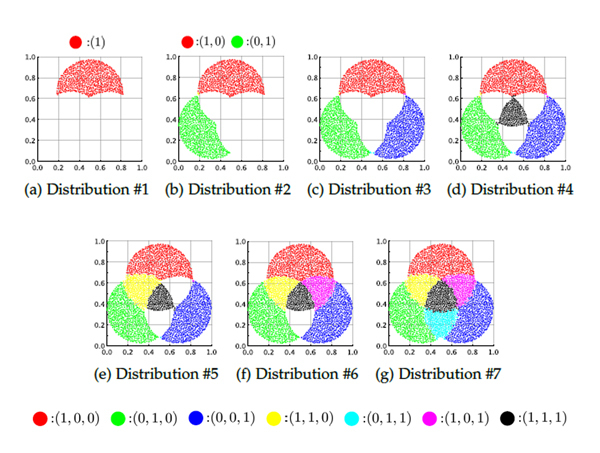
A process of continual learning for a synthetic multi-label dataset   The figure shows how new information is learned each time a data distribution is input, while retaining information learned in the past.
A process of continual learning for a synthetic multi-label dataset The figure shows how new information is learned each time a data distribution is input, while retaining information learned in the past.
Tyler O'Neal, Staff Editor ACADEMIA February 1, 2023, 7:00 am

Osaka Metro prof Masuyama proposes new data learning methods for AI

Advances in information technology have made it possible for us to easily and continually obtain large amounts of diverse data. Artificial intelligence technology is gaining attention as a tool to put this big data to use.

Conventional machine learning mainly deals with single-label classification problems, in which data and corresponding phenomena or objects (label information) are in a one-to-one relationship. However, in the real world, data, and label information rarely have a one-to-one relationship. In recent years, therefore, attention has focused on the multi-label classification problem, which deals with data that has a one-to-many relationship between data and label information. For example, a single landscape photo may include multiple labels for elements such as sky, mountains, and clouds. In addition, to efficiently learn from big data that is obtained continually, the ability to learn over time without destroying things that were learned previously is also required.

A research group led by Associate Professor Naoki Masuyama and Professor Yusuke Nojima of the Osaka Metropolitan University Graduate School of Informatics has developed a new method that combines classification performance for data with multiple labels, with the ability to continually learn with data. Numerical experiments on real-world multi-label datasets showed that the proposed method outperforms conventional methods.

The simplicity of this new algorithm makes it easy to devise an evolved version that can be integrated with other algorithms. Since the underlying clustering method groups data based on the similarity between data entries, it is expected to be a useful tool for continual big data preprocessing. In addition, the label information assigned to each cluster is learned continually, using a method based on the Bayesian approach. By learning the data and learning the label information corresponding to the data separately and continually, both high classification performance and continual learning capability are achieved.

“We believe that our method is capable of continual learning from multi-label data and has capabilities required for artificial intelligence in a future big data society,” Professor Masuyama concluded.
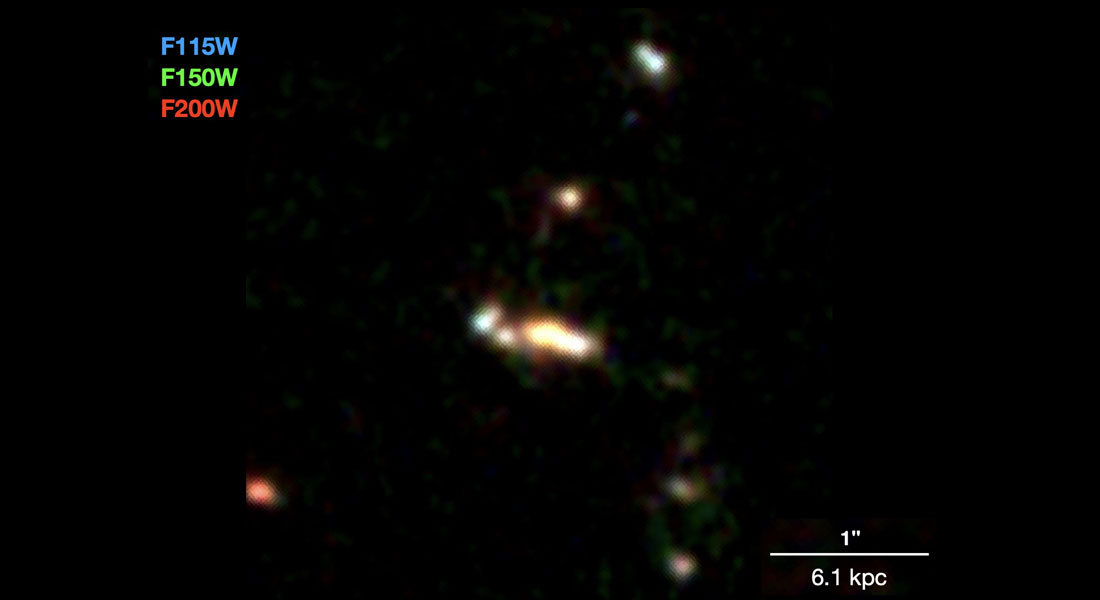
A group of small galaxies, seen almost 13 billion years back in time, likely in the process of forming a massive galaxy. The colors are composed from three different infrared colors. The white, horisontal bar shows the scale of approximately 20,000 lightyears. Credit: Shuowen Jin et al. (2023).

Giant galaxy formation caught in action with Danish supercomputing, JWST

Tyler O'Neal, Staff Editor ACADEMIA January 31, 2023, 2:00 pm

Astronomers from the Cosmic Dawn Center have unveiled the nature of the densest region of galaxies seen with the James Webb Space Telescope (JWST) in the early Universe. They find it to be likely the progenitor of a massive, Milky Way-like galaxy, seen at a time when it is still assembling from smaller galaxies. The discovery corroborates our understanding of how galaxies form. 

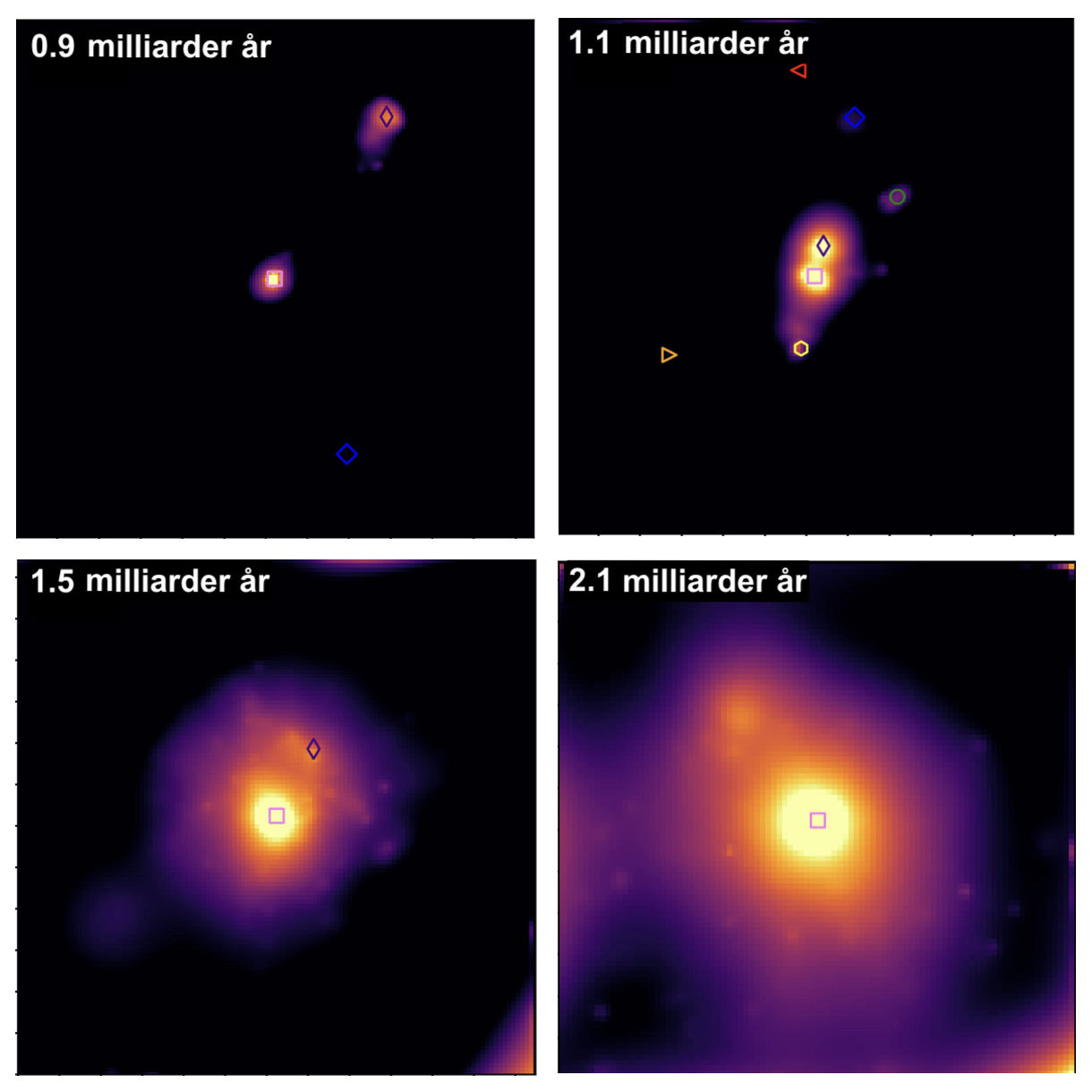
Four snapshots of the evolution of a simulated proto-galaxy from the "EAGLE" simulation, chosen to resemble the observed group CGG-z5. The brightness show the density of stars in the galaxies, and the symbols follow individual clumps of matter. In the 1.2 billion years that pass between the upper left and the lower right, the galaxies grows from a total stellar mass of 5 billion Suns to 65 billion Suns. Credit: A. Vijiayan and S. Jin.

According to our current understanding of structure formation in the Universe, galaxies form hierarchically, with small structures forming first in the very early Universe, later merging to build up larger structures. This is the prediction of theories and supercomputer simulations and is verified by observations of galaxies at various epochs in the history of the Universe.

To observe the very first structures assembling, we have to look as far back in time, and hence as far away, as possible. But these sources are both very small and very faint, and their detection requires advanced technologies.

In a new study, the early progenitor of what today will likely have evolved into a massive, Milky Way-sized galaxy, has been detected. This group of smaller galaxies, dubbed CGG-z5, was found through the observational program called "CEERS" with the James Webb Space Telescope and is seen when the Universe was only 1.1 billion years old, 8% of its current age.

CGG-z5 was discovered using the code GalCluster, which was created by Nikolaj Sillassen, an MSc student at the Cosmic Dawn Center (DAWN). 

"I developed the software during my studies to detect this kind of structure, and now we applied it to data from the CEERS program," says Nikolaj Sillassen, who already found a similar but more nearby group while testing the software.

"It's great to see how useful my code is becoming."

Impossible without James Webb

The brightest members of the galaxy group were discovered previously with the Hubble Space Telescope. But the CEERS program revealed new and smaller members.

"The other members of the group are both small and faint. Without the sensitivity and the spatial resolution of James Webb, we simply wouldn't be able to detect them," explains Shuowen Jin, Marie Curie Fellow at the Cosmic Dawn Center (DAWN) and lead author of the current study.

Exactly what the "future" of the galaxy group CGG-z5 will be, is of course unknown. Rather than forming a single galaxy, it could be that the group evolves into a large cluster of galaxies at later times. Yet another possibility is that the members are in reality not so closely packed as it seems, but instead a part of a filamentary structure that we just happen to view from one end to the other.

Help from supercomputer simulations

To distinguish between these scenarios, more precise observations involving the more time-consuming spectroscopy are needed. But in the meantime, help is available from supercomputer simulations:

"To better understand the nature and evolution of CGG-z5, we searched for similar structures in large-scale, hydrodynamical simulations," says Aswin Vijiayan, Postdoctoral Fellow at the Cosmic Dawn Center who conducted the simulation analysis in the study. "We found 14 structures that match closely the physical properties of our observed group CGG-z5, and then traced the evolution of these structures through time in the simulations, from the early Universe to the present epoch.

Although the exact unfolding of the evolution of these 14 structures is different, they all shared the same fate: Roughly 0.5 to 1 billion years later, they merge to form a single galaxy which, by the time the Universe is half its current age, have masses comparable to our own Milky Way.

"Given the predictions of the simulations, it is therefore tempting to speculate that the CGG-z5 system will also follow a similar evolutionary path and that we captured the process of small galaxies assembling into a single massive galaxy," Shuowen Jin concludes.

"Interestingly, the number of these early groups like CGG-z5 in a given volume of space is similar to the number of massive galaxies at later cosmic times", says Georgios Magdis, associate professor at DAWN and partaker in the study. "This makes merging groups appealing as the main progenitors of massive galaxies at later epochs".

Large samples and further work are needed to verify this picture.

(Image: Cern)
(Image: Cern)

Finnish researchers create a Higgs boson data-inspired AI algorithm for the field of visual analytics

Tyler O'Neal, Staff Editor ACADEMIA January 31, 2023, 9:00 am

A new AI algorithm developed by researchers at the Finnish Center for Artificial Intelligence is aimed at visualizing datasets as clearly as possible. The project demonstrated that the solution chosen independently by the algorithm was often very close to that most commonly favored by humans. 

The human brain has an astounding ability to observe various traits even from extremely large quantities of visual information. This ability is utilized, for example, in the study of large data masses whose content must be compacted into a form understandable to human intelligence. This problem of dimensional reduction is central to visual analytics.

At the Finnish Center for Artificial Intelligence (FCAI), researchers affiliated with Aalto University and the University of Helsinki tested the functionality of the most well-known methods of visual analytics, finding that none worked when the amount of data grew significantly. For example, the t-SNE, LargeViz, and UMAP methods were no longer able to distinguish extremely strong signals of observational groupings in the data when the number of observations was in the hundreds of thousands. 

Higgs boson data inspired the creation of the new algorithm

The dataset for experiments related to the discovery of the Higgs boson contains more than 11 million feature vectors, for instance.

“The visualizations drawn from them resembled a tangle of yarn, revealing none of the notable characteristics of particle behavior included in the data”, says Professor of Statistics and Probability Jukka Corander from the University of Helsinki.

“This finding provided the impetus to develop a new method that utilizes graphical acceleration similarly to modern AI methods for neural network computing. “

The AI algorithm designed by the researchers is aimed at visualization, so that data clusters and other macroscopic features, easily observed by and understandable to humans, are as distinct as possible. 

In the project, several volunteers tested the technique. It turned out that the solution independently chosen by the algorithm was often very close to the solution most typically favored by humans; in this situation, human intelligence clearly distinguishes, according to personal notions, between clusters of data composed of similar observations. When applying the technique to the Higgs boson data, their most important physical characteristics were clearly highlighted. 

“This is a veritable quantum leap in the field of visual analytics. Besides being several orders of magnitude faster than previous methods, our technique also is much more reliable in connection with challenging applications,” says Professor of Computer Science Jukka Corander from the University of Helsinki.

Under the direction of Corander’s group, a separate interface was also designed for utilizing the technique as efficiently as possible in genomics applications. This way, users can even analyze their datasets interactively by uploading files directly into the web browser. Employing global bacterial and SARS-CoV-2 datasets, this further study illustrated how the new tool can be used to quickly examine as many as millions of genomes and identify relevant characteristics.

The study was a collaboration between the Director of FCAI, Professor Sami Kaski, and Jukka Corander’s groups. Professor Zhirong Yang from the Norwegian University of Science and Technology served as the project lead. Professor Yang has a doctoral degree from Aalto University and has subsequently worked as a researcher at both Aalto University and the University of Helsinki in Professor Corander’s group. 

  1. MIT physicists demo exotic properties in magic-angle graphene to switch superconductivity abruptly for realizing neuromorphic supercomputing
  2. SETI deploys machine-learning to reveal signals of interest

Page 57 of 123

  • 52
  • 53
  • 54
  • 55
  • 56
  • 57
  • 58
  • 59
  • 60
  • 61
POPULAR RIGHT NOW
  • Supercomputers uncover a new class of cosmic explosions hidden in plain sight
    Supercomputers uncover a new class of cosmic explosions hidden in plain sight
  • AI supercharges the hunt for stronger magnets: Iowa State researchers launch a new era of intelligent materials discovery
    AI supercharges the hunt for stronger magnets: Iowa State researchers launch a new era of intelligent materials discovery
  • IBM's Historic stock collapse raises questions for the future of enterprise supercomputing
    IBM's Historic stock collapse raises questions for the future of enterprise supercomputing
  • Could a novel dark matter theory simultaneously resolve multiple cosmic enigmas? Supercomputer simulations provide a compelling, albeit currently unverified, potential solution
    Could a novel dark matter theory simultaneously resolve multiple cosmic enigmas? Supercomputer simulations provide a compelling, albeit currently unverified, potential solution
  • Melting icebergs may be reshaping Earth’s greatest ocean current
    Melting icebergs may be reshaping Earth’s greatest ocean current
  • Supercomputers replace ‘bathtub’ flood maps with physics-based digital twins of Britain’s coastline
    Supercomputers replace ‘bathtub’ flood maps with physics-based digital twins of Britain’s coastline
  • Supercomputers push neural quantum simulation beyond previous limits
    Supercomputers push neural quantum simulation beyond previous limits
  • Intel’s AI supercomputing revival: Q2 financial surge signals new era for CPU-powered HPC infrastructure
    Intel’s AI supercomputing revival: Q2 financial surge signals new era for CPU-powered HPC infrastructure
  • AI infrastructure financing fears shake semiconductor sector
    AI infrastructure financing fears shake semiconductor sector
  • AWS supercomputing investment reaches historic scale as Amazon’s AI strategy powers record financial results
    AWS supercomputing investment reaches historic scale as Amazon’s AI strategy powers record financial results
THIS YEAR'S MOST READ
  • Wall Street wants to trade supercomputing power like oil
    Wall Street wants to trade supercomputing power like oil
  • Cosmic ambition at scale: UK’s supercomputer unlocks a 2.5 petabytes universe
    Cosmic ambition at scale: UK’s supercomputer unlocks a 2.5 petabytes universe
  • Hidden order, revealed at scale: Supercomputing, electron ptychography uncover the inner workings of relaxor ferroelectrics
    Hidden order, revealed at scale: Supercomputing, electron ptychography uncover the inner workings of relaxor ferroelectrics
  • Beamforming the future: BeammWave's 6G push signals the rise of orbital-terrestrial wireless networks
    Joakim Axmon
    Joakim Axmon
  • Intel's Q1 results signal supercomputing surge driving Xeon momentum
    Intel's Q1 results signal supercomputing surge driving Xeon momentum
  • When stars fall apart: Supercomputing reveals the hidden physics of black holes
    When stars fall apart: Supercomputing reveals the hidden physics of black holes
  • Multi-layer simulations reveal the hidden supply chain of solar prominences
    Multi-layer simulations reveal the hidden supply chain of solar prominences
  • Japanese scientists decode dolphin speed with supercomputing: Turbulence, vortices, and the hidden physics of propulsion
    Japanese scientists decode dolphin speed with supercomputing: Turbulence, vortices, and the hidden physics of propulsion
  • Cosmic feedback at scale: Supercomputing reveals how quasars regulate the early Universe
    Cosmic feedback at scale: Supercomputing reveals how quasars regulate the early Universe
  • Modeling life at the microscopic scale: A computational breakthrough in oxygen transport
    Modeling life at the microscopic scale: A computational breakthrough in oxygen transport
MOST READ OF ALL-TIME
  • Largest Computational Biology Simulation Mimics The Ribosome
    Details
    112109
    The amino acid (green) slithers into the chemical reaction center, moving through an evolutionarily ancient corridor of the ribosome (purple). The amino acid is delivered to the reaction core by the transfer RNA molecule (yellow).
    The amino acid (green) slithers into the chemical reaction center, moving through an evolutionarily ancient corridor of the ribosome (purple). The amino acid is delivered to the reaction core by the transfer RNA molecule (yellow).
  • Silicon 'neurons' may add a new dimension to chips
    Details
    80996
    Silicon 'neurons' may add a new dimension to chips
  • Linux Networx Accelerators Expected to Drive up to 4x Price/Performance
    Details
    75540
  • Complex Concepts That Really Add Up
    Details
    73641
    Complex Concepts That Really Add Up
  • Blue Sky Studios Donates Animation SuperComputer to Wesleyan
    Details
    68142
    Each rack holds 52 Angstrom Microsystem-brand “blades,” with a memory footprint of 12 or 24 gigabytes each. (Photos by Olivia Bartlett Drake)
    Each rack holds 52 Angstrom Microsystem-brand “blades,” with a memory footprint of 12 or 24 gigabytes each. (Photos by Olivia Bartlett Drake)
  • Humanities, HPC connect at NERSC
    Details
    57949
  • TeraGrid ’09 'Call for Participation'
    Details
    54953
  • Turbulence responsible for black holes' balancing act
    Details
    52315
  • Cray Wins $52 Million SuperComputer Contract
    Details
    50143
  • SDSC Researchers Accurately Predict Protein Docking
    Details
    46083
  • FRONTPAGE
  • LATEST
  • POPULAR
  • REGISTER
  • SOCIAL
  • VIDEO
  • SUBSCRIPTION
  • RSS
  • GUIDELINES
  • PRIVACY
  • TOS
  • ABOUT
  • +1 (816) 799-4488
  • editorial@supercomputingonline.com
© 2001 - 2026 SuperComputingOnline.com, LLC. All rights reserved. This material may not be published, broadcast, rewritten or redistributed without permission.
Sign In
  • FRONT PAGE
  • LATEST
    • MEDIA KIT
    • MOST READ
    • RSS FEED
    • ACADEMIA
    • AEROSPACE
    • APPLICATIONS
    • ASTRONOMY
    • AUTOMOTIVE
    • BIG DATA
    • BIOLOGY
    • CHEMISTRY
    • CLIENTS
    • CLOUD
    • DEFENSE
    • DEVELOPER TOOLS
    • EARTH SCIENCES
    • ECONOMICS
    • ENGINEERING
    • ENTERTAINMENT
    • HEALTH
    • INDUSTRY
    • INTERCONNECTS
    • GAMING
    • GOVERNMENT
    • MANUFACTURING
    • MIDDLEWARE
    • MOVIES
    • NETWORKS
    • OIL & GAS
    • PHYSICS
    • PROCESSORS
    • RETAIL
    • SCIENCE
    • STORAGE
    • SYSTEMS
    • VISUALIZATION
  • VIDEOS
    • ADD YOUR VIDEOS
    • MANAGE VIDEOS
  • COMMUNITY
    • TRADE SHOWS
    • SOCIAL NETWORK VIDEOS
    • SURVEYS
    • APPLICATIONS BROWSER
    • CONVERSATION INBOX
    • SOCIAL ADVERTISER
    • GROUPS
    • MARKETPLACE LISTINGS
    • PAGES
    • LEADERBOARD
    • POINTS LISTING
      • BADGES
    • PRIVACY CONFIRM REQUEST
    • PRIVACY CREATE REQUEST

Hey there! We noticed you’re using an ad blocker.