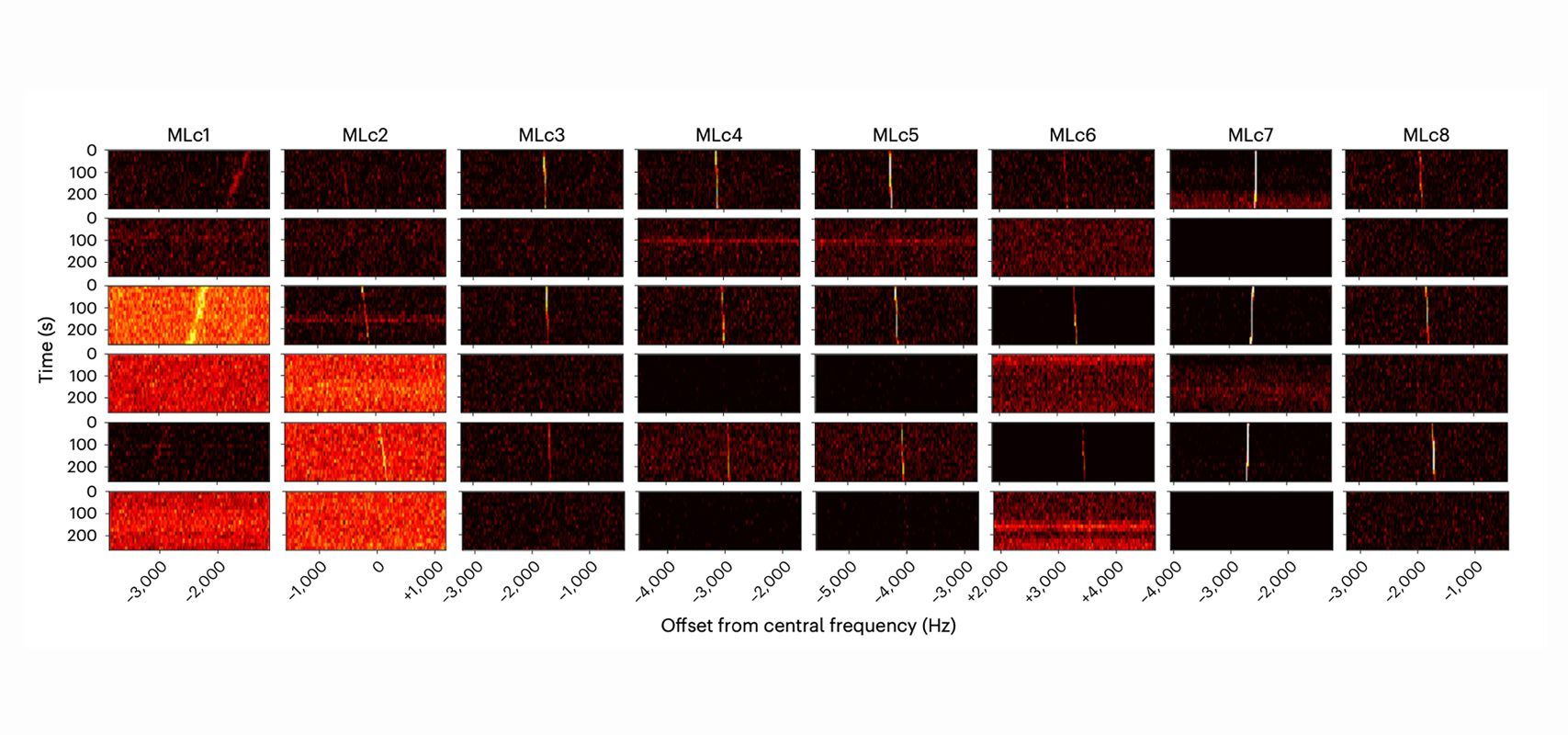
Examples showing the four types of training data.

SETI deploys machine-learning to reveal signals of interest

When pondering the probability of discovering technologically advanced extraterrestrial life, the question that often arises is, "if they're out there, why haven't we found them yet?" And often, the response is that we have only searched a tiny portion of the galaxy. Further, algorithms developed decades ago for the earliest digital computers can be outdated and inefficient when applied to modern petabyte-scale datasets. Now, research led by an undergraduate student at the University of Toronto, Peter Ma, along with researchers from the SETI Institute, Breakthrough Listen, and scientific research institutions around the world, has applied a deep learning technique to a previously studied dataset of nearby stars and uncovered eight previously unidentified signals of interest.

“In total, we had searched through 150 TB of data of 820 nearby stars, on a dataset that had previously been searched through in 2017 by classical techniques but labeled as devoid of interesting signals," said Peter Ma, lead author. “We're scaling this search effort to 1 million stars today with the MeerKAT telescope and beyond. We believe that work like this will help accelerate the rate we’re able to make discoveries in our grand effort to answer the question ‘are we alone in the universe?’”

The search for extraterrestrial intelligence (SETI) looks for evidence of extraterrestrial intelligence originating beyond Earth by trying to detect technosignatures, or evidence of technology, that alien civilizations could have developed. The most common technique is to search for radio signals. Radio is a great way to send information over the incredible distances between the stars; it quickly passes through the dust and gas that permeate space, and it does so at the speed of light (about 20,000 times faster than our best rockets). Many SETI efforts use antennas to eavesdrop on any radio signals aliens might be transmitting.

This study re-examined data taken with the Green Bank Telescope in West Virginia as part of a Breakthrough Listen campaign that initially indicated no targets of interest. The goal was to apply new deep learning techniques to a classical search algorithm to yield faster, more accurate results. After running the new algorithm and manually re-examining the data to confirm the results, newly detected signals had several key characteristics:

  1. The signals were narrow band, meaning they had narrow spectral width, on the order of just a few Hz. Signals caused by natural phenomena tend to be broadband.
  2. The signals had non-zero drift rates, which means the signals had a slope. Such slopes could indicate a signal’s origin had some relative acceleration with our receivers, hence not local to the radio observatory.
  3. The signals appeared in ON-source observations and not in OFF-source observations. If a signal originates from a specific celestial source, it appears when we point our telescope toward the target and disappears when we look away. Human radio interference usually occurs in ON and OFF observations due to the source being close by.

Cherry Ng, another of Ma’s research advisors and an astronomer at both the SETI Institute and the French National Center for Scientific Research said, “These results dramatically illustrate the power of applying modern machine learning and computer vision methods to data challenges in astronomy, resulting in both new detections and higher performance. Application of these techniques at scale will be transformational for radio techno signature science.”

While re-examinations of these new targets of interest have yet to result in re-detections of these signals, this new approach to analyzing data can enable researchers to more effectively understand the data they collect and act quickly to re-examine targets.  Ma and his advisor Dr. Cherry Ng are looking forward to deploying extensions of this algorithm on the SETI Institute’s COSMIC system.

Since SETI experiments began in 1960 with Frank Drake’s Project Ozma at the Greenbank Observatory, a site now home to the telescope used in this latest work, technological advances have enabled researchers to collect more data than ever. This massive volume of data requires new computational tools to process and analyze that data quickly to identify anomalies that could be evidence of extraterrestrial intelligence. This new machine-learning approach is breaking new ground in the quest to answer the question, “are we alone?”

FAU Harbor Branch wins EPA grant to study connectivity between Everglades, Florida Keys

The ongoing Comprehensive Everglades Restoration Plan (CERP) is working to restore the historical flow of the Florida Everglades to bring back the health of the ecosystem, which has seen declines in water quality and habitat loss and degradation. 

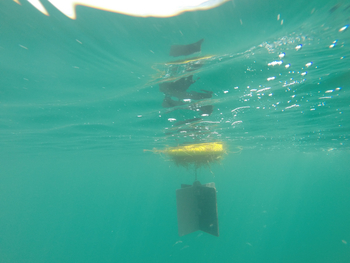
Using drifters, researchers will investigate the transport and dispersion of freshwater through the Florida Bay.

The Southwest Florida coast, the Florida Keys Reef Tract, and Florida Bay together support abundant underwater vegetation, corals, and fish as well as a prosperous tourist economy. At the epicenter of this region is the Florida Bay ecosystem, which is directly impacted by these watershed inputs and plays a critical role in buffering downstream ecosystems.

Reallocating freshwater flow to the Florida Bay is expected to reduce hypersaline conditions, which, on the other hand, may deliver more nutrients that elevate phytoplankton blooms. 

Significant evidence shows that these waters and associated nutrients can move further downstream and impact the Florida Keys National Marine Sanctuary and the Florida Keys Reef Tract. Interactions between nutrient inputs, phytoplankton blooms, and sediment processes change water properties before they reach the Florida Keys, and the transport pathways and subsequent biogeochemical responses are complex. At the same time, climate change including sea-level rise is modifying both oceanic boundary conditions of the regions, and watershed hydrological conditions and outputs, among other effects.

Currently, the predictive capability of these watershed impacts is limited. Most of the biogeochemical observations are through discrete water samples that are not continuous. New methods are urgently needed to synthesize all of the available sporadic observations and empirical biogeochemical theories into a coherent system for the region.

Researchers from Florida Atlantic University’s Harbor Branch Oceanographic Institute have received a $350,000 grant from the United States Environmental Protection Agency to study the connectivity between the Everglades and the Florida Keys via the Florida Bay. They are developing an ocean model for the region, an innovative tool to holistically examine and diagnose key processes with numerical simulations and experiments, and to predict changes in responses to water management, ecological restoration, and climate change. 

“Our model, when fully developed and validated, is expected to be a powerful tool that is currently lacking for this region,” said Mingshun Jiang, Ph.D., principal investigator, physical oceanographer specializing in ocean coupled physical-biogeochemical-ecological modeling, and an associate of research professor at FAU Harbor Branch. “It is designed to provide a suite of environmental and ecological information on the state of the greater Florida Bay ecosystem as well as potential future changes. Importantly, our model could potentially predict underwater aquatic vegetation coverage, harmful algal blooms, and fisheries resources under climate change and/or CERP management scenarios.”

To assist in the model development, Jiang and co-PI Laurent Chérubin, Ph.D., a physical oceanographer who specializes in the understanding of ocean dynamics and a research professor at FAU Harbor Branch, will measure currents and water quality parameters at several key locations in the Florida Bay during dry and wet seasons. They will gauge estimates of nutrients and organic export from the Florida Bay to the Florida Keys National Marine Sanctuary and the Florida Keys Reef Tract.

Jiang and Chérubin will release neutrally buoyant (artificial) drifters from designated locations and track their trajectories to observe the movements of waters and associated pollutants. Using these drifters, they will investigate the transport and dispersion of freshwater through the Florida Bay, particularly in the northeast region. These drifters have been successfully used for studying the transport and dispersion of waters in shallow waters such as Florida’s Indian River Lagoon.  

Fieldwork also will include moorings of three small benthic landers each equipped with one acoustic Doppler current profiler (ADCP) and a water quality sampling and monitoring meter. Deployed at strategic locations, the researchers will measure exchanges of waters between the northeastern basin, which receives high freshwater nutrients and inputs, the southeastern basin, and water exchanges between the Florida Bay and the southwest Florida shelf where fluxes remain highly uncertain.

A new biogeochemical model will be developed to simulate nutrient (nitrogen, phosphorus) cycles, phytoplankton blooms including Karenia Brevis (red tide), cyanobacteria (blue-green algae) blooms, zooplankton, and dissolved oxygen. This model will be coupled with an existing hydrodynamic model to synthesize the observations and empirical theories. In particular, using new and historical measurements along with the new model, researchers will quantify the Florida Bay export of nutrients and organic matter and evaluate the impacts of these exports on nutrients, phytoplankton blooms, and water clarity.

“New and historical data combined with our modeling will allow us to construct a full picture of connectivity of waters and associated pollutants such as nutrients, organics, and other emerging pollutants such as microplastics in this region under various conditions including wet and dry seasons as well as storms,” said Chérubin. “Results from our project will help water management agencies develop better plans for minimizing the environmental, ecological, and human impacts of discharges from the Everglades as well as potentially improving habitat restoration efforts for seagrass and corals.”

Collaborators on the project include the South Florida Water Management District, Florida International University, University of South Florida, Fish and Wildlife Research Institute, and NOAA’s Atlantic Oceanographic and Meteorological Laboratory.  

MD simulations of proteins help unravel why chemotherapy resistance occurs

Markus Seeliger and colleagues assess how molecular mutations affect the release of a leading drug for leukemia 

Understanding why and how chemotherapy resistance occurs is a major step toward optimizing treatments for cancer. A team of scientists including Markus Seeliger, Ph.D., of the Stony Brook Cancer Center and Renaissance School of Medicine at Stony Brook University, believe they have found a new process through which drug resistance happens. They are using a supercomputer simulation model that is helping them understand exactly how molecules interact with the cancer drug Imatinib (known as Gleevec) in the chemotherapy-resistant process. Imatinib treats chronic myeloid leukemia (CML) highly effectively, yet many late-stage patients experience drug resistance which renders the drug minimally effective at that stage. Three-dimensional structure of the cancer drug target Abl kinase (grey) bound to the anti-cancer drug imatinib. Normally, the drug exits slowing via the blue arrow. A modification in the kinase (red sphere) causes the drug to exit via a fast route (red arrow). Credit: Aziz M. Rangwala

The research is highlighted in a paper published in Angewandte Chemie and builds upon previous research in 2021.

Imatinib inhibits the BCR-Abl protein kinase, an overly active cellular signaling machinery in CML. In the study, researchers showed that variations in the building plan of the kinase can make it harder for Imatinib to bind to the kinase and also speed up drug release from the kinase. In the Angewandte Chemie paper, the research team took the computational methodology – developed by Pratyush Tiwary from the University of Maryland – that enabled them to study the very slow release of Imatinib from the kinase.

“This method in itself is a major technical achievement that extends computational abilities for drug resistance research, and importantly led to us being able to predict how rapidly healthy and mutant proteins would release this drug,” says Seeliger, Associate Professor in the Department of Pharmacological Sciences. “For the first time, we could see the release of a drug from a protein in such detail and accuracy. Moreover, we could show that the mutation changes fundamentally within the exit route of the drug from the protein.

“This is important since the speed of the drug release may be just as important for the therapeutic effect of a drug as how tightly a drug binds to the protein.”

Seeliger further explains that the method could provide a foundation for understanding the molecular mechanisms behind chemotherapy resistance.

More broadly, the implications of what they discovered are that if scientists can understand how drugs are released from their proteins, they may be able to design drugs with a slower release and higher therapeutic impact. Additionally, if rapid drug release could cause drug resistance, and clinicians can show this is happening, they may be able to re-activate the drug effectiveness by asking the patient to take the drug more frequently.

The groundwork for the mutation testing via the computational method was outlined. Seeliger and colleagues tested how imatinib binds to mutations in patients with imatinib-resistant CML. They found that the majority of mutations readily bind to imatinib, so that posed the question of just how do these mutations cause resistance in patients? The researchers then identified several mutants which bound imatinib readily but they release the drug much faster.

After identifying these mutants with a faster drug release, the team used nuclear magnetic resonance (NMR) and molecular dynamics to link the protein to drug disassociation – underlying the importance of drug disassociation kinetics for drug efficacy. This enabled them to identify a novel mechanism of imatinib resistance.