University of Exeter scientists build AI that learns coral reef 'song'

Artificial Intelligence (AI) can track the health of coral reefs by learning the "song of the reef," new research shows.

Coral reefs have a complex soundscape – and even experts have to conduct painstaking analyses to measure reef health based on sound recordings. A healthy coral reef in Sulawesi, Indonesia  CREDIT Tim Lamont

In the new study, at the University of Exeter, a public research university in the United Kingdom, scientists have trained a computer algorithm using multiple recordings of healthy and degraded reefs, allowing the machine to learn the difference.

The computer then analyzed a host of new recordings, and successfully identified reef health 92% of the time.

The team used this to track the progress of reef restoration projects.

"Coral reefs are facing multiple threats including climate change, so monitoring their health and the success of conservation projects is vital," said lead author Ben Williams.

"One major difficulty is that visual and acoustic surveys of reefs usually rely on labor-intensive methods.

"Visual surveys are also limited by the fact that many reef creatures conceal themselves, or are active at night, while the complexity of reef sounds has made it difficult to identify reef health using individual recordings.

"Our approach to that problem was to use machine learning – to see whether a computer could learn the song of the reef.

"Our findings show that a computer can pick up patterns that are undetectable to the human ear. It can tell us faster, and more accurately, how the reef is doing."

The fish and other creatures living on coral reefs make a vast range of sounds.

The meaning of many of these calls remains unknown, but the new AI method can distinguish between the overall sounds of healthy and unhealthy reefs.

The recordings used in the study were taken at the Mars Coral Reef Restoration Project, which is restoring heavily damaged reefs in Indonesia.

Co-author Dr. Tim Lamont, from Lancaster University, said the AI method creates major opportunities to improve coral reef monitoring.

"This is a really exciting development. Sound recorders and AI could be used around the world to monitor the health of reefs, and discover whether attempts to protect and restore them are working," Dr. Lamont said.

"In many cases, it's easier and cheaper to deploy an underwater hydrophone on a reef and leave it there than to have expert divers visiting the reef repeatedly to survey it – especially in remote locations."

University of Copenhagen astrophysicists discover stars are heavier than we thought

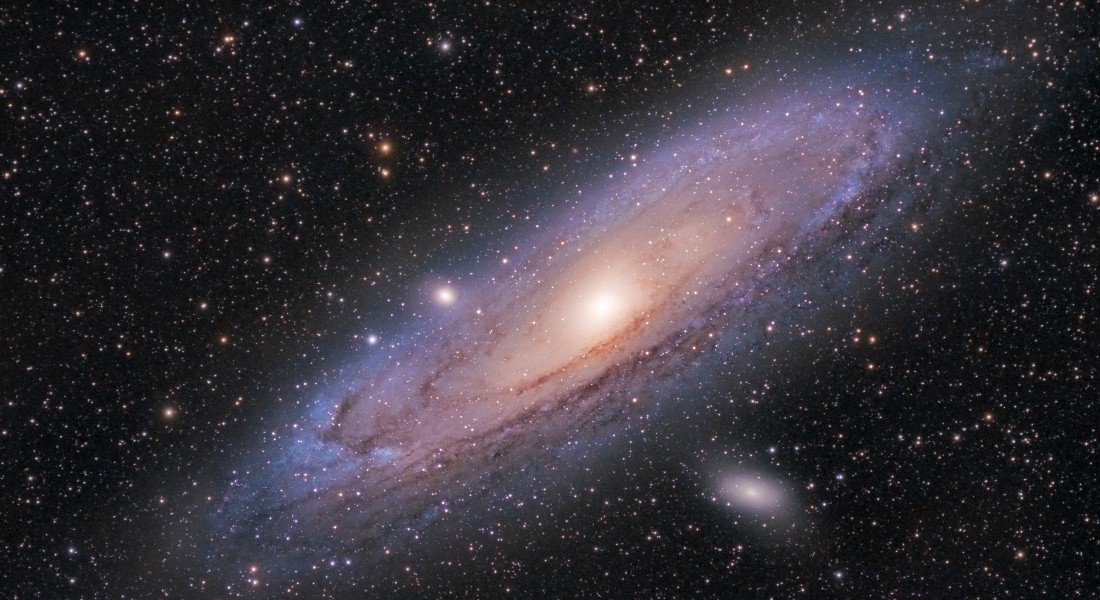
A team of University of Copenhagen astrophysicists has arrived at a major result regarding star populations beyond the Milky Way. The result could change our understanding of a wide range of astronomical phenomena, including the formation of black holes, supernovae, and why galaxies die. The Andromeda galaxy, our Milky Way's closest neighbor, is the most distant object in the sky that you can see with your unaided eye. Photo: Getty
For as long as humans have studied the heavens, how stars look in distant galaxies has been a mystery. In a study published today in The Astrophysical Journal, a team of researchers at the University of Copenhagen’s Niels Bohr Institute is doing away with previous understandings of stars beyond our galaxy.

Since 1955, it has been assumed that the composition of stars in the universe's other galaxies is similar to that of the hundreds of billions of stars within our own – a mixture of massive, medium mass, and low mass stars. But with the help of observations from 140,000 galaxies across the universe and a wide range of advanced models, the team has tested whether the same distribution of stars that appear in the Milky Way applies elsewhere. The answer is no. Stars in distant galaxies are typically more massive than those in our "local neighborhood". The finding has a major impact on what we think we know about the universe.

"The mass of stars tells us, astronomers, a lot. If you change mass, you also change the number of supernovae and black holes that arise out of massive stars. As such, our result means that we’ll have to revise many of the things we once presumed because distant galaxies look quite different from our own," says Albert Sneppen, a graduate student at the Niels Bohr Institute and first author of the study.

Analyzed light from 140.000 galaxies

Researchers assumed that the size and weight of stars in other galaxies were similar to our own for more than fifty years, for the simple reason that they were unable to observe them through a telescope, as they could with the stars of our galaxy.

Distant galaxies are billions of light-years away. As a result, only light from their most powerful stars ever reaches Earth. This has been a headache for researchers around the world for years, as they could never accurately clarify how stars in other galaxies were distributed, an uncertainty that forced them to believe that they were distributed much like the stars in our Milky Way.

"We’ve only been able to see the tip of the iceberg and known for a long time that expecting other galaxies to look like our own was not a particularly good assumption to make. However, no one has ever been able to prove that other galaxies form different populations of stars. This study has allowed us to do just that, which may open the door for a deeper understanding of galaxy formation and evolution," says Associate Professor Charles Steinhardt, a co-author of the study.

In the study, the researchers analyzed light from 140,000 galaxies using the COSMOS catalog, a large international database of more than one million observations of light from other galaxies. These galaxies are distributed from the nearest to farthest reaches of the universe, from which light has traveled a full twelve billion years before being observable on Earth.

Massive galaxies die first

According to the researchers, the discovery will have a wide range of implications. For example, it remains unresolved why galaxies die and stop forming new stars. The new result suggests that this might be explained by a simple trend.

"Now that we are better able to decode the mass of stars, we can see a new pattern; the least massive galaxies continue to form stars, while the more massive galaxies stop birthing new stars, This suggests a remarkably universal trend in the death of galaxies," concludes Albert Sneppen.

The research was conducted at the Cosmic Dawn Center (DAWN), an international basic research center for astronomy supported by the Danish National Research Foundation. DAWN is a collaboration between the Niels Bohr Institute at the University of Copenhagen and DTU Space at the Technical University of Denmark.

The center is dedicated to understanding when and how the first galaxies, stars, and black holes formed and evolved in the early universe, through observations using the largest telescopes along with theoretical work and simulations.


Hubble reaches a new milestone in the mystery of the Universe's expansion rate

Completing a nearly 30-year marathon, NASA's Hubble Space Telescope has calibrated more than 40 "milepost markers" of space and time to help scientists precisely measure the expansion rate of the universe – a quest with a plot twist.

The pursuit of the universe's expansion rate began in the 1920s with measurements by astronomers Edwin P. Hubble and Georges Lemaître. In 1998, this led to the discovery of "dark energy," a mysterious repulsive force accelerating the universe's expansion. In recent years, thanks to data from Hubble and other telescopes, astronomers found another twist: a discrepancy between the expansion rate as measured in the local universe compared to independent observations from right after the big bang, which predict a different expansion value.

The cause of this discrepancy remains a mystery. But Hubble data, encompassing a variety of cosmic objects that serve as distance markers, support the idea that something weird is going on, possibly involving brand new physics. This collection of 36 images from NASA's Hubble Space Telescope features galaxies that are all hosts to both Cepheid variables and supernovae. These two celestial phenomena are both crucial tools used by astronomers to determine astronomical distance, and have been used to refine our measurement of the Hubble constant, the expansion rate of the universe.  The galaxies shown in this photo (from top row, left to bottom row, right) are: NGC 7541, NGC 3021, NGC 5643, NGC 3254, NGC 3147, NGC 105, NGC 2608, NGC 3583, NGC 3147, Mrk 1337, NGC 5861, NGC 2525, NGC 1015, UGC 9391, NGC 691, NGC 7678, NGC 2442, NGC 5468, NGC 5917, NGC 4639, NGC 3972, The Antennae Galaxies, NGC 5584, M106, NGC 7250, NGC 3370, NGC 5728, NGC 4424, NGC 1559, NGC 3982, NGC 1448, NGC 4680, M101, NGC 1365, NGC 7329, and NGC 3447. Credits: NASA, ESA, Adam G. Riess (STScI, JHU)

"You are getting the most precise measurement of the expansion rate for the universe from the gold standard of telescopes and cosmic mile markers," said Nobel Laureate Adam Riess of the Space Telescope Science Institute (STScI) and the Johns Hopkins University in Baltimore, Maryland.

Riess leads a scientific collaboration investigating the universe's expansion rate called SH0ES, which stands for Supernova, H0, for the Equation of State of Dark Energy. "This is what the Hubble Space Telescope was built to do, using the best techniques we know to do it. This is likely Hubble's magnum opus because it would take another 30 years of Hubble's life to even double this sample size," Riess said.

Riess's team's paper, to be published in the Special Focus issue of The Astrophysical Journal reports on completing the biggest and likely last major update on the Hubble constant. The new results more than double the prior sample of cosmic distance markers. His team also reanalyzed all of the prior data, with the whole dataset now including over 1,000 Hubble orbits.

When NASA conceived of a large space telescope in the 1970s, one of the primary justifications for the expense and extraordinary technical effort was to be able to resolve Cepheids, stars that brighten and dim periodically, seen inside our Milky Way and external galaxies. Cepheids have long been the gold standard of cosmic mile markers since their utility was discovered by astronomer Henrietta Swan Leavitt in 1912. To calculate much greater distances, astronomers use exploding stars called Type Ia supernovae.

Combined, these objects built a "cosmic distance ladder" across the universe and are essential to measuring the expansion rate of the universe, called the Hubble constant after Edwin Hubble. That value is critical to estimating the age of the universe and provides a basic test of our understanding of the universe.

Starting right after Hubble's launch in 1990, the first set of observations of Cepheid stars to refine the Hubble constant was undertaken by two teams: the HST Key Project led by Wendy Freedman, Robert Kennicutt, Jeremy Mould, and Marc Aaronson, and another by Allan Sandage and collaborators, that used Cepheids as milepost markers to refine the distance measurement to nearby galaxies. By the early 2000s, the teams declared "mission accomplished" by reaching an accuracy of 10 percent for the Hubble constant, 72 plus or minus 8 kilometers per second per megaparsec.

In 2005 and again in 2009, the addition of powerful new cameras on board the Hubble telescope launched "Generation 2" of the Hubble constant research as teams set out to refine the value to an accuracy of just one percent. This was inaugurated by the SH0ES program. Several teams of astronomers using Hubble, including SH0ES, have converged on a Hubble constant value of 73 plus or minus 1 kilometer per second per megaparsec. While other approaches have been used to investigate the Hubble constant question, different teams have come up with values close to the same number.

The SH0ES team includes long-time leaders Dr. Wenlong Yuan of Johns Hopkins University, Dr. Lucas Macri of Texas A&M University, Dr. Stefano Casertano of STScI, and Dr. Dan Scolnic of Duke University. The project was designed to bracket the universe by matching the precision of the Hubble constant inferred from studying the cosmic microwave background radiation left over from the dawn of the universe.

"The Hubble constant is a very special number. It can be used to thread a needle from the past to the present for an end-to-end test of our understanding of the universe. This took a phenomenal amount of detailed work," said Dr. Licia Verde, a cosmologist at ICREA and the ICC-University of Barcelona, speaking about the SH0ES team's work.

The team measured 42 of the supernova milepost markers with Hubble. Because they are seen exploding at a rate of about one per year, Hubble has, for all practical purposes, logged as many supernovae as possible for measuring the universe's expansion. Riess said, "We have a complete sample of all the supernovae accessible to the Hubble telescope seen in the last 40 years." Like the lyrics from the song "Kansas City," from the Broadway musical Oklahoma, Hubble has "gone about as fur as it c'n go!"

Weird Physics?

The expansion rate of the universe was predicted to be slower than what Hubble sees. By combining the Standard Cosmological Model of the Universe and measurements by the European Space Agency's Planck mission (which observed the relic cosmic microwave background from 13.8 billion years ago), astronomers predict a lower value for the Hubble constant: 67.5 plus or minus 0.5 kilometers per second per megaparsec, compared to the SH0ES team's estimate of 73.

Given the large Hubble sample size, there is only a one-in-a-million chance astronomers are wrong due to an unlucky draw, said Riess, a common threshold for taking a problem seriously in physics. This finding is untangling what was becoming a nice and tidy picture of the universe's dynamical evolution. Astronomers are at a loss for an explanation of the disconnect between the expansion rate of the local universe versus the primeval universe, but the answer might involve additional physics of the universe.

Such confounding findings have made life more exciting for cosmologists like Riess. Thirty years ago they started to measure the Hubble constant to benchmark the universe, but now it has become something even more interesting. "Actually, I don't care what the expansion value is specifically, but I like to use it to learn about the universe," Riess added.

NASA's new Webb Space Telescope will extend Hubble's work by showing these cosmic milepost markers at greater distances or sharper resolution than what Hubble can see.