

SUPERCOMPUTING NEWS SUPERCOMPUTING NEWS
    • MEDIA KIT
    • MOST READ
    • RSS FEED
    • ACADEMIA
    • AEROSPACE
    • APPLICATIONS
    • ASTRONOMY
    • AUTOMOTIVE
    • BIG DATA
    • BIOLOGY
    • CHEMISTRY
    • CLIENTS
    • CLOUD
    • DEFENSE
    • DEVELOPER TOOLS
    • EARTH SCIENCES
    • ECONOMICS
    • ENGINEERING
    • ENTERTAINMENT
    • GAMING
    • GOVERNMENT
    • HEALTH
    • OIL & GAS
    • INDUSTRY
    • INTERCONNECTS
    • MANUFACTURING
    • MIDDLEWARE
    • MOVIES
    • NETWORKS
    • PHYSICS
    • PROCESSORS
    • RETAIL
    • SCIENCE
    • STORAGE
    • SYSTEMS
    • VISUALIZATION
    • AcyMailing subscription form

    • ADD YOUR VIDEOS
    • MANAGE VIDEOS
    • CONVERSATION INBOX
    • SOCIAL ADVERTISER
    • SOCIAL NETWORK VIDEOS
    • SURVEYS
    • GROUPS
    • PAGES
    • MARKETPLACE LISTINGS
    • APPLICATIONS BROWSER
    • PRIVACY CONFIRM REQUEST
    • PRIVACY CREATE REQUEST
    • LEADERBOARD
    • POINTS LISTING
      • BADGES
    • TRADE SHOWS
Sign In
Tyler O'Neal, Staff Editor ACADEMIA December 22, 2021, 8:00 am

Japanese modelers show Antarctic ice sheet melting could cause a multi-meter rise in sea levels by the end of the millennium

Scientists predict that continued global warming under current trends could lead to an elevation of the sea level by as much as five meters by the year 3000 CE.

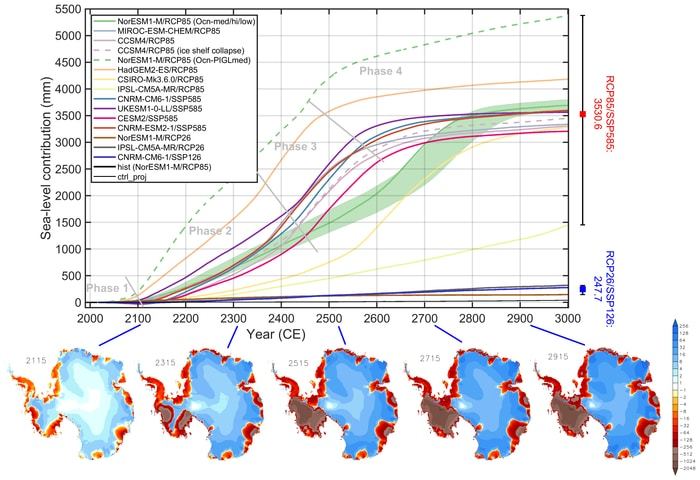
One of the many effects of global warming is sea-level rise due to the melting and retreat of the Earth’s ice sheets and glaciers as well as other sources. As the sea level rises, large areas of densely populated coastal land could ultimately become uninhabitable without extensive coastal modification. It is therefore vital to understand the impact of different pathways of future climate change on changes in sea level caused by ice sheets and glaciers. Simulated mass loss of the Antarctic ice sheet from 1990 until 3000 expressed as sea-level contribution: Fourteen experiments for the unabated warming pathway (RCP8.5, SSP5-8.5), three experiments for the reduced emissions pathway (RCP2.6, SSP1-2.6), a historical run (‘hist’) for 1990–2015 and a control run for a constant 1995–2014 climate (‘ctrl_proj’) under which the ice sheet is essentially stable. The red and blue boxes to the right show the means for RCP8.5/SSP5-8.5 and RCP2.6/SSP1-2.6, respectively; the whiskers show the full ranges. Phase 1 is the original ISMIP6 period until 2100. Phases 2-4 are valid for RCP8.5/SSP5-8.5 and show an accelerated mass loss (phase 2), the main instability of the West Antarctic ice sheet (phase 3) and a final phase 4 where the mass loss levels out. Map-view plots below are ice surface elevation differences relative to 2015 (in metres; blue means thickening, red/brown means thinning) for the simulation forced by MIROC-ESM-CHEM/RCP8.5 (Christopher Chambers et al. Journal of Glaciology. December 22, 2021).  CREDIT Christopher Chambers et al. Journal of Glaciology. December 22, 2021
A team of researchers from Hokkaido University, The University of Tokyo, and the Japan Agency for Marine-Earth Science and Technology (JAMSTEC) explored the long-term perspective for the Antarctic ice sheet beyond the 21st century under global-warming conditions, assuming late 21st-century climatic conditions remain constant. Their models and conclusions were published in the Journal of Glaciology.

The Ice Sheet Model Intercomparison Project for the Coupled Model Intercomparison Project Phase 6 (ISMIP6) was a major international effort that used the latest generation of models to estimate the impact of global warming on the ice sheets of Antarctica and Greenland. The objective was to provide input for the recently published Sixth Assessment Report (AR6) of the Intergovernmental Panel on Climate Change (IPCC). The contribution of the Antarctic ice sheet to sea-level rise by 2100 was assessed to be in the range between −7.8 and 30.0 centimeters under unabated warming and between 0 and 3 centimeters under reduced emissions of greenhouse gases.

The team used the ice-sheet model SICOPOLIS (SImulation COde for POLythermal Ice Sheets) to extend the whole ISMIP6 ensemble of fourteen experiments for the unabated warming pathway and three for the reduced emissions pathway. Until the year 2100, the set-up was the same as in the original ISMIP6 experiments. For the time beyond 2100, it was assumed that the late 21st-century climatic conditions remain constant—no further climate trend was applied. The team analyzed the results of the simulations for the total mass change of the ice sheet, regional changes in West Antarctica, East Antarctica, and the Antarctic Peninsula, and also the different contributors to mass change.

The simulations of mass loss of the Antarctic ice sheet show that, by the year 3000, the unabated warming pathway produces a sea-level equivalent (SLE) of as much as 1.5 to 5.4 meters, while for the reduced emissions pathway the SLE would be only 0.13 to 0.32 meters. The main reason for the decay under the unabated warming pathway is the collapse of the West Antarctic ice sheet, made possible by the fact that the West Antarctic ice sheet is grounded on a bed that is mostly well below sea level.

“This study demonstrates clearly that the impact of 21st-century climate change on the Antarctic ice sheet extends well beyond the 21st century itself, and the most severe consequences — multi-meter contribution to sea-level rise — will likely only be seen later,” says Dr. Christopher Chambers of Hokkaido University’s Institute of Low-Temperature Science and lead author of the paper. “Future work will include basing simulations on more realistic future climate scenarios, as well as using other ice-sheet models to model the outcomes.”
How NASA’s Psyche mission will explore an unexplored world

Tyler O'Neal, Staff Editor ACADEMIA December 21, 2021, 8:00 am

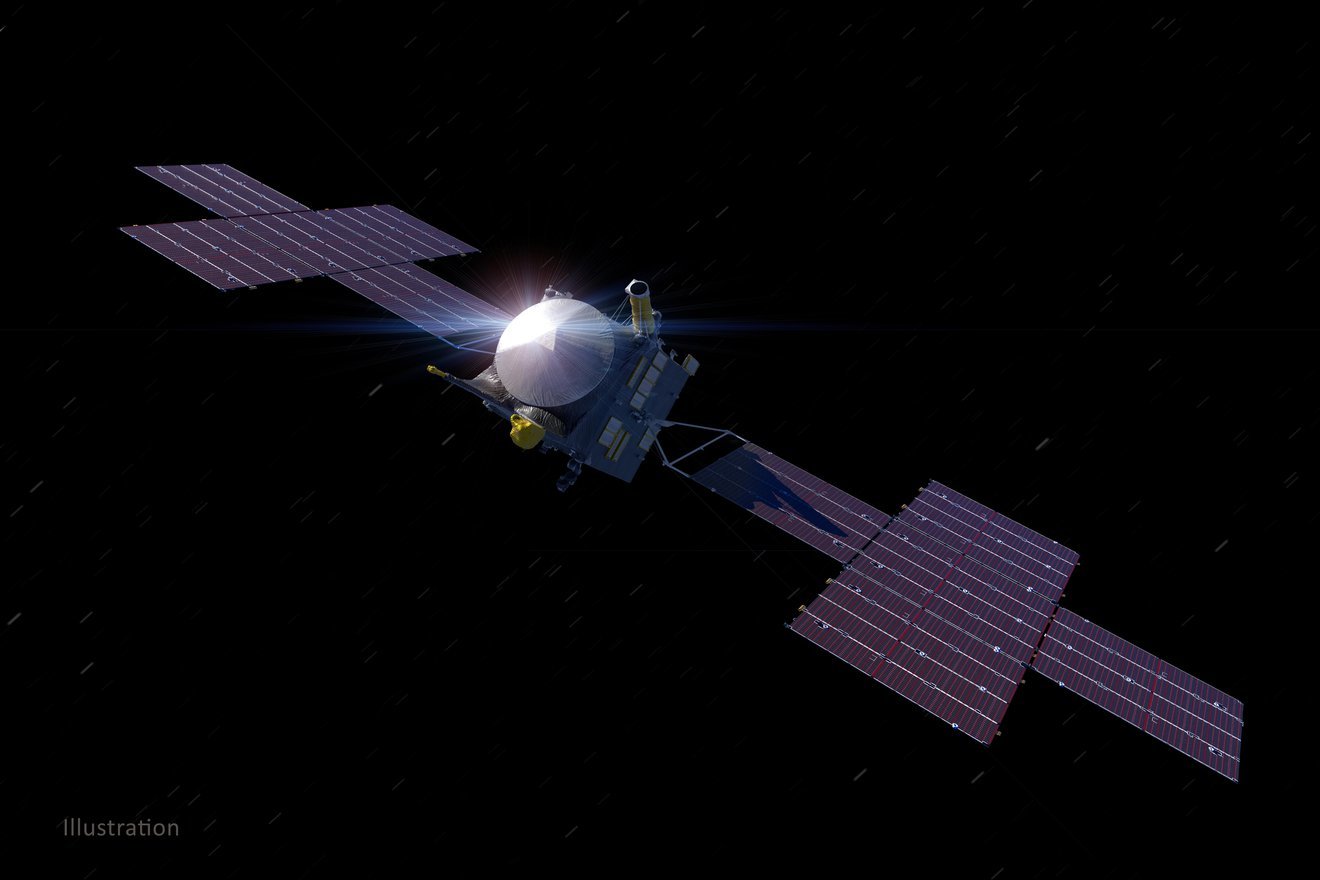
Launching in August 2022 and arriving at the asteroid belt in 2026, NASA’s Psyche spacecraft will orbit a world we can barely pinpoint from Earth and have never visited. This illustration, updated as of March 2021, depicts NASA's Psyche spacecraft. Set to launch in August 2022, the Psyche mission will explore a metal-rich asteroid of the same name that lies in the main asteroid belt between Mars and Jupiter. The spacecraft will arrive in early 2026 and orbit the asteroid for nearly two years to investigate its composition.  Scientists think that Psyche, unlike most other asteroids that are rocky or icy bodies, is made up of mostly iron and nickel — similar to Earth's core. The Psyche team will use a magnetometer to measure the asteroid's magnetic field. A multispectral imager will capture images of the surface, as well as data about Psyche's composition and topography. Spectrometers will analyze the neutrons and gamma rays coming from the surface to reveal the elements that make up the asteroid.  Maxar Technologies in Palo Alto, California, built the main body of the spacecraft, called the Solar Electric Propulsion (SEP) Chassis. Maxar also will deliver the five-panel solar arrays, shown here, that will provide the power for the spacecraft systems.  The image was created by Peter Rubin.

The target of NASA’s Psyche mission – a metal-rich asteroid, also called Psyche, in the main belt between Mars and Jupiter – is an uncharted world in outer space. From Earth- and space-based telescopes, the asteroid appears as a fuzzy blur. What scientists do know, from radar data, is that it’s shaped somewhat like a potato and that it spins on its side.

By analyzing light reflected off the asteroid, scientists hypothesize that asteroid Psyche is unusually rich in metal. One possible explanation is that it formed early in our solar system, either as a core of a planetesimal – a piece of a planet – or as primordial material that never melted. This mission aims to find out, and in the process of doing so, they expect to help answer fundamental questions about the formation of our solar system.

“If it turns out to be part of a metal core, it would be part of the very first generation of early cores in our solar system,” said Arizona State University’s Lindy Elkins-Tanton, who as principal investigator leads the Psyche mission. “But we don’t really know, and we won’t know anything for sure until we get there. We wanted to ask primary questions about the material that built planets. We’re filled with questions and not a lot of answers. This is real exploration.”

Elkins-Tanton led the group that proposed Psyche as a NASA Discovery-class mission; it was selected in 2017. A huge challenge, she said, was choosing the mission’s science instruments: How do you make sure you’ll get the data you need when you’re not sure of what, specifically, you’ll be measuring?

For example, to determine what exactly the asteroid is made of and whether it’s part of a planetesimal core, scientists needed instruments that could account for a range of possibilities: nickel, iron, different kinds of rock, or rock and metal mixed.

They selected a payload suite that includes a magnetometer to measure any magnetic field; imagers to photograph and map the surface, and spectrometers to indicate what the surface is made of by measuring the gamma rays and neutrons emitted from it. Scientists continue to hypothesize about what Psyche is made of, but “no one’s been able to come up with a Psyche that we can’t handle with the science instruments we have,” Elkins-Tanton said.

How to Tour an Unknown World

But before scientists can put those instruments to work, they’ll need to reach the asteroid and get into orbit. After launching from NASA’s Kennedy Space Center in August 2022, Psyche will sail past Mars nine months later, using the planet’s gravitational force to slingshot itself toward the asteroid. It’s a total journey of about 1.5 billion miles (2.4 billion kilometers).

The spacecraft will begin its final approach to the asteroid in late 2025. As the spacecraft gets closer to its target, the mission team will turn its cameras on, and the visual of asteroid Psyche will morph from the fuzzy blob we know now into high-definition, revealing surface features of this strange world for the first time. The imagery also will help engineers get their bearings as they prepare to slip into orbit in January 2026. The spacecraft’s initial orbit is designed to be at a high, safe altitude – about 435 miles (700 kilometers) above the asteroid’s surface.

During this first orbit, Psyche’s mission design and navigation team will be laser-focused on measuring the asteroid’s gravity field, the force that will keep the spacecraft in orbit. With an understanding of the gravity field, the team can then safely navigate the spacecraft closer and closer to the surface as the science mission is carried out in just under two years.

Psyche appears to be lumpy, wider across (173 miles, or 280 kilometers, at its widest point) than it is from top to bottom, with an uneven distribution of mass. Some parts may be less dense, like a sponge, and some may be more tightly packed and more massive. The parts of Psyche with more mass will have higher gravity, exerting a stronger pull on the spacecraft.

To solve the gravity-field mystery, the mission team will use the spacecraft’s telecommunications system. By measuring subtle changes in the X-band radio waves bouncing back and forth between the spacecraft and the large Deep Space Network antennas around Earth, engineers can precisely determine the asteroid’s mass, gravity field, rotation, orientation, and wobble.

The team has been working up scenarios and has devised thousands of “possible Psyches” – simulating variations in the asteroid’s density and mass, and orientation of its spin axis – to lay the groundwork for the orbital plan. They can test their models in supercomputer simulations, but there’s no way to know for sure until the spacecraft gets there.

Over the following 20 months, the spacecraft will use its gentle electric propulsion system to dip into lower and lower orbits. Measurements of the gravity field will grow more precise as the spacecraft gets closer, and images of the surface will become higher resolution, allowing the team to improve their understanding of the body. Eventually, the spacecraft will establish a final orbit about 53 miles (85 kilometers) above the surface.

It’s all to solve the riddles of this unique asteroid: Where did Psyche come from, what is it made of, and what does it tell us about the formation of our solar system?

“Humans have always been explorers,” Elkins-Tanton said. “We’ve always set out from where we are to find out what is over that hill. We always want to go farther; we always want to imagine. It’s inherent in us. We don’t know what we’re going to find, and I’m expecting us to be entirely surprised.”

UTEP wins $4M grant to advance cybersecurity training

Tyler O'Neal, Staff Editor ACADEMIA December 20, 2021, 2:00 pm

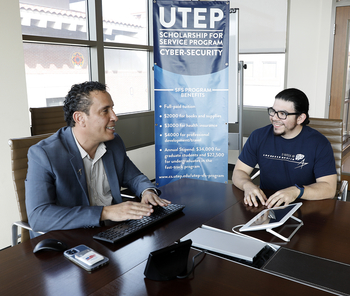
The University of Texas at El Paso will enhance the capacity of the regional and national cybersecurity workforce, thanks to a renewed commitment from the National Science Foundation (NSF) and the Department of Homeland Security (DHS). UTEP’s CyberCorps Scholarship for Service (SFS) program, designed to prepare cybersecurity professionals who can improve the nation’s security and economic competitiveness, has received a $4 million grant from NSF and DHS. The University of Texas at El Paso will enhance the capacity of the regional and national cybersecurity workforce, thanks to a a $4 million grant from the National Science Foundation and the Department of Homeland Security in support of the CyberCorps Scholarship for Service (SFS) program. Salamah Salamah, Ph.D., associate professor and chair of UTEP’s Department of Computer Science, left, oversees the program and is seen here counseling David Reyes, a doctoral candidate who has been part of the SFS program since its inception.  CREDIT Laura Trejo/UTEP Marketing and Communications.

UTEP’s original SFS program started in 2016 and has produced 30 graduates, all of whom have secured jobs in the cybersecurity sector with governmental entities.

“This renewal award will support over 35 graduate students in computer science (CS) and software engineering who will enter the government workforce with the knowledge and skills to transfer state-of-the-art cybersecurity techniques and approaches into practice,” said Salamah Salamah, Ph.D., associate professor and chair of UTEP’s Department of Computer Science.

The renewal of the CyberCorps scholarships program at UTEP will result in the support of highly qualified students, with an emphasis on Hispanic and female students. With the original and the new SFS program, the CS department at UTEP has supported 39 students, with 39% of those students being females and 85% Hispanic. 

David Reyes, a doctoral candidate in computer science, has been part of the SFS program since its inception.

“It has been an amazing opportunity,” Reyes said. “Before this program, I was a teaching assistant. So, it was sometimes difficult having to grade exams and keep up with my own coursework. Now, I can focus completely and dedicate my time directly to my studies.”

SFS Scholars receive full tuition, $6,000 for travel, research materials and supplies, a laptop, books, professional training and certifications, and an annual stipend ($34,000 as graduate students and $25,000 as undergraduates). In return, they commit to serving in a government cybersecurity position for some time equal to the number of years funded by the program.

“If you are really interested in cybersecurity and you want to learn new things and do some interesting work and have a passion for it, you should definitely apply,” said Reyes, who is scheduled to graduate in December 2022.

“UTEP is uniquely positioned to contribute to efforts to improve diversity in the cybersecurity workforce due to the population it serves, which includes Hispanic, first-generation, and lowest income quartile students,” Salamah said.

Over the past five years, UTEP has made significant advances in the development of cybersecurity educational programs, research and outreach activities. These efforts have resulted in several high-profile recognitions including designation by the National Security Agency as a Center of Academic Excellence in both Cyber Defense and Cyber Operations — only one of 21 throughout the nation — as well as designation as an Army Research Lab-South remote campus in cybersecurity.

The central role of software in the operation of defense, energy, communication, transportation, and manufacturing systems makes it increasingly important that these systems are designed in a way that integrates cybersecurity principles, Salamah explained.

UTEP’s SFS scholars take part in rigorous educational programs and complement the knowledge gained in the classroom with significant involvement in cybersecurity research, training, competitions, and hands-on activities. They are also required to engage in service to the community to build cybersecurity awareness and capabilities among UTEP students and beyond.

The goals of the UTEP SFS program are:

  • Recruit and retain at least 30 students into UTEP’s Master of Science in Software Engineering and the doctoral computer science programs.
  • Graduate students who will enter the workforce with the ability to transfer state-of-the-art cybersecurity techniques and approaches into practice.
  • Place students in government positions that utilize their knowledge and capabilities in cybersecurity, with a focus on placing graduates in federal/executive entities.
  • Advance cybersecurity awareness and competencies among K-12 students and educators.
  1. New Humboldt prof creates nature-inspired AI at Bielefeld University
  2. Flawed diamonds may provide perfect interface for quantum supercomputers

Page 79 of 123

  • 74
  • 75
  • 76
  • 77
  • 78
  • 79
  • 80
  • 81
  • 82
  • 83
POPULAR RIGHT NOW
  • Supercomputers uncover a new class of cosmic explosions hidden in plain sight
    Supercomputers uncover a new class of cosmic explosions hidden in plain sight
  • AI supercharges the hunt for stronger magnets: Iowa State researchers launch a new era of intelligent materials discovery
    AI supercharges the hunt for stronger magnets: Iowa State researchers launch a new era of intelligent materials discovery
  • IBM's Historic stock collapse raises questions for the future of enterprise supercomputing
    IBM's Historic stock collapse raises questions for the future of enterprise supercomputing
  • Could a novel dark matter theory simultaneously resolve multiple cosmic enigmas? Supercomputer simulations provide a compelling, albeit currently unverified, potential solution
    Could a novel dark matter theory simultaneously resolve multiple cosmic enigmas? Supercomputer simulations provide a compelling, albeit currently unverified, potential solution
  • Melting icebergs may be reshaping Earth’s greatest ocean current
    Melting icebergs may be reshaping Earth’s greatest ocean current
  • Supercomputers replace ‘bathtub’ flood maps with physics-based digital twins of Britain’s coastline
    Supercomputers replace ‘bathtub’ flood maps with physics-based digital twins of Britain’s coastline
  • Supercomputers push neural quantum simulation beyond previous limits
    Supercomputers push neural quantum simulation beyond previous limits
  • Intel’s AI supercomputing revival: Q2 financial surge signals new era for CPU-powered HPC infrastructure
    Intel’s AI supercomputing revival: Q2 financial surge signals new era for CPU-powered HPC infrastructure
  • AI infrastructure financing fears shake semiconductor sector
    AI infrastructure financing fears shake semiconductor sector
  • AWS supercomputing investment reaches historic scale as Amazon’s AI strategy powers record financial results
    AWS supercomputing investment reaches historic scale as Amazon’s AI strategy powers record financial results
THIS YEAR'S MOST READ
  • Wall Street wants to trade supercomputing power like oil
    Wall Street wants to trade supercomputing power like oil
  • Cosmic ambition at scale: UK’s supercomputer unlocks a 2.5 petabytes universe
    Cosmic ambition at scale: UK’s supercomputer unlocks a 2.5 petabytes universe
  • Hidden order, revealed at scale: Supercomputing, electron ptychography uncover the inner workings of relaxor ferroelectrics
    Hidden order, revealed at scale: Supercomputing, electron ptychography uncover the inner workings of relaxor ferroelectrics
  • Beamforming the future: BeammWave's 6G push signals the rise of orbital-terrestrial wireless networks
    Joakim Axmon
    Joakim Axmon
  • Intel's Q1 results signal supercomputing surge driving Xeon momentum
    Intel's Q1 results signal supercomputing surge driving Xeon momentum
  • When stars fall apart: Supercomputing reveals the hidden physics of black holes
    When stars fall apart: Supercomputing reveals the hidden physics of black holes
  • Multi-layer simulations reveal the hidden supply chain of solar prominences
    Multi-layer simulations reveal the hidden supply chain of solar prominences
  • Japanese scientists decode dolphin speed with supercomputing: Turbulence, vortices, and the hidden physics of propulsion
    Japanese scientists decode dolphin speed with supercomputing: Turbulence, vortices, and the hidden physics of propulsion
  • Cosmic feedback at scale: Supercomputing reveals how quasars regulate the early Universe
    Cosmic feedback at scale: Supercomputing reveals how quasars regulate the early Universe
  • Modeling life at the microscopic scale: A computational breakthrough in oxygen transport
    Modeling life at the microscopic scale: A computational breakthrough in oxygen transport
MOST READ OF ALL-TIME
  • Largest Computational Biology Simulation Mimics The Ribosome
    Details
    112108
    The amino acid (green) slithers into the chemical reaction center, moving through an evolutionarily ancient corridor of the ribosome (purple). The amino acid is delivered to the reaction core by the transfer RNA molecule (yellow).
    The amino acid (green) slithers into the chemical reaction center, moving through an evolutionarily ancient corridor of the ribosome (purple). The amino acid is delivered to the reaction core by the transfer RNA molecule (yellow).
  • Silicon 'neurons' may add a new dimension to chips
    Details
    80995
    Silicon 'neurons' may add a new dimension to chips
  • Linux Networx Accelerators Expected to Drive up to 4x Price/Performance
    Details
    75538
  • Complex Concepts That Really Add Up
    Details
    73639
    Complex Concepts That Really Add Up
  • Blue Sky Studios Donates Animation SuperComputer to Wesleyan
    Details
    68141
    Each rack holds 52 Angstrom Microsystem-brand “blades,” with a memory footprint of 12 or 24 gigabytes each. (Photos by Olivia Bartlett Drake)
    Each rack holds 52 Angstrom Microsystem-brand “blades,” with a memory footprint of 12 or 24 gigabytes each. (Photos by Olivia Bartlett Drake)
  • Humanities, HPC connect at NERSC
    Details
    57948
  • TeraGrid ’09 'Call for Participation'
    Details
    54952
  • Turbulence responsible for black holes' balancing act
    Details
    52313
  • Cray Wins $52 Million SuperComputer Contract
    Details
    50140
  • SDSC Researchers Accurately Predict Protein Docking
    Details
    46082
  • FRONTPAGE
  • LATEST
  • POPULAR
  • REGISTER
  • SOCIAL
  • VIDEO
  • SUBSCRIPTION
  • RSS
  • GUIDELINES
  • PRIVACY
  • TOS
  • ABOUT
  • +1 (816) 799-4488
  • editorial@supercomputingonline.com
© 2001 - 2026 SuperComputingOnline.com, LLC. All rights reserved. This material may not be published, broadcast, rewritten or redistributed without permission.
Sign In
  • FRONT PAGE
  • LATEST
    • MEDIA KIT
    • MOST READ
    • RSS FEED
    • ACADEMIA
    • AEROSPACE
    • APPLICATIONS
    • ASTRONOMY
    • AUTOMOTIVE
    • BIG DATA
    • BIOLOGY
    • CHEMISTRY
    • CLIENTS
    • CLOUD
    • DEFENSE
    • DEVELOPER TOOLS
    • EARTH SCIENCES
    • ECONOMICS
    • ENGINEERING
    • ENTERTAINMENT
    • HEALTH
    • INDUSTRY
    • INTERCONNECTS
    • GAMING
    • GOVERNMENT
    • MANUFACTURING
    • MIDDLEWARE
    • MOVIES
    • NETWORKS
    • OIL & GAS
    • PHYSICS
    • PROCESSORS
    • RETAIL
    • SCIENCE
    • STORAGE
    • SYSTEMS
    • VISUALIZATION
  • VIDEOS
    • ADD YOUR VIDEOS
    • MANAGE VIDEOS
  • COMMUNITY
    • TRADE SHOWS
    • SOCIAL NETWORK VIDEOS
    • SURVEYS
    • APPLICATIONS BROWSER
    • CONVERSATION INBOX
    • SOCIAL ADVERTISER
    • GROUPS
    • MARKETPLACE LISTINGS
    • PAGES
    • LEADERBOARD
    • POINTS LISTING
      • BADGES
    • PRIVACY CONFIRM REQUEST
    • PRIVACY CREATE REQUEST

Hey there! We noticed you’re using an ad blocker.