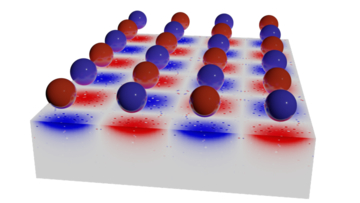
Columbia engineers build a breakthrough integrated photonics device

Over the past several decades, researchers have moved from using electric currents to manipulating light waves in the near-infrared range for telecommunications applications such as high-speed 5G networks, biosensors on a chip, and driverless cars. This research area, known as integrated photonics, is fast evolving, and investigators are now exploring the shorter visible wavelength range to develop a broad variety of emerging applications. These include chip-scale light detection and ranging (LIDAR), augmented/virtual/mixed reality (AR/VR/MR) goggles, holographic displays, quantum information processing chips, and implantable optogenetic probes in the brain.

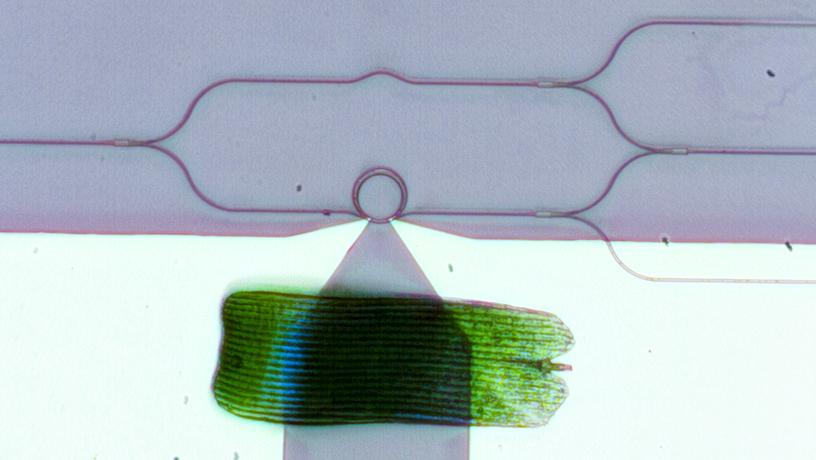
The one device critical to all these applications in the visible range is an optical phase modulator, which controls the phase of a light wave, similar to how the phase of radio waves is modulated in wireless computer networks. With a phase modulator, researchers can build an on-chip optical switch that channels light into different waveguide ports. With a large network of these optical switches, researchers could create sophisticated integrated optical systems that could control light propagating on a tiny chip or light emission from the chip. A visible-spectrum phase modulator (the ring at the center of a radius of 10 microns) is tinier than a butterfly wing scale. Photo credit: Heqing Huang and Cheng-Chia Tsai/Columbia Engineering
But phase modulators in the visible range are very hard to make: there are no materials that are transparent enough in the visible spectrum while also providing large tunability, either through thermo-optical or electro-optical effects. Currently, the two most suitable materials are silicon nitride and lithium niobate. While both are highly transparent in the visible range, neither one provides very much tunability. Visible-spectrum phase modulators based on these materials are thus not only large but also power-hungry: the length of individual waveguide-based modulators ranges from hundreds of microns to several millimeters, and a single modulator consumes tens of milliwatts for phase tuning. Researchers trying to achieve large-scale integration—embedding thousands of devices on a single microchip—have, up to now, been stymied by these bulky, energy-consuming devices.

Today, Columbia Engineering researchers announced that they have found a solution to this problem—they’ve developed a way based on micro-ring resonators to dramatically reduce both the size and the power consumption of a visible-spectrum phase modulator, from one millimeter to 10 microns, and from tens of milliwatts for π phase tuning to below one milliwatt. The study was published today by Nature Photonics.

“Usually the bigger something is, the better. But integrated devices are a notable exception,” said Nanfang Yu, associate professor of applied physics, co-principal investigator (PI) on the team, and an expert in nanophotonics. “It’s really hard to confine light to a spot and manipulate it without losing much of its power. We are excited that in this work we’ve made a breakthrough that will greatly expand the horizon of large-scale visible-spectrum integrated photonics.”

Conventional optical phase modulators operating at visible wavelengths are based on light propagation in waveguides. Yu worked with his colleague Michal Lipson, who is the leading expert on integrated photonics based on silicon nitride, to develop a very different approach.

“The key to our solution was to use an optical resonator and to operate it in the so-called ‘strongly over-coupled’ regime,” said Lipson, co-PI on the team, and Eugene Higgins Professor of Electrical Engineering and professor of applied physics.

Optical resonators are structures with a high degree of symmetry, such as rings that can cycle a beam of light many times and translate tiny refractive index changes to large phase modulation. Resonators can operate under several different conditions and so need to be used carefully. For example, if operating in the “under-coupled” or “critical coupled” regimes, a resonator will only provide a limited phase modulation and, more problematically, introduce a large amplitude variation to the optical signal. The latter is a highly undesirable optical loss because the accumulation of even moderate losses from individual phase modulators will prevent cascading them to form a circuit that has a sufficiently large output signal.

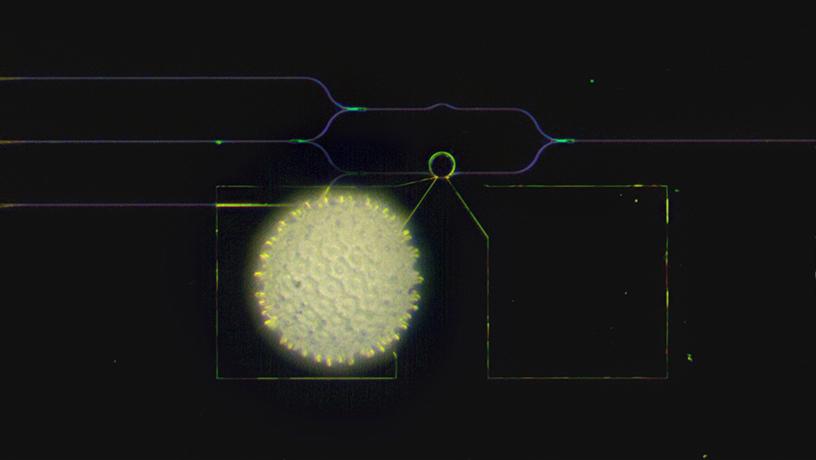
To achieve a complete 2π phase tuning and minimal amplitude variation, the Yu-Lipson team chose to operate a micro-ring in the “strongly over-coupled” regime, a condition in which the coupling strength between the micro-ring and the “bus” waveguide that feeds light into the ring is at least 10 times stronger than the loss of the micro-ring. “The latter is primarily due to optical scattering at the nanoscale roughness on the device sidewalls,” Lipson explained. “You can never fabricate photonic devices with perfectly smooth surfaces.” A visible-spectrum phase modulator (the ring at the center of a radius of 10 microns) is much smaller than a grain of pollen of the morning glory. Photo credit: Heqing Huang and Cheng-Chia Tsai/Columbia Engineering
The team developed several strategies to push the devices into the strongly over-coupled regime. The most crucial one was their invention of an adiabatic micro-ring geometry, in which the ring smoothly transitions between a narrow neck and a wide belly, which are at the opposite edges of the ring. The narrow neck of the ring facilitates the exchange of light between the bus waveguide and the micro-ring, thus enhancing the coupling strength. The ring’s wide belly reduces optical loss because the guided light interacts only with the outer sidewall, not the inner sidewall, of the widened portion of the adiabatic micro-ring, substantially reducing optical scattering at the sidewall roughness.

In a comparative study of adiabatic micro-rings and conventional micro-rings with uniform width fabricated side by side on the same chip, the team found that none of the conventional micro-rings satisfied the strong over-coupling condition they suffered very bad optical losses—while 63% of the adiabatic micro-rings kept operating in the strongly over-coupled regime.

“Our best phase modulators operating at the blue and green colors, which are the most difficult portion of the visible spectrum, have a radius of only five microns, consume power of 0.8 mW for π phase tuning, and introduce an amplitude variation of less than 10%,” said Heqing Huang, a graduate student in Yu’s lab and first author of the paper. “No prior work has demonstrated such compact, power-efficient, and low-loss phase modulators at visible wavelengths.”

The devices were designed in Yu’s lab and fabricated in the Columbia Nano Initiative cleanroom, at the Advanced Science Research Center NanoFabrication Facility at the Graduate Center of the City University of New York, and the Cornell NanoScale Science and Technology Facility. Device characterization was conducted in Lipson’s and Yu’s labs.

The researchers note that while they are nowhere near the degree of integration of electronics, their work shrinks the gap between photonic and electronic switches substantially. “If previous modulator technologies only allow for integration of 100 waveguide phase modulators given a certain chip footprint and power budget, now we can do that 100 times better and integrate 10,000 phase shifters on-chip to realize much more sophisticated functions,” said Yu.

The Lipson and Yu labs are now collaborating to demonstrate visible-spectrum LIDAR consisting of large 2D arrays of phase shifters based on adiabatic micro-rings. The design strategies employed for their visible-spectrum thermo-optical devices can be applied to electro-optical modulators to reduce their footprints and drive voltages, and can be adapted in other spectral ranges (e.g., ultraviolet, telecom, mid-infrared, and terahertz) and in other resonator designs beyond micro-rings.

“Thus, our work can inspire future effort where people can implement strong over-coupling in a wide range of resonator-based devices to enhance light-matter interactions, for example, for enhancing optical nonlinearity, for making novel lasers, for observing novel quantum optical effects, while suppressing optical losses at the same time,” Lipson said.


Stuttgart physicists develop a new supercomputer simulation for describing the attachment of a liquid to a surface

Liquids containing ions or polar molecules are ubiquitous in many applications needed for green technologies such as energy storage, electrochemistry, or catalysis. When such liquids are brought to an interface such as an electrode – or even confined in a porous material –  they exhibit unexpected behavior that goes beyond the effects already known. Recent experiments have shown that the properties of the employed material, which can be insulating or metallic, strongly influence the thermodynamic and dynamic behavior of these fluids. To shed more light on these effects, physicists at the University of Stuttgart, Université Grenoble Alpes, and Sorbonne Université Paris have developed a novel supercomputer simulation strategy using a virtual fluid that allows the electrostatic interactions within any material to be taken into account while being computationally sufficiently efficient to study the properties of fluids at such interfaces. The new method now made it possible for the first time to study the wetting transition at the nanoscale. This depends on whether the ionic liquid encounters a material that has insulating or metallic properties. This breakthrough approach provides a new theoretical framework for predicting the unusual behavior of charged liquids, especially in contact with nanoporous metallic structures, and has direct applications in the fields of energy storage and the environment. Schematic representation of an imperfect metal on which ions and their smeared-out mirror charges are shown Photo: University of Stuttgart / Alexander Schlaich

Despite their key role in physics, chemistry, and biology, the behavior of ionic or dipolar liquids near surfaces – such as a porous material – remains puzzling in many respects. One of the greatest challenges in the theoretical description of such systems is the complexity of the electrostatic interactions. For example, an ion in a perfect metal produces an inverse counter-charge, which corresponds to the negative mirror image. In contrast, no such image charges are induced in a perfect insulator because there are no freely moving electrons. However, any real, i.e., non-idealized material has properties that lie exactly between the two previously mentioned asymptotes. Accordingly, the metallic or insulating nature of the material is expected to have a significant influence on the properties of the adjacent fluid. However, established theoretical approaches reach their limits here, since they assume either perfectly metallic or perfectly insulating materials. To date, there is a gap in the description when it comes to explaining the observed surface properties of real materials in which the mirror charges are sufficiently smeared out.

In their recent investigation, Dr. Alexander Schlaich from the University of Stuttgart et al. presents a new atomic-scale simulation method that allows describing the adsorption of a liquid to a surface while explicitly considering the electron distribution in the metallic material. While common methods consider surfaces made of an insulating material or a perfect metal, they have developed a method that mimics the effects of electrostatic shielding caused by any material between these two extremes. The essential point of this approach is to describe the Coulombic interactions in the metallic material by a "virtual" fluid composed of light and fast charged particles. These create electrostatic shielding by reorganizing in the presence of the fluid. This strategy is particularly easy to implement in any standard atomistic simulation environment and can be easily transferred. In particular, this approach allows the calculation of the capacitive behavior of realistic systems as used in energy storage applications. As part of the SimTech cluster of excellence at the University of Stuttgart, Alexander Schlaich is using such simulations of porous, conductive electrode materials to optimize the efficiency of the next generation of supercapacitors, which can store enormous power density. The wetting behavior of aqueous salt solutions in realistic porous materials is also the focus of his contribution to the Stuttgart Collaborative Research Center 1313 "Interface-driven multi-field processes in porous media – flow, transport, and deformation," which also investigates precipitation and evaporation processes related to soil salinization. The developed methodology is thus relevant for a wide range of systems, as well as for further research at the University of Stuttgart.

CMCC Foundation explores the ML potential for climate change risk assessment

Large amounts of data and new methods and technologies with which to analyze them. The new frontier of machine learning, a branch of artificial intelligence, at the service of climate studies, in research by the CMCC Foundation and Ca’ Foscari University of Venice

Global warming is exacerbating weather and climate extreme events. The interaction between different forms of hazards triggered by climate change will cause future cross-sectoral impacts affecting a variety of natural and human systems.

Research can improve the understanding of these interactions and dynamics, support decision-makers in managing current and future climate change risks, also thanks to an improved ability to predict expected risks and quantify their impacts.

To this end, in recent years, the scientific community has started testing new methodological approaches, technologies, and tools, among which the application of machine learning, which can help exploit the potential of large amounts and variety of environmental monitoring data available today (big data).

What are the results of the exponential increase in the application of machine learning methods for the assessment of climate-induced risks?

In the study “Exploring machine learning potential for climate change risk assessment“, a team of scientists from the CMCC Foundation and Ca’ Foscari University of Venice conducted an in-depth review of more than 1,200 articles on the subject, published in the last 20 years, highlighting the potential and limitations of machine learning in this field.

“Machine learning is a branch of artificial intelligence,” explains Federica Zennaro, a researcher at the CMCC Foundation and Ca’ Foscari University Venice and the main author of the study. “By simulating the processes of the human brain, certain mathematical algorithms can understand the relationships between a set of input data in order to predict the required output. In our research, we identified that floods and landslides are the most analyzed events through machine learning models, probably because they are the most relevant and frequent around the world.”

Moreover, the study reveals that machine learning has two major potentials that make it particularly interesting when applied to this field of study.

The first is that said algorithms can learn from data: the more data, the better algorithms learn. Thanks to its ability to analyze and process large amounts of data, machine learning allows researchers to disentangle complex relationships underlying the functioning of socio-ecological systems, exploiting the big data collected from various sources, including sensors for environmental analysis at high temporal frequency, social media, satellite data and images, and drones.

The second is that they can combine different types of data, thus enabling an assessment of the risk extent whilst taking into account all its dimensions. These include not only the triggering hazard (for example, an increase in rainfall) but also the vulnerability and exposure of the socio-economic system at stake, which are crucial factors in an evaluation of overall impacts

“For example, consider a model that is trained with detailed data on flood events over the past 20 years, including their location and information on the affected context (urban or natural). This model can project, in a scenario characterized by future climate conditions, what the probability of an event happening at a certain point will be, and calculate its risk of causing harmful impacts to society and the environment,” Zennaro explains. “Machine learning represents the future of risk assessment, but its great potential is not yet widely exploited. Our research shows that there are still few studies that use these models to develop long-term future risk scenarios (up to 2100). The vast majority of studies focus on the short term, probably influenced by the reduced availability of extended time series data capable of supporting adequate model training for long-term projections.”

The next step, explains the co-author Elisa Furlan, a researcher at the CMCC Foundation and Ca’Foscari University Venice, is to develop machine learning models that are increasingly efficient at studying and untangling the complex spatiotemporal interrelationships among different climatic, environmental, and socioeconomic variables, thereby improving understanding of the behavior of complex systems. “Under the perspective of a rising abundance of data and machine learning models’ complexity, researchers will have the possibility (and duty) to improve the understanding of climate-related risks, with the main aim of providing accurate and sound multi-risk scenarios able to drive robust adaptation planning and disaster risk reduction and management”.