SUPERCOMPUTING NEWS SUPERCOMPUTING NEWS
    • MEDIA KIT
    • MOST READ
    • RSS FEED
    • ACADEMIA
    • AEROSPACE
    • APPLICATIONS
    • ASTRONOMY
    • AUTOMOTIVE
    • BIG DATA
    • BIOLOGY
    • CHEMISTRY
    • CLIENTS
    • CLOUD
    • DEFENSE
    • DEVELOPER TOOLS
    • EARTH SCIENCES
    • ECONOMICS
    • ENGINEERING
    • ENTERTAINMENT
    • GAMING
    • GOVERNMENT
    • HEALTH
    • OIL & GAS
    • INDUSTRY
    • INTERCONNECTS
    • MANUFACTURING
    • MIDDLEWARE
    • MOVIES
    • NETWORKS
    • PHYSICS
    • PROCESSORS
    • RETAIL
    • SCIENCE
    • STORAGE
    • SYSTEMS
    • VISUALIZATION
    • AcyMailing subscription form

    • ADD YOUR VIDEOS
    • MANAGE VIDEOS
    • CONVERSATION INBOX
    • SOCIAL ADVERTISER
    • SOCIAL NETWORK VIDEOS
    • SURVEYS
    • GROUPS
    • PAGES
    • MARKETPLACE LISTINGS
    • APPLICATIONS BROWSER
    • PRIVACY CONFIRM REQUEST
    • PRIVACY CREATE REQUEST
    • LEADERBOARD
    • POINTS LISTING
      • BADGES
    • TRADE SHOWS
Sign In
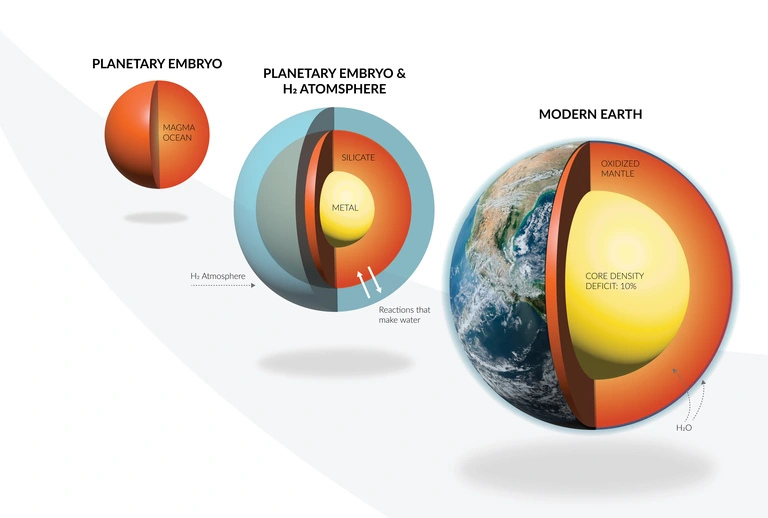
An illustration showing how some Earth’s signature features, such as its abundance of water and its overall oxidized state could potentially be attributable to  interactions between the molecular hydrogen atmospheres and magma oceans on the planetary embryos that comprised Earth’s formative years. Illustration by Edward Young/UCLA and Katherine Cain/Carnegie Institution for Science.
An illustration showing how some Earth’s signature features, such as its abundance of water and its overall oxidized state could potentially be attributable to interactions between the molecular hydrogen atmospheres and magma oceans on the planetary embryos that comprised Earth’s formative years. Illustration by Edward Young/UCLA and Katherine Cain/Carnegie Institution for Science.
Tyler O'Neal, Staff Editor EARTH SCIENCES April 18, 2023, 8:00 am

Carnegie, UCLA researchers build a model for Earth’s formation that shows a new method for detecting signs of life on other worlds

For decades, what researchers knew about planet formation was based primarily on our own Solar System. However, the explosion of exoplanet research over the past decade informed a new approach to modeling the Earth’s embryonic state. 

Our planet’s water could have originated from interactions between the hydrogen-rich atmospheres and magma oceans of the planetary embryos that comprised Earth’s formative years, according to new work from Carnegie Science’s Anat Shahar and UCLA’s Edward Young and Hilke Schlichting. Their findings could explain the origins of Earth’s signature features. matt hardy

For decades, what researchers knew about planet formation was based primarily on our own Solar System. Although there are some active debates about the formation of gas giants like Jupiter and Saturn, it is widely agreed upon that Earth and the other rocky planets accreted from the disk of dust and gas that surrounded our Sun in its youth.

As increasingly larger objects crashed into each other, the baby planetesimals that eventually formed Earth grew both larger and hotter, melting into a vast magma ocean due to the heat of collisions and radioactive elements. Over time, as the planet cooled, the densest material sank inward, separating Earth into three distinct layers—the metallic core, and the rocky, silicate mantle and crust.

However, the explosion of exoplanet research over the past decade informed a new approach to modeling the Earth’s embryonic state.

“Exoplanet discoveries have given us a much greater appreciation of how common it is for just-formed planets to be surrounded by atmospheres that are rich in molecular hydrogen, H2, during their first several million years of growth,” Shahar explained. “Eventually these hydrogen envelopes dissipate, but they leave their fingerprints on the young planet’s composition.”

Using this information, the researchers developed new models for Earth’s formation and evolution to see if our home planet’s distinct chemical traits could be replicated.

Using a newly developed model, the Carnegie and UCLA researchers were able to demonstrate that early in Earth’s existence, interactions between the magma ocean and a molecular hydrogen proto-atmosphere could have given rise to some of Earth’s signature features, such as its abundance of water and its overall oxidized state.  

The researchers used mathematical modeling to explore the exchange of materials between molecular hydrogen atmospheres and magma oceans by looking at 25 different compounds and 18 different types of reactions—complex enough to yield valuable data about Earth’s possible formative history, but simple enough to interpret fully.

Interactions between the magma ocean and the atmosphere in their simulated baby Earth resulted in the movement of large masses of hydrogen into the metallic core, the oxidation of the mantle, and the production of large quantities of water.

Even if all of the rocky material that collided to form the growing planet was completely dry, these interactions between the molecular hydrogen atmosphere and the magma ocean would generate copious amounts of water, the researchers revealed. Other water sources are possible, they say, but not necessary to explain Earth’s current state.

“This is just one possible explanation for our planet’s evolution, but one that would establish an important link between Earth’s formation history and the most common exoplanets that have been discovered orbiting distant stars, which are called Super-Earths and sub-Neptunes,” Shahar concluded.

This work was part of the interdisciplinary, multi-institution AEThER project, initiated and led by Shahar, which seeks to reveal the chemical makeup of the Milky Way galaxy’s most common planets—Super-Earths and sub-Neptunes—and to develop a framework for detecting signatures of life on distant worlds. Funded by the Alfred P. Sloan Foundation, this effort was developed to understand how the formation and evolution of these planets shape their atmospheres. This could—in turn—enable scientists to differentiate true biosignatures, which could only be produced by the presence of life, from atmospheric molecules of non-biological origin.

“Increasingly powerful telescopes are enabling astronomers to understand the compositions of exoplanet atmospheres in never-before-seen detail,” Shahar said. “AEThER’s work will inform their observations with experimental and modeling data that, we hope, will lead to a foolproof method for detecting signs of life on other worlds.”

 

Leeds geophysicists show how activity deep in Earth affects the global magnetic field

Leeds geophysicists show how activity deep in Earth affects the global magnetic field

Tyler O'Neal, Staff Editor EARTH SCIENCES March 17, 2023, 5:30 am

Compass readings that do not show the direction of true north and interference with the operations of satellites are a few of the problems caused by peculiarities of the Earth’s magnetic field. 

The magnetic field radiates worldwide and far into space, but it is set by processes that happen deep within the Earth’s core, where temperatures exceed 5,000 degrees C. 

New research from geophysicists at the University of Leeds suggests that the way this super-hot core is cooled is critical to understanding the causes of the peculiarities - or anomalies, as scientists call them - of the Earth’s magnetic field. 

Dynamo at the center of the Earth 

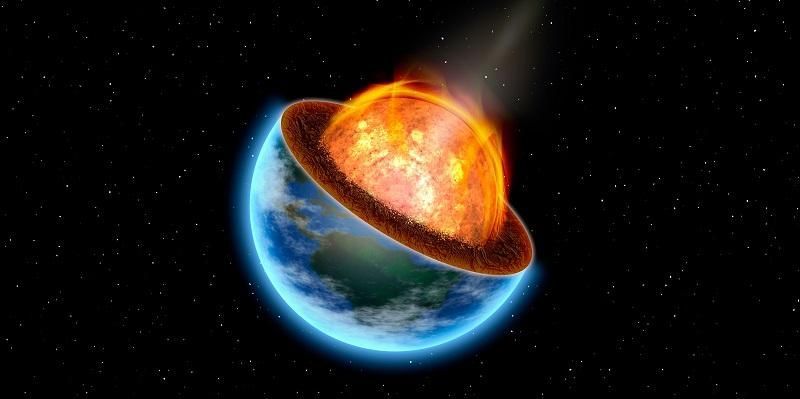
In the extremely hot temperatures found deep in the Earth, the core is a mass of swirling, molten iron which acts as a dynamo. As the molten iron moves, it generates the Earth’s global magnetic field. 

Convective currents keep the dynamo turning as heat flows out of the core and into the mantle, a rock layer that extends 2900 kilometers up to the Earth’s crust.  

Research by Dr. Jonathan Mound and Professor Christopher Davies, from the School of Earth and Environment at Leeds, has found that this cooling process does not happen in a uniform way across the Earth - and these variations cause anomalies in the Earth’s magnetic field.  

Seismic analysis has identified that regions of the mantle, under Africa and the Pacific for instance, are particularly hot. Supercomputer simulations by the researchers have revealed that these hot zones reduce the cooling effect on the core – and this causes regional or localized changes to the properties of the magnetic field. 

For example, where the mantle is hotter, the magnetic field at the top of the core is likely to be weaker.  

And this results in a weaker magnetic field which is projected into space above the South Atlantic, which causes problems for orbiting satellites. 

Interference with space technology 

Dr. Mound, who led the study, said: “One of the things that the magnetic field in space does is deflect charged particles emitted from the sun. When the magnetic field is weaker, this protective shield is not so effective.  

“So, when satellites pass over that area, these charged particles can disrupt and interfere with their operations.” 

Scientists have known about the anomaly over the South Atlantic since they started monitoring and observing the magnetic field, but it is not known if it is a long-lived feature or something that has happened more recently in the history of the Earth.  

As the study at Leeds has revealed, the anomalies are likely to be caused by differences in the rate at which heat is flowing from the Earth’s core into the mantle. Whereabouts in the Earth’s inner structure these heat flow differences happen is likely to dictate how long they could last. 

Dr. Mound added: “Processes in the mantle happen very slowly, so we can expect the temperature anomalies in the lower mantle will have stayed the same for tens of millions of years. Therefore, we would expect the properties of the magnetic field they create also to have been similar over tens of millions of years.  

“But the hotter, the outer core is quite a dynamic fluid region. So, the heat flow and the magnetic field properties they cause will probably fluctuate on shorter time scales, perhaps for 100's to thousands of years.” 

Tohoku University prof Mangin demos sub-picosecond magnetization reversal in rare-earth-free spin valves

Tohoku University prof Mangin demos sub-picosecond magnetization reversal in rare-earth-free spin valves

Tyler O'Neal, Staff Editor EARTH SCIENCES March 10, 2023, 5:00 am

Researchers at the Université de Lorraine in France and Tohoku University in Japan have demonstrated a sub-picosecond magnetization reversal in rare-earth-free archetypical spin valves. 

Manipulating magnetic materials without using magnetic fields is of paramount importance for many applications, such as non-volatile memory. Two decades ago, it was discovered that a magnetization reversal could be induced by a charge current. A decade later, a much faster, sub-picosecond control of the magnetization was achieved by shining femtosecond light pulses. This process became known as all-optical magnetization switching. However, only a few specific rare-earth-based material systems containing antiparallel alignment in magnetic sub-lattices experience such ultrafast phenomena.

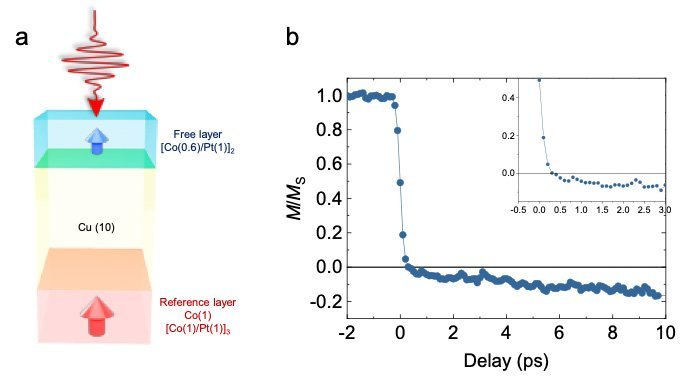
In their work, the research group demonstrated sub-picosecond optical control of magnetization in rare-earth-free archetypical spintronic structures, consisting of [Pt/Co]/Cu/[Co/Pt], at ultrafast timescales.
 A: Sample stack of a spin valve consisting of the reference layer (bottom, red layer), a Cu spacer (middle, yellow layer) and the free layer (top, blue layer). Values in parentheses are the layer thicknesses in nanometres. B: Magnetization dynamics of the free layer in the studied spin valve.
Furthermore, they observed magnetization reversal from parallel alignment, which was previously unseen and unexpected in ultrafast magnetism. Like the discovery of magnetization reversal by a charge current two decades ago, this breakthrough has the potential to drastically extend the bandwidth of common spintronic devices. This can be done by exploiting common spintronics phenomena in a strongly out-of-equilibrium context.

"Our findings provide a route for ultrafast magnetization control by bridging concepts from spintronics and ultrafast magnetism," says Dr. Junta Igarashi of the Université de Lorraine (JSPS Overseas Research Fellowships, an alumnus of Tohoku University). Professor Stéphane Mangin of the Université de Lorraine, also serving as a visiting professor at the Center for Science and Innovation in Spintronics (CSIS), Tohoku University, added, "Our findings are a milestone in the development of ultra-fast spintronics and could open the way to new applications for ultra-fast and energy-efficient memories."

The partnership between the Université de Lorraine and Tohoku University is driven, in large part, by the exchanges of graduate and post-doc students. More than a dozen exchanges on both sides have already taken place in recent months. This partnership was supported by Presidents Hideo Ohno and Pierre Mutzenhardt, who signed a consortium agreement in 2019 during the World Materials Forum, by Lorraine University of excellence, and by the sakura science exchange program and JSPS.

  1. RIKEN researcher Ueda demos PINN for modeling earthquakes
  2. University of Sydney geoscientist Salles builds a model that reveals Earth's past 100 million years

Page 5 of 23

  • 1
  • 2
  • 3
  • 4
  • 5
  • 6
  • 7
  • 8
  • 9
  • 10
POPULAR RIGHT NOW
  • AI supercharges the hunt for stronger magnets: Iowa State researchers launch a new era of intelligent materials discovery
    AI supercharges the hunt for stronger magnets: Iowa State researchers launch a new era of intelligent materials discovery
  • IBM's Historic stock collapse raises questions for the future of enterprise supercomputing
    IBM's Historic stock collapse raises questions for the future of enterprise supercomputing
  • Could a novel dark matter theory simultaneously resolve multiple cosmic enigmas? Supercomputer simulations provide a compelling, albeit currently unverified, potential solution
    Could a novel dark matter theory simultaneously resolve multiple cosmic enigmas? Supercomputer simulations provide a compelling, albeit currently unverified, potential solution
  • Melting icebergs may be reshaping Earth’s greatest ocean current
    Melting icebergs may be reshaping Earth’s greatest ocean current
  • Supercomputers replace ‘bathtub’ flood maps with physics-based digital twins of Britain’s coastline
    Supercomputers replace ‘bathtub’ flood maps with physics-based digital twins of Britain’s coastline
  • Supercomputers push neural quantum simulation beyond previous limits
    Supercomputers push neural quantum simulation beyond previous limits
  • Intel’s AI supercomputing revival: Q2 financial surge signals new era for CPU-powered HPC infrastructure
    Intel’s AI supercomputing revival: Q2 financial surge signals new era for CPU-powered HPC infrastructure
  • AI infrastructure financing fears shake semiconductor sector
    AI infrastructure financing fears shake semiconductor sector
  • AWS supercomputing investment reaches historic scale as Amazon’s AI strategy powers record financial results
    AWS supercomputing investment reaches historic scale as Amazon’s AI strategy powers record financial results
  • Catching the wave of the future: Supercomputers unlock the hidden dynamics of Venus
    Catching the wave of the future: Supercomputers unlock the hidden dynamics of Venus
THIS YEAR'S MOST READ
  • Wall Street wants to trade supercomputing power like oil
    Wall Street wants to trade supercomputing power like oil
  • Beamforming the future: BeammWave's 6G push signals the rise of orbital-terrestrial wireless networks
    Joakim Axmon
    Joakim Axmon
  • Cosmic ambition at scale: UK’s supercomputer unlocks a 2.5 petabytes universe
    Cosmic ambition at scale: UK’s supercomputer unlocks a 2.5 petabytes universe
  • Hidden order, revealed at scale: Supercomputing, electron ptychography uncover the inner workings of relaxor ferroelectrics
    Hidden order, revealed at scale: Supercomputing, electron ptychography uncover the inner workings of relaxor ferroelectrics
  • Intel's Q1 results signal supercomputing surge driving Xeon momentum
    Intel's Q1 results signal supercomputing surge driving Xeon momentum
  • When stars fall apart: Supercomputing reveals the hidden physics of black holes
    When stars fall apart: Supercomputing reveals the hidden physics of black holes
  • Multi-layer simulations reveal the hidden supply chain of solar prominences
    Multi-layer simulations reveal the hidden supply chain of solar prominences
  • Japanese scientists decode dolphin speed with supercomputing: Turbulence, vortices, and the hidden physics of propulsion
    Japanese scientists decode dolphin speed with supercomputing: Turbulence, vortices, and the hidden physics of propulsion
  • Cosmic feedback at scale: Supercomputing reveals how quasars regulate the early Universe
    Cosmic feedback at scale: Supercomputing reveals how quasars regulate the early Universe
  • Modeling life at the microscopic scale: A computational breakthrough in oxygen transport
    Modeling life at the microscopic scale: A computational breakthrough in oxygen transport
MOST READ OF ALL-TIME
  • Largest Computational Biology Simulation Mimics The Ribosome
    Details
    112127
    The amino acid (green) slithers into the chemical reaction center, moving through an evolutionarily ancient corridor of the ribosome (purple). The amino acid is delivered to the reaction core by the transfer RNA molecule (yellow).
    The amino acid (green) slithers into the chemical reaction center, moving through an evolutionarily ancient corridor of the ribosome (purple). The amino acid is delivered to the reaction core by the transfer RNA molecule (yellow).
  • Silicon 'neurons' may add a new dimension to chips
    Details
    81040
    Silicon 'neurons' may add a new dimension to chips
  • Linux Networx Accelerators Expected to Drive up to 4x Price/Performance
    Details
    75563
  • Complex Concepts That Really Add Up
    Details
    73693
    Complex Concepts That Really Add Up
  • Blue Sky Studios Donates Animation SuperComputer to Wesleyan
    Details
    68166
    Each rack holds 52 Angstrom Microsystem-brand “blades,” with a memory footprint of 12 or 24 gigabytes each. (Photos by Olivia Bartlett Drake)
    Each rack holds 52 Angstrom Microsystem-brand “blades,” with a memory footprint of 12 or 24 gigabytes each. (Photos by Olivia Bartlett Drake)
  • Humanities, HPC connect at NERSC
    Details
    57973
  • TeraGrid ’09 'Call for Participation'
    Details
    54976
  • Turbulence responsible for black holes' balancing act
    Details
    52339
  • Cray Wins $52 Million SuperComputer Contract
    Details
    50162
  • SDSC Researchers Accurately Predict Protein Docking
    Details
    46115
  • FRONTPAGE
  • LATEST
  • POPULAR
  • REGISTER
  • SOCIAL
  • VIDEO
  • SUBSCRIPTION
  • RSS
  • GUIDELINES
  • PRIVACY
  • TOS
  • ABOUT
  • +1 (816) 799-4488
  • editorial@supercomputingonline.com
© 2001 - 2026 SuperComputingOnline.com, LLC. All rights reserved. This material may not be published, broadcast, rewritten or redistributed without permission.
Sign In
  • FRONT PAGE
  • LATEST
    • MEDIA KIT
    • MOST READ
    • RSS FEED
    • ACADEMIA
    • AEROSPACE
    • APPLICATIONS
    • ASTRONOMY
    • AUTOMOTIVE
    • BIG DATA
    • BIOLOGY
    • CHEMISTRY
    • CLIENTS
    • CLOUD
    • DEFENSE
    • DEVELOPER TOOLS
    • EARTH SCIENCES
    • ECONOMICS
    • ENGINEERING
    • ENTERTAINMENT
    • HEALTH
    • INDUSTRY
    • INTERCONNECTS
    • GAMING
    • GOVERNMENT
    • MANUFACTURING
    • MIDDLEWARE
    • MOVIES
    • NETWORKS
    • OIL & GAS
    • PHYSICS
    • PROCESSORS
    • RETAIL
    • SCIENCE
    • STORAGE
    • SYSTEMS
    • VISUALIZATION
  • VIDEOS
    • ADD YOUR VIDEOS
    • MANAGE VIDEOS
  • COMMUNITY
    • TRADE SHOWS
    • SOCIAL NETWORK VIDEOS
    • SURVEYS
    • APPLICATIONS BROWSER
    • CONVERSATION INBOX
    • SOCIAL ADVERTISER
    • GROUPS
    • MARKETPLACE LISTINGS
    • PAGES
    • LEADERBOARD
    • POINTS LISTING
      • BADGES
    • PRIVACY CONFIRM REQUEST
    • PRIVACY CREATE REQUEST

Hey there! We noticed you’re using an ad blocker.