Researchers combine massive climate reanalysis datasets, extreme-weather algorithms, and ensemble snowmelt modeling to uncover a powerful, and previously underappreciated, driver of extreme snowmelt and flood risk.
They last only a few days.
They arrive when mountain snowpacks are at their seasonal peak.
And they can turn a vast reservoir of frozen water into runoff with startling speed.
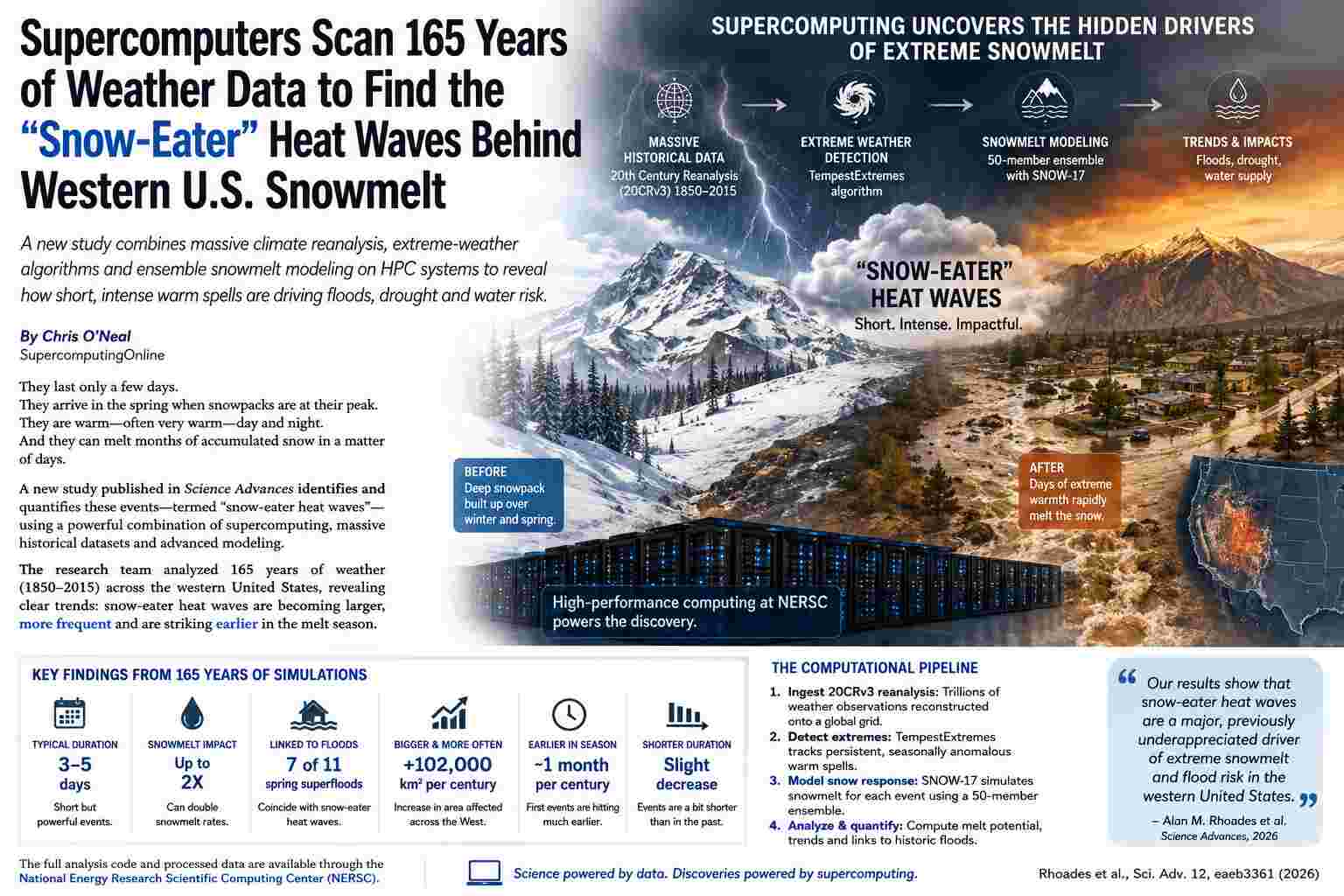
Scientists call them “snow-eater heat waves.” A new study has used high-performance computing to analyze 165 years of reconstructed weather conditions across the western United States, revealing that these short-lived events are becoming larger, more frequent, and increasingly early-season phenomena.
The research demonstrates something particularly important for the supercomputing community: the discovery depended on computational methods capable of searching enormous historical datasets, automatically identifying extreme weather patterns and modeling their physical consequences.
Rather than examining individual heat waves one at a time, the researchers built a computational framework that could examine a century and a half of atmospheric history.
The result is a new picture of how brief periods of extreme warmth can rapidly consume mountain snowpack, and potentially amplify both flood and water-supply risks.
A 165-year computational search
The study, published in Science Advances, examines snow-eater heat waves from 1850 through 2015.
That time span creates an immediate computational challenge.
Modern observational networks don't extend continuously across 165 years with the spatial coverage necessary for this kind of analysis. Instead, the researchers turned to the 20th Century Reanalysis Version 3 (20CRv3), which reconstructs historical atmospheric conditions on a global grid.
From that enormous dataset, the team developed a systematic process for identifying snow-eater heat waves.
The researchers combined the reanalysis data with the TempestExtremes extreme-weather tracking framework and the SNOW-17 snowmelt model.
That combination is important.
The computer isn't simply searching for hot days.
It is looking for specific combinations of atmospheric conditions, geography, seasonality and persistence that produce the physical phenomenon capable of rapidly accelerating snowmelt.
This is precisely the type of scientific problem for which high-performance computing excels.
Finding the events hidden in the data
A conventional analysis might begin with a list of known heat waves and examine what happened during each one.
This research turns that process around.
The computational system searches the historical record to determine which events meet the researchers' definition of a snow-eater heat wave.
That distinction is crucial.
The researchers can then build a consistent catalog of events across more than a century, allowing them to ask questions that would be difficult or impossible to answer from individual case studies.
How often did they occur?
How large were they?
How long did they last?
When did they happen?
How much snow could they melt?
And are those characteristics changing?
The answers emerge only after the computer processes the historical record as a coherent dataset.
The computational pipeline
The study essentially creates a multi-stage scientific computing pipeline:
Massive climate dataset → extreme-event detection → snowmelt modeling → ensemble calculations → statistical analysis → physical interpretation.
Each stage solves a different problem.
The 20CRv3 data provide the reconstructed atmospheric history.
TempestExtremes identifies and tracks relevant extreme-weather events.
SNOW-17 estimates the resulting snowmelt response.
The researchers then analyze the resulting event population statistically.
This is an excellent example of modern computational science in which the breakthrough doesn't come from one algorithm or one supercomputer.
It comes from connecting multiple computational tools into a scientific workflow.
Modeling the snow response
Finding a heat wave is only half the problem.
The researchers also need to determine what that heat wave does to the snowpack.
For that, they use the SNOW-17 snowmelt model and calculate a 50-member ensemble of melt-potential estimates.
The ensemble approach is important because snowmelt isn't determined by temperature alone.
The researchers aggregate results across different time periods and calculate maximum one-, three-, and five-day melt potentials. They also convert modeled snowmelt depth into estimates of water volume.
This transforms the analysis from meteorology into something directly relevant to hydrology.
The question isn't merely:
“How hot was the heat wave?”
It becomes:
“How much water could this event suddenly release from the mountain snowpack?”
That's a much more consequential computational question.
Nearly 1.1 million snow measurements
The researchers also tested their modeling against an extensive observational record.
Across western U.S. SNOTEL stations between 1980 and 2015, the study analyzed approximately 1.13 million daily snow-water-equivalent measurements.
More than 55,000 measurements occurred during identified snow-eater heat-wave days.
This is another place where computation becomes indispensable.
The researchers are not comparing a handful of observations.
They are evaluating thousands of station-days against a computationally generated catalog of extreme events.
The resulting analysis helps determine whether the modeled snow-eater signal appears in the real-world observations.
The snow eaters are getting bigger
The computational results reveal a striking pattern.
Snow-eater heat waves have expanded geographically across the western United States.
The researchers estimate that their affected area has increased by approximately 102,000 square kilometers per century. Frequency has also increased by nearly one event per century.
Perhaps even more interesting from a computational perspective is the change in timing.
The first snow-eater event of the season is occurring approximately one month earlier per century.
The events themselves have become slightly shorter.
But shorter doesn't necessarily mean less important.
A concentrated burst of extreme warmth can produce an extraordinary amount of melt in only a few days.
Heat waves that can double snowmelt
The modeling indicates that snow-eater heat waves can produce roughly twice the normal snowmelt rates.
That makes them fundamentally different from ordinary warm periods.
A conventional spring warming event gradually removes snow.
A snow-eater heat wave can accelerate the process dramatically.
And because these events occur while substantial snowpack remains in the mountains, the amount of water released can become enormous.
The study finds that snow-eater heat waves coincide with seven of eleven documented spring superfloods in the western United States.
That connection makes the computational discovery particularly valuable.
The researchers are identifying a weather phenomenon that can connect atmospheric extremes to hydrological extremes.
Why the historical simulation matters
One of the most powerful features of this research is its historical reach.
A single modern weather station can tell researchers what happened at one location over several decades.
The 20CRv3-based computational reconstruction allows scientists to examine atmospheric conditions across a much longer period and a much larger geographic region.
That effectively creates a virtual historical laboratory.
Researchers can search through decades in a matter of computational operations.
They can apply the same event-detection criteria to 1855 as they apply to 2005.
They can calculate comparable melt metrics.
They can investigate changes in geographic extent and frequency.
And they can test statistical relationships across the entire record.
Without computational methods, the scale of this analysis would be extraordinarily difficult to achieve.
Supercomputing turns weather into a search problem
There is a broader lesson here.
Modern scientific computing increasingly turns scientific questions into search problems over enormous datasets.
Instead of asking a researcher to find the interesting events manually, the computer can search millions of observations and identify candidates according to precisely defined physical criteria.
That changes how discoveries are made.
The scientist defines the question.
The computer searches the data.
The model tests the physical consequences.
And the researcher interprets the resulting patterns.
In this study, that process exposed an extreme-weather phenomenon that can otherwise be hidden among the enormous variability of daily weather.
The NERSC connection
The computational character of the work is reinforced by its connection to the National Energy Research Scientific Computing Center (NERSC).
The study makes its analysis code and processed data available through NERSC, helping make the computational workflow more reproducible and useful to other researchers.
That is increasingly important in computational science.
The scientific result is no longer just a paper.
It can include:
- the source data;
- processing workflows;
- event-detection algorithms;
- model configurations;
- ensemble calculations;
- analysis code; and
- derived datasets.
Together, those components form a computational research artifact that other scientists can inspect, reproduce, and extend.
From supercomputer to water manager
Perhaps the most compelling part of the research is where the computation ultimately leads.
A supercomputer identifies an atmospheric pattern.
An algorithm tracks it.
A snow model estimates its physical impact.
An ensemble quantifies uncertainty.
A statistical analysis reveals its long-term behavior.
And the final result can inform water-resource management and flood forecasting.
That is the full value chain of high-performance scientific computing.
The supercomputer isn't the final destination.
It is the engine that turns massive quantities of raw information into something humans can use.
A New kind of flood warning
The findings also suggest that recognizing snow-eater heat waves could improve the way scientists think about extreme runoff.
Traditional flood forecasting often focuses heavily on precipitation.
But in snow-dominated watersheds, the atmosphere can effectively deliver water in another form: stored snow.
A heat wave can unlock that storage rapidly.
The computational identification of snow-eater events therefore provides another potential indicator of elevated runoff risk.
It offers a way of thinking about floods not simply as the result of too much rain, but sometimes as the result of too much heat applied to too much stored snow at the wrong time.
Why HPC matters
This is exactly the kind of research that demonstrates why high-performance computing remains essential to Earth-system science.
The important computational workload isn't necessarily one enormous simulation running for months.
It is the combination of: huge datasets + automated detection + physical modeling + ensemble calculations + statistical analysis.
Modern HPC systems are increasingly being used this way.
They become engines for interrogating historical records, testing hypotheses, and finding patterns that would otherwise remain invisible.
The scale of the data becomes part of the scientific instrument.
The computer found the pattern
Perhaps the best way to understand the study is to imagine trying to perform the analysis without computers.
Take 165 years of atmospheric history.
Identify every period meeting the physical definition of a snow-eater heat wave.
Track each event.
Determine its geographic footprint.
Calculate the associated snowmelt.
Run ensemble estimates.
Compare the results against more than a million snow measurements.
Then determine whether the events are changing over time.
It is not simply a large amount of work.
It is the wrong kind of work for humans to perform manually.
It is exactly the kind of problem computers were built to solve.
And that is where the story becomes bigger than snow.
Supercomputing reveals the weather we didn't know we were missing
This study marks a significant evolution in atmospheric science by demonstrating that high-performance computing (HPC) is not just a tool for acceleration, but a primary instrument for discovery. By moving beyond traditional case studies, the researchers transformed 165 years of climate data into a searchable, quantifiable historical record.
This approach highlights a shift in scientific methodology:
Core Components of the Computational Workflow:
- Massive Dataset Synthesis: Leveraging the 20th Century Reanalysis (20CRv3) to create a continuous, multi-decadal grid of atmospheric history.
- Automated Detection: Using TempestExtremes to filter millions of data points into a specific, identifiable class of weather events.
- Physical Modeling: Integrating the SNOW-17 model to convert meteorological metrics into hydrological impacts, specifically measuring water volume released from snowpack.
- Ensemble Uncertainty: Applying 50-member ensemble calculations to quantify melt potential, providing a robust range of outcomes rather than a single estimate.
- Statistical Interpretation: Analyzing the resulting catalog to identify long-term trends, such as the earlier arrival and expanded geographic reach of these events.
The value of this study lies in its ability to bridge the gap between abstract weather data and actionable water-resource management. By identifying that “snow-eater” heat waves correlate with the majority of major spring superfloods, the researchers have provided a new framework for predicting hydrological risks. This research underscores that the most critical frontier in Earth science is not just gathering more data, but developing the computational pipelines necessary to uncover the complex, systemic patterns already embedded in the data we currently possess.