SUPERCOMPUTING NEWS SUPERCOMPUTING NEWS
    • MEDIA KIT
    • MOST READ
    • RSS FEED
    • ACADEMIA
    • AEROSPACE
    • APPLICATIONS
    • ASTRONOMY
    • AUTOMOTIVE
    • BIG DATA
    • BIOLOGY
    • CHEMISTRY
    • CLIENTS
    • CLOUD
    • DEFENSE
    • DEVELOPER TOOLS
    • EARTH SCIENCES
    • ECONOMICS
    • ENGINEERING
    • ENTERTAINMENT
    • GAMING
    • GOVERNMENT
    • HEALTH
    • OIL & GAS
    • INDUSTRY
    • INTERCONNECTS
    • MANUFACTURING
    • MIDDLEWARE
    • MOVIES
    • NETWORKS
    • PHYSICS
    • PROCESSORS
    • RETAIL
    • SCIENCE
    • STORAGE
    • SYSTEMS
    • VISUALIZATION
    • AcyMailing subscription form

    • ADD YOUR VIDEOS
    • MANAGE VIDEOS
    • CONVERSATION INBOX
    • SOCIAL ADVERTISER
    • SOCIAL NETWORK VIDEOS
    • SURVEYS
    • GROUPS
    • PAGES
    • MARKETPLACE LISTINGS
    • APPLICATIONS BROWSER
    • PRIVACY CONFIRM REQUEST
    • PRIVACY CREATE REQUEST
    • LEADERBOARD
    • POINTS LISTING
      • BADGES
    • TRADE SHOWS
Sign In
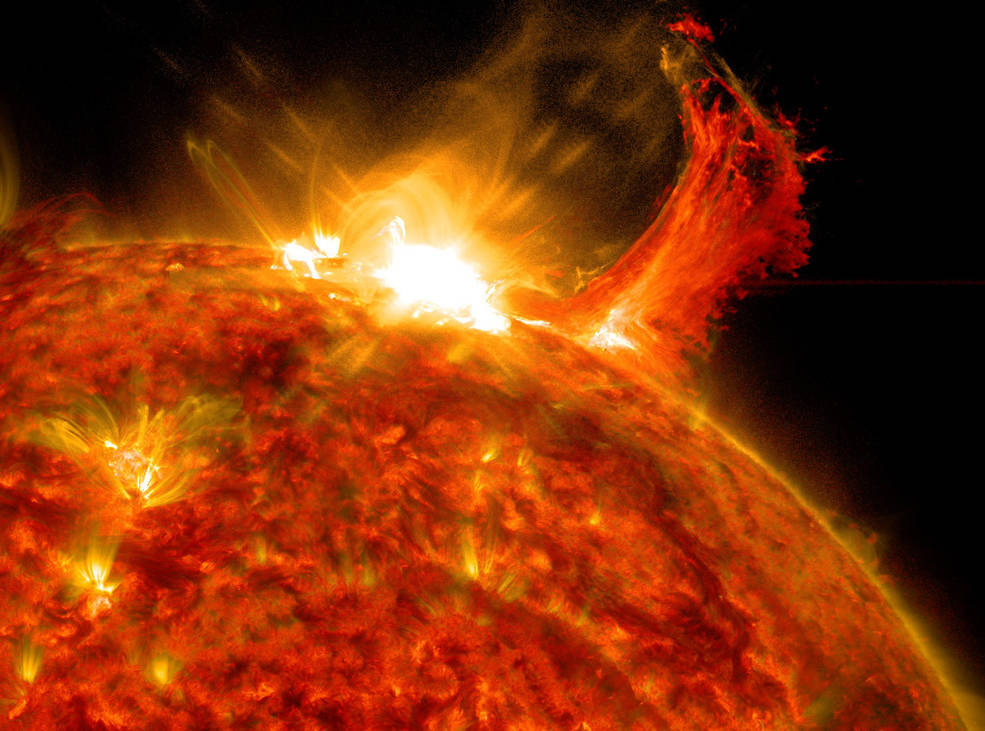
NASA's Solar Dynamics Observatory captured this image of a solar flare on Oct. 2, 2014. The solar flare is the bright flash of light at top. A burst of solar material erupting out into space can be seen just to the right of it. Credits: NASA/SDO
Tyler O'Neal, Staff Editor ACADEMIA March 30, 2023, 1:30 pm

NASA-built supercomputer model DAGGER makes predictions with AI to give time to prepare for solar storms

Like a tornado siren for life-threatening storms in America’s heartland, a new supercomputer model that combines artificial intelligence (AI) and NASA satellite data could sound the alarm for dangerous space weather. This movie, captured by SOHO

The model uses AI to analyze spacecraft measurements of the solar wind (an unrelenting stream of material from the Sun) and predict where an impending solar storm will strike, anywhere on Earth, with 30 minutes of warning. This could provide just enough time to prepare for these storms and prevent severe impacts on power grids and other critical infrastructure.

The Sun constantly sheds solar material into space – both in a steady flow known as the “solar wind,” and in shorter, more energetic bursts from solar eruptions. When this solar material strikes Earth’s magnetic environment (its “magnetosphere”), it sometimes creates so-called geomagnetic storms. The impacts of these magnetic storms can range from mild to extreme, but in a world increasingly dependent on technology, their effects are growing ever more disruptive.

For example, a destructive solar storm in 1989 caused electrical blackouts across Quebec for 12 hours, plunging millions of Canadians into the dark and closing schools and businesses. The most intense solar storm on record, the Carrington Event in 1859, sparked fires at telegraph stations and prevented messages from being sent. If the Carrington Event happened today, it would have even more severe impacts, such as widespread electrical disruptions, persistent blackouts, and interruptions to global communications. Such technological chaos could cripple economies and endanger the safety and livelihoods of people worldwide.

In addition, the risk of geomagnetic storms and devastating effects on our society is presently increasing as we approach the next “solar maximum” – a peak in the Sun’s 11-year activity cycle – which is expected to arrive sometime in 2025.

To help prepare, an international team of researchers at the Frontier Development Lab – a public-private partnership that includes NASA, the U.S. Geological Survey, and the U.S. Department of Energy – have been using artificial intelligence (AI) to look for connections between the solar wind and geomagnetic disruptions, or perturbations, that cause havoc on our technology. The researchers applied an AI method called “deep learning,” which trains computers to recognize patterns based on previous examples. They used this type of AI to identify relationships between solar wind measurements from heliophysics missions (including ACE, Wind, IMP-8, and Geotail) and geomagnetic perturbations observed at ground stations across the planet.
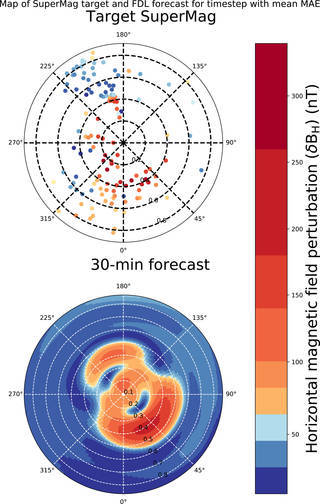
DAGGER’s developers compared the model’s predictions to measurements made during solar storms in August 2011 and March 2015. At the top, colored dots show measurements made during the 2011 storm. Colors indicate the intensity of geomagnetic perturbations that can induce currents in electric grids, with orange and red indicating the strongest effects. DAGGER’s 30-minute forecast for that same time (bottom) shows the most intense perturbations in approximately the same locations around Earth’s north pole. Credits: V. Upendran et al.From this, they developed a supercomputer model called DAGGER (formally, Deep Learning Geomagnetic Perturbation) that can quickly and accurately predict geomagnetic disturbances worldwide, 30 minutes before they occur. According to the team, the model can produce predictions in less than a second, and the predictions update every minute.

The DAGGER team tested the model against two geomagnetic storms that happened in August 2011 and March 2015. In each case, DAGGER was able to quickly and accurately forecast the storm’s impacts around the world.

Previous prediction models have used AI to produce local geomagnetic forecasts for specific locations on Earth. Other models that didn’t use AI have provided global predictions that weren’t very timely. DAGGER is the first one to combine the swift analysis of AI with real measurements from space and across Earth to generate frequently updated predictions that are both prompt and precise for sites worldwide.

“With this AI, it is now possible to make rapid and accurate global predictions and inform decisions in the event of a solar storm, thereby minimizing – or even preventing – devastation to modern society,” said Vishal Upendran of the Inter-University Center for Astronomy and Astrophysics in India, who is the lead author of a paper about the DAGGER model published in the journal Space Weather.

The supercomputer code in the DAGGER model is open source, and according to Upendran, it could be adopted, with help, by power grid operators, satellite controllers, telecommunications companies, and others to apply the predictions for their specific needs. Such warnings could give them time to take action to protect their assets and infrastructure from an impending solar storm, such as temporarily taking sensitive systems offline or moving satellites to different orbits to minimize damage.

With models like DAGGER, there could one day be solar storm sirens that sound an alarm in power stations and satellite control centers around the world, just as tornado sirens wail in advance of threatening terrestrial weather in towns and cities across America.

Researchers envision a future where artificial intelligence is used to craft better survey questions, refining them to be more accessible and representative; and even simulate populations that are difficult to reach.  CREDIT Illustration by Nate Edwards
Researchers envision a future where artificial intelligence is used to craft better survey questions, refining them to be more accessible and representative; and even simulate populations that are difficult to reach. CREDIT Illustration by Nate Edwards

Can AI predict how you'll vote in the next election?

Tyler O'Neal, Staff Editor ACADEMIA March 30, 2023, 4:00 am

BYU study proves artificial intelligence can respond to complex survey questions like a real human.

Artificial intelligence technologies like ChatGPT are seemingly doing everything these days: writing code, composing music and even creating images so realistic you'll think they were taken by professional photographers. Add thinking and responding like a human to the conga line of capabilities. A recent study from BYU proves that artificial intelligence can respond to complex survey questions just like a real human.

To determine the possibility of using artificial intelligence as a substitute for human responders in survey-style research, a team of political science and computer science professors and graduate students at BYU tested the accuracy of programmed algorithms of a GPT-3 language model – a model that mimics the complicated relationship between human ideas, attitudes, and sociocultural contexts of subpopulations.

In one experiment, the researchers created artificial personas by assigning the AI certain characteristics like race, age, ideology, and religiosity; and then tested to see if the artificial personas would vote the same as humans did in 2012, 2016, and 2020 U.S. presidential elections. Using the American National Election Studies (ANES) for their comparative human database, they found a high correspondence between how the AI and humans voted.

"I was absolutely surprised to see how accurately it matched up," said David Wingate, BYU computer science professor, and co-author of the study. "It's especially interesting because the model wasn't trained to do political science – it was just trained on a hundred billion words of text downloaded from the internet. But the consistent information we got back was so connected to how people really voted."

In another experiment, they conditioned artificial personas to offer responses from a list of options in an interview-style survey, again using the ANES as their human sample. They found a high similarity between nuanced patterns in human and AI responses.

This innovation holds exciting prospects for researchers, marketers, and pollsters. Researchers envision a future where artificial intelligence is used to craft better survey questions, refining them to be more accessible and representative; and even simulate populations that are difficult to reach. It can be used to test surveys, slogans, and taglines as a precursor to focus groups.

"We're learning that AI can help us understand people better," said BYU political science professor Ethan Busby. "It's not replacing humans, but it is helping us more effectively study people. It's about augmenting our ability rather than replacing it. It can help us be more efficient in our work with people by allowing us to pre-test our surveys and our messaging."

And while the expansive possibilities of large language models are intriguing, the rise of artificial intelligence poses a host of questions – how much does AI really know? Which populations will benefit from this technology and which will be negatively impacted? And how can we protect ourselves from scammers and fraudsters who will manipulate AI to create more sophisticated phishing scams?

While much of that is still to be determined, the study lays out a set of criteria that future researchers can use to determine how accurate an AI model is for different subject areas.

"We're going to see positive benefits because it's going to unlock new capabilities," said Wingate, noting that AI can help people in many different jobs be more efficient. "We're also going to see negative things happen because sometimes computer models are inaccurate and sometimes they're biased. It will continue to churn society."

Busby says surveying artificial personas shouldn't replace the need to survey real people and that academics and other experts need to come together to define the ethical boundaries of artificial intelligence surveying in research related to social science.

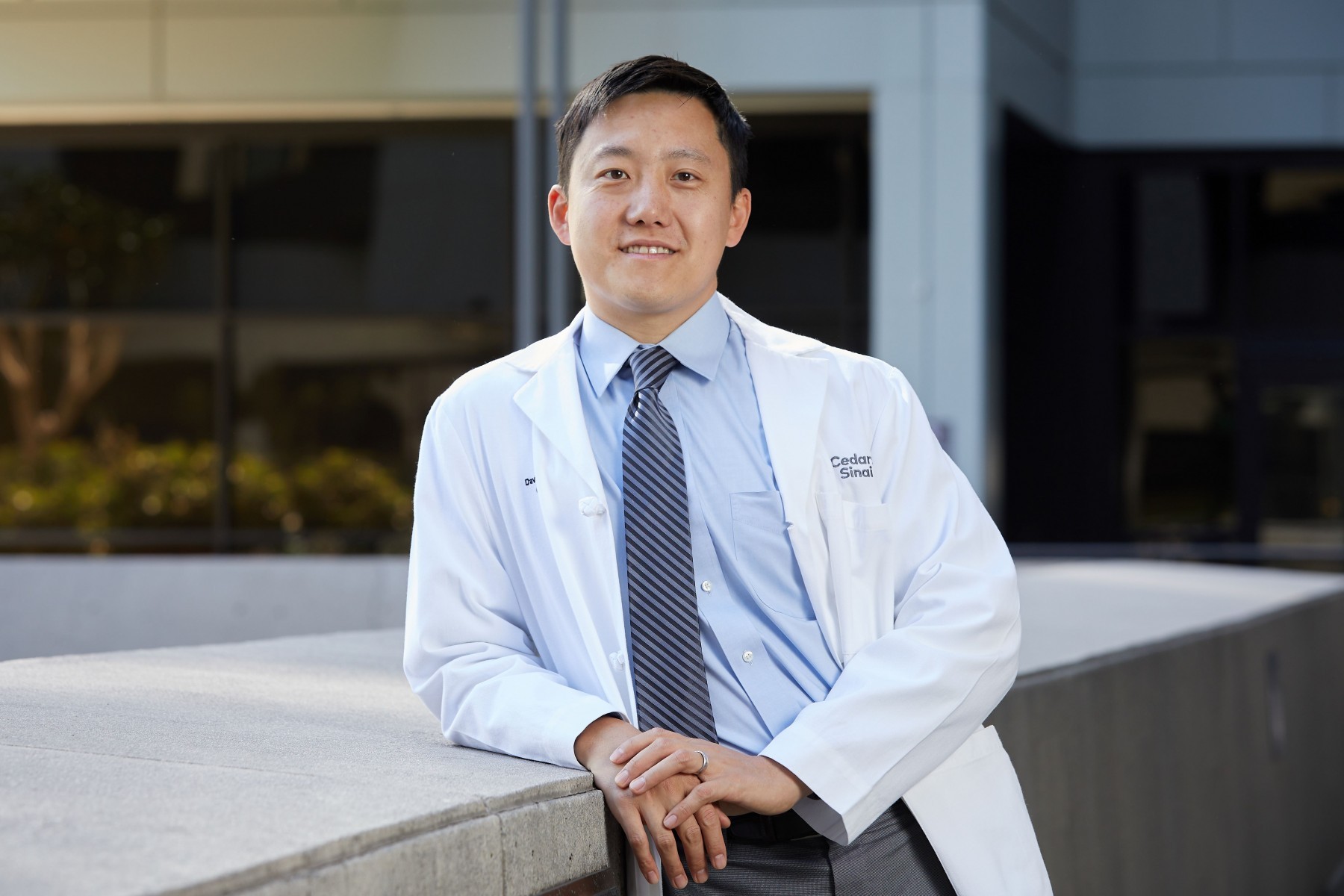
A new study, led by David Ouyang, MD, a cardiologist in the Smidt Heart Institute and a researcher in the Division of Artificial Intelligence in Medicine, found individuals with spherical hearts were 31% more likely to develop atrial fibrillation and 24% more likely to develop cardiomyopathy, a type of heart muscle disease.

The shape of your heart matters

Tyler O'Neal, Staff Editor ACADEMIA March 29, 2023, 11:00 am

New research from the Smidt Heart Institute finds that your heart’s shape and specific genetic markers may predict the risk for developing atrial fibrillation and heart muscle disease

Curious to know if you’re at risk for two common heart conditions? Your doctor may want to check the shape of your heart. 

Investigators from the Smidt Heart Institute at Cedars-Sinai have discovered that patients who have round hearts shaped like baseballs are more likely to develop future heart failure and atrial fibrillation than patients who have longer hearts shaped like the traditional Valentine heart. 

Their findings, published in Med—Cell Press’ new peer-reviewed medical journal—used deep learning and advanced imaging analysis to study the genetics of heart structure. Their results were telling.

“We found that individuals with spherical hearts were 31% more likely to develop atrial fibrillation and 24% more likely to develop cardiomyopathy, a type of heart muscle disease,” said David Ouyang, MD, a cardiologist in the Smidt Heart Institute and a researcher in the Division of Artificial Intelligence in Medicine.

The risk was identified after investigators analyzed cardiac MRI images from 38,897 healthy individuals from the UK Biobank. Using this same database, researchers then used computational models to identify genetic markers of the heart that are associated with these cardiac conditions.

“By looking at the genetics of sphericity, we found four genes associated with cardiomyopathy: PLN, ANGPT1, PDZRN3, and HLA DR/DQ,” said Ouyang. “The first three of these genes were also associated with a greater risk of developing atrial fibrillation.”

Atrial fibrillation, the most common type of abnormal heart rhythm disorder, greatly increases a person’s risk of having a stroke. The condition is rising in prevalence and is projected to affect 12.1 million people in the U.S. by 2030. 

Cardiomyopathy is a type of heart muscle disease that makes it harder for the heart to pump blood to the rest of the body and can eventually lead to heart failure. The main types of cardiomyopathies—dilated, hypertrophic, arrhythmogenic, and restrictive—affect as many as 1 of every 500 adults. 

Christine M. Albert, MD, MPHCedars-Sinai cardiologists say the shape of one’s heart changes over years, typically becoming rounder over time and especially after a major cardiac event like a heart attack.

“A change in the heart’s shape may be a first sign of disease,” said Christine M. Albert, MD, MPH, chair of the Department of Cardiology at the Smidt Heart Institute and a study author. “Understanding how a heart changes when faced with illness—coupled with now having more reliable and intuitive imaging to support this knowledge—is a critical step in prevention for two life-altering diseases.” 

Ouyang says the findings provide more clarity on the potential use of cardiac imaging to diagnose more effectively—and prevent—many conditions. He also emphasized the need for additional studies. 

“Large biobanks with cardiac imaging data now offer an opportunity to analyze and define variation in cardiac structure and function that was not possible using traditional approaches,” said Ouyang. “Deep learning and computer vision also allow for faster as well as more comprehensive cardiac measures that may help to identify genetic variations affecting a heart—up to years or even decades before any obvious heart disease develops.”  

  1. Swiss magnonics researchers demo spin waves for a new supercomputing architecture
  2. UK prof Nightingale uses gravitational lensing, supercomputing to discover one of the biggest black holes

Page 34 of 123

  • 29
  • 30
  • 31
  • 32
  • 33
  • 34
  • 35
  • 36
  • 37
  • 38
POPULAR RIGHT NOW
  • Supercomputers uncover a new class of cosmic explosions hidden in plain sight
    Supercomputers uncover a new class of cosmic explosions hidden in plain sight
  • AI supercharges the hunt for stronger magnets: Iowa State researchers launch a new era of intelligent materials discovery
    AI supercharges the hunt for stronger magnets: Iowa State researchers launch a new era of intelligent materials discovery
  • IBM's Historic stock collapse raises questions for the future of enterprise supercomputing
    IBM's Historic stock collapse raises questions for the future of enterprise supercomputing
  • Could a novel dark matter theory simultaneously resolve multiple cosmic enigmas? Supercomputer simulations provide a compelling, albeit currently unverified, potential solution
    Could a novel dark matter theory simultaneously resolve multiple cosmic enigmas? Supercomputer simulations provide a compelling, albeit currently unverified, potential solution
  • Melting icebergs may be reshaping Earth’s greatest ocean current
    Melting icebergs may be reshaping Earth’s greatest ocean current
  • Supercomputers replace ‘bathtub’ flood maps with physics-based digital twins of Britain’s coastline
    Supercomputers replace ‘bathtub’ flood maps with physics-based digital twins of Britain’s coastline
  • Supercomputers push neural quantum simulation beyond previous limits
    Supercomputers push neural quantum simulation beyond previous limits
  • Intel’s AI supercomputing revival: Q2 financial surge signals new era for CPU-powered HPC infrastructure
    Intel’s AI supercomputing revival: Q2 financial surge signals new era for CPU-powered HPC infrastructure
  • AI infrastructure financing fears shake semiconductor sector
    AI infrastructure financing fears shake semiconductor sector
  • AWS supercomputing investment reaches historic scale as Amazon’s AI strategy powers record financial results
    AWS supercomputing investment reaches historic scale as Amazon’s AI strategy powers record financial results
THIS YEAR'S MOST READ
  • Wall Street wants to trade supercomputing power like oil
    Wall Street wants to trade supercomputing power like oil
  • Cosmic ambition at scale: UK’s supercomputer unlocks a 2.5 petabytes universe
    Cosmic ambition at scale: UK’s supercomputer unlocks a 2.5 petabytes universe
  • Hidden order, revealed at scale: Supercomputing, electron ptychography uncover the inner workings of relaxor ferroelectrics
    Hidden order, revealed at scale: Supercomputing, electron ptychography uncover the inner workings of relaxor ferroelectrics
  • Beamforming the future: BeammWave's 6G push signals the rise of orbital-terrestrial wireless networks
    Joakim Axmon
    Joakim Axmon
  • Intel's Q1 results signal supercomputing surge driving Xeon momentum
    Intel's Q1 results signal supercomputing surge driving Xeon momentum
  • When stars fall apart: Supercomputing reveals the hidden physics of black holes
    When stars fall apart: Supercomputing reveals the hidden physics of black holes
  • Multi-layer simulations reveal the hidden supply chain of solar prominences
    Multi-layer simulations reveal the hidden supply chain of solar prominences
  • Japanese scientists decode dolphin speed with supercomputing: Turbulence, vortices, and the hidden physics of propulsion
    Japanese scientists decode dolphin speed with supercomputing: Turbulence, vortices, and the hidden physics of propulsion
  • Cosmic feedback at scale: Supercomputing reveals how quasars regulate the early Universe
    Cosmic feedback at scale: Supercomputing reveals how quasars regulate the early Universe
  • Modeling life at the microscopic scale: A computational breakthrough in oxygen transport
    Modeling life at the microscopic scale: A computational breakthrough in oxygen transport
MOST READ OF ALL-TIME
  • Largest Computational Biology Simulation Mimics The Ribosome
    Details
    112108
    The amino acid (green) slithers into the chemical reaction center, moving through an evolutionarily ancient corridor of the ribosome (purple). The amino acid is delivered to the reaction core by the transfer RNA molecule (yellow).
    The amino acid (green) slithers into the chemical reaction center, moving through an evolutionarily ancient corridor of the ribosome (purple). The amino acid is delivered to the reaction core by the transfer RNA molecule (yellow).
  • Silicon 'neurons' may add a new dimension to chips
    Details
    80994
    Silicon 'neurons' may add a new dimension to chips
  • Linux Networx Accelerators Expected to Drive up to 4x Price/Performance
    Details
    75538
  • Complex Concepts That Really Add Up
    Details
    73637
    Complex Concepts That Really Add Up
  • Blue Sky Studios Donates Animation SuperComputer to Wesleyan
    Details
    68141
    Each rack holds 52 Angstrom Microsystem-brand “blades,” with a memory footprint of 12 or 24 gigabytes each. (Photos by Olivia Bartlett Drake)
    Each rack holds 52 Angstrom Microsystem-brand “blades,” with a memory footprint of 12 or 24 gigabytes each. (Photos by Olivia Bartlett Drake)
  • Humanities, HPC connect at NERSC
    Details
    57947
  • TeraGrid ’09 'Call for Participation'
    Details
    54952
  • Turbulence responsible for black holes' balancing act
    Details
    52312
  • Cray Wins $52 Million SuperComputer Contract
    Details
    50140
  • SDSC Researchers Accurately Predict Protein Docking
    Details
    46080
  • FRONTPAGE
  • LATEST
  • POPULAR
  • REGISTER
  • SOCIAL
  • VIDEO
  • SUBSCRIPTION
  • RSS
  • GUIDELINES
  • PRIVACY
  • TOS
  • ABOUT
  • +1 (816) 799-4488
  • editorial@supercomputingonline.com
© 2001 - 2026 SuperComputingOnline.com, LLC. All rights reserved. This material may not be published, broadcast, rewritten or redistributed without permission.
Sign In
  • FRONT PAGE
  • LATEST
    • MEDIA KIT
    • MOST READ
    • RSS FEED
    • ACADEMIA
    • AEROSPACE
    • APPLICATIONS
    • ASTRONOMY
    • AUTOMOTIVE
    • BIG DATA
    • BIOLOGY
    • CHEMISTRY
    • CLIENTS
    • CLOUD
    • DEFENSE
    • DEVELOPER TOOLS
    • EARTH SCIENCES
    • ECONOMICS
    • ENGINEERING
    • ENTERTAINMENT
    • HEALTH
    • INDUSTRY
    • INTERCONNECTS
    • GAMING
    • GOVERNMENT
    • MANUFACTURING
    • MIDDLEWARE
    • MOVIES
    • NETWORKS
    • OIL & GAS
    • PHYSICS
    • PROCESSORS
    • RETAIL
    • SCIENCE
    • STORAGE
    • SYSTEMS
    • VISUALIZATION
  • VIDEOS
    • ADD YOUR VIDEOS
    • MANAGE VIDEOS
  • COMMUNITY
    • TRADE SHOWS
    • SOCIAL NETWORK VIDEOS
    • SURVEYS
    • APPLICATIONS BROWSER
    • CONVERSATION INBOX
    • SOCIAL ADVERTISER
    • GROUPS
    • MARKETPLACE LISTINGS
    • PAGES
    • LEADERBOARD
    • POINTS LISTING
      • BADGES
    • PRIVACY CONFIRM REQUEST
    • PRIVACY CREATE REQUEST

Hey there! We noticed you’re using an ad blocker.