SUPERCOMPUTING NEWS SUPERCOMPUTING NEWS
    • MEDIA KIT
    • MOST READ
    • RSS FEED
    • ACADEMIA
    • AEROSPACE
    • APPLICATIONS
    • ASTRONOMY
    • AUTOMOTIVE
    • BIG DATA
    • BIOLOGY
    • CHEMISTRY
    • CLIENTS
    • CLOUD
    • DEFENSE
    • DEVELOPER TOOLS
    • EARTH SCIENCES
    • ECONOMICS
    • ENGINEERING
    • ENTERTAINMENT
    • GAMING
    • GOVERNMENT
    • HEALTH
    • OIL & GAS
    • INDUSTRY
    • INTERCONNECTS
    • MANUFACTURING
    • MIDDLEWARE
    • MOVIES
    • NETWORKS
    • PHYSICS
    • PROCESSORS
    • RETAIL
    • SCIENCE
    • STORAGE
    • SYSTEMS
    • VISUALIZATION
    • AcyMailing subscription form

    • ADD YOUR VIDEOS
    • MANAGE VIDEOS
    • CONVERSATION INBOX
    • SOCIAL ADVERTISER
    • SOCIAL NETWORK VIDEOS
    • SURVEYS
    • GROUPS
    • PAGES
    • MARKETPLACE LISTINGS
    • APPLICATIONS BROWSER
    • PRIVACY CONFIRM REQUEST
    • PRIVACY CREATE REQUEST
    • LEADERBOARD
    • POINTS LISTING
      • BADGES
    • TRADE SHOWS
Sign In
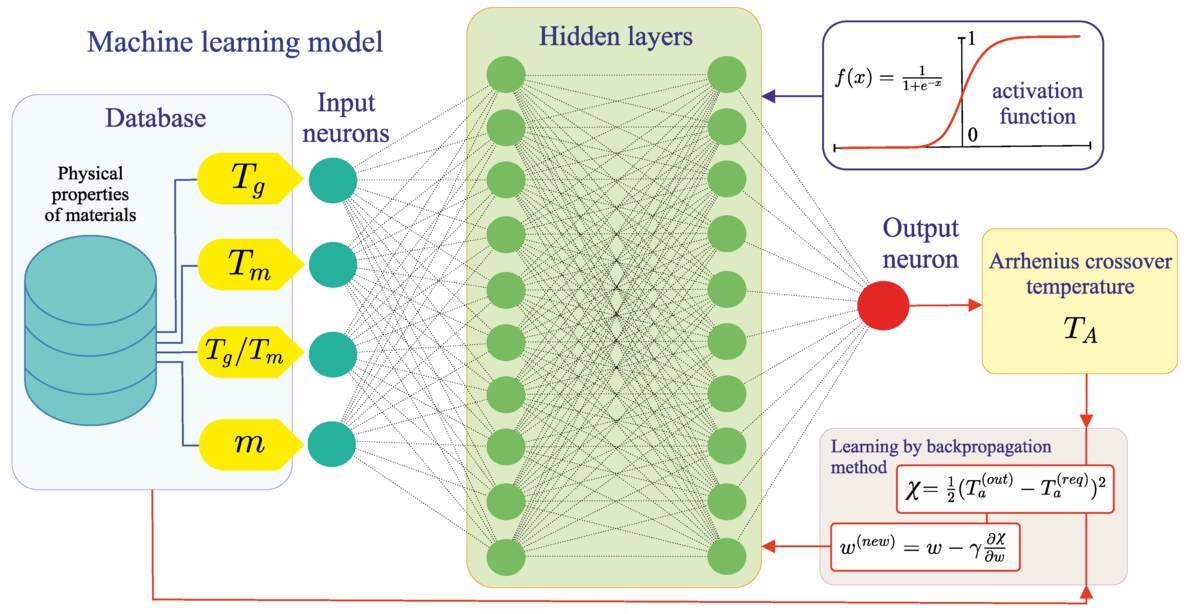
Scheme of the machine learning model based on the feedforward artificial neural network
Tyler O'Neal, Staff Editor ACADEMIA February 27, 2023, 9:00 am

Russian scientists develop a neural network algorithm that predicts Arrhenius crossover temperature with 90 percent accuracy

A joint paper by the Department of Computational Physics and Modeling of Physical Processes and Udmurt Federal Research Center of the Russian Academy of Sciences saw light in Materials.

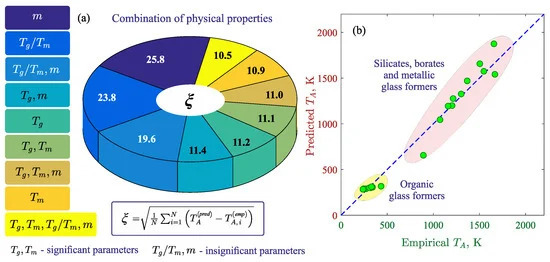
The algorithm can help speed up the production of many materials, including metal alloys, and simplify quality control during such production. An algorithm based on a neural network created at KFU makes it possible to accurately calculate the Arrhenius temperature from several physical parameters of the material. (a) Diagram of the root mean square error ξ of estimation of the Arrhenius crossover temperature TA calculated for various combinations of the quantities Tm, Tg, Tg/Tm and m, which were the inputs of the machine learning model. Inset: T(pred)A and T(emp)A are the predicted and empirical Arrhenius crossover temperatures, respectively. (b) Correspondence between the empirical TA and the TA predicted by the machine learning model using the validation data set.

Among the parameters used by the team for modeling were melting temperature, glass transition temperature, and brittleness value. They are used to describe phase transitions and structural changes in liquids during cooling.

Co-author, Associate Professor Bulat Galimzyanov comments, “Many solid materials, such as glass, metals, plastics, initially have the form of melts – they are viscous liquids that solidify at a certain temperature, turning into a solid state. The temperature at which a change in the state of aggregation begins is called the Arrhenius temperature. When approaching it, the atoms of matter begin to move in groups and more slowly than before. This indicates the preparation of the liquid for solidification.”

The algorithm was tested for metallic, silicate, borate, and organic glasses, according to the interviewee, “We found out that for the created neural network, the melting and glass transition temperatures of the material are significant and sufficient characteristics for estimating the Arrhenius temperature. From these two values, the algorithm determined the Arrhenius temperature for all analyzed liquids with an accuracy of more than 90 percent.”

The scientists worked out an equation linking the Arrhenius temperature with the melting temperatures and the glass transition temperature.

“Glass transition and melting temperatures are easily measured in lab conditions. Furthermore, they can be found in the literature. Thus, determining the Arrhenius temperature has now become easier. We can analyze the properties of liquids faster and estimate the characteristics of resulting solid materials more precisely,” concludes Galimzyanov.

The team further plans to adapt the created algorithm to more complex materials, such as polymers.

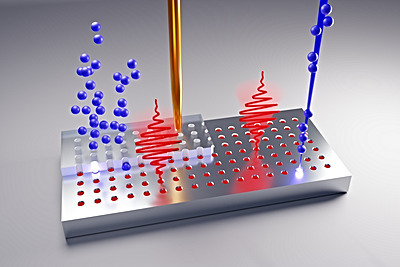
Controlled generation of single-photon emitters in silicon (red) by broad-beam implantation of ions (blue) through a lithographically defined mask (left) and by a scanned focused ion beam (right). Symbolically shown: the emission of two single photons at locations defined for this purpose by the process. In the background: An electron beam creates holes in the lithographic mask made of acrylate.  Source: M. Hollenbach, B. Schröder/HZDR
Controlled generation of single-photon emitters in silicon (red) by broad-beam implantation of ions (blue) through a lithographically defined mask (left) and by a scanned focused ion beam (right). Symbolically shown: the emission of two single photons at locations defined for this purpose by the process. In the background: An electron beam creates holes in the lithographic mask made of acrylate. Source: M. Hollenbach, B. Schröder/HZDR

Germany builds single-photon emitters in silicon at the nanoscale

Tyler O'Neal, Staff Editor ACADEMIA February 23, 2023, 5:55 am

Very shortly, quantum supercomputers are expected to revolutionize the way we compute, with new approaches to database searches, AI systems, simulations, and more. But to achieve such novel quantum technology applications, photonic integrated circuits which can effectively control photonic quantum states – the so-called qubits – are needed. Physicists from the Helmholtz-Zentrum Dresden-Rossendorf (HZDR), TU Dresden, and Leibniz-Institut für Kristallzüchtung (IKZ) have made a breakthrough in this effort: for the first time, they demonstrated the controlled creation of single-photon emitters in silicon at the nanoscale.

Photonic integrated circuits, or in short, PICs, utilize particles of light, better known as photons, as opposed to electrons that run in electronic integrated circuits. The main difference between the two is: A photonic integrated circuit provides functions for information signals imposed on optical wavelengths typically in the near-infrared spectrum. “Actually, these PICs with many integrated photonic components can generate, route, process, and detect light on a single chip”, says Dr. Georgy Astakhov, Head of Quantum Technologies at HZDR's Institute of Ion Beam Physics and Materials Research, and adds: “This modality is poised to play a key role in upcoming future technology, such as quantum computing. And PICs will lead the way.”

Before, quantum photonics experiments were notorious for the massive use of “bulk optics” distributed across the optical table and occupying the entire lab. Now, photonic chips are radically changing this landscape. Miniaturization, stability, and suitability for mass production might turn them into the workhorse of modern-day quantum photonics.

From random to control mode

Monolithic integration of single-photon sources in a controllable way would give a resource-efficient route to implement millions of photonic qubits in PICs. To run quantum computation protocols, these photons must be indistinguishable. With this, industrial-scale photonic quantum processor production would become feasible.

However, the currently established fabrication method stands in the way of the compatibility of this promising concept with today's semiconductor technology.

In a first attempt reported about two years ago, the researchers were already able to generate single photons on a silicon wafer, but only in a random and non-scalable way. Since then, they have come far. “Now, we show how focused ion beams from liquid metal alloy ion sources are used to place single-photon emitters at desired positions on the wafer while obtaining a high creation yield and high spectral quality”, says Dr. Nico Klingner, physicist.

Furthermore, the scientists at HZDR subjected the same single-photon emitters to a rigorous material testing program: After several cooling-down and warming-up cycles, they did not observe any degradation of their optical properties. These findings meet the preconditions required for mass production later on.

To translate this achievement into a widespread technology, and allow for wafer-scale engineering of individual photon emitters on the atomic scale compatible with established foundry manufacturing, the team implemented broad-beam implantation in a commercial implanter through a lithographically defined mask. “This work really allowed us to take advantage of the state-of-the-art silicon processing cleanroom and electron beam lithography machines at the Nano Fabrication facility Rossendorf”, explains Dr. Ciarán Fowley, Cleanroom group leader and Head of Nanofabrication and Analysis.

Using both methods, the team can create dozens of telecom single-photon emitters at predefined locations with a spatial accuracy of about 50 nm. They emit in the strategically important telecommunication O-band and exhibit stable operation over days under continuous-wave excitation.

The scientists are convinced that the realization of controllable fabrication of single-photon emitters in silicon makes them a highly promising candidate for photonic quantum technologies, with a fabrication pathway compatible with very large-scale integration. These single-photon emitters are now technologically ready for production in semiconductor fabs and incorporation into the existing telecommunication infrastructure.

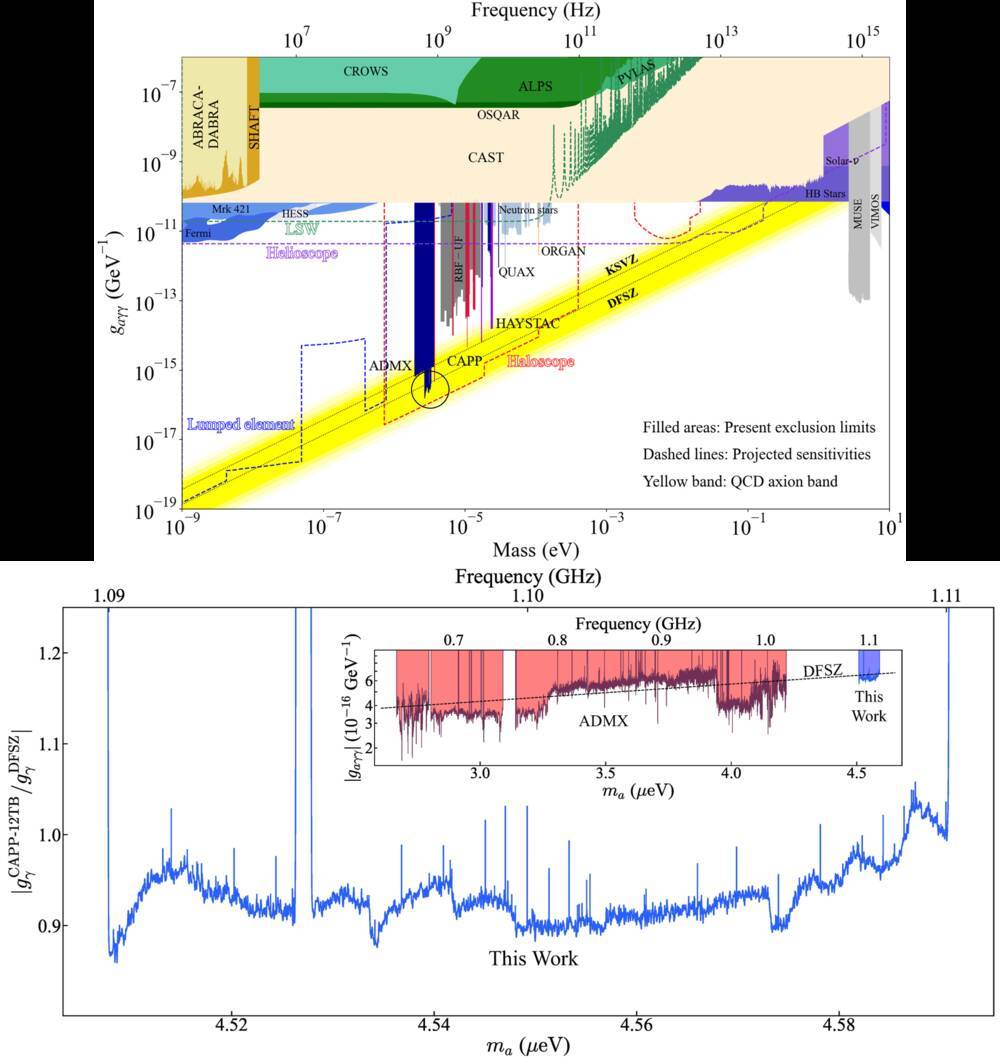
Figure 1. (Top) Current exclusion limits for axion mass from both experiments and astrophysical observation. KSVZ line is the expectation for standard KSVZ axion, while DFSZ line is GUT DFSZ axion. Searching for DFSZ axions requires much higher sensitivity than KSVZ axions. IBS-CAPP axion search experiment explored axion dark matter around 1.1 GHz frequency range at DFSZ sensitivity, denoted by red. Blue denotes the ranges previously excluded by ADMX. (Bottom) IBS-CAPP axion search experiment explored axion dark matter around 1.1 GHz frequency range at DFSZ sensitivity, denoted by blue. Red denotes the axion search experiment previously conducted by ADMX.

South Korea begins to search for DFSZ axion dark matter

Tyler O'Neal, Staff Editor ACADEMIA February 22, 2023, 9:00 am

Search for physics beyond the Standard Model using a colossal magnet 300,000 stronger than the Earth’s magnetic field

A South Korean research team at the Center for Axion and Precision Physics Research (CAPP) within the Institute for Basic Science (IBS) recently announced the most advanced experimental setup to search for axions. The group has successfully taken its first step toward the search for Dine-Fischler-Srednicki-Zhitnitskii (DFSZ) axion dark matter originating from the Grand Unification Theory (GUT). Not only that, IBS-CAPP experimental setup allowed for far greater search speed compared to any other axion search experiments in the world.

The notion of physics being dead has been a recurrent opinion across the longstanding history of the subject. In the late 19th century, William Thompson, also known as Lord Kelvin, erroneously believed that there would be no discovery in physics after 1900. Likewise, some have thought that there were no new particles to be found after neutrons were discovered in the 1930s. Even today, some worry that modern theoretical physics is at a dead end.

However, this is far from the truth. Our current limit of knowledge in physics, the Standard Model, is capable of only explaining 5% of the universe, with the other 95% consisting of dark matter and dark energy.

Not only that, the current Standard Model has limitations in explaining problems such as the strong CP (charge conjugation-parity) problem. The problem arises from the observation that the strong force, which is described by quantum chromodynamics (QCD), does not appear to violate CP symmetry, while the electroweak force violates CP symmetry to a small extent. This contradicts the Standard Model which predicts that CP symmetry should be violated by the strong force at a level that is much larger than what has been observed.

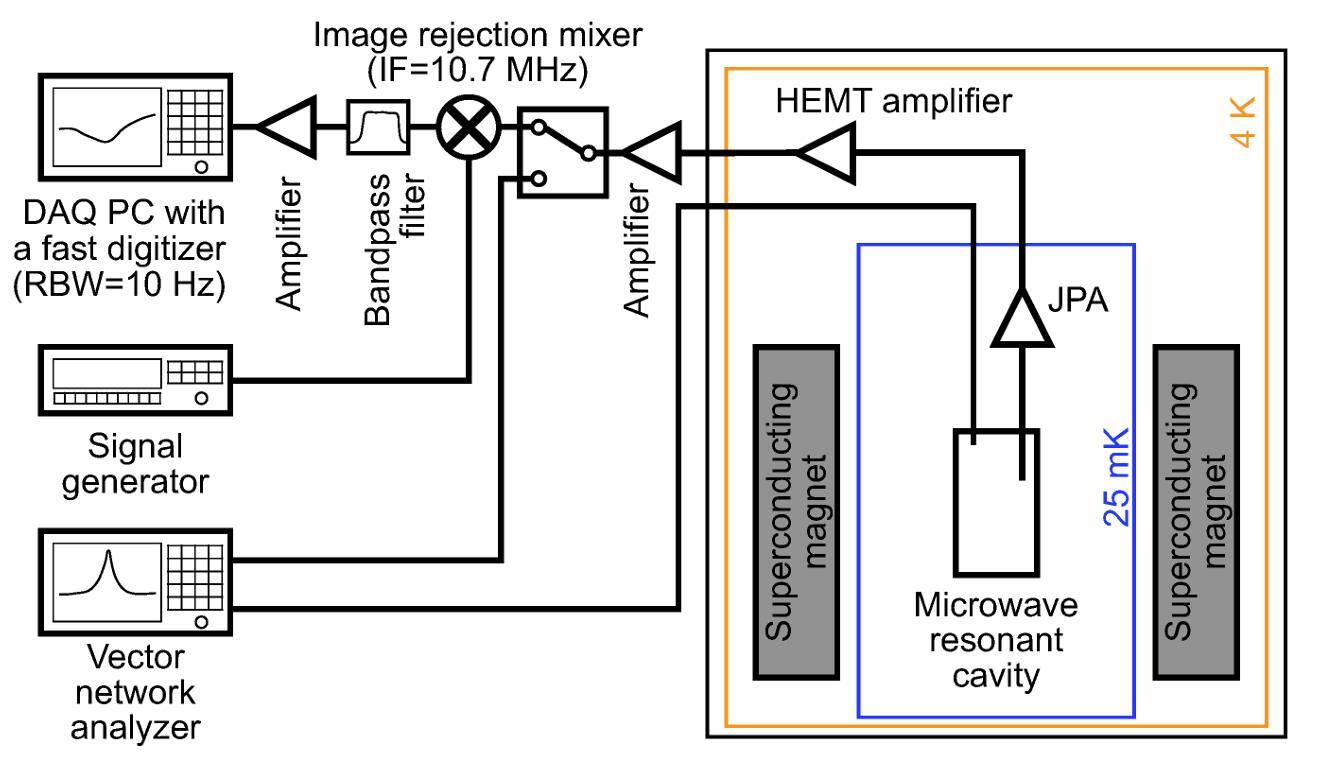
One proposed solution to the problem involves the existence of hypothetical particles called axions, which could resolve the discrepancy between the predicted and observed levels of CP violation in the strong force. Axion is one of the strongest candidates for dark matter. The discovery of axion dark matter is a landmark event in human history that can unveil the reality of 27% of the Universe, and its discoverers will undoubtedly win a ticket to Stockholm. Schematic of the CAPP-12TB experiment.
Currently, two different proposals for “beyond the Standard Model” exist to explain the strong CP problem. The main difference between the two models is that they predict different types of couplings between axions and other particles. In the “Kim-Shifman-Vainshtein-Zakharov” (KSVZ) model, axions are primarily coupled to heavy quarks, while in the “Dine-Fischler-Srednicki-Zhitnitsky” (DFSZ) model, they are coupled to the Standard Model quarks and leptons via Higgs bosons.

As a dark matter, axions have very weak (or little) interaction with ordinary matter, so searching for them can be a tricky business. One commonly used approach involves microwave cavity experiments. These experiments use a strong magnetic field to convert axions (if they exist) into resonant electromagnetic waves, which are then detected using a receiver. The axion’s mass can then be calculated from the detected wave’s frequency.

Since axion mass is unknown, physicists must expand their search and scan a huge range of frequencies (see Figure 1).

The problem is exacerbated in the case of searching for a DFSZ axion, which requires much greater sensitivity than the KSVZ axion. In microwave cavity search experiments, achieving higher sensitivity requires exponentially higher search time, and hence searching for DFSZ axion is out of reach for almost all existing experimental setups.

As a result, while a few axion search experiments have successfully searched for signals in the KSVZ axion sensitivity ranges, so far the only experiment that was capable of attaining the sensitivity necessary to search for DFSZ axions was the ADMX (Axion Dark Matter eXperiment) conducted by the ADMX collaboration. This makes IBS-CAPP the second group in the world to successfully search for an axion with DFSZ sensitivity.

IBS-CAPP group utilized a 12T magnet, which is more powerful than the 8T magnet used by the ADMX. In order to minimize the background noise, the experiment setup was maintained at close to absolute zero temperature.

In addition to using a more powerful magnet, the IBS-CAPP experiment used quantum technologies and a more effective computational approach to curate the data. This allowed the IBS-CAPP to search for DFSZ axions at 3.5 times the rate of the ADMX setup. CAPP-12TB receiver diagram.
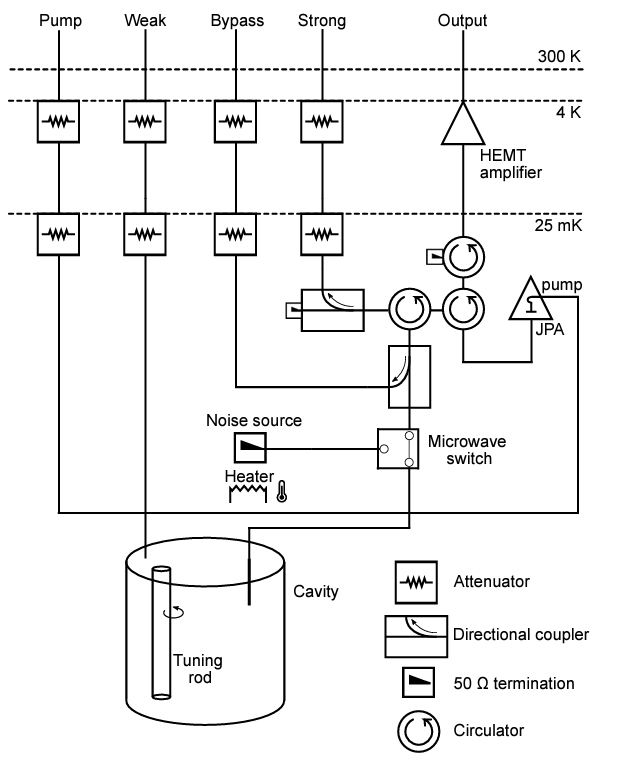
The latest publication by the IBS-CAPP details the demonstration of their new setup for DFSZ axion search from 2022 March 1st to March 18th. As a result, the group was able to exclude axion dark matter around 4.55 µeV at DFSZ sensitivity.

“Discovery of axion will allow us to understand up to 32% of the mass-energy of the universe, up from 5% offered by the current Standard Model,” states research fellow KO Byeong Rok of the IBS-CAPP. He added, “We plan to take advantage of the blazingly fast speed of our experimental setup to quickly search for DFSZ axions at the wide frequency ranges of 1 to 2 GHz.”

It is hoped that the discovery of axion will support the Grand Unification Theory (GUT), which unites the three fundamental forces – strong, weak, and electromagnetism. It is believed that the three fundamental forces were united and indistinguishable at the earliest moment after the Big Bang, under conditions orders of magnitudes higher than achievable in the Large Hadron Collider today. It is hoped that the GUT will serve as a stepping stone to the coveted Theory of Everything (TOE) that has eluded theoretical physicists all these years.

Director Yannis SEMERTZIDIS of IBS-CAPP said, “We are highly grateful for all the funding and support that the Institute for Basic Science and South Korean taxpayers provided for this project. It is thanks to them that South Korea now hosts the most advanced axion search experimental facility in the world. If axion exists, I have no doubt it will be found right here in South Korea.”


 

  1. UB researchers use computational models to show gene variations for immune, metabolic conditions have persisted in humans for more than 700,000 years
  2. Australian Antarctic scientists deploy Nilas online for sea-ice zone data sets

Page 46 of 123

  • 41
  • 42
  • 43
  • 44
  • 45
  • 46
  • 47
  • 48
  • 49
  • 50
POPULAR RIGHT NOW
  • Supercomputers uncover a new class of cosmic explosions hidden in plain sight
    Supercomputers uncover a new class of cosmic explosions hidden in plain sight
  • AI supercharges the hunt for stronger magnets: Iowa State researchers launch a new era of intelligent materials discovery
    AI supercharges the hunt for stronger magnets: Iowa State researchers launch a new era of intelligent materials discovery
  • IBM's Historic stock collapse raises questions for the future of enterprise supercomputing
    IBM's Historic stock collapse raises questions for the future of enterprise supercomputing
  • Could a novel dark matter theory simultaneously resolve multiple cosmic enigmas? Supercomputer simulations provide a compelling, albeit currently unverified, potential solution
    Could a novel dark matter theory simultaneously resolve multiple cosmic enigmas? Supercomputer simulations provide a compelling, albeit currently unverified, potential solution
  • Melting icebergs may be reshaping Earth’s greatest ocean current
    Melting icebergs may be reshaping Earth’s greatest ocean current
  • Supercomputers replace ‘bathtub’ flood maps with physics-based digital twins of Britain’s coastline
    Supercomputers replace ‘bathtub’ flood maps with physics-based digital twins of Britain’s coastline
  • Supercomputers push neural quantum simulation beyond previous limits
    Supercomputers push neural quantum simulation beyond previous limits
  • Intel’s AI supercomputing revival: Q2 financial surge signals new era for CPU-powered HPC infrastructure
    Intel’s AI supercomputing revival: Q2 financial surge signals new era for CPU-powered HPC infrastructure
  • AI infrastructure financing fears shake semiconductor sector
    AI infrastructure financing fears shake semiconductor sector
  • AWS supercomputing investment reaches historic scale as Amazon’s AI strategy powers record financial results
    AWS supercomputing investment reaches historic scale as Amazon’s AI strategy powers record financial results
THIS YEAR'S MOST READ
  • Wall Street wants to trade supercomputing power like oil
    Wall Street wants to trade supercomputing power like oil
  • Cosmic ambition at scale: UK’s supercomputer unlocks a 2.5 petabytes universe
    Cosmic ambition at scale: UK’s supercomputer unlocks a 2.5 petabytes universe
  • Hidden order, revealed at scale: Supercomputing, electron ptychography uncover the inner workings of relaxor ferroelectrics
    Hidden order, revealed at scale: Supercomputing, electron ptychography uncover the inner workings of relaxor ferroelectrics
  • Beamforming the future: BeammWave's 6G push signals the rise of orbital-terrestrial wireless networks
    Joakim Axmon
    Joakim Axmon
  • Intel's Q1 results signal supercomputing surge driving Xeon momentum
    Intel's Q1 results signal supercomputing surge driving Xeon momentum
  • When stars fall apart: Supercomputing reveals the hidden physics of black holes
    When stars fall apart: Supercomputing reveals the hidden physics of black holes
  • Multi-layer simulations reveal the hidden supply chain of solar prominences
    Multi-layer simulations reveal the hidden supply chain of solar prominences
  • Japanese scientists decode dolphin speed with supercomputing: Turbulence, vortices, and the hidden physics of propulsion
    Japanese scientists decode dolphin speed with supercomputing: Turbulence, vortices, and the hidden physics of propulsion
  • Cosmic feedback at scale: Supercomputing reveals how quasars regulate the early Universe
    Cosmic feedback at scale: Supercomputing reveals how quasars regulate the early Universe
  • Modeling life at the microscopic scale: A computational breakthrough in oxygen transport
    Modeling life at the microscopic scale: A computational breakthrough in oxygen transport
MOST READ OF ALL-TIME
  • Largest Computational Biology Simulation Mimics The Ribosome
    Details
    112108
    The amino acid (green) slithers into the chemical reaction center, moving through an evolutionarily ancient corridor of the ribosome (purple). The amino acid is delivered to the reaction core by the transfer RNA molecule (yellow).
    The amino acid (green) slithers into the chemical reaction center, moving through an evolutionarily ancient corridor of the ribosome (purple). The amino acid is delivered to the reaction core by the transfer RNA molecule (yellow).
  • Silicon 'neurons' may add a new dimension to chips
    Details
    80995
    Silicon 'neurons' may add a new dimension to chips
  • Linux Networx Accelerators Expected to Drive up to 4x Price/Performance
    Details
    75538
  • Complex Concepts That Really Add Up
    Details
    73639
    Complex Concepts That Really Add Up
  • Blue Sky Studios Donates Animation SuperComputer to Wesleyan
    Details
    68141
    Each rack holds 52 Angstrom Microsystem-brand “blades,” with a memory footprint of 12 or 24 gigabytes each. (Photos by Olivia Bartlett Drake)
    Each rack holds 52 Angstrom Microsystem-brand “blades,” with a memory footprint of 12 or 24 gigabytes each. (Photos by Olivia Bartlett Drake)
  • Humanities, HPC connect at NERSC
    Details
    57948
  • TeraGrid ’09 'Call for Participation'
    Details
    54952
  • Turbulence responsible for black holes' balancing act
    Details
    52313
  • Cray Wins $52 Million SuperComputer Contract
    Details
    50140
  • SDSC Researchers Accurately Predict Protein Docking
    Details
    46082
  • FRONTPAGE
  • LATEST
  • POPULAR
  • REGISTER
  • SOCIAL
  • VIDEO
  • SUBSCRIPTION
  • RSS
  • GUIDELINES
  • PRIVACY
  • TOS
  • ABOUT
  • +1 (816) 799-4488
  • editorial@supercomputingonline.com
© 2001 - 2026 SuperComputingOnline.com, LLC. All rights reserved. This material may not be published, broadcast, rewritten or redistributed without permission.
Sign In
  • FRONT PAGE
  • LATEST
    • MEDIA KIT
    • MOST READ
    • RSS FEED
    • ACADEMIA
    • AEROSPACE
    • APPLICATIONS
    • ASTRONOMY
    • AUTOMOTIVE
    • BIG DATA
    • BIOLOGY
    • CHEMISTRY
    • CLIENTS
    • CLOUD
    • DEFENSE
    • DEVELOPER TOOLS
    • EARTH SCIENCES
    • ECONOMICS
    • ENGINEERING
    • ENTERTAINMENT
    • HEALTH
    • INDUSTRY
    • INTERCONNECTS
    • GAMING
    • GOVERNMENT
    • MANUFACTURING
    • MIDDLEWARE
    • MOVIES
    • NETWORKS
    • OIL & GAS
    • PHYSICS
    • PROCESSORS
    • RETAIL
    • SCIENCE
    • STORAGE
    • SYSTEMS
    • VISUALIZATION
  • VIDEOS
    • ADD YOUR VIDEOS
    • MANAGE VIDEOS
  • COMMUNITY
    • TRADE SHOWS
    • SOCIAL NETWORK VIDEOS
    • SURVEYS
    • APPLICATIONS BROWSER
    • CONVERSATION INBOX
    • SOCIAL ADVERTISER
    • GROUPS
    • MARKETPLACE LISTINGS
    • PAGES
    • LEADERBOARD
    • POINTS LISTING
      • BADGES
    • PRIVACY CONFIRM REQUEST
    • PRIVACY CREATE REQUEST

Hey there! We noticed you’re using an ad blocker.