SUPERCOMPUTING NEWS SUPERCOMPUTING NEWS
    • MEDIA KIT
    • MOST READ
    • RSS FEED
    • ACADEMIA
    • AEROSPACE
    • APPLICATIONS
    • ASTRONOMY
    • AUTOMOTIVE
    • BIG DATA
    • BIOLOGY
    • CHEMISTRY
    • CLIENTS
    • CLOUD
    • DEFENSE
    • DEVELOPER TOOLS
    • EARTH SCIENCES
    • ECONOMICS
    • ENGINEERING
    • ENTERTAINMENT
    • GAMING
    • GOVERNMENT
    • HEALTH
    • OIL & GAS
    • INDUSTRY
    • INTERCONNECTS
    • MANUFACTURING
    • MIDDLEWARE
    • MOVIES
    • NETWORKS
    • PHYSICS
    • PROCESSORS
    • RETAIL
    • SCIENCE
    • STORAGE
    • SYSTEMS
    • VISUALIZATION
    • AcyMailing subscription form

    • ADD YOUR VIDEOS
    • MANAGE VIDEOS
    • CONVERSATION INBOX
    • SOCIAL ADVERTISER
    • SOCIAL NETWORK VIDEOS
    • SURVEYS
    • GROUPS
    • PAGES
    • MARKETPLACE LISTINGS
    • APPLICATIONS BROWSER
    • PRIVACY CONFIRM REQUEST
    • PRIVACY CREATE REQUEST
    • LEADERBOARD
    • POINTS LISTING
      • BADGES
    • TRADE SHOWS
Sign In
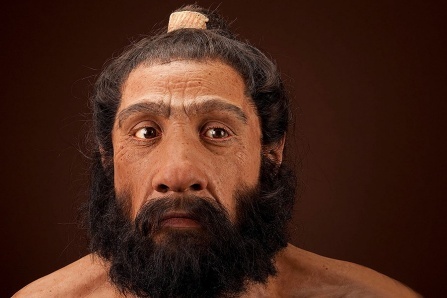
Homo neanderthalensis adult male.  Reconstruction based on Shanidar 1 by John Gurche for the Human Origins Program, NMNH.  Date:  225,000 to 28,000 years.
Homo neanderthalensis adult male. Reconstruction based on Shanidar 1 by John Gurche for the Human Origins Program, NMNH. Date: 225,000 to 28,000 years.
Tyler O'Neal, Staff Editor ACADEMIA February 21, 2023, 10:00 am

UB researchers use computational models to show gene variations for immune, metabolic conditions have persisted in humans for more than 700,000 years

Genetic study of modern humans, Neanderthals, and Denisovans points to the importance of ‘balancing selection’ in evolution

Like a merchant of old, balancing the weights of two different commodities on a scale, nature can keep different genetic traits in balance as a species evolves over millions of years.

Depending on the environment, these traits can be beneficial (for example, fending off disease) or harmful (making humans more susceptible to illness).

The theory behind these evolutionary trade-offs is called balancing selection. A University at Buffalo-led study accepted on Jan. 10 and published on Feb. 21 in eLife explores this phenomenon by analyzing thousands of modern human genomes alongside ancient hominin groups, such as Neanderthal and Denisovan genomes.

The research has “implications for understanding human diversity, the origin of diseases, and biological trade-offs that may have shaped our evolution,” says evolutionary biologist Omer Gokcumen, the study’s corresponding author. Omer Gokcumen

Gokcumen, Ph.D., associate professor of biological sciences at the UB College of Arts and Sciences, adds that the study shows that many biologically relevant variants “have been segregating among our ancestors for hundreds of thousands, or even millions, of years. These ancient variations are our shared legacy as a species.”

Ties with Neanderthals stronger than previously thought

The work builds upon genetic discoveries in the past decade, including when scientists uncovered that modern humans and Neanderthals interbred as early humans moved out of Africa.

It also coincides with the growth of personalized genetic testing, with many people now claiming that a small percentage of their genome comes from Neanderthals. But, as the eLife study shows, humans share much more in common with Neanderthals than those small percentages indicate.

This additional sharing can be traced back to a common ancestor of  Neanderthals and humans that lived about 700,000 years ago. This common ancestor bequeathed to the Neanderthals and modern humans a shared legacy in the form of genetic variation.

The research team explored this ancient genetic legacy, focusing on a particular type of genetic variation: deletions.

Gokcumen says that the “deletions are strange because they affect large segments. Some of us are missing large chunks of our genome. These deletions should have negative effects and, as a result, be eliminated from the population by natural selection. However, we observed that some deletions are older than modern humans, dating back millions of years ago.”

Gene variations passed down over millions of years

The researchers used computational models to show an excess of these ancient deletions, some of which have persisted since our ancestors first learned to make tools, some 2.6 million years ago. Furthermore, the models found that balancing selection can explain this surplus of ancient deletions.

“Our study contributes to the growing body of evidence suggesting that balancing selection may be an important force in the evolution of genomic variation among humans,” says first author Alber Aqil, a Ph.D. candidate in biological sciences in Gokcumen’s lab. Alber Aqil

The investigators found that deletions dating back millions of years are more likely to play an outsized role in metabolic and autoimmune conditions.

Indeed, the persistence of versions of genes that cause severe disease in human populations has long baffled scientists since they expect natural selection to get rid of these versions of genes. It is, after all, very unusual for potentially disease-causing variation to persist for such long periods. The authors argue that balancing selection can solve this riddle.

Aqil says these variations may “protect against infectious diseases, outbreaks, and starvation, which have occurred periodically throughout human history. Thus, the findings represent a considerable leap in our understanding of how genetic variations evolve in humans. A variant may be protective against a pathogen or starvation while also underlying certain metabolic or autoimmune disorders, like Crohn’s disease.”

Additional co-authors include Leo Speidel, Ph.D., Sir Henry Wellcome Postdoctoral Fellow at the Genetics Institute of University College London and the Francis Crick Institute; and Pavlos Pavlidis of the Institute of Computer Science, one of eight institutes of the Foundation of Research and Technology-Hellas in Greece.

The National Science Foundation, the Sir Henry Wellcome Fellowship, and the Wellcome Trust supported the research.
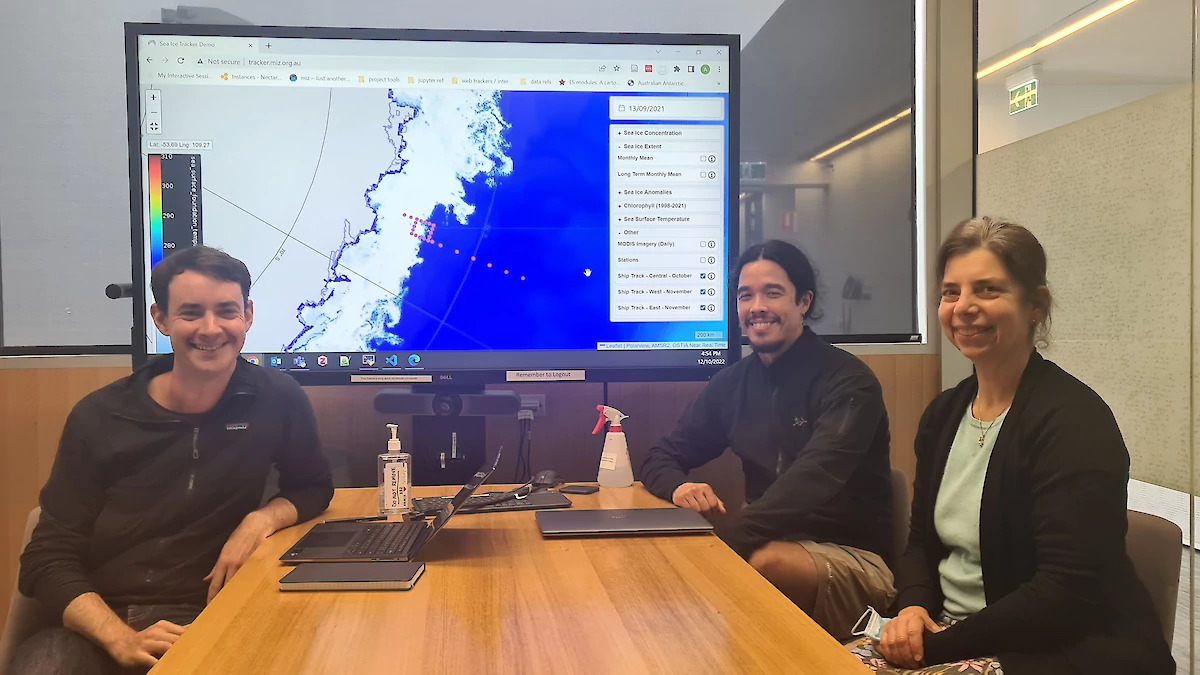
Nilas, the Southern Ocean Mapping Platform developers, Anton Steketee (left), Sean Chua and Dr Petra Heil. Photo: Wendy Pyper

Australian Antarctic scientists deploy Nilas online for sea-ice zone data sets

Tyler O'Neal, Staff Editor ACADEMIA February 20, 2023, 2:00 pm

A new interactive Antarctic map promises to assist voyage planning and enhance climate research in the sea-ice zone, by bringing together Southern Ocean data from the past four decades.

Developed by Australian Antarctic Division sea-ice scientists Dr. Petra Heil, Sean Chua, and Anton Steketee, ‘Nilas’ presents near-real-time and historical data on sea ice, chlorophyll (a proxy for phytoplankton production), and sea-surface temperature around Antarctica. 

Nilas is a thin, elastic crust of sea ice, that easily bends on waves and swells, and under pressure.

Dr. Heil said the historical ice and ocean data and the ability to superimpose past or proposed ship trajectories or animal or instrument tracks over the data, made it a powerful planning, analysis, and research tool.

The tool includes sea-ice data dating back to 1980, chlorophyll data from 1998, and sea surface temperature from 1981.

“We have used this tool to plan a marine-science voyage, and are currently using it to pinpoint deployment locations for autonomous instruments to study ice-edge processes, such as wave-induced ice breakup,” Dr. Heil said.

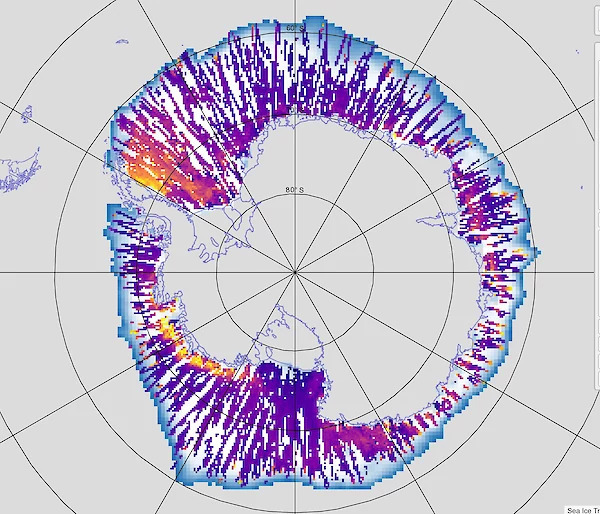
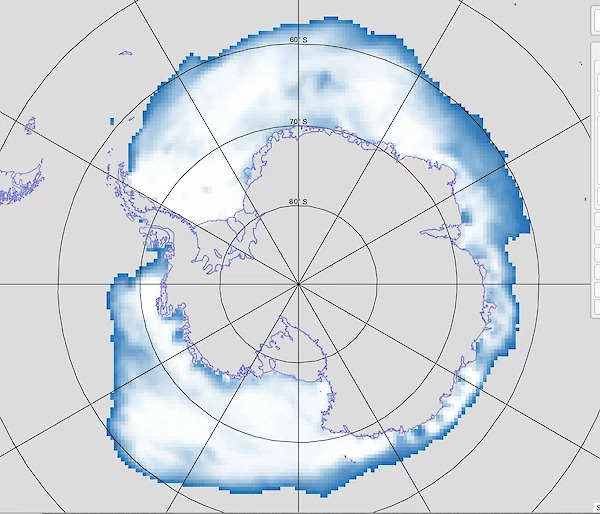
A Nilas screen shot of the monthly sea-ice concentration around Antarctica for November 2022. White areas are 100% sea-ice concentration (coverage). (Photo: Nilas) 

This graphic shows the sea-ice concentration for July 2022 overlaid with the sea-ice freeboard (ice height above the ocean surface). It allows users to identify zones of thicker versus thinner sea ice and to assess these against the areal sea-ice coverage. This information assists, for example, selection of deployment sites for instruments or planning navigation in an unfamiliar ice-covered ocean. (Photo: Nilas)

“The tool allows us to look back at the sea-ice concentration and extent over the past few years to gain an understanding of the likely sea-ice conditions in the month of our voyage. We can then identify the most suitable location to take samples and deploy instruments.

“The tool also allows us to look at ice conditions in locations where we may have limited or no experience in navigating the ice area and make decisions about the best time of year to visit to achieve our objective.”

Mr. Chua said the ability to look at different ice and ocean variables at the same time could spark new research ideas, or enable scientists to explore links between different Earth system components.

“If you’re an atmospheric scientist sampling air from a vessel and you see a signal that does not make sense, you could look back at the ice or chlorophyll conditions at the time and location of your signal and check for any correlation,” he said.

“Phytoplankton may have released sulfate aerosols into the air, affecting the atmospheric properties, for example. So having all these data in one interface enables connections between scientific disciplines.”

To build the mapping platform the team used existing data sets generated from satellite observations. Data sets came from a range of sources, including the National Snow and Ice Data Center, Unversität Bremen, the Met Office, and the Ocean Colour Climate Change Initiative.

Data sets include daily and monthly sea-ice concentration (amount of sea-ice cover), sea-ice freeboard (height above the ocean surface), chlorophyll concentration, and sea-surface temperature. They also include in-house derived parameters.

“In consultation with Antarctic scientists, we chose source data and products that would be the most useful for looking at the long-term climate record,” Mr. Steketee said.

“We standardized that data added some functionality, and presented it on a platform that doesn’t need any technical expertise to use.

“This tool does not require any software or downloads to run, it can be configured to run without an internet connection, and it displays multiple variables at different time scales.”

Dr. Heil said the availability of different sea-ice variables within one application was also important in teasing out sea-ice conditions. For example, an area of interest could show 100% sea-ice concentration. However, including the sea-ice freeboard variable (height of sea ice above the water level), could identify areas of thicker or thinner ice within.

“An area of interest may be 100% covered in ice, and only the freeboard data will show whether it is freshly frozen over and very thin, or if it’s thick, multi-year ice that one would not want to venture into,” she said.

The development team said the mapping platform could also be used by students to conceptualize climate variability or to provide climate modelers with an accessible, visual means of comparing model outputs with actual observations.

“There are many ways to look at sea ice in Antarctica, but our tool brings together a diverse set of observations to explore Earth system characteristics and processes that are relevant to the Australian Antarctic Division and the Australian Southern Ocean science community,” Mr. Chua said.

“While people can view many of these variables in isolation, the power of our mapping tool is in the combination of variables and the ability to overlay them within an accessible interface.”

The tool is available at nilas.org. The Australian Antarctic Data Centre houses the software and data in the Australian Antarctic Data Centre.

Tokyo Tech demos multi-policy-based annealer for solving real-world combinatorial optimization problems

Tokyo Tech demos multi-policy-based annealer for solving real-world combinatorial optimization problems

Tyler O'Neal, Staff Editor ACADEMIA February 18, 2023, 5:00 am

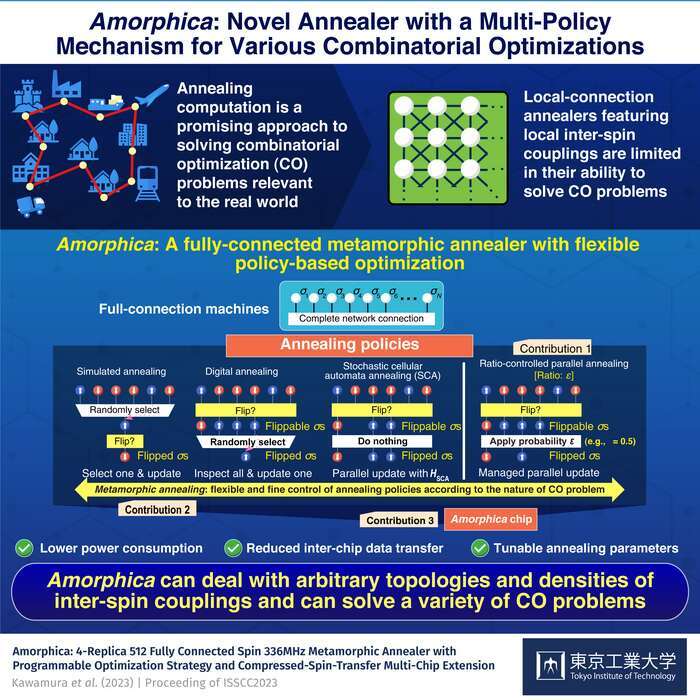
A fully-connected annealer extendable to a multi-chip system and featuring a multi-policy mechanism has been designed by Tokyo Tech researchers to solve a broad class of combinatorial optimization (CO) problems relevant to real-world scenarios quickly and efficiently. Named Amorphica, the annealer has the ability to fine-tune parameters according to a specific target CO problem and has potential applications in logistics, finance, machine learning, and so on.

The modern world has grown accustomed to the efficient delivery of goods right at our doorsteps. But did you know that realizing such efficiency requires solving a mathematical problem, namely what is the best possible route between all the destinations? Known as the “traveling salesman problem,” this belongs to a class of mathematical problems known as “combinatorial optimization” (CO) problems.

As the number of destinations increases, the number of possible routes grows exponentially, and a brute force method based on an exhaustive search for the best route becomes impractical. Instead, an approach called “annealing computation” is adopted to find the best route quickly without an exhaustive search. Yet, a numerical study done by Tokyo Tech researchers has shown that while there exist many annealing computation methods, there is no one method suitable for solving a broad class of CO problems. Therefore, there is a need for an annealing mechanism that features multiple annealing methods (a multi-policy mechanism) to target a variety of such problems.

Fortunately, the same team of researchers, led by Assistant Professor Kazushi Kawamura and Professor Masato Motomura from the Tokyo Institute of Technology (Tokyo Tech), have reported a new annealer that features such a multi-policy approach or “metamorphic annealing.” Their findings are published in the Proceeding of ISSCC2023 and will be presented in the upcoming 2023 International Solid-State Circuits Conference.

“In the annealing computation, a CO problem is represented as an energy function in terms of (pseudo) spin vectors. We start from an initially randomized spin vector configuration and then update it stochastically to find the minimum energy states by reducing its (pseudo) temperature. This closely mirrors the annealing process of metals where hot metals are cooled down in a controlled manner,” explains Dr. Kawamura. “Our annealer named Amorphica features multiple annealing methods, including a new one proposed by our team. This provides it the ability to adopt the annealing method to the specific CO problem at hand.”

The team designed Amorphica to address the limitations of previous annealers, namely that their applicability is limited to only a few CO problems. This is first because these annealers are local-connection ones, meaning they can only deal with spin models having local inter-spin coupling. Another reason is that they do not have flexibility in terms of annealing methods and parameter control. These issues were solved in Amorphica by employing a full-connection spin model and incorporating finely controllable annealing methods and parameters. In addition, the team introduced a new annealing policy called “ratio-controlled parallel annealing” to improve the convergence speed and stability of existing annealing methods.

Additionally, Amorphica can be extended to a multi-chip, full-connection system with reduced inter-chip data transfer. On testing Amorphica against a GPU, the researchers found that it was up to 58 times faster while using only (1/500) power consumption, meaning it achieves around 30k times more energy efficiency.

“With a full-connection annealer like Amorphica, we can now deal with arbitrary topologies and densities of inter-spin couplings, even when they are irregular. This, in turn, would allow us to solve real-world CO problems such as those related to logistics, finance, and machine learning,” concludes Prof. Motomura.

  1. Prof Lee's supercomputing reveals an acceleration of global sea level rise imminent past 1.8℃ planetary warming
  2. AI model sheds light on cognition, brain disorders

Page 47 of 123

  • 42
  • 43
  • 44
  • 45
  • 46
  • 47
  • 48
  • 49
  • 50
  • 51
POPULAR RIGHT NOW
  • Supercomputers uncover a new class of cosmic explosions hidden in plain sight
    Supercomputers uncover a new class of cosmic explosions hidden in plain sight
  • AI supercharges the hunt for stronger magnets: Iowa State researchers launch a new era of intelligent materials discovery
    AI supercharges the hunt for stronger magnets: Iowa State researchers launch a new era of intelligent materials discovery
  • IBM's Historic stock collapse raises questions for the future of enterprise supercomputing
    IBM's Historic stock collapse raises questions for the future of enterprise supercomputing
  • Could a novel dark matter theory simultaneously resolve multiple cosmic enigmas? Supercomputer simulations provide a compelling, albeit currently unverified, potential solution
    Could a novel dark matter theory simultaneously resolve multiple cosmic enigmas? Supercomputer simulations provide a compelling, albeit currently unverified, potential solution
  • Melting icebergs may be reshaping Earth’s greatest ocean current
    Melting icebergs may be reshaping Earth’s greatest ocean current
  • Supercomputers replace ‘bathtub’ flood maps with physics-based digital twins of Britain’s coastline
    Supercomputers replace ‘bathtub’ flood maps with physics-based digital twins of Britain’s coastline
  • Supercomputers push neural quantum simulation beyond previous limits
    Supercomputers push neural quantum simulation beyond previous limits
  • Intel’s AI supercomputing revival: Q2 financial surge signals new era for CPU-powered HPC infrastructure
    Intel’s AI supercomputing revival: Q2 financial surge signals new era for CPU-powered HPC infrastructure
  • AI infrastructure financing fears shake semiconductor sector
    AI infrastructure financing fears shake semiconductor sector
  • AWS supercomputing investment reaches historic scale as Amazon’s AI strategy powers record financial results
    AWS supercomputing investment reaches historic scale as Amazon’s AI strategy powers record financial results
THIS YEAR'S MOST READ
  • Wall Street wants to trade supercomputing power like oil
    Wall Street wants to trade supercomputing power like oil
  • Cosmic ambition at scale: UK’s supercomputer unlocks a 2.5 petabytes universe
    Cosmic ambition at scale: UK’s supercomputer unlocks a 2.5 petabytes universe
  • Hidden order, revealed at scale: Supercomputing, electron ptychography uncover the inner workings of relaxor ferroelectrics
    Hidden order, revealed at scale: Supercomputing, electron ptychography uncover the inner workings of relaxor ferroelectrics
  • Beamforming the future: BeammWave's 6G push signals the rise of orbital-terrestrial wireless networks
    Joakim Axmon
    Joakim Axmon
  • Intel's Q1 results signal supercomputing surge driving Xeon momentum
    Intel's Q1 results signal supercomputing surge driving Xeon momentum
  • When stars fall apart: Supercomputing reveals the hidden physics of black holes
    When stars fall apart: Supercomputing reveals the hidden physics of black holes
  • Multi-layer simulations reveal the hidden supply chain of solar prominences
    Multi-layer simulations reveal the hidden supply chain of solar prominences
  • Japanese scientists decode dolphin speed with supercomputing: Turbulence, vortices, and the hidden physics of propulsion
    Japanese scientists decode dolphin speed with supercomputing: Turbulence, vortices, and the hidden physics of propulsion
  • Cosmic feedback at scale: Supercomputing reveals how quasars regulate the early Universe
    Cosmic feedback at scale: Supercomputing reveals how quasars regulate the early Universe
  • Modeling life at the microscopic scale: A computational breakthrough in oxygen transport
    Modeling life at the microscopic scale: A computational breakthrough in oxygen transport
MOST READ OF ALL-TIME
  • Largest Computational Biology Simulation Mimics The Ribosome
    Details
    112108
    The amino acid (green) slithers into the chemical reaction center, moving through an evolutionarily ancient corridor of the ribosome (purple). The amino acid is delivered to the reaction core by the transfer RNA molecule (yellow).
    The amino acid (green) slithers into the chemical reaction center, moving through an evolutionarily ancient corridor of the ribosome (purple). The amino acid is delivered to the reaction core by the transfer RNA molecule (yellow).
  • Silicon 'neurons' may add a new dimension to chips
    Details
    80995
    Silicon 'neurons' may add a new dimension to chips
  • Linux Networx Accelerators Expected to Drive up to 4x Price/Performance
    Details
    75539
  • Complex Concepts That Really Add Up
    Details
    73640
    Complex Concepts That Really Add Up
  • Blue Sky Studios Donates Animation SuperComputer to Wesleyan
    Details
    68141
    Each rack holds 52 Angstrom Microsystem-brand “blades,” with a memory footprint of 12 or 24 gigabytes each. (Photos by Olivia Bartlett Drake)
    Each rack holds 52 Angstrom Microsystem-brand “blades,” with a memory footprint of 12 or 24 gigabytes each. (Photos by Olivia Bartlett Drake)
  • Humanities, HPC connect at NERSC
    Details
    57948
  • TeraGrid ’09 'Call for Participation'
    Details
    54952
  • Turbulence responsible for black holes' balancing act
    Details
    52313
  • Cray Wins $52 Million SuperComputer Contract
    Details
    50141
  • SDSC Researchers Accurately Predict Protein Docking
    Details
    46082
  • FRONTPAGE
  • LATEST
  • POPULAR
  • REGISTER
  • SOCIAL
  • VIDEO
  • SUBSCRIPTION
  • RSS
  • GUIDELINES
  • PRIVACY
  • TOS
  • ABOUT
  • +1 (816) 799-4488
  • editorial@supercomputingonline.com
© 2001 - 2026 SuperComputingOnline.com, LLC. All rights reserved. This material may not be published, broadcast, rewritten or redistributed without permission.
Sign In
  • FRONT PAGE
  • LATEST
    • MEDIA KIT
    • MOST READ
    • RSS FEED
    • ACADEMIA
    • AEROSPACE
    • APPLICATIONS
    • ASTRONOMY
    • AUTOMOTIVE
    • BIG DATA
    • BIOLOGY
    • CHEMISTRY
    • CLIENTS
    • CLOUD
    • DEFENSE
    • DEVELOPER TOOLS
    • EARTH SCIENCES
    • ECONOMICS
    • ENGINEERING
    • ENTERTAINMENT
    • HEALTH
    • INDUSTRY
    • INTERCONNECTS
    • GAMING
    • GOVERNMENT
    • MANUFACTURING
    • MIDDLEWARE
    • MOVIES
    • NETWORKS
    • OIL & GAS
    • PHYSICS
    • PROCESSORS
    • RETAIL
    • SCIENCE
    • STORAGE
    • SYSTEMS
    • VISUALIZATION
  • VIDEOS
    • ADD YOUR VIDEOS
    • MANAGE VIDEOS
  • COMMUNITY
    • TRADE SHOWS
    • SOCIAL NETWORK VIDEOS
    • SURVEYS
    • APPLICATIONS BROWSER
    • CONVERSATION INBOX
    • SOCIAL ADVERTISER
    • GROUPS
    • MARKETPLACE LISTINGS
    • PAGES
    • LEADERBOARD
    • POINTS LISTING
      • BADGES
    • PRIVACY CONFIRM REQUEST
    • PRIVACY CREATE REQUEST

Hey there! We noticed you’re using an ad blocker.