St George's AI discovers twisting of eye vessels could cause high blood pressure, heart disease

Research led by scientists at St George’s, University of London has discovered 119 areas in the genome that help to determine the size and shape of blood vessels at the back of the eye, and that an increase in ‘twisting’ of the arteries could cause high blood pressure and heart disease.

It’s relatively easy to take a high-resolution digital image of the back of the eye, allowing medical professionals and researchers to visualize the retina and its associated blood vessels and nerves. The eyes can act as a ‘window’ into the body, allowing researchers to directly study the characteristics of these blood vessels and gain information about the body.

Scientists have previously shown that the shape and size of blood vessels on the retina are associated with health conditions including high blood pressure, heart disease, diabetes, and obesity. However, until now, little was known about how genetics play a role in determining the architectural characteristics of these blood vessels.

Researchers studied retinal images from nearly 53,000 people who were enrolled in a large study called the UK Biobank.

They applied artificial intelligence (AI) technology to the images to quickly and automatically distinguish between the different types of blood vessels (arteries and veins), and to measure blood vessel width and the extent to which the vessels twist and turn.

The team then used a technique called a genome-wide association study (GWAS) to determine whether there were similarities in the DNA of people with similar blood vessel characteristics. They carried this out on the genetic data of 52,798 UK Biobank members.

The team then repeated the analyses on 5000 people who were part of the EPIC-Norfolk’s Eye Study. Together with the UK Biobank, they identified 119 sections of the genome that are associated with retinal blood vessel shape and size characteristics – more than any previous study. Of the 119 sections found, 89 regions were linked to arterial twisting.

The level of twisting and turning of retinal arteries was the feature that was most strongly genetically determined. A higher level of twisting to the arteries also appeared to cause high diastolic blood pressure and heart disease. Diastolic blood pressure is a measure of the pressure in the arteries when the heart is between beats.

Professor Christopher Owen, Head of Chronic Disease Epidemiology at St George’s, University of London said: “It had been thought that high blood pressure might cause twisted arteries, but our work unveils that it’s the other way around. This genetic information is a vital piece of the puzzle in our understanding and could pave the way for new treatments in the future.

“Retinal imaging is already a mainstay in high-street optometrists. Our AI analysis of these images as part of routine eye checks could easily be done as part of a health check to identify those at high risk of developing high blood pressure or heart disease and in need of early intervention.”

The study was funded by the Medical Research Council and the British Heart Foundation.

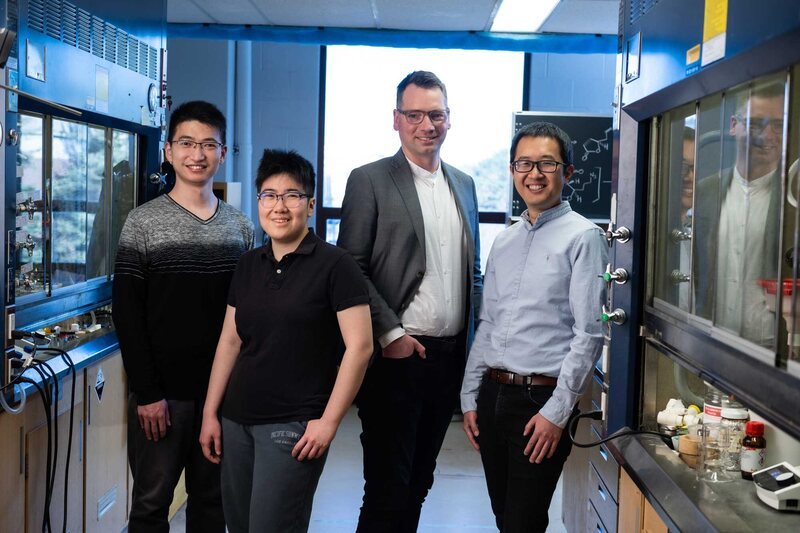
Di Wang (from left), Rui Zhang, Tim Cernak, and Yingfu Lin in the Cernak Lab at the Chemistry Building. Image credit: Austin Thomason, Michigan Photography

Michigan builds AI algo to dramatically reduce the time to build molecules for better medicines

With a big assist from artificial intelligence and a heavy dose of human touch, Tim Cernak’s lab at the University of Michigan made a discovery that dramatically speeds up the time-consuming chemical process of building molecules that will be tomorrow’s medicines, agrichemicals, or materials.

The discovery, published in the Feb. 3 issue of Science, is the culmination of years of chemical synthesis and data science research by the Cernak Lab in the College of Pharmacy and Department of Chemistry.

The goal of the research was to identify key reactions in the synthesis of a molecule, ultimately reducing the process to as few steps as possible. In the end, Cernak and his team achieved the synthesis of a complex alkaloid found in nature in just three steps. Previous syntheses took between seven and 26 steps. Replica of the complex molecule, stemoamide, built in mere three steps in Tim Cernak’s Lab. Image credit: Austin Thomason, Michigan Photography

“Making a chemical structure that has atoms in just the right place to give you efficacious and nontoxic medicines, for instance, is tricky,” said Cernak, assistant professor of medicinal chemistry and chemistry. “It requires a chemical synthesis strategy grounded in the chemical building blocks you can actually buy and then stitch together using chemical reactions.”

The accomplishment has powerful implications for speeding up the development of medicines.

Cernak compared the construction of these complex molecules to playing chess. You need to orchestrate a series of moves to get to the end of the game. While there’s a near-infinite number of possible moves, there’s a logic that can be followed.

“We developed a logic here, based on graph theory, to get to the end as quickly as possible,” he said.

Cernak and colleagues used SYNTHIA Retrosynthesis Software, which provides scientists with a database of pathways, or steps, and formulas for millions of molecular structures. This gave the team an enormous amount of computational synthesis data to play with.

Using an algorithm they developed to curate the data, the researchers identified the steps along the pathway that was high impact, or key steps, and the steps that were making progress toward completing the synthesis but ultimately inefficient for the whole process.

“We hope this research can lead to better medicines,” Cernak said. “So far, we have been limited in the molecular structures we can quickly access with chemical synthesis.”

Co-authors include Yingfu Lin, a senior research fellow in pharmacy; Rui (Sam) Zhang, a doctoral student in chemistry; and Di Wang, a doctoral student in pharmacy.

BYU professor D.J. Lee and students Shad Torrie and Andrew Sumsion sit in the press box at LaVell Edwards Stadium. Their AI technology could improve film study for college and NFL football teams. Photo by Nate Edwards/BYU Photo

BYU creates AI algo to benefit Super Bowl rivals

Players and coaches for the Philadelphia Eagles and Kansas City Chiefs will spend hours and hours in film rooms this week in preparation for the Super Bowl. They’ll study positions, plays, and formations, trying to pinpoint what opponent tendencies they can exploit while looking to their film to shore up weaknesses.

New artificial intelligence technology being developed by engineers at Brigham Young University could significantly cut down on the time and cost that goes into film study for Super Bowl-bound teams (and all NFL and college football teams), while also enhancing game strategy by harnessing the power of big data.

BYU professor D.J. Lee, master’s student Jacob Newman and Ph.D. students Andrew Sumsion and Shad Torrie are using AI to automate the time-consuming process of analyzing and annotating game footage manually. Using deep learning and computer vision, the researchers have created an algorithm that can consistently locate and label players from game film and determine the formation of the offensive team — a process that currently requires a slew of video assistants.

“We were having a conversation about this and realized, whoa, we could probably teach an algorithm to do this,” said Lee, a professor of electrical and computer engineering. “So we set up a meeting with BYU football to learn their process and immediately knew, yeah, we can do this a lot faster.”

A game still used to train the algorithm.

While still early in the research, the team has already obtained better than 90% accuracy on player detection and labeling with their algorithm, along with 85% accuracy on determining formations. They believe the technology could eventually eliminate the need for the inefficient and tedious practice of manual annotation and analysis of recorded video used by NFL and college teams.

Lee and Newman first looked at real game footage provided by BYU’s football team. As they started to analyze it, they realized they needed some additional angles to properly train their algorithm. So they bought a copy of Madden 2020, which shows the field from above and behind the offense, and manually labeled 1,000 images and videos from the game.

They used those images to train a deep-learning algorithm to locate the players, which then feeds into a Residual Network framework to determine what position the players are playing. Finally, their neural network uses the location and position information to determine what formation (of more than 25 formations) the offense is using — anything from the Pistol Bunch TE to the I Form H Slot Open.

Lee said the algorithm can accurately identify formations at 99.5% when the player location and labeling information is correct. The I Formation, where four players are lined up one in front of the next — center, quarterback, fullback, and running back — proved to be one of the most challenging formations to identify.

Lee and Newman said the AI system could also have applications in other sports. For example, in baseball, it could locate player positions on the field and identify common patterns to assist teams in refining how they defend against certain batters. Or it could be used to locate soccer players to help determine more efficient and effective formations.

The BYU algorithm is detailed in a journal article “Automated Pre-Play Analysis of American Football Formations Using Deep Learning,” recently published in a special issue of Advances of Artificial Intelligence and Vision Applications in Electronics.

“Once you have this data there will be a lot more you can do with it; you can take it to the next level,” Lee said. “Big data can help us know the strategies of this team or the tendencies of that coach. It could help you know if they are likely to go for it on 4th Down and 2 or if they will punt. The idea of using AI for sports is really cool, and if we can give them even 1% of an advantage, it will be worth it.”