DAWN discovers a dusty compact object bridging galaxies, quasars at cosmic dawn

An international effort led by astrophysicists at the Niels Bohr Institute, University of Copenhagen, and the Technical University of Denmark, has identified a distant object with properties that lie in between those of a galaxy and those of a so-called quasar. The object can be seen as the ancestor of a supermassive black hole, and it was born relatively soon after the Big Bang. Simulations had indicated that such objects would exist, but this is the first actual finding. An international team of astronomers using archival data from the NASA/ESA Hubble Space Telescope and other space- and ground-based observatories have discovered a unique object in the distant, early Universe that is a crucial link between young star-forming galaxies and the earliest supermassive black holes. This object is the first of its kind to be discovered so early in the Universe’s history, and had been lurking unnoticed in one of the best-studied areas of the night sky. The object, which is referred to as GNz7q, is shown here in the centre of the image of the Hubble GOODS-North field.  CREDIT NASA, ESA, G. Illingworth (University of California, Santa Cruz), P. Oesch (University of California, Santa Cruz; Yale University), R. Bouwens and I. Labbé (Leiden University), and the Science Team, S. Fujimoto et al. (Cosmic Dawn Center [DAWN] and University of Copenhagen)

“The discovered object connects two rare populations of celestial objects, namely dusty starbursts and luminous quasars, and thereby provides a new avenue toward understanding the rapid growth of supermassive black holes in the early universe,” says Seiji Fujimoto, a postdoctoral fellow based at the Niels Bohr Institute, University of Copenhagen.

The discovery can be attributed to the Hubble Space Telescope operated jointly by ESA and NASA. With its location in space – undisturbed by weather changes, pollution, etc. – the telescope can gaze further into the depths of the universe than would have been the case on the ground. And in astronomy, looking further equals being able to observe phenomena that took place at earlier cosmic periods – since light and other types of radiation will have traveled longer to reach us.

The newly found object – named GNz7q by the team – was born 750 million years after the Big Bang which is generally accepted as the beginning of the universe as we know it. Since the Big Bang occurred about 13.8 billion years ago, GNz7q origins in an epoch known as “Cosmic Dawn”.

The mystery of supermassive black holes

The discovery is linked to a specific type of quasars. Quasars, also known as quasi-stellar objects, are extremely luminous objects. Images from Hubble and other advanced telescopes have revealed that quasars occur in the centers of galaxies. The host galaxy for GNz7q is intensely star-forming, forming stars at a rate 1,600 times faster than our galaxy, the Milky Way. The stars, in turn, create and heat cosmic dust, making it glow in infrared to the extent that GNz7q’s host is more luminous in dust emission than any other known object at this period of the Cosmic Dawn.

In the most recent years, it has transpired, that luminous quasars are powered by supermassive black holes, with masses ranging from millions to tens of billions of solar masses, surrounded by vast amounts of gas. As the gas falls towards the black hole, it will heat up due to friction which provides an enormous luminous effect.

“Understanding how supermassive black holes form and grow in the early universe has become a major mystery. Theorists have predicted that these black holes undergo an early phase of rapid growth: a dust-reddened compact object emerges from a heavily dust-obscured starburst galaxy, then transitions to an unobscured luminous compact object by expelling the surrounding gas and dust,” explains Associate Professor Gabriel Brammer, Niels Bohr Institute, continuing:

“Although luminous quasars had already been found even at the earliest epochs of the universe, the transition phase of the rapid growth of both the black hole and its star-bursting host had not been found at similar epochs. Moreover, the observed properties are in excellent agreement with the theoretical simulations and suggest that GNz7q is the first example of the transitioning, rapid growth phase of black holes at the dusty star core, an ancestor of the later supermassive black hole.”

Both Seiji Fujimoto and Gabriel Brammer are part of the Cosmic Dawn Center (DAWN), a collaboration between Niels Bohr Institute and DTU Space.

Hiding in plain sight

Curiously, GNz7q was found at the center of an intensely studied sky field known as the Hubble GOODS North field.

“This shows how big discoveries can often be hidden right in front of you,” Gabriel Brammer comments.

Finding GNz7q hiding in plain sight was only possible thanks to the uniquely detailed, multi-wavelength datasets available for GOODS North. Without the richness of data, the object would have been easy to overlook, as it lacks the distinguishing features of quasars in the early universe.

“It’s unlikely that discovering GNz7q within the relatively small GOODS-N survey was just “dumb luck”, but rather that the prevalence of such sources may be significantly higher than previously thought,” Brammer adds.

The team now hopes to systematically search for similar objects using dedicated high-resolution surveys and to take advantage of the NASA/ESA/CSA James Webb Space Telescope.

“Fully characterizing these objects and probing their evolution and underlying physics in much greater detail will become possible with the James Webb Telescope. Once in regular operation, Webb will have the power to decisively determine how common these rapidly growing black holes truly are,” Seiji Fujimoto concludes.


Johns Hopkins researchers build AI that predicts if, when someone will have cardiac arrest

First-of-its-kind survival predictor detects patterns in heart MRIs invisible to the naked eye

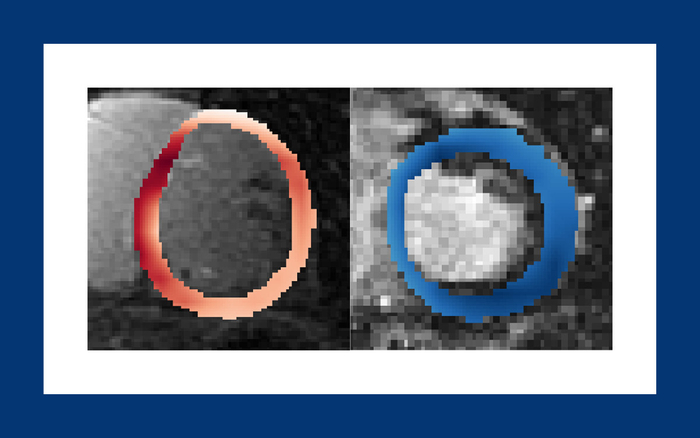
A new artificial-intelligence-based approach can predict, significantly more accurately than a doctor, if and when a patient could die of cardiac arrest. The technology, built on raw images of patients’ diseased hearts and patient backgrounds, stands to revolutionize clinical decision-making and increase survival from sudden and lethal cardiac arrhythmias, one of medicine’s deadliest and most puzzling conditions. A first-of-its-kind algorithm, using raw MRI images, can predict if and when a patient will have a lethal episode of heart arrhythmia. It detected high risk in the heart circled in red.

“Sudden cardiac death caused by arrhythmia accounts for as many as 20 percent of all deaths worldwide and we know little about why it’s happening or how to tell who’s at risk,” said senior author Natalia Trayanova, the Murray B. Sachs Professor of Biomedical Engineering and Medicine. “There are patients who may be at low risk of sudden cardiac death getting defibrillators that they might not need and then there are high-risk patients that aren’t getting the treatment they need and could die in the prime of their life. What our algorithm can do is determine who is at risk for cardiac death and when it will occur, allowing doctors to decide exactly what needs to be done.”

The team is the first to use neural networks to build a personalized survival assessment for each patient with heart disease. These risk measures provide with high accuracy the chance for a sudden cardiac death over 10 years, and when it’s most likely to happen.

The deep learning technology is called Survival Study of Cardiac Arrhythmia Risk (SSCAR). The name alludes to cardiac scarring caused by heart disease that often results in lethal arrhythmias and is the key to the algorithm’s predictions.

The team used contrast-enhanced cardiac images that visualize scar distribution from hundreds of real patients at Johns Hopkins Hospital with cardiac scarring to train an algorithm to detect patterns and relationships not visible to the naked eye. Current clinical cardiac image analysis extracts only simple scar features like volume and mass, severely underutilizing what’s demonstrated in this work to be critical data.

“The images carry critical information that doctors haven’t been able to access,” said first author Dan Popescu, a former Johns Hopkins doctoral student. “This scarring can be distributed in different ways and it says something about a patient’s chance for survival. There is information hidden in it.”

The team trained a second neural network to learn from 10 years of standard clinical patient data, 22 factors such as patients’ age, weight, race, and prescription drug use.

The algorithms’ predictions were not only significantly more accurate on every measure than doctors, they were validated in tests with an independent patient cohort from 60 health centers across the United States, with different cardiac histories and different imaging data, suggesting the platform could be adopted anywhere.

“This has the potential to significantly shape clinical decision-making regarding arrhythmia risk and represents an essential step towards bringing patient trajectory prognostication into the age of artificial intelligence,” said Trayanova, co-director of the Alliance for Cardiovascular Diagnostic and Treatment Innovation. “It epitomizes the trend of merging artificial intelligence, engineering, and medicine as the future of healthcare.”

The team is now working to build algorithms now to detect other cardiac diseases. According to Trayanova, the deep-learning concept could be developed for other fields of medicine that rely on a visual diagnosis.

The team from Johns Hopkins also included: Bloomberg Distinguished Professor of Data-Intensive Computation Mauro Maggioni; Julie Shade; Changxin Lai; Konstantino Aronis; and Katherine Wu. Other authors include M. Vinayaga Moorthy and Nancy Cook of Brigham and Women’s Hospital; Daniel Lee of Northwestern University; Alan Kadish of Touro College and University System; David Oyyang and Christine Albert of Cedar-Sinai Medical Center.

MD Anderson builds ML models that predict adverse outcomes after abdominal hernia surgery

Procedure-specific risk calculator has the potential to encourage changes in patient behaviors before surgery to improve success in abdominal wall reconstruction operations

Machine learning (ML) models developed by surgeons at the University of Texas MD Anderson Cancer Center in Houston have shown a high level of accuracy in predicting which types of patients are most likely to have a hernia recurrence or other complications. Research findings are reported in an academic article published on the website of the Journal of the American College of Surgeons (JACS).

Repair of ventral hernias—hernias that occur when a bulge emerges through the abdominal muscles—is a common operation, with more than 400,000 performed annually in the U.S. However, more than a third of these types of hernias end up happening again or patients experience some other type of post-surgery complication.

“We found that the machine learning algorithm, trained by using our own data, could accurately predict the occurrence of complications after complex abdominal wall repair,” said lead study author Abbas M. Hassan, MD, postdoctoral fellow and Ph.D. candidate, department of plastic surgery, MD Anderson. “It was also able to identify factors associated with poor outcomes.”

Dr. Hassan and colleagues say this is the first study to describe the use of ML to predict postsurgery complications of abdominal wall reconstruction.

Ventral hernias can occur in patients who’ve had an abdominal operation for something other than hernia repair, such as gall bladder removal or, in many cases at MD Anderson, to remove a tumor and nearby tissue, or even part of an organ. The surgeons noted that with more than 4 million abdominal operations performed in the United States annually, the demand for abdominal wall reconstruction is growing.

Accuracy rates and identified risk factors
The ML models achieved average accuracy rates as follows:

  • 85% for predicting hernia recurrence
  • 72% for predicting surgical site occurrence
  • 84% for predicting 30-day hospital readmission

A deeper analysis found that factors that contributed to an increased risk of hernia recurrence were an existing breach of the rectus muscle of the front abdominal wall, obesity, and the bridged repair technique, which uses mesh to span the hernia defect.

Study insights
Dr. Butler explained the rationale for developing the ML models. “It’s really important for surgeons to understand what the risk factors are to abdominal wall reconstruction,” he said. “It is such a common problem that surgeons have to deal with in just about every subspecialty of surgery. It puts tremendous financial, emotional, and physical strains on the healthcare system and on the patients that are affected as well as the surgeons dealing with these problems.”

Many patients experience discomfort and distress if they develop a hernia as well as if their hernia recurs after an operation to repair it fails. “Any information that we can have to help predict some of these adverse outcomes and potentially avoid or mitigate them will be a huge benefit to the patients, their outcomes, and to the financial well-being of the healthcare system,” Dr. Butler said.

Dr. Hassan noted research that has shown that a 1% reduction in the rate of hernia recurrence alone would save the U.S. healthcare system $30 million, according to a 2012 study. “Reduction in complications is really one of the paramount goals of abdominal wall reconstruction,” Dr. Hassan said. “Patients who develop a complication may require readmission or reoperation, and this results in increased morbidity and mortality and healthcare costs, as well as reduced quality of life. So, this becomes a critical concern when we care for patients with cancer who are immunocompromised.”

Reducing risk factors that lead to complications
Dr. Butler said the goal is to incorporate an even broader dataset into the ML models and construct risk calculators that can help surgeons more clearly identify patients who are most susceptible to complications after ventral hernia repair and potential risk factors that can be modified to improve their chances of success. “And then you can have a frank discussion in real-time and set goals with patients,” he said. “For example, you can use the risk calculator to explain to the patient that your chance of hernia recurrence will go down by a certain percent if you lose weight, reduce your HbA1c*, and stop smoking. Also, your risk of having a surgical site occurrence by doing those things will go down by a different tangible percent.” This approach gives patients accurate, tangible goals and provides realistic motivation to actively participate in improving their outcomes of abdominal wall reconstruction.

“We believe the models can be improved and made to be more generalizable in subsequent iterations, and we’re currently embarking on a multicenter study to validate the models and develop a first-of-its-kind integrated tool that uses these models and clinical data and imaging data to provide a robust prediction tool,” Dr. Hassan said. “Our hope is that this tool will be integrated in the future in the electronic medical record and mobile interfaces.”

Study coauthors are Sheng-Chieh Lu, Ph.D., and C. Sidey-Gibbons, Ph.D., of the MD Anderson Center for INSPiRED Cancer Care, Department of Symptom Research; and Malke Asaad, MD, Jun Liu, Ph.D., and Anaeze C. Offodile 2nd, MD, MPH, of the Department of Plastic and Reconstructive Surgery at MD Anderson.

Dr. Offodile is also affiliated with the Institute for Cancer Care Innovation at MD Anderson. Dr. Butler is a consultant for Allergan/AbbVie. Dr. Offodile has received research funding from Blue Cross Blue Shield and the National Academy of Medicine unrelated to the submitted work and reports honorarium from Indiana University.