SUPERCOMPUTING NEWS SUPERCOMPUTING NEWS
    • MEDIA KIT
    • MOST READ
    • RSS FEED
    • ACADEMIA
    • AEROSPACE
    • APPLICATIONS
    • ASTRONOMY
    • AUTOMOTIVE
    • BIG DATA
    • BIOLOGY
    • CHEMISTRY
    • CLIENTS
    • CLOUD
    • DEFENSE
    • DEVELOPER TOOLS
    • EARTH SCIENCES
    • ECONOMICS
    • ENGINEERING
    • ENTERTAINMENT
    • GAMING
    • GOVERNMENT
    • HEALTH
    • OIL & GAS
    • INDUSTRY
    • INTERCONNECTS
    • MANUFACTURING
    • MIDDLEWARE
    • MOVIES
    • NETWORKS
    • PHYSICS
    • PROCESSORS
    • RETAIL
    • SCIENCE
    • STORAGE
    • SYSTEMS
    • VISUALIZATION
    • AcyMailing subscription form

    • ADD YOUR VIDEOS
    • MANAGE VIDEOS
    • CONVERSATION INBOX
    • SOCIAL ADVERTISER
    • SOCIAL NETWORK VIDEOS
    • SURVEYS
    • GROUPS
    • PAGES
    • MARKETPLACE LISTINGS
    • APPLICATIONS BROWSER
    • PRIVACY CONFIRM REQUEST
    • PRIVACY CREATE REQUEST
    • LEADERBOARD
    • POINTS LISTING
      • BADGES
    • TRADE SHOWS
Sign In
Tyler O'Neal, Staff Editor ACADEMIA May 19, 2022, 7:59 am

Mann builds models of wildfires in an unprecedented time to insight

With wildfires becoming more robust and more frequent, there is a need to predict when and how the next wildfire might occur.

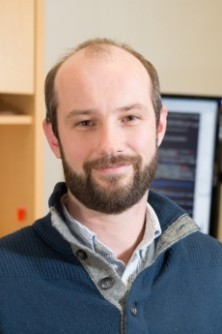
By examining statistical data on California’s wildfires dating back more than 60 years, Michael Mann, an associate professor of geography at George Washington University, has created a model that can forecast the likelihood of wildfires throughout the state from now until the year 2050. Predictions are based on climate variations, indicators of tree and plant growth, population density, and potential ignition sources within each one-kilometer area. Michael Mann

According to Mann, California makes a great test case for the use of this model because the ecosystems that exist within its borders are representative of what is found in the rest of the country. However, Mann says there has been a shift in the modeling in the last five years.

“Basically, none of the models can ‘keep up’ with wildfire risks caused by the megadrought. It’s truly unprecedented in the historical record we use for modeling. There are all kinds of consequences that ripple through everything from insurance to carbon credits and more.”

UCF demos photonic materials for light-based supercomputing

Tyler O'Neal, Staff Editor ACADEMIA May 18, 2022, 3:06 pm

The materials they are developing could allow for faster photonic supercomputers that use less energy and could also one day lead to quantum supercomputing.

The University of Central Florida researchers are developing new photonic materials that could one day help enable low power, ultra-fast, light-based supercomputing. The UCF-developed, new photonic material overcomes drawbacks of contemporary topological designs that offered less features and control, while supporting much longer propagation lengths for information packets by minimizing power losses. Image credit: Adobe Stock

The unique materials, known as topological insulators, are like wires that have been turned inside out, where the current runs along the outside and the interior is insulated.

Topological insulators are important because they could be used in circuit designs that allow for more processing power to be crammed into a single space without generating heat, thus avoiding the overheating problem today’s smaller and smaller circuits face.

In their latest work, the researchers demonstrated a new approach to creating materials that use a novel, chained, honeycomb lattice design.

The researcher laser-etched the chained, honeycombed design onto a sample of silica, the material commonly used to make photonic circuits.

Nodes in the design allow the researchers to modulate the current without bending or stretching the photonic wires, an essential feature needed for controlling the flow of light and thus information in a circuit.

The new photonic material overcomes drawbacks of contemporary topological designs that offered fewer features and control while supporting much longer propagation lengths for information packets by minimizing power losses.

The researchers envision that the new design approach introduced by the bimorphic topological insulators will lead to a departure from traditional modulation techniques, bringing the technology of light-based computing one step closer to reality.

Topological insulators could also one day lead to quantum computing as their features could be used to protect and harness fragile quantum information bits, thus allowing processing power hundreds of millions of times faster than today’s conventional computers.

The researchers confirmed their findings using advanced imaging techniques and numerical simulations.

“Bimorphic topological insulators introduce a new paradigm shift in the design of photonic circuitry by enabling secure transport of light packets with minimal losses,” says Georgios Pyrialakos, a postdoctoral researcher with UCF’s College of Optics and Photonics and the study’s lead author.

The next steps for the research include the incorporation of nonlinear materials into the lattice that could enable the active control of topological regions, thus creating custom pathways for light packets, says Demetrios Christodoulides, a professor in UCF’s College of Optics and Photonics and study co-author.

Rice chemists skew the odds to prevent cancer

Tyler O'Neal, Staff Editor ACADEMIA May 17, 2022, 5:59 pm

Theory shows mutations have few easy paths to establish themselves in cells and initiate tumors

The path to cancer prevention is long and arduous for legions of researchers, but new work by Rice University scientists shows that there may be shortcuts.

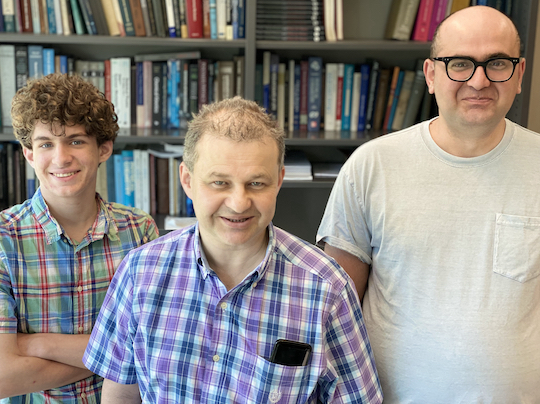
Rice chemist Anatoly Kolomeisky, lead author and postdoctoral researcher Hamid Teimouri and research assistant Cade Spaulding are developing a theoretical framework to explain how cancers caused by more than one genetic mutation can be more easily identified and perhaps stopped. A new paper shows how to increase the odds of identifying cancer-causing mutations before tumors take hold. Authors are, from left, Cade Spaulding, Anatoly Kolomeisky and Hamid Teimouri.
Essentially, it does so by identifying and ignoring transition pathways that don’t contribute much to the fixation of mutations in a cell that goes on to establish a tumor.

A study in the Biophysical Journal describes their analysis of the effective energy landscapes of cellular transformation pathways implicated in a variety of cancers. The ability to limit the number of pathways to the few most likely to kick-start cancer could help to find ways to halt the process before it ever really starts.

“In some sense, cancer is a bad-luck story,” said Kolomeisky, a professor of chemistry and of chemical and biomolecular engineering. “We think we can decrease the probability of this bad luck by looking for low-probability collections of mutations that typically lead to cancer. Depending on the type of cancer, this can range between two mutations and 10.”

Calculating the effective energies that dictate interactions in biomolecular systems can predict how they behave. The theory is commonly used to predict how a protein will fold, based on the sequence of its constituent atoms and how they interact.

The Rice team is applying the same principle to cancer initiation pathways that operate in cells but sometimes carry mutations missed by the body’s safeguards. When two or more of these mutations are fixed in a cell, they are carried forward as the cells divide and tumors grow.

By their calculations, the odds favor the most dominant pathways, those that carry mutations forward while expending the least amount of energy, Kolomeisky said.

“Instead of looking at all possible chemical reactions, we identify the few that we might need to look at,” he explained. “It seems to us that most tissues involved in the initiation of cancer are trying to be as homogenous as possible. The rule is a pathway that decreases heterogeneity is always going to be the fastest on the road to tumor formation.”

The huge number of possible pathways seems to make narrowing them down an intractable problem. “But it turned out that using our chemical intuition and building an effective free-energy landscape helped by allowing us to calculate where in the process a mutation is likely to become fixated in a cell,” Kolomeisky said.

The team simplified calculations by focusing initially on pathways involving only two mutations that, when fixed, initiate a tumor. Kolomeisky said mechanisms involving more mutations will complicate calculations, but the procedure remains the same.

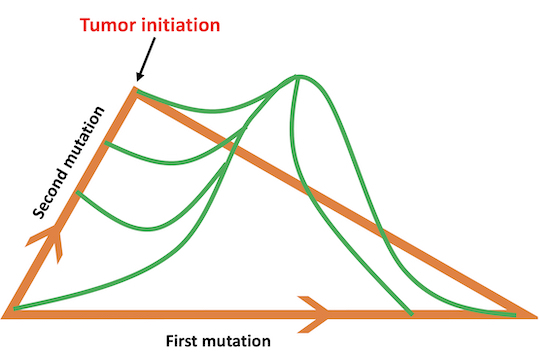
Much of the credit goes to Spaulding, who under Teimouri’s direction created the algorithms that greatly simplify the calculations. The visiting research assistant was 12 when he first met Kolomeisky to ask for guidance. Having graduated from a Houston high school two years early, he joined the Rice lab last year at 16 and will attend Trinity University in San Antonio this fall. An algorithm developed at Rice identifies and ignores transition pathways that don’t contribute much to the fixation of mutations in a cell that goes on to establish a tumor. Illustration by Hamid Teimouri
“Cade has outstanding ability in computer programming and in implementing sophisticated algorithms despite his very young age,” Kolomeisky said. “He came up with the most efficient Monte Carlo simulations to test our theory, where the size of the system can involve up to a billion cells.”

Spaulding said the project brought together chemistry, physics, and biology in a way that meshes with his interests, along with his computer programming skills. “It was good way to combine all of the branches of science and also programming, which is what I find most interesting,” he said.

The study follows a 2019 paper in which the Rice lab modeled stochastic (random) processes to learn why some cancerous cells overcome the body’s defenses and trigger spread of the disease.

But understanding how those cells become cancerous in the first place could help head them off at the pass, Kolomeisky said. “This has implications for personalized medicine,” he said. “If a tissue test can find mutations, our framework might tell you if you are likely to develop a tumor and whether you need to have more frequent checkups. I think this powerful framework can be a tool for prevention.”


  1. Franco lab makes laser bursts that drive fastest-ever logic gates
  2. Stockholm University researcher discovers more difficulty than expected for glaciers to recover from climate warming

Page 66 of 123

  • 61
  • 62
  • 63
  • 64
  • 65
  • 66
  • 67
  • 68
  • 69
  • 70
POPULAR RIGHT NOW
  • Supercomputers uncover a new class of cosmic explosions hidden in plain sight
    Supercomputers uncover a new class of cosmic explosions hidden in plain sight
  • AI supercharges the hunt for stronger magnets: Iowa State researchers launch a new era of intelligent materials discovery
    AI supercharges the hunt for stronger magnets: Iowa State researchers launch a new era of intelligent materials discovery
  • IBM's Historic stock collapse raises questions for the future of enterprise supercomputing
    IBM's Historic stock collapse raises questions for the future of enterprise supercomputing
  • Could a novel dark matter theory simultaneously resolve multiple cosmic enigmas? Supercomputer simulations provide a compelling, albeit currently unverified, potential solution
    Could a novel dark matter theory simultaneously resolve multiple cosmic enigmas? Supercomputer simulations provide a compelling, albeit currently unverified, potential solution
  • Melting icebergs may be reshaping Earth’s greatest ocean current
    Melting icebergs may be reshaping Earth’s greatest ocean current
  • Supercomputers replace ‘bathtub’ flood maps with physics-based digital twins of Britain’s coastline
    Supercomputers replace ‘bathtub’ flood maps with physics-based digital twins of Britain’s coastline
  • Supercomputers push neural quantum simulation beyond previous limits
    Supercomputers push neural quantum simulation beyond previous limits
  • Intel’s AI supercomputing revival: Q2 financial surge signals new era for CPU-powered HPC infrastructure
    Intel’s AI supercomputing revival: Q2 financial surge signals new era for CPU-powered HPC infrastructure
  • AI infrastructure financing fears shake semiconductor sector
    AI infrastructure financing fears shake semiconductor sector
  • AWS supercomputing investment reaches historic scale as Amazon’s AI strategy powers record financial results
    AWS supercomputing investment reaches historic scale as Amazon’s AI strategy powers record financial results
THIS YEAR'S MOST READ
  • Wall Street wants to trade supercomputing power like oil
    Wall Street wants to trade supercomputing power like oil
  • Cosmic ambition at scale: UK’s supercomputer unlocks a 2.5 petabytes universe
    Cosmic ambition at scale: UK’s supercomputer unlocks a 2.5 petabytes universe
  • Hidden order, revealed at scale: Supercomputing, electron ptychography uncover the inner workings of relaxor ferroelectrics
    Hidden order, revealed at scale: Supercomputing, electron ptychography uncover the inner workings of relaxor ferroelectrics
  • Beamforming the future: BeammWave's 6G push signals the rise of orbital-terrestrial wireless networks
    Joakim Axmon
    Joakim Axmon
  • Intel's Q1 results signal supercomputing surge driving Xeon momentum
    Intel's Q1 results signal supercomputing surge driving Xeon momentum
  • When stars fall apart: Supercomputing reveals the hidden physics of black holes
    When stars fall apart: Supercomputing reveals the hidden physics of black holes
  • Multi-layer simulations reveal the hidden supply chain of solar prominences
    Multi-layer simulations reveal the hidden supply chain of solar prominences
  • Japanese scientists decode dolphin speed with supercomputing: Turbulence, vortices, and the hidden physics of propulsion
    Japanese scientists decode dolphin speed with supercomputing: Turbulence, vortices, and the hidden physics of propulsion
  • Cosmic feedback at scale: Supercomputing reveals how quasars regulate the early Universe
    Cosmic feedback at scale: Supercomputing reveals how quasars regulate the early Universe
  • Modeling life at the microscopic scale: A computational breakthrough in oxygen transport
    Modeling life at the microscopic scale: A computational breakthrough in oxygen transport
MOST READ OF ALL-TIME
  • Largest Computational Biology Simulation Mimics The Ribosome
    Details
    112109
    The amino acid (green) slithers into the chemical reaction center, moving through an evolutionarily ancient corridor of the ribosome (purple). The amino acid is delivered to the reaction core by the transfer RNA molecule (yellow).
    The amino acid (green) slithers into the chemical reaction center, moving through an evolutionarily ancient corridor of the ribosome (purple). The amino acid is delivered to the reaction core by the transfer RNA molecule (yellow).
  • Silicon 'neurons' may add a new dimension to chips
    Details
    80995
    Silicon 'neurons' may add a new dimension to chips
  • Linux Networx Accelerators Expected to Drive up to 4x Price/Performance
    Details
    75540
  • Complex Concepts That Really Add Up
    Details
    73641
    Complex Concepts That Really Add Up
  • Blue Sky Studios Donates Animation SuperComputer to Wesleyan
    Details
    68142
    Each rack holds 52 Angstrom Microsystem-brand “blades,” with a memory footprint of 12 or 24 gigabytes each. (Photos by Olivia Bartlett Drake)
    Each rack holds 52 Angstrom Microsystem-brand “blades,” with a memory footprint of 12 or 24 gigabytes each. (Photos by Olivia Bartlett Drake)
  • Humanities, HPC connect at NERSC
    Details
    57949
  • TeraGrid ’09 'Call for Participation'
    Details
    54952
  • Turbulence responsible for black holes' balancing act
    Details
    52315
  • Cray Wins $52 Million SuperComputer Contract
    Details
    50143
  • SDSC Researchers Accurately Predict Protein Docking
    Details
    46083
  • FRONTPAGE
  • LATEST
  • POPULAR
  • REGISTER
  • SOCIAL
  • VIDEO
  • SUBSCRIPTION
  • RSS
  • GUIDELINES
  • PRIVACY
  • TOS
  • ABOUT
  • +1 (816) 799-4488
  • editorial@supercomputingonline.com
© 2001 - 2026 SuperComputingOnline.com, LLC. All rights reserved. This material may not be published, broadcast, rewritten or redistributed without permission.
Sign In
  • FRONT PAGE
  • LATEST
    • MEDIA KIT
    • MOST READ
    • RSS FEED
    • ACADEMIA
    • AEROSPACE
    • APPLICATIONS
    • ASTRONOMY
    • AUTOMOTIVE
    • BIG DATA
    • BIOLOGY
    • CHEMISTRY
    • CLIENTS
    • CLOUD
    • DEFENSE
    • DEVELOPER TOOLS
    • EARTH SCIENCES
    • ECONOMICS
    • ENGINEERING
    • ENTERTAINMENT
    • HEALTH
    • INDUSTRY
    • INTERCONNECTS
    • GAMING
    • GOVERNMENT
    • MANUFACTURING
    • MIDDLEWARE
    • MOVIES
    • NETWORKS
    • OIL & GAS
    • PHYSICS
    • PROCESSORS
    • RETAIL
    • SCIENCE
    • STORAGE
    • SYSTEMS
    • VISUALIZATION
  • VIDEOS
    • ADD YOUR VIDEOS
    • MANAGE VIDEOS
  • COMMUNITY
    • TRADE SHOWS
    • SOCIAL NETWORK VIDEOS
    • SURVEYS
    • APPLICATIONS BROWSER
    • CONVERSATION INBOX
    • SOCIAL ADVERTISER
    • GROUPS
    • MARKETPLACE LISTINGS
    • PAGES
    • LEADERBOARD
    • POINTS LISTING
      • BADGES
    • PRIVACY CONFIRM REQUEST
    • PRIVACY CREATE REQUEST

Hey there! We noticed you’re using an ad blocker.