UK scientists use machine learning to identify antibiotic resistant bacteria that can spread between animals, humans, the environment

Experts from the University of Nottingham, United Kingdom, have developed ground-breaking software, which combines DNA sequencing and machine learning to help them find where, and to what extent, antibiotic-resistant bacteria are being transmitted between humans, animals, and the environment.

The study, which is published in PLOS Computational Biology, was led by Dr. Tania Dottorini from the School of Veterinary Medicine and Science at the University.

Anthropogenic environments (spaces created by humans), such as areas of intensive livestock farming, are seen as ideal breeding grounds for antimicrobial-resistant bacteria and antimicrobial-resistant genes, which are capable of infecting humans and carrying resistance to drugs used in human medicine. This can have huge implications for how certain illnesses and infections can be treated effectively.

source of meat in the country, and is the largest user of antibiotics for food production in the world.

In this new study, a team of experts looked at a large-scale commercial poultry farm in China and collected 154 samples from animals, carcasses, workers, and their households and environments. From the samples, they isolated a specific bacteria called Escherichia coli (E. coli). These bacteria can live quite harmlessly in a person’s gut, but can also be pathogenic, and the genome carries resistance genes against certain drugs, which can result in illnesses including severe stomach cramps, diarrhea, and vomiting.

Researchers used a computational approach that integrates machine learning, whole-genome sequencing, gene sharing networks, and mobile genetic elements, to characterize the different types of pathogens found on the farm. They found that antimicrobial genes (genes conferring resistance to the antibiotics) were present in both pathogenic and non-pathogenic bacteria.

The new approach, using machine learning, enabled the team to uncover an entire network of genes associated with antimicrobial resistance, shared across animals, farmworkers, and the environment around them. Notably, this network included genes known to cause antibiotic resistance as well as yet unknown genes associated with antibiotic resistance.

Dr. Dottorini said: “We cannot say at this stage where the bacteria originated from, we can only say we found it and it has been shared between animals and humans. As we already know there has been sharing, this is worrying, because people can acquire resistance to drugs in two different ways - from direct contact with an animal, or indirectly by eating contaminated meat. This could be a particular problem in poultry farming, as it is the most widely used meat in the world.

“The computational tools that we have developed will enable us to analyze large complex data from different sources, at the same time as identifying where hotspots for certain bacteria may be. They are fast, they are precise and they can be applied in large environments – for instance – multiple farms at the same time.

“There are many antimicrobial-resistant genes we already know about, but how do we go beyond these and unravel new targets to design new drugs?

Our approach, using machine learning, opens up new possibilities for the development of fast, affordable, and effective computational methods that can provide new insights into the epidemiology of antimicrobial resistance in livestock farming.”Dr. Tania Dottorini from the School of Veterinary Medicine and Science at the University.

NOAA develops global forecasts of marine heatwaves to foretell ecological, economic impacts

The forecasts could help fishing fleets, ocean managers, and coastal communities anticipate the effects of marine heatwaves.

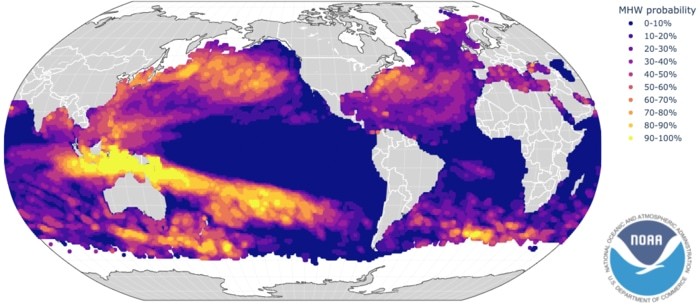
Researchers have developed global forecasts that can provide up to a year's notice of marine heatwaves, and sudden and pronounced increases in ocean temperatures that can dramatically affect ocean ecosystems. The latest global marine heatwave forecast showing the predicted probability of marine heatwaves for September 2022. Forecasts are experimental guidance, providing insight from the latest climate models. https://psl.noaa.gov/marine-heatwaves/  CREDIT NOAA

The forecasts could help fishing fleets, ocean managers, and coastal communities anticipate the effects of marine heatwaves. One such heatwave, known as “the Blob,” emerged about 2013 in the northeast Pacific Ocean and persisted through 2016. It led to shifting fish stocks, harmful algal blooms, entanglements of endangered humpback whales, and thousands of starving sea lion pups washing up on beaches.

“We have seen marine heatwaves cause sudden and pronounced changes in ocean ecosystems around the world, and forecasts can help us anticipate what may be coming,” said lead author Michael Jacox, a research scientist at NOAA Fisheries’ Southwest Fisheries Science Center in Monterey, California, and NOAA’s Physical Sciences Laboratory in Boulder, Colorado.

Marine heatwave forecasts will be available online through NOAA’s Physical Sciences Laboratory. The researchers called the forecasts a “key advance toward improved climate adaptation and resilience for marine-dependent communities around the globe.”

The forecasts leverage global climate models to predict the likely emergence of new marine heatwaves. “This is a really exciting way to use existing modeling tools in a much-needed new application,” Jacox said.

Reducing Ecological and Economic Impacts

Impacts of marine heatwaves have been documented in ecosystems around the world, particularly in the past decade. These include:

  • Fish and shellfish declines that caused global fishery losses of hundreds of millions of dollars
  • Shifting distributions of marine species that increased human-wildlife conflict and disputes about fishing rights
  • Extremely warm waters have caused bleaching and mass mortalities of corals

On the U.S. West Coast, marine heatwaves gained notoriety following the Blob, which rattled the California Current Ecosystem starting in 2014. That marine heatwave led to an ecological cascade in which whales’ prey was concentrated unusually close to shore, and a severe bloom of toxic algae along the coast delayed the opening of the valuable Dungeness crab fishery. Humpback whales moved closer to shore to feed in some of the same waters targeted by the crab fishery. As fishermen tried to make up for a lost time after the delay by deploying additional crab traps, whales became entangled in record numbers in the lines attached to crab traps. Recent research has also connected marine heatwaves along the West Coast to a northward shift in California market squid, which has long supported one of California’s largest commercial fisheries.

NOAA Fisheries scientists have since developed a Marine Heatwave Tracker that monitors the North Pacific Ocean for signs of marine heatwaves. The forecasts go a step further to anticipate where marine heatwaves are likely to emerge in the coming months, and how long they are expected to persist.

“Extreme events in concert with increasing global temperatures can serve as a catalyst for ecosystem change and reorganization,” said Elliott Hazen, a research ecologist at the Southwest Fisheries Science Center and researcher. “While marine heatwaves can have some unanticipated effects, knowing what’s coming allows for a more precautionary approach to lessen the impact on both fisheries and protected species. Understanding the ocean is the first step towards forecasting ecological changes and incorporating that foresight into decision-making.”

El Niño-Southern Oscillation Boosts Forecast Accuracy

The forecasts are most accurate during periods influenced by the El Niño-Southern Oscillation, a well-known climate pattern in the Pacific Ocean. El Niño (the warm phase of the oscillation) could be considered the “world’s most prominent marine heatwave,” Jacox said. It demonstrates that the heatwaves themselves are not new.

The forecasts cannot predict marine heatwaves as far in advance in regions such as the Mediterranean Sea, or off the U.S. East Coast. The atmosphere and ocean fluctuate more rapidly in these areas. The forecasts provide the greatest foresight in areas with known ocean-climate patterns such as the Indo-Pacific region north of Australia, the California Current System, and the northern Brazil Current.

The scientists noted that managers of fisheries and other marine life must weigh their reaction to predicted marine heatwaves based on the potential consequences. For example, they would need to weigh the economic costs of limiting fisheries ahead of a marine heatwave against the risk of inadvertently entangling endangered whales or sea turtles.

“We’re talking about the difference between making informed choices and reacting to changes as they impact ecosystems,” Hazen said. “That is always going to be a balance, but now it is a much more informed one.”

UCR astrophysicist shows why Venus rotates, slowly, despite sun’s powerful grip

The planet’s atmosphere explains the gravity of the situation

If not for the soupy, fast-moving atmosphere on Venus, Earth’s sister planet would likely not rotate. Instead, Venus would be locked in place, always facing the sun the way the same side of the moon always faces Earth. Bright Venus seen near the crescent moon.  CREDIT NASA/Bill Dunford

The gravity of a large object in space can keep a smaller object from spinning, a phenomenon called tidal locking. Because it prevents this locking, a UC Riverside scientist argues the atmosphere needs to be a more prominent factor in studies of Venus as well as other planets.

“We think of the atmosphere as a thin, almost separate layer on top of a planet that has minimal interaction with the solid planet,” said Stephen Kane, UCR astrophysicist, and lead researcher. “Venus’ powerful atmosphere teaches us that it’s a much more integrated part of the planet that affects absolutely everything, even how fast the planet rotates.”

Venus takes 243 Earth days to rotate one time, but its atmosphere circulates the planet every four days. Extremely fast winds cause the atmosphere to drag along the surface of the planet as it circulates, slowing its rotation while also loosening the grip of the sun’s gravity.  

Slow rotation in turn has dramatic consequences for the sweltering Venusian climate, with average temperatures of up to 900 degrees Fahrenheit — hot enough to melt lead. 

“It’s incredibly alien, a wildly different experience than being on Earth,” Kane said. “Standing on the surface of Venus would be like standing at the bottom of a very hot ocean. You couldn’t breathe on it.”low-res_d_transit_lineup_full-_d6bc0_2bafc.jpg

One reason for the heat is that nearly all of the sun’s energy absorbed by the planet is soaked up by Venus’ atmosphere, never reaching the surface. This means that a rover with solar panels like the one NASA sent to Mars wouldn’t work. 

The Venusian atmosphere also blocks the sun’s energy from leaving the planet, preventing cooling or liquid water on its surface, a state known as a runaway greenhouse effect. 

It is unclear whether being partially tidally locked contributes to this runaway greenhouse state, a condition that ultimately renders a planet uninhabitable by life as we know it. 

Not only is it important to gain clarity on this question to understand Venus, but it is also important for studying the exoplanets likely to be targeted for future NASA missions. 

Most of the planets likely to be observed with the recently launched James Webb Space Telescope are very close to their stars, even closer than Venus is to the sun. Therefore, they’re also likely to be tidally locked. 

Since humans may never be able to visit exoplanets in person, making sure supercomputer models account for the effects of tidal locking is critical. “Venus is our opportunity to get these models correct, so we can properly understand the surface environments of planets around other stars,” Kane said. 

“We aren’t doing a good job of considering this right now. We’re mostly using Earth-type models to interpret the properties of exoplanets. Venus is waving both arms around saying, ‘look over here!’”

Gaining clarity about the factors that contributed to a runaway greenhouse state on Venus, Earth’s closest planetary neighbor, can also help improve models of what could one day happen to Earth’s climate. 

“Ultimately, my motivation in studying Venus is to better understand the Earth,” Kane said.