Faint galaxies lurking in the dark

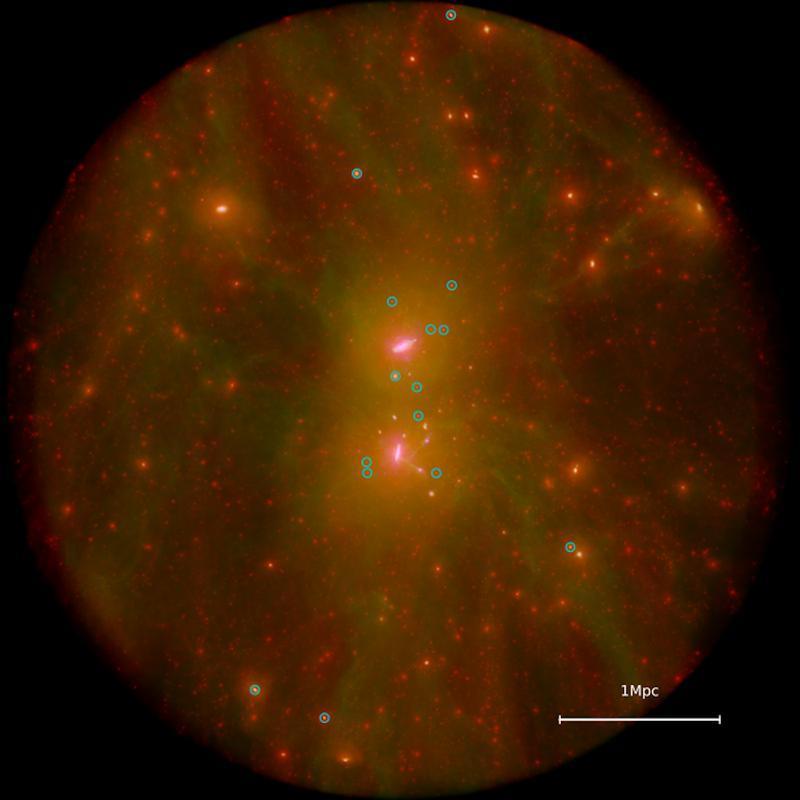
Using the most accurate and detailed cosmological simulations available, an international team has made an exciting prediction that may shed new light on our understanding of the universe: a large population of faint galaxies in our cosmic neighborhood await discovery.

The study focuses on ultra-diffuse galaxies: faint galaxies with masses of up to one billion Suns – about one-thousandth of the mass of the Milky Way – that are spread over an area comparable to the size of our Milky Way. This makes them very faint and difficult to observe, and as a result, they remain poorly understood.

The researchers believe that the Local Group, a small cluster that currently contains approximately 60 known galaxies, including our home galaxies the Milky Way and Andromeda, holds the best prospects for further discoveries. While only two ultra-diffuse galaxies have been found in the Local Group so far, scientists believe that understanding the total number of ultra-diffuse galaxies in the Local Group is crucial to our understanding of the cosmos.

So, how many more lurk in our cosmic backyard? To find out, the international team examined state-of-the-art supercomputer simulations of our cosmic neighborhood. Named after the ancient Greek goddess of the home, the HESTIA simulations are the most accurate and detailed simulations of the Milky Way and its immediate neighborhood in existence. The simulations predict that there may be as many as 12 ultra-diffuse galaxies waiting to be discovered in the Local Group. Based on an analysis of the ultra-diffuse galaxies’ properties in the HESTIA simulations, the team believes several of these galaxies could be directly observable using existing data from surveys such as the Sloan Digital Sky Survey.

The discovery of these new galaxies could have far-reaching implications for our understanding of galaxy formation and evolution. Current models suggest that up to half of the low-mass galaxies in the universe could be extended and diffuse, and most of them will be unobservable with our current technological capabilities. As the number of galaxies in the universe is a strong prediction of various cosmological models, the size of the population of ultra-diffuse galaxies in the Local Group could be used to rule out some of these models.

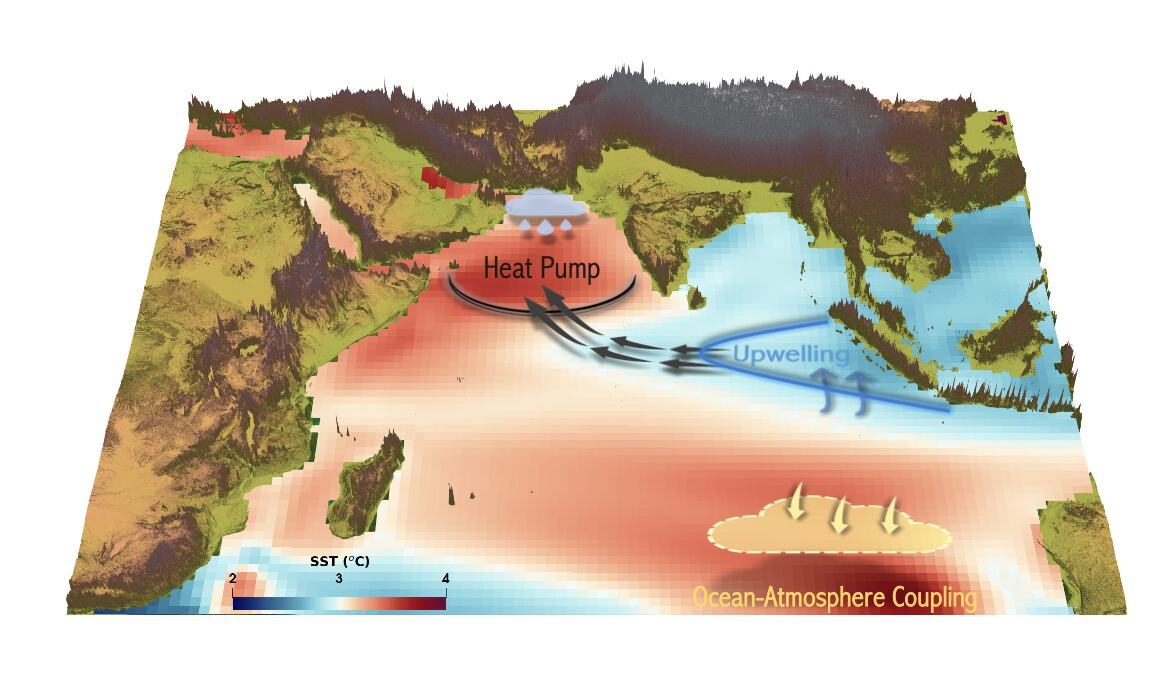
Schematic showing the expected future (2081-2100) warming pattern and the corresponding changes in winds and ocean heat transport for an SSP5-8.5 greenhouse gas emission scenario / Figure credit: Sahil Sharma

Korea's Aleph supercomputer uncovers the mechanisms that cause uneven warming in the Indian Ocean

An international team of climate scientists uncovers the physical mechanisms that can cause uneven future warming in the Indian Ocean and corresponding shifts in monsoon precipitation. 

Even though Global Warming is happening globally, some areas warm faster than others in response to increasing greenhouse gas concentrations. The corresponding climate change temperature difference pattern causes large-scale changes in winds and weather systems, impacting societies and ecosystems. Previous work has mainly focused on the well-known Arctic amplification pattern and on the projected east/west temperature difference in the equatorial Pacific, which in turn can impact regions far outside the tropics. Little attention has been paid so far to the mechanisms that cause uneven heating in the Indian Ocean and related impacts on wind and rainfall in the adjacent land area.

By analyzing data from one of the most extensive future climate change simulations performed to date (the ICCP/CESM Large-Ensemble simulation of the Community Earth System Model, version 2), the team of scientists from South Korea and Japan was able to pinpoint why over the next decades the tropical eastern Indian Ocean is expected to warm less than the Arabian Sea and the Southeastern Indian Ocean (Figure).

A key area identified by the researchers to explain the uneven Indian Ocean warming is the area west of Indonesia, where under present-day conditions colder deep waters occasionally upwell to the surface. This connection between surface and deeper ocean waters serves as a thermostat, which explains the weakened future regional warming signal relative to other Indian Ocean areas. In the tropics, air rises in warmer areas and tends to sink in colder regions.  The reduced eastern equatorial Indian warming is therefore accompanied by higher-than-normal sea level pressure and winds that blow toward the Arabian Sea. 

“Changes in the winds automatically influence the ocean circulation. In our case, stronger future winds blowing from Indonesia towards the Arabian Peninsula push more tropical waters toward the Arabian Sea. This leads to accelerated warming of the ocean there” says Sahil Sharma, a Ph.D. student at the IBS Center for Climate Physics (ICCP) and Pusan National University, South Korea, and the first writer of the study. 

“Enhanced future warming in the Arabian Sea will further reduce atmospheric surface pressure and generate more rainfall, also in the adjacent regions.  Climate models show on average a 50% intensification of mean rainfall over the southern Arabian Peninsula and parts of western India by the year 2100 if CO2 emissions are not cut drastically.”, says Prof. Kyung-Ja Ha from the IBS Center for Climate Physics and Pusan National University and corresponding author of the study.

The writers further highlighted the southeastern Indian ocean as a regional global warming hotspot. In this region, future surface warming induced by greenhouse gases can be further amplified by a reduction of clouds and more sunshine arriving at the surface of the ocean.

“The Indian Ocean is a peculiar region. Ocean currents are less efficient in transporting excess heating from Global Warming to higher latitudes, as compared to other ocean basins. The northern transport route is blocked by land. This means that we find a very different temperature response pattern in the Indian Ocean, which emerges from a combination of oceanic and atmospheric processes, including winds and clouds ”, says Dr. Keith Rodgers from the IBS Center for Climate Physics, co-author of the study.

This study was made possible by using a climate computer model experiment, which was previously conducted on the ICCP/IBS supercomputer Aleph. Rather than running a climate model only once into the future for a given greenhouse gas forcing, the researcher ran 100 simulations into the future which represent different realizations of the internal variability in the climate system.

This new modeling resource has been instrumental in identifying the complex interplay between the ocean and atmosphere which is responsible for the Indian Ocean warming pattern. This understanding will be useful for informing fisheries and other marine resource management concerns.

The research team will further explore how climate change will impact other regional processes in the Indian Ocean area, including marine ecosystems and sea levels.

NASA's Solar Dynamics Observatory captured this image of a solar flare on Oct. 2, 2014. The solar flare is the bright flash of light at top. A burst of solar material erupting out into space can be seen just to the right of it. Credits: NASA/SDO

NASA-built supercomputer model DAGGER makes predictions with AI to give time to prepare for solar storms

Like a tornado siren for life-threatening storms in America’s heartland, a new supercomputer model that combines artificial intelligence (AI) and NASA satellite data could sound the alarm for dangerous space weather. This movie, captured by SOHO

The model uses AI to analyze spacecraft measurements of the solar wind (an unrelenting stream of material from the Sun) and predict where an impending solar storm will strike, anywhere on Earth, with 30 minutes of warning. This could provide just enough time to prepare for these storms and prevent severe impacts on power grids and other critical infrastructure.

The Sun constantly sheds solar material into space – both in a steady flow known as the “solar wind,” and in shorter, more energetic bursts from solar eruptions. When this solar material strikes Earth’s magnetic environment (its “magnetosphere”), it sometimes creates so-called geomagnetic storms. The impacts of these magnetic storms can range from mild to extreme, but in a world increasingly dependent on technology, their effects are growing ever more disruptive.

For example, a destructive solar storm in 1989 caused electrical blackouts across Quebec for 12 hours, plunging millions of Canadians into the dark and closing schools and businesses. The most intense solar storm on record, the Carrington Event in 1859, sparked fires at telegraph stations and prevented messages from being sent. If the Carrington Event happened today, it would have even more severe impacts, such as widespread electrical disruptions, persistent blackouts, and interruptions to global communications. Such technological chaos could cripple economies and endanger the safety and livelihoods of people worldwide.

In addition, the risk of geomagnetic storms and devastating effects on our society is presently increasing as we approach the next “solar maximum” – a peak in the Sun’s 11-year activity cycle – which is expected to arrive sometime in 2025.

To help prepare, an international team of researchers at the Frontier Development Lab – a public-private partnership that includes NASA, the U.S. Geological Survey, and the U.S. Department of Energy – have been using artificial intelligence (AI) to look for connections between the solar wind and geomagnetic disruptions, or perturbations, that cause havoc on our technology. The researchers applied an AI method called “deep learning,” which trains computers to recognize patterns based on previous examples. They used this type of AI to identify relationships between solar wind measurements from heliophysics missions (including ACEWindIMP-8, and Geotail) and geomagnetic perturbations observed at ground stations across the planet.

DAGGER’s developers compared the model’s predictions to measurements made during solar storms in August 2011 and March 2015. At the top, colored dots show measurements made during the 2011 storm. Colors indicate the intensity of geomagnetic perturbations that can induce currents in electric grids, with orange and red indicating the strongest effects. DAGGER’s 30-minute forecast for that same time (bottom) shows the most intense perturbations in approximately the same locations around Earth’s north pole. Credits: V. Upendran et al.From this, they developed a supercomputer model called DAGGER (formally, Deep Learning Geomagnetic Perturbation) that can quickly and accurately predict geomagnetic disturbances worldwide, 30 minutes before they occur. According to the team, the model can produce predictions in less than a second, and the predictions update every minute.

The DAGGER team tested the model against two geomagnetic storms that happened in August 2011 and March 2015. In each case, DAGGER was able to quickly and accurately forecast the storm’s impacts around the world.

Previous prediction models have used AI to produce local geomagnetic forecasts for specific locations on Earth. Other models that didn’t use AI have provided global predictions that weren’t very timely. DAGGER is the first one to combine the swift analysis of AI with real measurements from space and across Earth to generate frequently updated predictions that are both prompt and precise for sites worldwide.

“With this AI, it is now possible to make rapid and accurate global predictions and inform decisions in the event of a solar storm, thereby minimizing – or even preventing – devastation to modern society,” said Vishal Upendran of the Inter-University Center for Astronomy and Astrophysics in India, who is the lead author of a paper about the DAGGER model published in the journal Space Weather.

The supercomputer code in the DAGGER model is open source, and according to Upendran, it could be adopted, with help, by power grid operators, satellite controllers, telecommunications companies, and others to apply the predictions for their specific needs. Such warnings could give them time to take action to protect their assets and infrastructure from an impending solar storm, such as temporarily taking sensitive systems offline or moving satellites to different orbits to minimize damage.

With models like DAGGER, there could one day be solar storm sirens that sound an alarm in power stations and satellite control centers around the world, just as tornado sirens wail in advance of threatening terrestrial weather in towns and cities across America.