

SUPERCOMPUTING NEWS SUPERCOMPUTING NEWS
    • MEDIA KIT
    • MOST READ
    • RSS FEED
    • ACADEMIA
    • AEROSPACE
    • APPLICATIONS
    • ASTRONOMY
    • AUTOMOTIVE
    • BIG DATA
    • BIOLOGY
    • CHEMISTRY
    • CLIENTS
    • CLOUD
    • DEFENSE
    • DEVELOPER TOOLS
    • EARTH SCIENCES
    • ECONOMICS
    • ENGINEERING
    • ENTERTAINMENT
    • GAMING
    • GOVERNMENT
    • HEALTH
    • OIL & GAS
    • INDUSTRY
    • INTERCONNECTS
    • MANUFACTURING
    • MIDDLEWARE
    • MOVIES
    • NETWORKS
    • PHYSICS
    • PROCESSORS
    • RETAIL
    • SCIENCE
    • STORAGE
    • SYSTEMS
    • VISUALIZATION
    • AcyMailing subscription form

    • ADD YOUR VIDEOS
    • MANAGE VIDEOS
    • CONVERSATION INBOX
    • SOCIAL ADVERTISER
    • SOCIAL NETWORK VIDEOS
    • SURVEYS
    • GROUPS
    • PAGES
    • MARKETPLACE LISTINGS
    • APPLICATIONS BROWSER
    • PRIVACY CONFIRM REQUEST
    • PRIVACY CREATE REQUEST
    • LEADERBOARD
    • POINTS LISTING
      • BADGES
    • TRADE SHOWS
Sign In
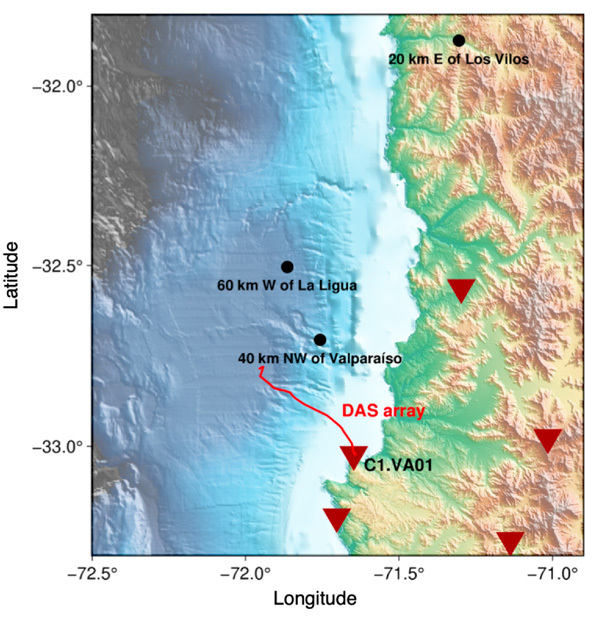
Map of the study area in Chile. Red curve is the DAS array, black dots are earthquakes, dark red triangles are permanent seismic stations. | TSR doi.org/10.1785/0320230018
Tyler O'Neal, Staff Editor EARTH SCIENCES October 17, 2023, 3:00 pm

Researchers use a deep-learning model to identify earthquake waves from the DAS data from the offshore cable

Unused telecommunications fiber optic cables can provide three seconds of improved warning time for offshore earthquake early warning systems, as researchers have shown. The researchers used a deep-learning artificial intelligence model to identify earthquake waves from the DAS data obtained from the offshore cable. There are over 1500 cable landing stations across the globe, and this technology allows the use of operational cables and integration of DAS systems without disrupting telecommunications data transportation. This presents an exciting opportunity for further research.

Seismic stations located offshore of heavily populated coastlines are lacking, which poses a significant challenge for earthquake early warning systems (EEW). These areas are some of the world's most seismically active regions. A new study published in The Seismic Record shows how the conversion of unused telecommunications fiber optic cable can address this issue for offshore EEW.

Jiuxun Yin, a Caltech researcher now at SLB, and colleagues utilized a 50-kilometer submarine telecom cable that runs between the United States and Chile. They sampled seismic data at 8,960 channels along the cable for four days using the Distributed Acoustic Sensing (DAS) technique. This technique uses the tiny internal flaws in a long optical fiber as thousands of seismic sensors.

During the study period, Yin and colleagues used the cable data to determine earthquake locations and estimate earthquake magnitudes for one onshore (magnitude 3.7) and two offshore (magnitude 2.7 and 3.3) earthquakes.

Their results showed that using this single offshore DAS array offers an approximate three-second improvement in earthquake early warning compared to onshore DAS arrays. In a simulation conducted by the researchers, they found that by deploying multiple DAS arrays spaced 50 kilometers apart and working together in the area, they could improve EEW alert times in the subduction zone by five seconds.

Yin expressed that they had anticipated some improvements due to the offshore placement of the DAS array. However, the actual speed gains were even greater than their initial projections. The array's offshore location eliminates the wait time for seismic waves to reach land-based stations, which is the primary advantage.

Offshore Chile and the Cascadia region offshore Canada and the U.S. Pacific Northwest are alike. They both have an active subduction zone, where tectonic plates collide, and one plate plunges beneath another, causing some of history's largest and most destructive earthquakes. Even Southern California's offshore region has witnessed numerous faults that have hosted earthquakes of magnitude 6 or more. In all these densely populated coastal areas, offshore earthquake early warning could help protect lives and property.

Yin explained that Chile's elevated seismic risk was the primary reason for selecting this cable. The region experiences frequent offshore earthquakes and has been affected by several significant magnitude 8+ earthquakes in history, including the largest ever recorded in 1960. Considering the high seismic risk and potentially devastating impacts of a large earthquake, there is a pressing need for a reliable offshore earthquake early warning system in Chile.

The researchers utilized a deep learning artificial intelligence model, which had been trained and validated on previous seismic and DAS data, to identify the earthquake waves from the DAS data of this offshore cable. According to Yin, the volume of data collected for DAS is substantial and pre-trained deep learning models offer a highly efficient and reliable option for real-time applications like EEW. However, other traditional seismological methods of picking earthquakes can still be effective in processing DAS data with automation.

Yin also noted that researchers require more data, particularly from larger magnitude earthquakes, to develop and test EEW algorithms effectively, as well as more information on how DAS instruments respond before building a real-time EEW system that integrates with existing EEW frameworks. He stated that there are plenty of places around the world to continue this research.

As per Yin, "There are more than 1500 cable landing stations around the globe, and the progress in the technology permits the use of operational cables and adding DAS systems without affecting [telecommunications] data transportation. We believe that this opens up a host of exciting research opportunities, and we are keen to explore these in future studies. We are looking for close interactions with cable owners, environmental agencies, and policymakers to scale the DAS-EEW for the benefit of coastal communities."
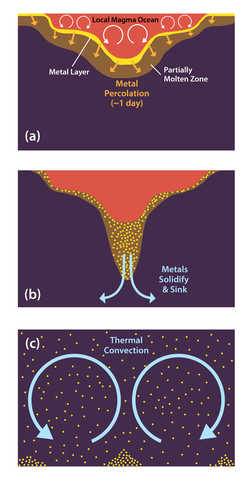
This schematic illustrates the most geophysically plausible explanation for the abundance of HSE metals present in the Earth’s mantle. During the long period of bombardment, impactors would strike the Earth and deliver materials. (a) Liquid metals would sink in the locally produced impact-generated magma ocean before percolating through the partially molten zone beneath. (b) Compression causes the metals in the molten zone to solidify and sink. (c) Then thermal convection mixes and redistributes the metal-impregnated mantle components over long geologic time frames.

New research proposes impact-driven mixing of mantle materials for current mantle composition, shedding light on Earth's precious metals

Tyler O'Neal, Staff Editor EARTH SCIENCES October 10, 2023, 6:00 am

A new study has found a geophysically plausible scenario to explain the abundance of certain precious metals, including gold and platinum, in the Earth’s mantle.

Scientists hypothesize that early in Earth’s evolution, about 4.5 billion years ago, the Earth sustained an impact with a Mars-sized planet and the Moon formed from the debris that was ejected into an Earth-orbiting disk.

The study's simulations used the mixing of mantle materials to explain how the metals could have been prevented from completely sinking into the Earth’s core, and that mantle convection could be responsible for redistributing the materials and retaining HSEs in the mantle.

Dr. Simone Marchi from Southwest Research Institute collaborated on a recent study that found the first geophysically plausible scenario explaining the abundance of precious metals in the Earth's mantle, including gold and platinum. The simulations carried out by scientists suggest that an impact-driven mixing of mantle materials could prevent the metals from completely sinking into the Earth's core.

The Earth sustained an impact with a Mars-sized planet about 4.5 billion years ago, resulting in the formation of the Moon from the debris ejected into an Earth-orbiting disk. The so-called "late accretion" followed, during which planetesimals as large as our Moon impacted the Earth, delivering materials like highly "siderophile" elements (HSEs) - metals with a strong affinity for iron - that were integrated into the young Earth.

Previous simulations of impacts penetrating Earth's mantle showed that only small fractions of a metallic core of planetesimals are available to be assimilated by Earth's mantle, while most of these metals, including HSEs, quickly drain down to the Earth's core. This brings us to the question: how did Earth get some of its precious metals? To explain the metal and rock mix of materials in the present-day mantle, the researchers developed new simulations.

The relative abundance of HSEs in the mantle points to delivery via impact after Earth's core had formed; however, retaining those elements in the mantle proved difficult to model - until now. The new simulation considered how a partially molten zone under a localized impact-generated magma ocean could have stalled the descent of planetesimal metals into Earth's core.

The researchers modeled mixing an impacting planetesimal with mantle materials in three flowing phases - solid silicate minerals, molten silicate magma, and liquid metal. The rapid dynamics of such a three-phase system, combined with the long-term mixing provided by convection in the mantle, allows HSEs from planetesimals to be retained in the mantle.

In this scenario, an impactor would crash into the Earth, creating a localized liquid magma ocean where heavy metals sink to the bottom. When metals reach the partially molten region beneath, the metal would quickly percolate through the melt and, after that, slowly sink toward the bottom of the mantle. During this process, the molten mantle solidifies, trapping the metal. That's when convection takes over, as heat from the Earth's core causes a very slow creeping motion of materials in the solid mantle, and the ensuing currents carry heat from the interior to the planet's surface.

"Mantle convection refers to the process of rising hot mantle material and sinking colder material," lead author Dr. Jun Korenaga from Yale University said. "The mantle is almost entirely solid although, over long geologic time spans, it behaves as a ductile and highly viscous fluid, mixing and redistributing mantle materials, including HSEs accumulated from large collisions that took place billions of years ago."

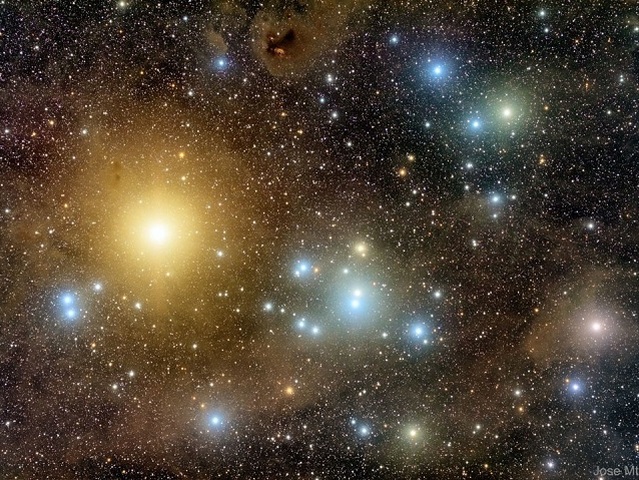
Image of the Hyades star cluster. Image: Jose Mtanous

A recent study suggests that the Hyades star cluster may contain the closest black holes to Earth

Tyler O'Neal, Staff Editor EARTH SCIENCES September 8, 2023, 1:00 pm

A new study suggests that there may be multiple black holes in the Hyades cluster, which is the closest open cluster to our solar system. This discovery marks the detection of the nearest black holes to Earth. The research was conducted by a group of scientists led by Stefano Torniamenti from the University of Padua, with significant contributions from Mark Gieles, ICREA professor at the Faculty of Physics, the Institute of Cosmos Sciences of the University of Barcelona (ICCUB), and the Institute of Space Studies of Catalonia (IEEC), and Friedrich Anders (ICCUB-IEEC).

Specifically, the finding took place during a research stay of the expert Stefano Torniamenti at the ICCUB, one of the research units that make up the IEEC.

Black holes in the Hyades star cluster?

Black holes have always been one of the most enigmatic and captivating phenomena in the Universe, enticing researchers from all corners of the world. The interest in black holes has particularly surged after their discovery through the detection of gravitational waves. Since the first gravitational waves were detected in 2015, experts have recorded numerous events that point to the mergers of low-mass black hole pairs.

The team of astrophysicists conducted a study using supercomputer simulations to track the motion and evolution of all the stars in the Hyades. This star cluster is located at a distance of about 45 parsecs or 150 light-years from the Sun. They used the simulations to replicate the current state of the stars in the cluster.

Loosely bound groups of hundreds of stars that share certain properties such as age and chemical characteristics are called open clusters. To validate simulation results, the positions and velocities of stars in the Hyades were compared with the actual data collected by the European Space Agency's (ESA) Gaia satellite.

"Our simulations can only simultaneously match the mass and size of the Hyades if some black holes are present at the center of the cluster today (or until recently)", says Stefano Torniamenti, a postdoctoral researcher at the University of Padua and first author of the paper.

The properties observed in the Hyades can be best replicated with supercomputer simulations that include two or three black holes at present. However, simulations that do not include any black holes, because they were all ejected within the last 150 million years (roughly the last quarter of the cluster's age), can still provide a good match. This is because the cluster's evolution could not erase the traces of its previous black hole population.

The new results indicate that the Hyades-born black holes are still inside the cluster, or very close to the cluster. This makes them the closest black holes to the Sun, much closer than the previous candidate (namely the black hole Gaia BH1, which is 480 parsecs from the Sun).

In recent years, the breakthrough of the Gaia space telescope has made it possible for the first time to study the position and velocity of open cluster stars in detail and to identify individual stars with confidence.

"This observation helps us understand how the presence of black holes affects the evolution of star clusters and how star clusters, in turn, contribute to gravitational wave sources", says Mark Gieles, a member of the UB Department of Quantum Physics and Astrophysics and host of the first author in Barcelona. "These results also give us insight into how these mysterious objects are distributed across the galaxy”.

The new study is the result of close collaboration between the University of Padova, ICUBB-IEEC, the University of Cambridge (United Kingdom), the European Southern Observatory (ESO), and the National Sun Yat-sen University (China).

The study of the Hyades star cluster has led to the discovery of the black holes closest to Earth so far. This remarkable discovery provides a great insight into the universe around us and has the potential to open up a new field of research, enabling us to explore the mysteries of these objects in greater detail. It also serves as an inspirational reminder that the universe is full of wonders and that we should never stop exploring and pushing the boundaries of our knowledge.

  1. Black hole engulfs star matter equivalent to three Earths
  2. Discover the power of deep learning with UCSC seismologists' pioneering technology that enables them to predict earthquakes

Page 2 of 23

  • 1
  • 2
  • 3
  • 4
  • 5
  • 6
  • 7
  • 8
  • 9
  • 10
POPULAR RIGHT NOW
  • AI supercharges the hunt for stronger magnets: Iowa State researchers launch a new era of intelligent materials discovery
    AI supercharges the hunt for stronger magnets: Iowa State researchers launch a new era of intelligent materials discovery
  • IBM's Historic stock collapse raises questions for the future of enterprise supercomputing
    IBM's Historic stock collapse raises questions for the future of enterprise supercomputing
  • Could a novel dark matter theory simultaneously resolve multiple cosmic enigmas? Supercomputer simulations provide a compelling, albeit currently unverified, potential solution
    Could a novel dark matter theory simultaneously resolve multiple cosmic enigmas? Supercomputer simulations provide a compelling, albeit currently unverified, potential solution
  • Melting icebergs may be reshaping Earth’s greatest ocean current
    Melting icebergs may be reshaping Earth’s greatest ocean current
  • Supercomputers replace ‘bathtub’ flood maps with physics-based digital twins of Britain’s coastline
    Supercomputers replace ‘bathtub’ flood maps with physics-based digital twins of Britain’s coastline
  • Supercomputers push neural quantum simulation beyond previous limits
    Supercomputers push neural quantum simulation beyond previous limits
  • Intel’s AI supercomputing revival: Q2 financial surge signals new era for CPU-powered HPC infrastructure
    Intel’s AI supercomputing revival: Q2 financial surge signals new era for CPU-powered HPC infrastructure
  • AI infrastructure financing fears shake semiconductor sector
    AI infrastructure financing fears shake semiconductor sector
  • AWS supercomputing investment reaches historic scale as Amazon’s AI strategy powers record financial results
    AWS supercomputing investment reaches historic scale as Amazon’s AI strategy powers record financial results
  • Catching the wave of the future: Supercomputers unlock the hidden dynamics of Venus
    Catching the wave of the future: Supercomputers unlock the hidden dynamics of Venus
THIS YEAR'S MOST READ
  • Wall Street wants to trade supercomputing power like oil
    Wall Street wants to trade supercomputing power like oil
  • Beamforming the future: BeammWave's 6G push signals the rise of orbital-terrestrial wireless networks
    Joakim Axmon
    Joakim Axmon
  • Cosmic ambition at scale: UK’s supercomputer unlocks a 2.5 petabytes universe
    Cosmic ambition at scale: UK’s supercomputer unlocks a 2.5 petabytes universe
  • Hidden order, revealed at scale: Supercomputing, electron ptychography uncover the inner workings of relaxor ferroelectrics
    Hidden order, revealed at scale: Supercomputing, electron ptychography uncover the inner workings of relaxor ferroelectrics
  • Intel's Q1 results signal supercomputing surge driving Xeon momentum
    Intel's Q1 results signal supercomputing surge driving Xeon momentum
  • When stars fall apart: Supercomputing reveals the hidden physics of black holes
    When stars fall apart: Supercomputing reveals the hidden physics of black holes
  • Multi-layer simulations reveal the hidden supply chain of solar prominences
    Multi-layer simulations reveal the hidden supply chain of solar prominences
  • Japanese scientists decode dolphin speed with supercomputing: Turbulence, vortices, and the hidden physics of propulsion
    Japanese scientists decode dolphin speed with supercomputing: Turbulence, vortices, and the hidden physics of propulsion
  • Cosmic feedback at scale: Supercomputing reveals how quasars regulate the early Universe
    Cosmic feedback at scale: Supercomputing reveals how quasars regulate the early Universe
  • Modeling life at the microscopic scale: A computational breakthrough in oxygen transport
    Modeling life at the microscopic scale: A computational breakthrough in oxygen transport
MOST READ OF ALL-TIME
  • Largest Computational Biology Simulation Mimics The Ribosome
    Details
    112127
    The amino acid (green) slithers into the chemical reaction center, moving through an evolutionarily ancient corridor of the ribosome (purple). The amino acid is delivered to the reaction core by the transfer RNA molecule (yellow).
    The amino acid (green) slithers into the chemical reaction center, moving through an evolutionarily ancient corridor of the ribosome (purple). The amino acid is delivered to the reaction core by the transfer RNA molecule (yellow).
  • Silicon 'neurons' may add a new dimension to chips
    Details
    81040
    Silicon 'neurons' may add a new dimension to chips
  • Linux Networx Accelerators Expected to Drive up to 4x Price/Performance
    Details
    75563
  • Complex Concepts That Really Add Up
    Details
    73693
    Complex Concepts That Really Add Up
  • Blue Sky Studios Donates Animation SuperComputer to Wesleyan
    Details
    68166
    Each rack holds 52 Angstrom Microsystem-brand “blades,” with a memory footprint of 12 or 24 gigabytes each. (Photos by Olivia Bartlett Drake)
    Each rack holds 52 Angstrom Microsystem-brand “blades,” with a memory footprint of 12 or 24 gigabytes each. (Photos by Olivia Bartlett Drake)
  • Humanities, HPC connect at NERSC
    Details
    57973
  • TeraGrid ’09 'Call for Participation'
    Details
    54976
  • Turbulence responsible for black holes' balancing act
    Details
    52339
  • Cray Wins $52 Million SuperComputer Contract
    Details
    50162
  • SDSC Researchers Accurately Predict Protein Docking
    Details
    46115
  • FRONTPAGE
  • LATEST
  • POPULAR
  • REGISTER
  • SOCIAL
  • VIDEO
  • SUBSCRIPTION
  • RSS
  • GUIDELINES
  • PRIVACY
  • TOS
  • ABOUT
  • +1 (816) 799-4488
  • editorial@supercomputingonline.com
© 2001 - 2026 SuperComputingOnline.com, LLC. All rights reserved. This material may not be published, broadcast, rewritten or redistributed without permission.
Sign In
  • FRONT PAGE
  • LATEST
    • MEDIA KIT
    • MOST READ
    • RSS FEED
    • ACADEMIA
    • AEROSPACE
    • APPLICATIONS
    • ASTRONOMY
    • AUTOMOTIVE
    • BIG DATA
    • BIOLOGY
    • CHEMISTRY
    • CLIENTS
    • CLOUD
    • DEFENSE
    • DEVELOPER TOOLS
    • EARTH SCIENCES
    • ECONOMICS
    • ENGINEERING
    • ENTERTAINMENT
    • HEALTH
    • INDUSTRY
    • INTERCONNECTS
    • GAMING
    • GOVERNMENT
    • MANUFACTURING
    • MIDDLEWARE
    • MOVIES
    • NETWORKS
    • OIL & GAS
    • PHYSICS
    • PROCESSORS
    • RETAIL
    • SCIENCE
    • STORAGE
    • SYSTEMS
    • VISUALIZATION
  • VIDEOS
    • ADD YOUR VIDEOS
    • MANAGE VIDEOS
  • COMMUNITY
    • TRADE SHOWS
    • SOCIAL NETWORK VIDEOS
    • SURVEYS
    • APPLICATIONS BROWSER
    • CONVERSATION INBOX
    • SOCIAL ADVERTISER
    • GROUPS
    • MARKETPLACE LISTINGS
    • PAGES
    • LEADERBOARD
    • POINTS LISTING
      • BADGES
    • PRIVACY CONFIRM REQUEST
    • PRIVACY CREATE REQUEST

Hey there! We noticed you’re using an ad blocker.