

SUPERCOMPUTING NEWS SUPERCOMPUTING NEWS
    • MEDIA KIT
    • MOST READ
    • RSS FEED
    • ACADEMIA
    • AEROSPACE
    • APPLICATIONS
    • ASTRONOMY
    • AUTOMOTIVE
    • BIG DATA
    • BIOLOGY
    • CHEMISTRY
    • CLIENTS
    • CLOUD
    • DEFENSE
    • DEVELOPER TOOLS
    • EARTH SCIENCES
    • ECONOMICS
    • ENGINEERING
    • ENTERTAINMENT
    • GAMING
    • GOVERNMENT
    • HEALTH
    • OIL & GAS
    • INDUSTRY
    • INTERCONNECTS
    • MANUFACTURING
    • MIDDLEWARE
    • MOVIES
    • NETWORKS
    • PHYSICS
    • PROCESSORS
    • RETAIL
    • SCIENCE
    • STORAGE
    • SYSTEMS
    • VISUALIZATION
    • AcyMailing subscription form

    • ADD YOUR VIDEOS
    • MANAGE VIDEOS
    • CONVERSATION INBOX
    • SOCIAL ADVERTISER
    • SOCIAL NETWORK VIDEOS
    • SURVEYS
    • GROUPS
    • PAGES
    • MARKETPLACE LISTINGS
    • APPLICATIONS BROWSER
    • PRIVACY CONFIRM REQUEST
    • PRIVACY CREATE REQUEST
    • LEADERBOARD
    • POINTS LISTING
      • BADGES
    • TRADE SHOWS
Sign In
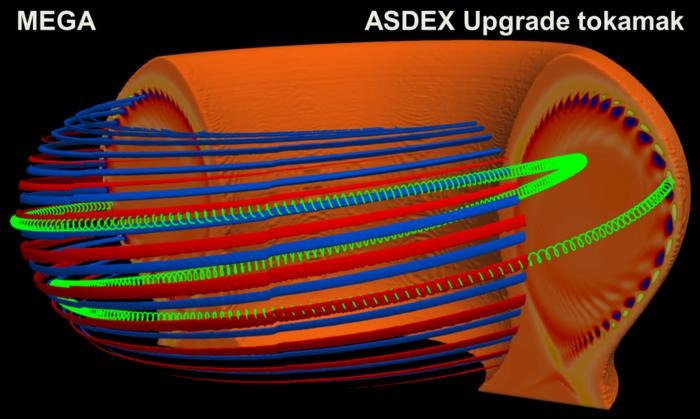
3D visualization of an ELM in the ASDEX Upgrade tokamak, simulated with the MEGA code. The tokamak volume is colored according to the ELM structure. The ELM interacts with the energetic particle, whose orbit is shown in green.
Tyler O'Neal, Staff Editor ENGINEERING January 10, 2025, 8:22 pm

The uncertain promise of controlling plasma flares with energetic particles

In an age inundated with promises of scientific breakthroughs and revolutionary technologies, the recent revelation by a team of international researchers from the Plasma Science and Fusion Technology Laboratory of the University of Seville has sparked intrigue and skepticism. The groundbreaking claim that energetic particles could aid in controlling plasma flares at the edge of a tokamak, the quintessential fusion reactor design, casts a shadow of doubt over the veracity of such assertions.

Their findings suggest that the interplay between energetic suprathermal particles and Edge Localized Modes (ELMs) within the tokamak plasma edge could hold the key to mitigating particle and energy losses that plague current fusion reactor designs. Through a combination of experiments, supercomputer modeling, and simulations utilizing the MEGA code, the researchers purport to have unearthed a novel understanding of the behaviors of ELMs in the presence of energetic particles.

The narrative weaved by the research team speaks of a tantalizing promise—that the interaction between energetic ions and ELMs could potentially alter the spatiotemporal structure of these plasma instabilities.

Drawing an analogy to a surfer riding a wave, the researchers posit that energetic particles are active actuators in controlling Magnetohydrodynamic (MHD) waves, akin to how a surfer leaves footprints on a wave. This so-called interaction mechanism hints at a radical shift in our understanding of plasma dynamics that could revolutionize the field of fusion energy.

However, as we peel back the layers of this narrative, a shroud of skepticism descends upon the purported implications of this research. The inherent complexities of plasma physics and fusion energy pose a formidable challenge to the feasibility of using energetic particles as a panacea for ELM control. The nuanced interplay between experimental data and simulations raises questions about the reliability and reproducibility of the claimed results.

Moreover, the assertion that a strong energy and momentum exchange between ELMs and energetic ions is expected for ITER, the largest tokamak under construction in France, introduces a caveat of uncertainty. Can the intricate dance between energetic particles and plasma instabilities truly be harnessed to advance the frontiers of nuclear fusion, or are we venturing into the realm of lofty conjectures and speculative claims?

While the research conducted under the aegis of the European fusion consortium EUROfusion paints a promising picture of prospective advancements in fusion energy, the pragmatic skeptic urges a cautious approach.

In a world marred by grandiose promises and utopian visions of technological advancement, interrogating scientific claims through diverse perspectives becomes paramount. As we venture further into plasma physics and fusion energy, let us tread with a critical eye and an inquisitive mind, discerning between the genuine paradigm shifts and the ephemeral mirages that seduce us with hollow promises.


UNH researchers unleash the power of AI, transforming the realm of auroral exploration

UNH researchers unleash the power of AI, transforming the realm of auroral exploration

Tyler O'Neal, Staff Editor ENGINEERING January 10, 2025, 6:00 pm

In a world where the mysteries of the cosmos continually beckon humanity's insatiable curiosity, the University of New Hampshire (UNH) shines as a beacon of innovation. Researchers at UNH have recently pioneered artificial intelligence to categorize a colossal database of over 700 million stunning aurora images, providing insight into a realm where science, technology, and imagination intersect.

The aurora borealis, a breathtaking display of light in the night sky, has captivated generations with its mystical beauty. However, behind this ethereal phenomenon lies a scientific field full of challenges and untapped potential. The groundbreaking work led by Jeremiah Johnson, an associate professor of applied engineering and sciences, and a team of visionary collaborators embarks on a transformative journey into the heart of auroral exploration.

Published in the esteemed Journal of Geophysical Research, this research highlights the development of innovative artificial intelligence and machine learning tools capable of analyzing the vast repository of auroral data found in NASA's THEMIS database. By meticulously categorizing and annotating images taken by the THEMIS twin spacecraft, the researchers are paving the way for a deeper understanding of the dynamic relationship between the solar wind and Earth's magnetosphere.

"The massive dataset is a treasure trove of knowledge, offering profound insights into the intricate dance of cosmic forces that shape our planet," asserts Johnson. "Our novel algorithm not only clarifies the complexities of auroral dynamics but also opens the door to a new era of discovery, enabling researchers to utilize historical data more efficiently than ever."

Each image has been meticulously classified into six categories, ranging from arcs to clouds. This labeled database facilitates the study of auroral dynamics and is a valuable resource for future research. The project, led by a team that includes Amy Keesee and esteemed collaborators from the University of Alaska–Fairbanks and NASA's Goddard Space Flight Center, exemplifies the collaborative spirit that drives scientific progress.

As we stand on the brink of a new frontier in auroral research, the implications of this monumental achievement extend far beyond academia. The spirit of innovation fostered at the University of New Hampshire embodies a sentiment of exploration and discovery that transcends boundaries, inspiring a new generation of aspiring scientists and dreamers to reach for the stars.

In a world where artificial intelligence and human ingenuity converge, the journey into the cosmos is not merely a quest for knowledge but a testament to the boundless potential of the human spirit. As we admire the mesmerizing beauty of the aurora borealis, let us remember our capacity to unlock the secrets of the universe and illuminate the path toward a future where discovery knows no limits.

Mingyu “Max” Joo and Hai Che

Bridging uncertainty: The role of AI in predicting optimal prices

Tyler O'Neal, Staff Editor ENGINEERING January 8, 2025, 6:00 am

In a world characterized by turmoil and unpredictability, businesses face the challenge of setting prices that successfully balance profitability and consumer appeal. The rise of artificial intelligence (AI) has been viewed as a potential game-changer in this area, offering a promising solution to help navigate uncertain times. However, recent global disruptions, such as the COVID-19 pandemic, have revealed the limitations of traditional AI models to adapt to drastic changes.

A new development emerges from this landscape thanks to the work of UC Riverside School of Business professors Mingyu "Max" Joo and Hai Che, along with collaborators from Baruch College and Ohio State University. They have created an innovative deep-learning model that combines historical sales data with economic demand theory. This breakthrough has the potential to transform how businesses understand and predict consumer behavior, especially during challenging times.

The essence of their research highlights a significant shift in perspective. Traditionally, AI models relied solely on historical sales data, often neglecting the complexities of consumer behavior during unforeseen events. Joo and Che's model integrates fundamental principles of economic theory, creating a new paradigm for pricing predictions.

Through the application of economic theory, the researchers have successfully quantified the unpredictable nature of consumer behavior during extraordinary circumstances—a challenge that has long confounded conventional AI models. By analyzing the interactions between external influences like pandemics or economic shocks and pricing strategies, their model offers hope for businesses navigating uncertain terrains.

The past year has underscored the weaknesses of traditional AI models, and this breakthrough serves as a timely reminder of the value that diverse perspectives bring. The combination of AI and economic theory not only provides a clearer understanding of consumer behavior but also showcases the transformative potential of interdisciplinary collaboration.

Validation of their model during the COVID-19 pandemic highlights its resilience. While conventional AI models struggled under immense disruptions, Joo and Che's approach demonstrated exceptional accuracy, significantly reducing generalization errors. This development paves the way for a new era in pricing predictions.

This work offers a compelling glimpse into a future where advanced AI techniques and established economic principles converge to form a robust and adaptable framework.

In an era marked by uncertainty, these advancements highlight AI's transformative potential when combined with diverse perspectives. They pave the way for a future in which businesses can confidently navigate uncharted waters with insight and expertise.

  1. Discovering the secrets of dark matter: A journey of exploration
  2. Yale researchers discover a new method for calculating electron structure, shedding light on material mysteries

Page 2 of 78

  • 1
  • 2
  • 3
  • 4
  • 5
  • 6
  • 7
  • 8
  • 9
  • 10
POPULAR RIGHT NOW
  • Meta’s next frontier may not be social media; it may be supercomputing
    Meta’s next frontier may not be social media; it may be supercomputing
  • The future of cancer research runs on supercomputers
    Jill Mesirov, PhD
    Jill Mesirov, PhD
  • Rebuilding a lost continent: Supercomputers reveal Antarctica before the ice
    Antarctic ice meets the rocky coastline. Researchers traced landscape features from the two-kilometre-high coastal escarpment of Dronning Maud Land to the subglacial Gamburtsev Mountains, buried beneath 1–3 km of ice  Credit Matt Palmer
    Antarctic ice meets the rocky coastline. Researchers traced landscape features from the two-kilometre-high coastal escarpment of Dronning Maud Land to the subglacial Gamburtsev Mountains, buried beneath 1–3 km of ice Credit Matt Palmer
  • Supercomputers uncover a new class of cosmic explosions hidden in plain sight
    Supercomputers uncover a new class of cosmic explosions hidden in plain sight
  • AI supercharges the hunt for stronger magnets: Iowa State researchers launch a new era of intelligent materials discovery
    AI supercharges the hunt for stronger magnets: Iowa State researchers launch a new era of intelligent materials discovery
  • IBM's Historic stock collapse raises questions for the future of enterprise supercomputing
    IBM's Historic stock collapse raises questions for the future of enterprise supercomputing
  • Could a novel dark matter theory simultaneously resolve multiple cosmic enigmas? Supercomputer simulations provide a compelling, albeit currently unverified, potential solution
    Could a novel dark matter theory simultaneously resolve multiple cosmic enigmas? Supercomputer simulations provide a compelling, albeit currently unverified, potential solution
  • Melting icebergs may be reshaping Earth’s greatest ocean current
    Melting icebergs may be reshaping Earth’s greatest ocean current
  • Supercomputers replace ‘bathtub’ flood maps with physics-based digital twins of Britain’s coastline
    Supercomputers replace ‘bathtub’ flood maps with physics-based digital twins of Britain’s coastline
  • Supercomputers push neural quantum simulation beyond previous limits
    Supercomputers push neural quantum simulation beyond previous limits
MOST READ THIS YEAR
  • Cosmic ambition at scale: UK’s supercomputer unlocks a 2.5 petabytes universe
    Cosmic ambition at scale: UK’s supercomputer unlocks a 2.5 petabytes universe
  • Intel's Q1 results signal supercomputing surge driving Xeon momentum
    Intel's Q1 results signal supercomputing surge driving Xeon momentum
  • When stars fall apart: Supercomputing reveals the hidden physics of black holes
    When stars fall apart: Supercomputing reveals the hidden physics of black holes
  • FRONTPAGE
  • LATEST
  • POPULAR
  • REGISTER
  • SOCIAL
  • VIDEO
  • SUBSCRIPTION
  • RSS
  • GUIDELINES
  • PRIVACY
  • TOS
  • ABOUT
  • +1 (816) 799-4488
  • editorial@supercomputingonline.com
© 2001 - 2026 SuperComputingOnline.com, LLC. All rights reserved. This material may not be published, broadcast, rewritten or redistributed without permission.
Sign In
  • FRONT PAGE
  • LATEST
    • MEDIA KIT
    • MOST READ
    • RSS FEED
    • ACADEMIA
    • AEROSPACE
    • APPLICATIONS
    • ASTRONOMY
    • AUTOMOTIVE
    • BIG DATA
    • BIOLOGY
    • CHEMISTRY
    • CLIENTS
    • CLOUD
    • DEFENSE
    • DEVELOPER TOOLS
    • EARTH SCIENCES
    • ECONOMICS
    • ENGINEERING
    • ENTERTAINMENT
    • HEALTH
    • INDUSTRY
    • INTERCONNECTS
    • GAMING
    • GOVERNMENT
    • MANUFACTURING
    • MIDDLEWARE
    • MOVIES
    • NETWORKS
    • OIL & GAS
    • PHYSICS
    • PROCESSORS
    • RETAIL
    • SCIENCE
    • STORAGE
    • SYSTEMS
    • VISUALIZATION
  • VIDEOS
    • ADD YOUR VIDEOS
    • MANAGE VIDEOS
  • COMMUNITY
    • TRADE SHOWS
    • SOCIAL NETWORK VIDEOS
    • SURVEYS
    • APPLICATIONS BROWSER
    • CONVERSATION INBOX
    • SOCIAL ADVERTISER
    • GROUPS
    • MARKETPLACE LISTINGS
    • PAGES
    • LEADERBOARD
    • POINTS LISTING
      • BADGES
    • PRIVACY CONFIRM REQUEST
    • PRIVACY CREATE REQUEST

Hey there! We noticed you’re using an ad blocker.