

SUPERCOMPUTING NEWS SUPERCOMPUTING NEWS
    • MEDIA KIT
    • MOST READ
    • RSS FEED
    • ACADEMIA
    • AEROSPACE
    • APPLICATIONS
    • ASTRONOMY
    • AUTOMOTIVE
    • BIG DATA
    • BIOLOGY
    • CHEMISTRY
    • CLIENTS
    • CLOUD
    • DEFENSE
    • DEVELOPER TOOLS
    • EARTH SCIENCES
    • ECONOMICS
    • ENGINEERING
    • ENTERTAINMENT
    • GAMING
    • GOVERNMENT
    • HEALTH
    • OIL & GAS
    • INDUSTRY
    • INTERCONNECTS
    • MANUFACTURING
    • MIDDLEWARE
    • MOVIES
    • NETWORKS
    • PHYSICS
    • PROCESSORS
    • RETAIL
    • SCIENCE
    • STORAGE
    • SYSTEMS
    • VISUALIZATION
    • AcyMailing subscription form

    • ADD YOUR VIDEOS
    • MANAGE VIDEOS
    • CONVERSATION INBOX
    • SOCIAL ADVERTISER
    • SOCIAL NETWORK VIDEOS
    • SURVEYS
    • GROUPS
    • PAGES
    • MARKETPLACE LISTINGS
    • APPLICATIONS BROWSER
    • PRIVACY CONFIRM REQUEST
    • PRIVACY CREATE REQUEST
    • LEADERBOARD
    • POINTS LISTING
      • BADGES
    • TRADE SHOWS
Sign In
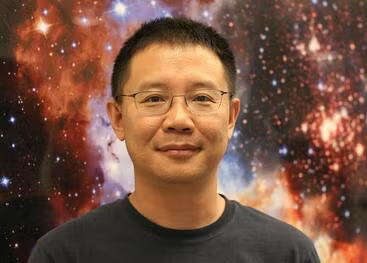
Hai-Bo Yu
Hai-Bo Yu
Tyler O'Neal, Staff Editor ENGINEERING January 8, 2025, 5:00 am

Discovering the secrets of dark matter: A journey of exploration

In a realm where the invisible communicates loudly and the unknown holds the key to understanding the universe's deepest secrets, physicists embark on a journey that challenges conventional wisdom. At the forefront of this cosmic exploration is Hai-Bo Yu, a visionary researcher at the University of California, Riverside. His groundbreaking work has revealed the mysterious nature of stellar streams and the significant impact of dark matter.

The GD-1 stellar stream, a fascinating feature surrounding the Milky Way, has long intrigued astronomers with its complex structures—a delicate dance of stars that reveals stories of cosmic interactions. In the midst of this celestial phenomenon, a team led by researcher Hai-Bo Yu has made significant strides in unraveling a longstanding cosmic mystery by proposing the existence of a core-collapsing self-interacting dark matter (SIDM) subhalo as the key entity behind the unique characteristics of the GD-1 stream.

Published in The Astrophysical Journal Letters, Yu’s research sheds light on the obscure aspects of the universe, providing new insights into the properties and dynamics of dark matter. Collaborating with a dedicated group of researchers, Yu utilized the capabilities of supercomputer N-body simulations to model a collapsing SIDM subhalo, thereby enhancing our understanding of the cosmic forces at work.

In a universe heavily influenced by the unseen, Yu’s findings illuminate the complexities of stellar streams and invite deeper contemplation about the nature of dark matter. By embracing the concept of self-interacting dark matter, Yu's research opens doors to new avenues of exploration, challenging traditional theories and paving the way for innovative insights into previously uncharted areas.

As we observe the stunning array of stars in the Milky Way’s galactic halo, we are reminded of the transformative power of scientific inquiry and the limitless potential of human curiosity. Through the lens of Yu's visionary research, we recognize that the universe is a canvas of infinite possibilities, eager to be explored by curious minds determined to uncover its mysteries.

In a world where cosmic wonders and scientific breakthroughs converge, let Hai-Bo Yu's pioneering spirit inspire us, guiding us toward a future where discovery knows no limits and the secrets of the universe are unveiled one star at a time.

Yale researchers discover a new method for calculating electron structure, shedding light on material mysteries

Yale researchers discover a new method for calculating electron structure, shedding light on material mysteries

Tyler O'Neal, Staff Editor ENGINEERING December 19, 2024, 10:00 am

Exploring material science has always been challenging, as complex calculations often demand significant computing power. However, a team of innovative researchers at Yale University has recently unveiled a groundbreaking approach that utilizes artificial intelligence to transform the calculation of electron structures in materials.

Understanding the electronic structure of materials is crucial for unlocking new possibilities and insights. Traditionally, density functional theory (DFT) has been widely used in this area. However, conventional methods can fall short when it comes to investigating excited-state properties—such as light interactions or electrical conductivity. This challenge inspired Professor Diana Qiu and her team to find a novel solution.

Focusing on electrons' wave function, which defines a particle's quantum state, the researchers set out to uncover the intricacies of material behavior. Using two-dimensional materials as their canvas, they employed a variational autoencoder (VAE), an AI-powered image processing tool, to create a dimensional representation of the wave function without human intervention.

"The wave function can be visualized as a probability spread over space, allowing us to condense significant amounts of data into a concise set of numbers that capture the essence of electron behavior," explained Professor Qiu, who led this transformative study. This new representation proved more accurate and significantly reduced computational time, enabling the exploration of a broader range of materials.

In a field where traditional methods could consume between 100,000 to a million CPU hours for calculations involving just three atoms, the VAE-assisted technique has reduced that timeframe to only one hour. This remarkable leap in computational efficiency accelerates research efforts and opens doors to discovering new materials with unique and desirable properties.

The strength of this approach lies in its ability to move beyond human intuition, paving the way for more precise and versatile material analysis. As Professor Qiu aptly states, "This method not only speeds up complicated calculations but also broadens our horizons in material discovery, offering a glimpse into the vast possibilities within the realm of electron structures."

Armed with this innovative methodology, Yale researchers are positioned to significantly impact material science, unraveling the complexities of electron structures and unlocking potential breakthroughs that could shape the future of technology and innovation.

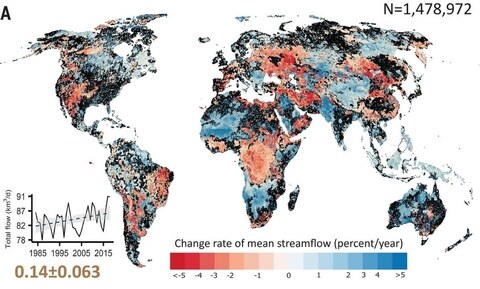
These maps illustrates significant changes in 6,167 reaches of the largest rivers on earth—44.2% saw decreases in streamflow and 11.9% saw increases over 35 years. Of nearly 1.5 million of the smallest, upstream rivers on earth, 17% of rivers saw a 1-5% increase in streamflow (blue) while 9.9% saw a decrease (red) over 35 years.

Supercomputer modeling revolutionizes understanding of global river changes

Tyler O'Neal, Staff Editor ENGINEERING December 13, 2024, 10:15 am

A groundbreaking study published in Science by researchers from the University of Massachusetts Amherst and the University of Cincinnati has unveiled a new era in river monitoring. This research marks a significant advancement in our understanding of river ecosystems by mapping 35 years of river changes on a global scale for the first time. The collaboration among hydrologists has revealed a concerning shift in river flow patterns: downstream rivers are experiencing a decline in water flow, while smaller upstream rivers have seen an increase.

The core of this transformative research lies in the innovative use of supercomputer modeling and satellite data to assess river flow rates across 3 million stream reaches worldwide. This advanced approach enables researchers to monitor every river, every day, everywhere, over the span of 35 years, providing a comprehensive and real-time insight into the evolution of our rivers.

Lead author Dongmei Feng, an assistant professor at the University of Cincinnati, and co-author Colin Gleason, the Armstrong Professional Development Professor of civil and environmental engineering at UMass Amherst, have paved the way for a deeper understanding of how rivers respond to various factors, including climate change and human intervention. By utilizing the power of supercomputers, they have accessed a wealth of previously unavailable data, shedding light on the complex dynamics of river systems.

This study's optimistic tone lies in its significant potential for informed decision-making and sustainable resource management. By identifying specific changes in river flow rates, communities worldwide can better prepare for disruptions in water supply, mitigate the impact of floods, and plan for future hydropower development. The data generated from this supercomputer modeling highlights the challenges we face and provides practical insights into how we can adapt and thrive in a changing environment.

Furthermore, this research highlights the critical role that advanced technology plays in addressing complex environmental issues. Integrating large-scale computation, modeling, data assimilation, remote sensing, and innovative geomorphic theory has allowed researchers to present a comprehensive view of global river landscapes. This optimistic outlook marks a new chapter in hydrological research, where supercomputers serve as powerful tools for transformation and progress.

As we embark on this journey of discovery and innovation, the hopeful spirit of this study fuels our collective efforts to safeguard our rivers, protect our ecosystems, and build a more sustainable future for generations to come. With supercomputer modeling leading the way, the possibilities are endless, and the potential for positive change is within reach.

The NASA Terrestrial Hydrology, Early Career Investigator, and Surface Water and Ocean Topography Programs supported this research.

  1. M87's powerful gamma-ray outburst: Supercomputer simulation unveils the mysteries of the Universe
  2. Concerns about the NASA, DOD study on coastal groundwater saltwater mixing

Page 3 of 78

  • 1
  • 2
  • 3
  • 4
  • 5
  • 6
  • 7
  • 8
  • 9
  • 10
POPULAR RIGHT NOW
  • Meta’s next frontier may not be social media; it may be supercomputing
    Meta’s next frontier may not be social media; it may be supercomputing
  • The future of cancer research runs on supercomputers
    Jill Mesirov, PhD
    Jill Mesirov, PhD
  • Rebuilding a lost continent: Supercomputers reveal Antarctica before the ice
    Antarctic ice meets the rocky coastline. Researchers traced landscape features from the two-kilometre-high coastal escarpment of Dronning Maud Land to the subglacial Gamburtsev Mountains, buried beneath 1–3 km of ice  Credit Matt Palmer
    Antarctic ice meets the rocky coastline. Researchers traced landscape features from the two-kilometre-high coastal escarpment of Dronning Maud Land to the subglacial Gamburtsev Mountains, buried beneath 1–3 km of ice Credit Matt Palmer
  • Supercomputers uncover a new class of cosmic explosions hidden in plain sight
    Supercomputers uncover a new class of cosmic explosions hidden in plain sight
  • AI supercharges the hunt for stronger magnets: Iowa State researchers launch a new era of intelligent materials discovery
    AI supercharges the hunt for stronger magnets: Iowa State researchers launch a new era of intelligent materials discovery
  • IBM's Historic stock collapse raises questions for the future of enterprise supercomputing
    IBM's Historic stock collapse raises questions for the future of enterprise supercomputing
  • Could a novel dark matter theory simultaneously resolve multiple cosmic enigmas? Supercomputer simulations provide a compelling, albeit currently unverified, potential solution
    Could a novel dark matter theory simultaneously resolve multiple cosmic enigmas? Supercomputer simulations provide a compelling, albeit currently unverified, potential solution
  • Melting icebergs may be reshaping Earth’s greatest ocean current
    Melting icebergs may be reshaping Earth’s greatest ocean current
  • Supercomputers replace ‘bathtub’ flood maps with physics-based digital twins of Britain’s coastline
    Supercomputers replace ‘bathtub’ flood maps with physics-based digital twins of Britain’s coastline
  • Supercomputers push neural quantum simulation beyond previous limits
    Supercomputers push neural quantum simulation beyond previous limits
MOST READ THIS YEAR
  • Cosmic ambition at scale: UK’s supercomputer unlocks a 2.5 petabytes universe
    Cosmic ambition at scale: UK’s supercomputer unlocks a 2.5 petabytes universe
  • Intel's Q1 results signal supercomputing surge driving Xeon momentum
    Intel's Q1 results signal supercomputing surge driving Xeon momentum
  • When stars fall apart: Supercomputing reveals the hidden physics of black holes
    When stars fall apart: Supercomputing reveals the hidden physics of black holes
  • FRONTPAGE
  • LATEST
  • POPULAR
  • REGISTER
  • SOCIAL
  • VIDEO
  • SUBSCRIPTION
  • RSS
  • GUIDELINES
  • PRIVACY
  • TOS
  • ABOUT
  • +1 (816) 799-4488
  • editorial@supercomputingonline.com
© 2001 - 2026 SuperComputingOnline.com, LLC. All rights reserved. This material may not be published, broadcast, rewritten or redistributed without permission.
Sign In
  • FRONT PAGE
  • LATEST
    • MEDIA KIT
    • MOST READ
    • RSS FEED
    • ACADEMIA
    • AEROSPACE
    • APPLICATIONS
    • ASTRONOMY
    • AUTOMOTIVE
    • BIG DATA
    • BIOLOGY
    • CHEMISTRY
    • CLIENTS
    • CLOUD
    • DEFENSE
    • DEVELOPER TOOLS
    • EARTH SCIENCES
    • ECONOMICS
    • ENGINEERING
    • ENTERTAINMENT
    • HEALTH
    • INDUSTRY
    • INTERCONNECTS
    • GAMING
    • GOVERNMENT
    • MANUFACTURING
    • MIDDLEWARE
    • MOVIES
    • NETWORKS
    • OIL & GAS
    • PHYSICS
    • PROCESSORS
    • RETAIL
    • SCIENCE
    • STORAGE
    • SYSTEMS
    • VISUALIZATION
  • VIDEOS
    • ADD YOUR VIDEOS
    • MANAGE VIDEOS
  • COMMUNITY
    • TRADE SHOWS
    • SOCIAL NETWORK VIDEOS
    • SURVEYS
    • APPLICATIONS BROWSER
    • CONVERSATION INBOX
    • SOCIAL ADVERTISER
    • GROUPS
    • MARKETPLACE LISTINGS
    • PAGES
    • LEADERBOARD
    • POINTS LISTING
      • BADGES
    • PRIVACY CONFIRM REQUEST
    • PRIVACY CREATE REQUEST

Hey there! We noticed you’re using an ad blocker.