Keese’s modeling delivers insight into nuclear rocket engine heat transfer; wins the best student paper at NETS conference

A research paper about heat transfer inside the reactor of a conceptual liquid-fueled nuclear rocket engine by a University of Alabama in Huntsville (UAH) graduate student was hot stuff at the American Nuclear Society’s recent Nuclear and Emerging Technologies for Space (NETS) conference, winning the best student paper at the Cleveland event. Jacob Keese says the novel engine design could open the door for much more ambitious space missions.  Michael Mercier | UAH

Winner Jacob Keese, a native of Valley Center, Kan., is a second-year master’s student in mechanical engineering at UAH, a part of the University of Alabama System. Keese is advised by Dr. Keith Hollingsworth, chair of the UAH Department of Mechanical and Aerospace Engineering. It was the second consecutive year a UAH student won the best student paper at NETS.

Keese’s research was done as part of UAH investigations into a novel concept of nuclear thermal spacecraft propulsion called Centrifugal Nuclear Thermal Propulsion (CNTP), where uranium fuel is spun in a combustion chamber so the centrifugal force holds it to the walls. The fuel heats to the point of liquefaction at temperatures not far from those found on the sun, and then hydrogen gas is bubbled through it. The expansion of the hydrogen propels the spacecraft.

With UAH's eminent scholar in systems engineering Dr. Dale Thomas as the principal investigator, UAH is leading a collaboration of universities across the nation to investigate the feasibility of such an engine under a research contract for the Space Nuclear Propulsion Project Office at NASA’s Marshall Space Flight Center.

“My research has been to create a numerical model of the heat transfer and thermodynamic processes within the liquid-fueled reactor,” Keese says. “This is an advanced nuclear rocket concept that promises much greater performance than current rocket engines.”

Keese’s modeling provides insight into what temperatures can be attained within the reactor.

“That, in turn, will help us understand the performance potential of the rocket,” he says.

“My research has application primarily to advanced space missions that require very high-performance rocket engines,” Keese says. “The CNTP concept promises an enhanced specific impulse, which is basically the efficiency of a rocket engine, like miles per gallon in a car.”

The concept could deliver efficiency that is as much as three to four times that of traditional rocket engines and one and a half to two times that of the solid-fueled nuclear rocket engines currently under development, Keese says.

“This enhanced efficiency could be achieved without sacrificing a high thrust, which could open the door for much more ambitious missions,” he says. “Some of the missions which have been proposed are human missions to Mars with significantly reduced trip times, and robotic scientific missions to the far reaches of our solar system.”

“Jacob’s model allows us to examine the influence of such parameters as cylinder size, rotation rate, hydrogen flow rate, and the level of controlled nuclear decay of the uranium,” says Dr. Hollingsworth, who is a co-author of the paper entitled "One-Dimensional Steady-State Thermal Model of CNTP Reactor."

“The right balance of these variables will keep the cylinder walls cooled down to a survivable temperature while giving us the desired level of thrust from the motor,” Dr. Hollingsworth says. “Jacob’s best paper award recognizes both his extraordinary talent as a graduate student presenter and the quality of his contribution to the field.”

Intriguing conceptually, the CNTP idea has been around since the 1960s, but the engineering challenges involved have kept it from getting off the drawing board, Dr. Thomas says.

Uranium has a high melting point, so it’s a fine line between an ultra-high performance rocket engine and a radioactive hot mess, according to Dr. Thomas.

The UAH team is attempting to walk that line and Keese’s research has contributed to the effort, he says.

“Jacob’s work on the heat transfer between the cold gaseous hydrogen and the very hot liquid uranium is foundational to establishing the engineering viability of this high-performance rocket engine concept,” Dr. Thomas says.

Keese says he was deeply honored when his name was announced for the award at the conference.

“I had been blown away by the presentations at the conference, and I was not at all expecting to receive the best student paper award,” he says. “I also felt thankful for being given the opportunity to work on such an ambitious and interesting project.”

Scottish built simulations show new spin on galaxy rotation saves controversial gravity theory

An international group of astronomers, led by a physicist at the University of St Andrews, has revived an alternative gravity theory.

Headed by Dr. Indranil Banik of the School of Physics and Astronomy at St Andrews in Scotland, the study revealed a high predicted rotation speed of gas in a dwarf galaxy consistent with the previously debunked theory known as Milgromian Dynamics (MOND).

An earlier study of the rotation speed of gas in the dwarf galaxy AGC 114905 (Mancera Pina et al, 2022) found that the gas rotated very slowly and claimed the MOND theory was dead.

Such theories are essential in understanding our universe because, according to known physics, galaxies rotate so quickly they should fly apart. MOND, a controversial alternative to General Relativity, the prevailing Einstein-inspired understanding of the phenomenon of gravity that requires dark matter to hold galaxies together; does not require dark matter. As the dark matter has never been detected despite decades of very sensitive searches, various theories have been put forward to explain what holds galaxies together, and debate rages over which is right. The very low rotation speed reported in the Mancera Pina et al study is inconsistent with predictions in a universe governed by General Relativity with large amounts of dark matter.

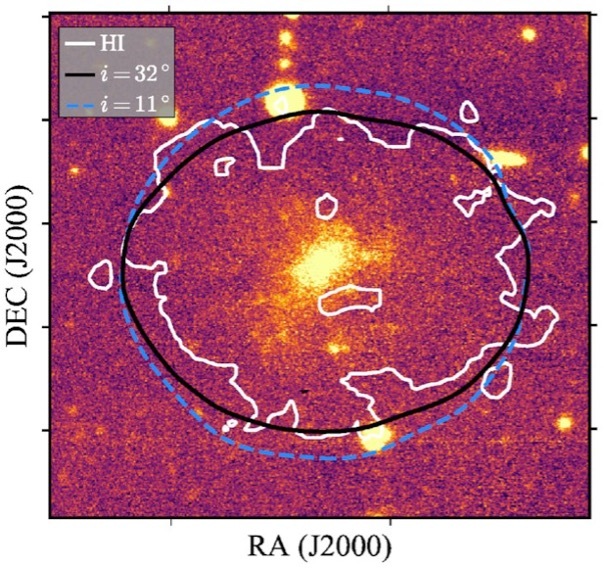
Dr. Banik’s group argues that the high predicted rotation speed in the MOND gravity theory is consistent with observations if the inclination of the galaxy is overestimated. Gravity 59557

The rotation of stars and gas in distant galaxies cannot be measured directly. Only the component along the line of sight is known from precise spectroscopic measurements. If the galaxy is viewed almost face-on, then it would mostly rotate within the plane of the sky. This could mislead observers into thinking that the galaxy is rotating very slowly, which would require them to overestimate the inclination between disc and sky planes. This inclination was estimated from how elliptical the galaxy appears (see image).

The new study explored this crucial issue using detailed MOND simulations of a disc galaxy similar to AGC 114905 made at the University of Bonn by Srikanth Nagesh and instigated by Pavel Kroupa, Professor at the University of Bonn, and the Charles University in Prague. The simulations show that it can appear somewhat elliptical even when viewed face-on. This is because stars and gas in the galaxy have gravity and can pull themselves into a somewhat non-circular shape. A similar process causes the spiral arms in disc galaxies, features which are so common that these are often called spiral galaxies.

As a result, the galaxy could be a lot closer to face-on than the observers thought. This could mean the galaxy is rotating much faster than reported, removing the tension with MOND.

Dr. Banik, the lead author of the new study, said: “Our simulations show that the inclination of AGC 114905 might be significantly less than reported, which would mean the galaxy is actually rotating much faster than people think, in line with MOND expectations.”

Dr. Hongsheng Zhao, of the School of Physics and Astronomy at the University of St Andrews, said: “The very low reported rotation speed of this galaxy is inconsistent with both MOND and the standard approach with dark matter. But only MOND can get around this apparent contradiction.”

The new study also argues that a similar ‘fake inclination’ effect is unlikely to arise in the standard dark matter approach because the galaxy is dominated by the smooth dark matter halo. The stars and gas contribute little to the gravity, so the disc is not ‘self-gravitating’.

This means it is likely to look very circular if viewed face-on, as confirmed by simulations carried out by another group (Sellwood & Sanders, 2022). As a result, the observed ellipticity must be due to a significant inclination between the disc and sky planes. The rotation velocity would then be very small, implying that the galaxy has very little dark matter. It is not possible in this framework that an isolated dwarf galaxy would have such a small amount of dark matter given how much mass it has in stars and gas.

Pavel Kroupa, Professor at the University of Bonn and Charles University in Prague, said of the broader context of these results: “While MOND works well in the tests conducted so far, the standard approach causes very severe problems on all scales ranging from dwarf galaxies like AGC 114905 all the way up to cosmological scales, as found by many independent teams.”

South Korean prof develops neuromorphic memory device that simulates neurons, synapses​

Simultaneous emulation of neuronal and synaptic properties promotes the development of brain-like artificial intelligence

Researchers have reported a nano-sized neuromorphic memory device that emulates neurons and synapses simultaneously in a unit cell, another step toward completing the goal of neuromorphic supercomputing designed to rigorously mimic the human brain with semiconductor devices.

Neuromorphic supercomputing aims to realize artificial intelligence (AI) by mimicking the mechanisms of neurons and synapses that make up the human brain. Inspired by the cognitive functions of the human brain that current computers cannot provide, neuromorphic devices have been widely investigated. However, current Complementary Metal-Oxide Semiconductor (CMOS)-based neuromorphic circuits simply connect artificial neurons and synapses without synergistic interactions, and the concomitant implementation of neurons and synapses remains a challenge. To address these issues, a research team led by KAIST located in Daedeok Innopolis, Daejeon, South Korea, Professor Keon Jae Lee from the Department of Materials Science and Engineering implemented the biological working mechanisms of humans by introducing the neuron-synapse interactions in a single memory cell, rather than the conventional approach of electrically connecting artificial neuronal and synaptic devices. Neuromorphic memory device consisting of bottom volatile and top nonvolatile memory layers emulating neuronal and synaptic properties, respectively

Similar to commercial graphics cards, the artificial synaptic devices previously studied are often used to accelerate parallel computations, which shows clear differences from the operational mechanisms of the human brain. The research team implemented the synergistic interactions between neurons and synapses in the neuromorphic memory device, emulating the mechanisms of the biological neural network. In addition, the developed neuromorphic device can replace complex CMOS neuron circuits with a single device, providing high scalability and cost-efficiency. 

The human brain consists of a complex network of 100 billion neurons and 100 trillion synapses. The functions and structures of neurons and synapses can flexibly change according to the external stimuli, adapting to the surrounding environment. The research team developed a neuromorphic device in which short-term and long-term memories coexist using volatile and non-volatile memory devices that mimic the characteristics of neurons and synapses, respectively. A threshold switch device is used as volatile memory and phase-change memory is used as a non-volatile device. Two thin-film devices are integrated without intermediate electrodes, implementing the functional adaptability of neurons and synapses in the neuromorphic memory.

Professor Keon Jae Lee explained, "Neurons and synapses interact with each other to establish cognitive functions such as memory and learning, so simulating both is an essential element for brain-inspired artificial intelligence. The developed neuromorphic memory device also mimics the retraining effect that allows quick learning of the forgotten information by implementing a positive feedback effect between neurons and synapses.” Retraining operation in the neuromorphic device array. a) Schematic graph showing the retraining effect. b) Scanning electron microscope image of the neuromorphic device array. c) Training pattern “F” for the retraining test. d) Evolution of the memory state of the neuromorphic device array for the naive training and retraining scheme.