

SUPERCOMPUTING NEWS SUPERCOMPUTING NEWS
    • MEDIA KIT
    • MOST READ
    • RSS FEED
    • ACADEMIA
    • AEROSPACE
    • APPLICATIONS
    • ASTRONOMY
    • AUTOMOTIVE
    • BIG DATA
    • BIOLOGY
    • CHEMISTRY
    • CLIENTS
    • CLOUD
    • DEFENSE
    • DEVELOPER TOOLS
    • EARTH SCIENCES
    • ECONOMICS
    • ENGINEERING
    • ENTERTAINMENT
    • GAMING
    • GOVERNMENT
    • HEALTH
    • OIL & GAS
    • INDUSTRY
    • INTERCONNECTS
    • MANUFACTURING
    • MIDDLEWARE
    • MOVIES
    • NETWORKS
    • PHYSICS
    • PROCESSORS
    • RETAIL
    • SCIENCE
    • STORAGE
    • SYSTEMS
    • VISUALIZATION
    • AcyMailing subscription form

    • ADD YOUR VIDEOS
    • MANAGE VIDEOS
    • CONVERSATION INBOX
    • SOCIAL ADVERTISER
    • SOCIAL NETWORK VIDEOS
    • SURVEYS
    • GROUPS
    • PAGES
    • MARKETPLACE LISTINGS
    • APPLICATIONS BROWSER
    • PRIVACY CONFIRM REQUEST
    • PRIVACY CREATE REQUEST
    • LEADERBOARD
    • POINTS LISTING
      • BADGES
    • TRADE SHOWS
Sign In
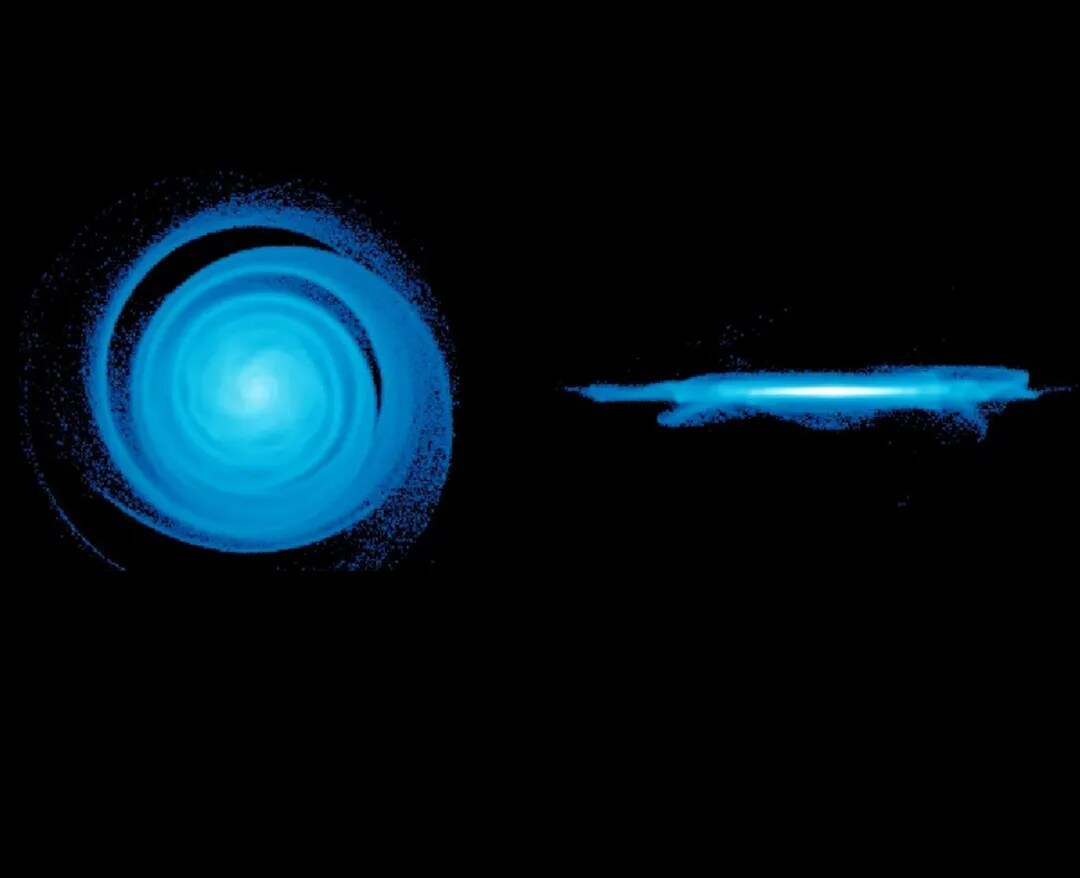
A recent discovery by astronomers reveals that seismic ripples have been detected in an ancient galactic disk
Tyler O'Neal, Staff Editor ACADEMIA December 22, 2023, 12:02 pm

A recent discovery by astronomers reveals that seismic ripples have been detected in an ancient galactic disk

Astronomers have detected seismic waves in an ancient galaxy's disk, providing new insights into its formation and the origins of our own Milky Way. This spiral galaxy, named BRI 1335-0417, is more than 12 billion years old and is currently the furthest known of its kind in the entire Universe.

Using the advanced ALMA telescope, lead author Dr. Takafumi Tsukui and his team studied the ancient galaxy in great detail, with particular interest in the movement of gas within and around the galaxy, which is crucial for star formation. By observing the gas dynamics, they captured the formation of a seismic wave, which is a first for this type of early galaxy. The movement of the stars, gas, and dust in the flattened disk of BRI 1335-0417 is similar to ripples forming on a pond after a stone is thrown in.

The latest data has revealed new insights into the formation of our galaxy, which were previously unknown. The ALMA observatory, located in the European Southern Observatory (ESO), boasts an impressive array of 66 antennas that work together to focus on a single galaxy. Each antenna gathers data, which is then merged through a powerful supercomputer to produce a detailed image of the galaxy. This groundbreaking study took place at ALMA, revolutionizing our understanding of the origins of our Universe.

According to Dr. Tsukui, the disk's vertical oscillating motion could be a result of an external force, possibly from new gas entering the galaxy or from coming into contact with smaller galaxies, providing the galaxy with new material for star formation. Additionally, the study revealed a bar-like structure within the disk, which can disrupt gas and transport it towards the center of the galaxy. This distant bar in BRI 1335-0417 is the most distant one known, indicating the dynamic growth of a young galaxy.

Because this galaxy is so far away, its light takes a longer time to reach Earth, allowing us to see images from its early days when the universe was only 10% of its current age. Co-author Associate Professor Emily Wisnioski notes that early galaxies form stars at a much faster rate than modern ones, including BRI 1335-0417, which forms them hundreds of times faster despite having a similar mass to our Milky Way. To understand how gas is supplied to sustain this rapid star formation, they observed rare spiral structures in the early universe. The exact process by which these structures form remains unknown, but this study provides important clues for potential scenarios. While direct observation of a galaxy's evolution is impossible, supercomputer simulations can be used to piece together its story based on snapshots collected through observations like this one.
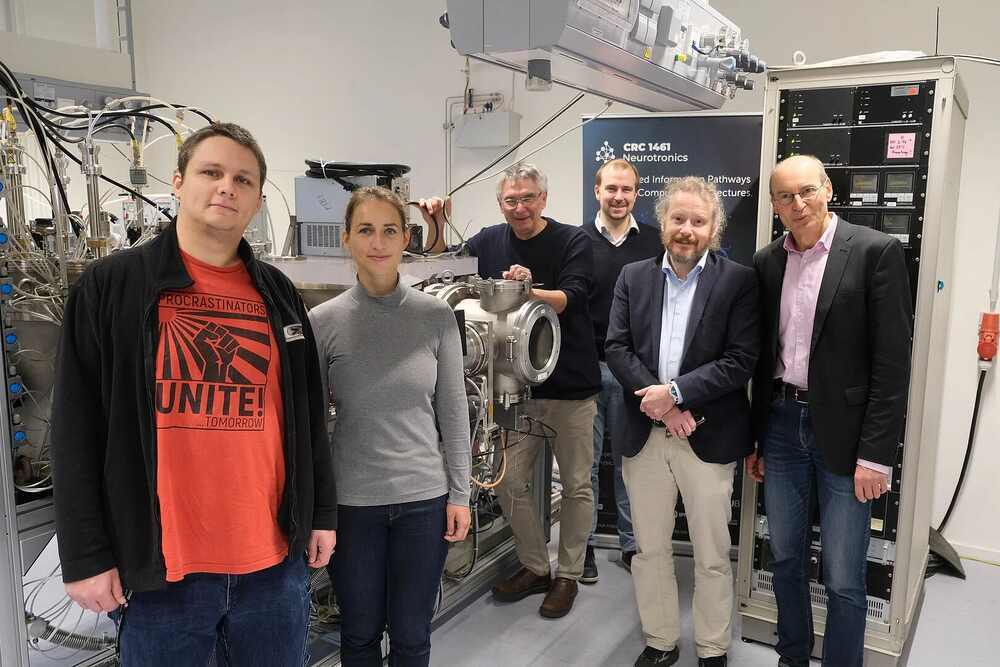
Part of the research team from the collaborative research center 1461 Neurotronics (from left): Maik-Ivo Terasa, Maximiliane Noll, Hermann Kohlstedt, Alexander Vahl, Rainer Adelung und Franz Faupel.

Unlocking the potential of novel materials for biologically-inspired information processing

Tyler O'Neal, Staff Editor ACADEMIA December 21, 2023, 10:00 am

Researchers at Kiel University in Germany have discovered innovative mechanisms and materials that could transform the biologically inspired information processing field. In today's world of artificial intelligence (AI) and big data, computer usage is increasing with every search engine query and AI-generated text. However, the human brain is still significantly more energy-efficient compared to computers, despite developments like autonomous driving that contribute to the overall energy consumption of computers and data centers. To create more powerful and sustainable computer systems inspired by the brain, a team of researchers from Kiel University's Materials Science and Electrical Engineering departments have identified key requirements for suitable hardware. By creating dynamic materials that mimic biological nervous systems, they have opened up the possibility for a new method of information processing in electronic systems.

Prof Dr Hermann Kohlstedt, a nanoelectronics expert and spokesperson for Kiel University's Collaborative Research Centre 1461 Neurotronics, is looking to nature for inspiration in creating new electronic components and computer architectures. Unlike traditional chips, transistors, and processors, these components would function similarly to the ever-changing network of neurons and synapses in our brains. While supercomputers excel in certain tasks, such as artificial intelligence, they cannot match the ability of humans to handle a variety of everyday tasks, from driving a car to making music to telling stories at social gatherings. However, computers still rely on silicon technology. While there have been advancements in hardware development, networks of neurons and synapses still outperform computers in terms of connectivity and resilience, says materials scientist Dr Alexander Vahl. Further research into new materials and processes is necessary to effectively replicate the dynamic information processing found in biological systems.

To mimic the dynamic behavior of three-dimensional biological nervous systems, the research team focused on developing materials that can change and adapt. They identified seven essential principles that computer hardware must embody to function similarly to the brain. One crucial element is plasticity, which allows for learning and memory processes. While the materials developed by the researchers fulfill many of these principles, there is currently no material that fully embodies all of them.

Prof. Dr. Rainer Adelung, Professor of Functional Nanomaterials, believes that combining materials can lead to new possibilities in computer technology. With the need for more computing power rising, strategies such as miniaturization are no longer sufficient. The research team has developed special granular networks with unique behavior when stimulated by electrical signals using silver-gold nanoparticles. This balance between stability and conductivity mirrors the brain's optimal state known as criticality. In other experiments, zinc oxide nanoparticles and electrochemically formed metal filaments were used to alter network paths via electrical input from oscillators. Coupling these circuits resulted in synchronized signal deflections over time, similar to how electrical impulses exchange information between neurons during conscious sensory perception.

AI unlocks secrets of polycrystalline materials

AI unlocks secrets of polycrystalline materials

Tyler O'Neal, Staff Editor ACADEMIA December 21, 2023, 6:00 am

Scientists at Nagoya University in Japan have used supercomputer technology to discover a new method of detecting tiny imperfections called dislocations in polycrystalline materials. These materials are widely used in electronics, solar panels, and other tech devices, but their effectiveness can be hindered by the presence of dislocations.

Polycrystalline materials are a vital component in many devices we use daily, such as smartphones, computers, and cars. However, because of their complex structures, they are challenging to use effectively. Besides their composition, factors like microstructure, dislocations, and impurities can affect the performance of these materials. One significant issue in using polycrystals is the formation of dislocations caused by stress and temperature changes, which can disrupt the arrangement of atoms and affect performance. It is crucial to understand the formation of these dislocations to prevent failures in devices that use polycrystalline materials.

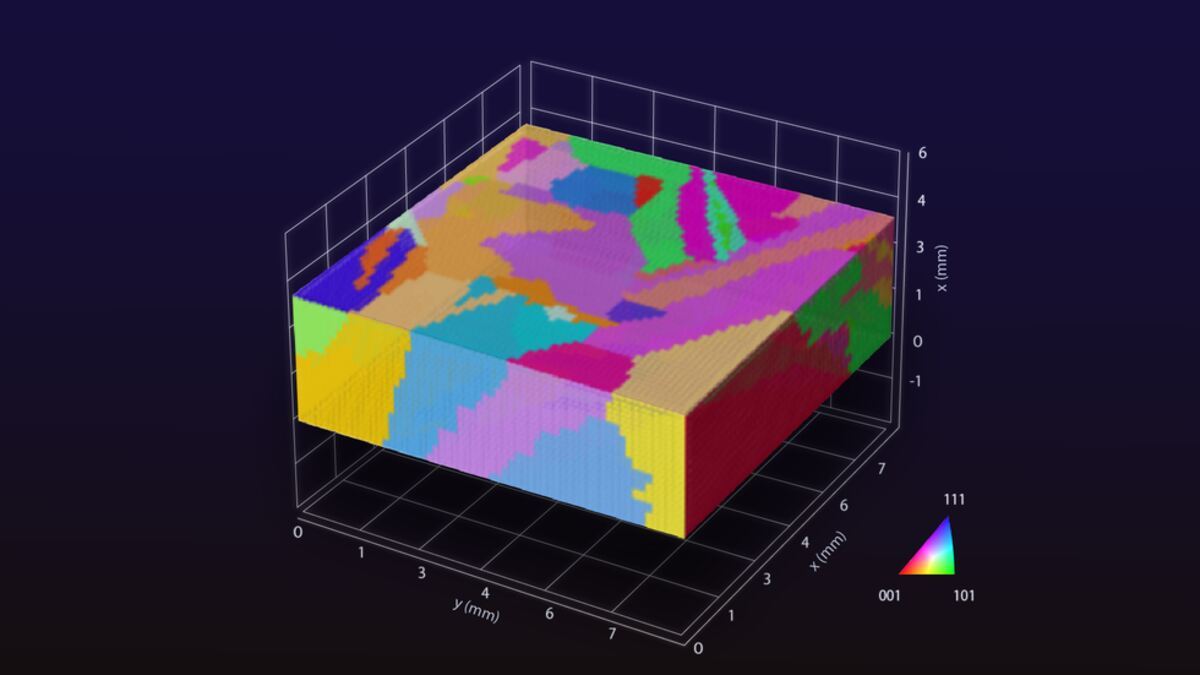
A team of researchers at Nagoya University, led by Professor Noritaka Usami and including Lecturer Tatsuya Yokoi and Associate Professor Hiroaki Kudo, utilized AI to analyze image data of a commonly used material called polycrystalline silicon, which is used in solar panels. The AI created a 3D model in virtual space, allowing the team to identify areas where clusters of dislocations were affecting the material's performance.

The researchers used electron microscopy and theoretical calculations to analyze dislocation clusters and determine how they formed. They found stress distribution in the crystal lattice and staircase-like structures at the boundaries between crystal grains, which contribute to dislocations during crystal growth. This discovery has implications not only for practical applications but also for the study of crystal growth and deformation. The Haasen-Alexander-Sumino (HAS) model is commonly used to understand dislocation behavior in materials, but the researchers believe that their work uncovered previously unrecognized types of dislocations not accounted for by the HAS model.

Furthermore, the team made another surprising discovery while examining the atomic arrangement of these structures. They found significant tensile bond strains along the edges of the staircase-like formations which triggered the generation of dislocations. Usami, one of the experts on this subject, stated that they were amazed and delighted to finally have evidence of dislocations in these structures. This suggests that by controlling the direction in which boundaries spread, we can also control the formation of dislocation clusters. Through a combination of experiments, theory, and AI, they were able to analyze nanoscale regions in polycrystalline materials and shed light on previously unexplained phenomena. This breakthrough research has paved the way for universal guidelines in creating high-performance materials, with potential impacts beyond solar cells to various fields such as ceramics and semiconductors. Improved performance in polycrystalline materials could have a revolutionary effect as they are widely used in society.

  1. Woolpert VP named 2024 Houston Engineer of the Year
  2. TAU opens a new window of observation on the Moon for the detection of radio waves

Page 15 of 123

  • 10
  • 11
  • 12
  • 13
  • 14
  • 15
  • 16
  • 17
  • 18
  • 19
POPULAR RIGHT NOW
  • Supercomputers uncover a new class of cosmic explosions hidden in plain sight
    Supercomputers uncover a new class of cosmic explosions hidden in plain sight
  • AI supercharges the hunt for stronger magnets: Iowa State researchers launch a new era of intelligent materials discovery
    AI supercharges the hunt for stronger magnets: Iowa State researchers launch a new era of intelligent materials discovery
  • IBM's Historic stock collapse raises questions for the future of enterprise supercomputing
    IBM's Historic stock collapse raises questions for the future of enterprise supercomputing
  • Could a novel dark matter theory simultaneously resolve multiple cosmic enigmas? Supercomputer simulations provide a compelling, albeit currently unverified, potential solution
    Could a novel dark matter theory simultaneously resolve multiple cosmic enigmas? Supercomputer simulations provide a compelling, albeit currently unverified, potential solution
  • Melting icebergs may be reshaping Earth’s greatest ocean current
    Melting icebergs may be reshaping Earth’s greatest ocean current
  • Supercomputers replace ‘bathtub’ flood maps with physics-based digital twins of Britain’s coastline
    Supercomputers replace ‘bathtub’ flood maps with physics-based digital twins of Britain’s coastline
  • Supercomputers push neural quantum simulation beyond previous limits
    Supercomputers push neural quantum simulation beyond previous limits
  • Intel’s AI supercomputing revival: Q2 financial surge signals new era for CPU-powered HPC infrastructure
    Intel’s AI supercomputing revival: Q2 financial surge signals new era for CPU-powered HPC infrastructure
  • AI infrastructure financing fears shake semiconductor sector
    AI infrastructure financing fears shake semiconductor sector
  • AWS supercomputing investment reaches historic scale as Amazon’s AI strategy powers record financial results
    AWS supercomputing investment reaches historic scale as Amazon’s AI strategy powers record financial results
THIS YEAR'S MOST READ
  • Wall Street wants to trade supercomputing power like oil
    Wall Street wants to trade supercomputing power like oil
  • Cosmic ambition at scale: UK’s supercomputer unlocks a 2.5 petabytes universe
    Cosmic ambition at scale: UK’s supercomputer unlocks a 2.5 petabytes universe
  • Hidden order, revealed at scale: Supercomputing, electron ptychography uncover the inner workings of relaxor ferroelectrics
    Hidden order, revealed at scale: Supercomputing, electron ptychography uncover the inner workings of relaxor ferroelectrics
  • Beamforming the future: BeammWave's 6G push signals the rise of orbital-terrestrial wireless networks
    Joakim Axmon
    Joakim Axmon
  • Intel's Q1 results signal supercomputing surge driving Xeon momentum
    Intel's Q1 results signal supercomputing surge driving Xeon momentum
  • When stars fall apart: Supercomputing reveals the hidden physics of black holes
    When stars fall apart: Supercomputing reveals the hidden physics of black holes
  • Multi-layer simulations reveal the hidden supply chain of solar prominences
    Multi-layer simulations reveal the hidden supply chain of solar prominences
  • Japanese scientists decode dolphin speed with supercomputing: Turbulence, vortices, and the hidden physics of propulsion
    Japanese scientists decode dolphin speed with supercomputing: Turbulence, vortices, and the hidden physics of propulsion
  • Cosmic feedback at scale: Supercomputing reveals how quasars regulate the early Universe
    Cosmic feedback at scale: Supercomputing reveals how quasars regulate the early Universe
  • Modeling life at the microscopic scale: A computational breakthrough in oxygen transport
    Modeling life at the microscopic scale: A computational breakthrough in oxygen transport
MOST READ OF ALL-TIME
  • Largest Computational Biology Simulation Mimics The Ribosome
    Details
    112107
    The amino acid (green) slithers into the chemical reaction center, moving through an evolutionarily ancient corridor of the ribosome (purple). The amino acid is delivered to the reaction core by the transfer RNA molecule (yellow).
    The amino acid (green) slithers into the chemical reaction center, moving through an evolutionarily ancient corridor of the ribosome (purple). The amino acid is delivered to the reaction core by the transfer RNA molecule (yellow).
  • Silicon 'neurons' may add a new dimension to chips
    Details
    80990
    Silicon 'neurons' may add a new dimension to chips
  • Linux Networx Accelerators Expected to Drive up to 4x Price/Performance
    Details
    75537
  • Complex Concepts That Really Add Up
    Details
    73635
    Complex Concepts That Really Add Up
  • Blue Sky Studios Donates Animation SuperComputer to Wesleyan
    Details
    68140
    Each rack holds 52 Angstrom Microsystem-brand “blades,” with a memory footprint of 12 or 24 gigabytes each. (Photos by Olivia Bartlett Drake)
    Each rack holds 52 Angstrom Microsystem-brand “blades,” with a memory footprint of 12 or 24 gigabytes each. (Photos by Olivia Bartlett Drake)
  • Humanities, HPC connect at NERSC
    Details
    57946
  • TeraGrid ’09 'Call for Participation'
    Details
    54951
  • Turbulence responsible for black holes' balancing act
    Details
    52310
  • Cray Wins $52 Million SuperComputer Contract
    Details
    50139
  • SDSC Researchers Accurately Predict Protein Docking
    Details
    46078
  • FRONTPAGE
  • LATEST
  • POPULAR
  • REGISTER
  • SOCIAL
  • VIDEO
  • SUBSCRIPTION
  • RSS
  • GUIDELINES
  • PRIVACY
  • TOS
  • ABOUT
  • +1 (816) 799-4488
  • editorial@supercomputingonline.com
© 2001 - 2026 SuperComputingOnline.com, LLC. All rights reserved. This material may not be published, broadcast, rewritten or redistributed without permission.
Sign In
  • FRONT PAGE
  • LATEST
    • MEDIA KIT
    • MOST READ
    • RSS FEED
    • ACADEMIA
    • AEROSPACE
    • APPLICATIONS
    • ASTRONOMY
    • AUTOMOTIVE
    • BIG DATA
    • BIOLOGY
    • CHEMISTRY
    • CLIENTS
    • CLOUD
    • DEFENSE
    • DEVELOPER TOOLS
    • EARTH SCIENCES
    • ECONOMICS
    • ENGINEERING
    • ENTERTAINMENT
    • HEALTH
    • INDUSTRY
    • INTERCONNECTS
    • GAMING
    • GOVERNMENT
    • MANUFACTURING
    • MIDDLEWARE
    • MOVIES
    • NETWORKS
    • OIL & GAS
    • PHYSICS
    • PROCESSORS
    • RETAIL
    • SCIENCE
    • STORAGE
    • SYSTEMS
    • VISUALIZATION
  • VIDEOS
    • ADD YOUR VIDEOS
    • MANAGE VIDEOS
  • COMMUNITY
    • TRADE SHOWS
    • SOCIAL NETWORK VIDEOS
    • SURVEYS
    • APPLICATIONS BROWSER
    • CONVERSATION INBOX
    • SOCIAL ADVERTISER
    • GROUPS
    • MARKETPLACE LISTINGS
    • PAGES
    • LEADERBOARD
    • POINTS LISTING
      • BADGES
    • PRIVACY CONFIRM REQUEST
    • PRIVACY CREATE REQUEST

Hey there! We noticed you’re using an ad blocker.