

SUPERCOMPUTING NEWS SUPERCOMPUTING NEWS
    • MEDIA KIT
    • MOST READ
    • RSS FEED
    • ACADEMIA
    • AEROSPACE
    • APPLICATIONS
    • ASTRONOMY
    • AUTOMOTIVE
    • BIG DATA
    • BIOLOGY
    • CHEMISTRY
    • CLIENTS
    • CLOUD
    • DEFENSE
    • DEVELOPER TOOLS
    • EARTH SCIENCES
    • ECONOMICS
    • ENGINEERING
    • ENTERTAINMENT
    • GAMING
    • GOVERNMENT
    • HEALTH
    • OIL & GAS
    • INDUSTRY
    • INTERCONNECTS
    • MANUFACTURING
    • MIDDLEWARE
    • MOVIES
    • NETWORKS
    • PHYSICS
    • PROCESSORS
    • RETAIL
    • SCIENCE
    • STORAGE
    • SYSTEMS
    • VISUALIZATION
    • AcyMailing subscription form

    • ADD YOUR VIDEOS
    • MANAGE VIDEOS
    • CONVERSATION INBOX
    • SOCIAL ADVERTISER
    • SOCIAL NETWORK VIDEOS
    • SURVEYS
    • GROUPS
    • PAGES
    • MARKETPLACE LISTINGS
    • APPLICATIONS BROWSER
    • PRIVACY CONFIRM REQUEST
    • PRIVACY CREATE REQUEST
    • LEADERBOARD
    • POINTS LISTING
      • BADGES
    • TRADE SHOWS
Sign In
Caltech's landmark breakthrough in quantum networking: A true revolution or just theoretical hype
Tyler O'Neal, Staff Editor ACADEMIA February 26, 2025, 7:31 pm

Caltech's landmark breakthrough in quantum networking: A true revolution or just theoretical hype

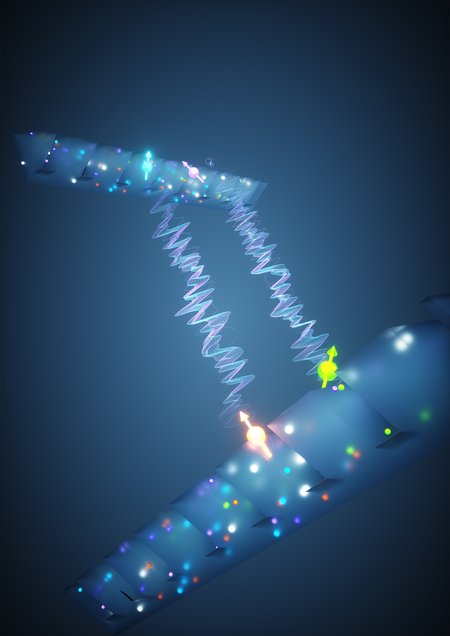
Caltech scientists claim a significant advancement in quantum networking with a method for "multiplexing entanglement," which could improve the efficiency of quantum communication systems. They suggest this technique might lead to faster, more scalable quantum networks—potentially paving the way for a "quantum internet." But is this a practical breakthrough or just another case of quantum hype?

The researchers demonstrated a technique for distributing quantum entanglement among multiple users, likened to conventional networks using multiplexing to send various signals over a single channel. However, the details of this method remain abstract, and its real-world implications are unclear.

Theory vs. Reality

Quantum entanglement is challenging to maintain over long distances. While Caltech asserts its multiplexing method could enhance scalability, it provides no evidence that it will function outside lab conditions. Moreover, established internet infrastructure relies on classical physics, whereas quantum communication needs a different framework that is not yet in place.

The Quantum Internet Mirage

Although the "quantum internet" promises secure communication, many skeptics doubt it will become operational soon. Theoretically, quantum networks are immune to eavesdropping, but practical applications remain experimental. Despite significant investments from governments and companies like Google and IBM, a functional quantum internet seems distant.

Limited Real-World Application

Even if multiplexing entanglement proves helpful, it's uncertain who would benefit—businesses, governments, or consumers—because the researchers do not indicate when this technology might be deployed beyond experimental labs. Until quantum networks can reliably transmit data at scale, announcements like these are merely theoretical milestones.

The "quantum internet" is still more buzzword than reality. While Caltech's research is technically impressive, not all breakthroughs lead to revolutions. Enthusiasts may feel hopeful, but the broader community should remain cautious until these advancements show practical benefits beyond academic contexts.


Breakthrough or hype? Questions arise over 'low-cost' computer claims

Breakthrough or hype? Questions arise over 'low-cost' computer claims

Tyler O'Neal, Staff Editor ACADEMIA February 26, 2025, 7:17 pm

Swedish researchers at the University of Gothenburg have announced a potential breakthrough in creating a low-cost computer to make high-performance computing more accessible. However, whether this represents a true revolution in affordable computing or merely an academic project is unclear.

The university claims this innovative microchip technology significantly reduces production costs while achieving low energy consumption. Yet, the term "low-cost" is subjective. Are we talking about a product for the mass market or just a slight cost decrease? The announcement lacks concrete pricing comparisons with options like Raspberry Pi or low-end Chromebooks.

Moreover, academic advancements frequently do not lead to commercial success, and it remains uncertain who would manufacture or distribute these computers at scale. The energy efficiency claims must also be validated against industry standards. Without supporting data, it is not easy to assess whether this innovation stands out or is merely incremental.

Software compatibility is another vital concern. A low-cost computer only succeeds if it can run essential applications. Will it rely on existing operating systems or require custom software that limits adoption? Many similar projects have struggled with these challenges.

While the research is intriguing, tangible proof of performance and a clear route to market are essential to avoid this "breakthrough" being just an academic exercise. Until then, the tech world should remain skeptical as the promise of a low-cost computer revolution is yet to be substantiated.

USC shows a more accurate picture of brain aging

USC shows a more accurate picture of brain aging

Tyler O'Neal, Staff Editor ACADEMIA February 25, 2025, 11:23 pm

In a groundbreaking development, researchers at the USC Leonard Davis School of Gerontology have unveiled an innovative artificial intelligence model designed to measure the rate at which our brains age. This cutting-edge tool estimates an individual's brain age and provides profound insights into neurocognitive changes, potentially revolutionizing our understanding of neurological health.

The model utilizes deep learning techniques to analyze neuroimaging data, accurately predicting brain age by identifying patterns associated with aging. Such precise estimations are invaluable, as discrepancies between chronological and brain age can indicate accelerated aging or neurological disorders.

A comprehensive review titled "Deep Learning for Brain Age Estimation: A Systematic Review" highlights the significance of these AI-driven approaches. The study emphasizes that machine learning models have been successfully employed to predict brain age, with deviations from typical aging patterns linked to brain abnormalities. The review also underscores the importance of accurate diagnostic techniques for reliable brain age estimations.

However, this journey does not end here. The field is rapidly evolving, with researchers continually refining AI models to enhance their accuracy and applicability across diverse populations. The ultimate goal is to integrate these tools into clinical settings, providing personalized assessments and interventions to maintain cognitive health throughout aging.

As we stand on the cusp of this exciting frontier, the fusion of artificial intelligence and neuroscience promises to unlock more profound mysteries of the human brain, paving the way for a future where cognitive decline is not an inevitable part of aging but a challenge we are equipped to understand and address.

  1. Germans use AI algorithms to teach telescopes to predict objects' trajectories for tracking
  2. Marsha Berger wins 2025 SIAM John von Neumann Prize

Page 3 of 123

  • 1
  • 2
  • 3
  • 4
  • 5
  • 6
  • 7
  • 8
  • 9
  • 10
POPULAR RIGHT NOW
  • Supercomputers uncover a new class of cosmic explosions hidden in plain sight
    Supercomputers uncover a new class of cosmic explosions hidden in plain sight
  • AI supercharges the hunt for stronger magnets: Iowa State researchers launch a new era of intelligent materials discovery
    AI supercharges the hunt for stronger magnets: Iowa State researchers launch a new era of intelligent materials discovery
  • IBM's Historic stock collapse raises questions for the future of enterprise supercomputing
    IBM's Historic stock collapse raises questions for the future of enterprise supercomputing
  • Could a novel dark matter theory simultaneously resolve multiple cosmic enigmas? Supercomputer simulations provide a compelling, albeit currently unverified, potential solution
    Could a novel dark matter theory simultaneously resolve multiple cosmic enigmas? Supercomputer simulations provide a compelling, albeit currently unverified, potential solution
  • Melting icebergs may be reshaping Earth’s greatest ocean current
    Melting icebergs may be reshaping Earth’s greatest ocean current
  • Supercomputers replace ‘bathtub’ flood maps with physics-based digital twins of Britain’s coastline
    Supercomputers replace ‘bathtub’ flood maps with physics-based digital twins of Britain’s coastline
  • Supercomputers push neural quantum simulation beyond previous limits
    Supercomputers push neural quantum simulation beyond previous limits
  • Intel’s AI supercomputing revival: Q2 financial surge signals new era for CPU-powered HPC infrastructure
    Intel’s AI supercomputing revival: Q2 financial surge signals new era for CPU-powered HPC infrastructure
  • AI infrastructure financing fears shake semiconductor sector
    AI infrastructure financing fears shake semiconductor sector
  • AWS supercomputing investment reaches historic scale as Amazon’s AI strategy powers record financial results
    AWS supercomputing investment reaches historic scale as Amazon’s AI strategy powers record financial results
THIS YEAR'S MOST READ
  • Wall Street wants to trade supercomputing power like oil
    Wall Street wants to trade supercomputing power like oil
  • Cosmic ambition at scale: UK’s supercomputer unlocks a 2.5 petabytes universe
    Cosmic ambition at scale: UK’s supercomputer unlocks a 2.5 petabytes universe
  • Hidden order, revealed at scale: Supercomputing, electron ptychography uncover the inner workings of relaxor ferroelectrics
    Hidden order, revealed at scale: Supercomputing, electron ptychography uncover the inner workings of relaxor ferroelectrics
  • Beamforming the future: BeammWave's 6G push signals the rise of orbital-terrestrial wireless networks
    Joakim Axmon
    Joakim Axmon
  • Intel's Q1 results signal supercomputing surge driving Xeon momentum
    Intel's Q1 results signal supercomputing surge driving Xeon momentum
  • When stars fall apart: Supercomputing reveals the hidden physics of black holes
    When stars fall apart: Supercomputing reveals the hidden physics of black holes
  • Multi-layer simulations reveal the hidden supply chain of solar prominences
    Multi-layer simulations reveal the hidden supply chain of solar prominences
  • Japanese scientists decode dolphin speed with supercomputing: Turbulence, vortices, and the hidden physics of propulsion
    Japanese scientists decode dolphin speed with supercomputing: Turbulence, vortices, and the hidden physics of propulsion
  • Cosmic feedback at scale: Supercomputing reveals how quasars regulate the early Universe
    Cosmic feedback at scale: Supercomputing reveals how quasars regulate the early Universe
  • Modeling life at the microscopic scale: A computational breakthrough in oxygen transport
    Modeling life at the microscopic scale: A computational breakthrough in oxygen transport
MOST READ OF ALL-TIME
  • Largest Computational Biology Simulation Mimics The Ribosome
    Details
    112107
    The amino acid (green) slithers into the chemical reaction center, moving through an evolutionarily ancient corridor of the ribosome (purple). The amino acid is delivered to the reaction core by the transfer RNA molecule (yellow).
    The amino acid (green) slithers into the chemical reaction center, moving through an evolutionarily ancient corridor of the ribosome (purple). The amino acid is delivered to the reaction core by the transfer RNA molecule (yellow).
  • Silicon 'neurons' may add a new dimension to chips
    Details
    80990
    Silicon 'neurons' may add a new dimension to chips
  • Linux Networx Accelerators Expected to Drive up to 4x Price/Performance
    Details
    75537
  • Complex Concepts That Really Add Up
    Details
    73635
    Complex Concepts That Really Add Up
  • Blue Sky Studios Donates Animation SuperComputer to Wesleyan
    Details
    68140
    Each rack holds 52 Angstrom Microsystem-brand “blades,” with a memory footprint of 12 or 24 gigabytes each. (Photos by Olivia Bartlett Drake)
    Each rack holds 52 Angstrom Microsystem-brand “blades,” with a memory footprint of 12 or 24 gigabytes each. (Photos by Olivia Bartlett Drake)
  • Humanities, HPC connect at NERSC
    Details
    57945
  • TeraGrid ’09 'Call for Participation'
    Details
    54951
  • Turbulence responsible for black holes' balancing act
    Details
    52310
  • Cray Wins $52 Million SuperComputer Contract
    Details
    50139
  • SDSC Researchers Accurately Predict Protein Docking
    Details
    46078
  • FRONTPAGE
  • LATEST
  • POPULAR
  • REGISTER
  • SOCIAL
  • VIDEO
  • SUBSCRIPTION
  • RSS
  • GUIDELINES
  • PRIVACY
  • TOS
  • ABOUT
  • +1 (816) 799-4488
  • editorial@supercomputingonline.com
© 2001 - 2026 SuperComputingOnline.com, LLC. All rights reserved. This material may not be published, broadcast, rewritten or redistributed without permission.
Sign In
  • FRONT PAGE
  • LATEST
    • MEDIA KIT
    • MOST READ
    • RSS FEED
    • ACADEMIA
    • AEROSPACE
    • APPLICATIONS
    • ASTRONOMY
    • AUTOMOTIVE
    • BIG DATA
    • BIOLOGY
    • CHEMISTRY
    • CLIENTS
    • CLOUD
    • DEFENSE
    • DEVELOPER TOOLS
    • EARTH SCIENCES
    • ECONOMICS
    • ENGINEERING
    • ENTERTAINMENT
    • HEALTH
    • INDUSTRY
    • INTERCONNECTS
    • GAMING
    • GOVERNMENT
    • MANUFACTURING
    • MIDDLEWARE
    • MOVIES
    • NETWORKS
    • OIL & GAS
    • PHYSICS
    • PROCESSORS
    • RETAIL
    • SCIENCE
    • STORAGE
    • SYSTEMS
    • VISUALIZATION
  • VIDEOS
    • ADD YOUR VIDEOS
    • MANAGE VIDEOS
  • COMMUNITY
    • TRADE SHOWS
    • SOCIAL NETWORK VIDEOS
    • SURVEYS
    • APPLICATIONS BROWSER
    • CONVERSATION INBOX
    • SOCIAL ADVERTISER
    • GROUPS
    • MARKETPLACE LISTINGS
    • PAGES
    • LEADERBOARD
    • POINTS LISTING
      • BADGES
    • PRIVACY CONFIRM REQUEST
    • PRIVACY CREATE REQUEST

Hey there! We noticed you’re using an ad blocker.